Some wall decals whisper, “Live, Laugh, Love.” A Marcel Duchamp–inspired “Fountain” decal looks at that phrase, raises one eyebrow, and asks, “But is the wall doing the laughing, or are we?” That is the peculiar magic of Dadaist design: it takes the ordinary, flips it sideways, signs it with a joke, and suddenly your room feels like it has enrolled in an art-history seminar with a very mischievous professor.
The Dadaist Dream: The Marcel Duchamp–Inspired “Fountain” Decal is more than a decorative sticker. It is a miniature rebellion, a clever visual wink, and a conversation starter that refuses to sit politely in the corner. Inspired by Duchamp’s infamous 1917 artwork Fountain, the decal brings the spirit of the readymade into modern interiors, studios, galleries, bathrooms, dorm rooms, laptops, and anywhere else that could use a little conceptual chaos.
At first glance, a decal based on a porcelain urinal might sound like a decorating decision made after three espressos and a dare. But the idea makes perfect sense. Duchamp’s Fountain challenged the definition of art by presenting a mass-produced plumbing fixture as sculpture. A decal inspired by it performs a similar trick on a smaller, more livable scale: it transforms a flat surface into a platform for questions about taste, authorship, value, humor, and the wonderfully strange relationship between art and everyday life.
What Makes Duchamp’s “Fountain” So Important?
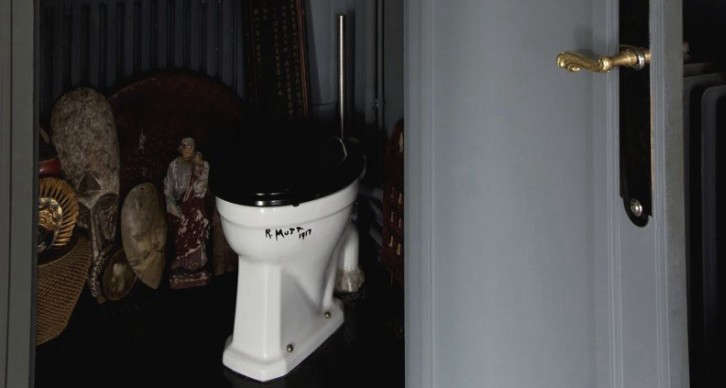
To understand the appeal of a Marcel Duchamp “Fountain” decal, it helps to revisit the original scandal. In 1917, Duchamp submitted a store-bought porcelain urinal to the Society of Independent Artists in New York. He turned it from its usual position, signed it “R. Mutt,” titled it Fountain, and presented it as art. The Society claimed to be open and democratic, with no jury and no prizes, but the work was not displayed. In other words, even the “anything goes” art crowd looked at it and said, “Well, perhaps not that.”
The original object disappeared, but the idea did not. A photograph by Alfred Stieglitz helped preserve the image, and later replicas continued the legacy. Today, Fountain is widely regarded as one of the most influential artworks of the twentieth century. Its power does not come from technical carving, painterly brushwork, or glamorous material. It comes from a question: Who decides what art is?
That question still feels alive. Every time someone argues about modern art, minimalist design, NFTs, AI-generated images, street murals, or whether a banana taped to a wall deserves museum lighting, Duchamp’s ghost is somewhere nearby, probably playing chess and trying not to laugh.
The Readymade: Art by Selection, Not Decoration
Duchamp called works like Fountain “readymades.” A readymade is an ordinary manufactured object chosen by the artist and repositioned as art. The artist’s act is not necessarily making the object by hand but selecting, naming, framing, and relocating it. The idea sounds simple, but it cracked open the door to conceptual art, installation, appropriation, pop art, performance, and countless forms of visual culture that followed.
For a Duchamp-inspired decal, this history matters. A decal is also a mass-produced object. It may be printed, cut, peeled, and stuck onto a wall, mirror, notebook, or studio door. Yet when it borrows the image and attitude of Fountain, it becomes more than surface decoration. It becomes a readymade about a readymade, which is exactly the kind of layered joke Dada would bring to a dinner party, then replace the soup with a philosophical argument.
Dadaism: The Beautiful Nonsense Behind the Decal
Dada emerged during the chaos of World War I as a reaction against logic, nationalism, bourgeois taste, and the cultural systems that many artists believed had helped lead society into disaster. Dada artists embraced absurdity, collage, chance, satire, nonsense poetry, performance, provocation, and anti-art gestures. They were not trying to make art more comfortable. They were trying to make comfort look suspicious.
That is why Dadaist wall art feels so fresh in contemporary spaces. Modern homes and offices are often polished until they look like no one has ever had a strange thought in them. A Duchamp-inspired Fountain decal interrupts that smoothness. It says, “Yes, this room has a chair, a desk, and adequate Wi-Fi. But it also has questions.”
Dada does not ask viewers to admire passively. It pokes them. It wants a reaction. A laugh counts. Confusion counts. Mild discomfort counts. A friend pausing in your hallway and saying, “Wait, is that a urinal sticker?” absolutely counts.
Why a “Fountain” Decal Works as Modern Decor
The best decals are not just pretty shapes. They change the mood of a space. A Marcel Duchamp decal works because it carries a visual punch and a cultural backstory. It is graphic enough to function as design, but smart enough to reward anyone who recognizes the reference.
It Turns the Wall Into a Gallery
A blank wall is innocent until proven boring. Add a Fountain decal, and suddenly the wall becomes an exhibition site. The decal does not need a gold frame or velvet rope. Its meaning comes from placement, context, and attitude. On a studio wall, it suggests creative rebellion. In a bathroom, it becomes a joke with perfect aim. In a classroom, it becomes a teaching tool. On a laptop, it announces that the owner has opinions about art and probably uses the word “context” before lunch.
It Blends Humor With Intellectual Style
One reason Duchamp remains so compelling is that his work is serious without being stiff. Fountain is philosophical, but it is also funny. The signature “R. Mutt” sounds like a prank, a pseudonym, and a tiny cartoon character hiding inside art history. A decal can preserve that double tone. It can look clean and minimal while still carrying the mischievous energy of a visual punchline.
It Fits Minimalist, Maximalist, and Eclectic Spaces
A Fountain wall decal can adapt to many design styles. In a minimalist room, a simple black outline of the urinal form feels sharp, ironic, and architectural. In a maximalist room, it becomes one more delightful oddity among posters, books, plants, and objects with suspiciously complicated origin stories. In an eclectic apartment, it can sit beside vintage prints, surrealist postcards, punk flyers, or contemporary design pieces and look perfectly at home.
Design Ideas for a Duchamp-Inspired “Fountain” Decal
A strong Dada home decor piece does not need to shout. The best version of a Duchamp-inspired decal depends on how much visual drama you want and how quickly you want visitors to ask questions.
1. The Minimal Line-Art Decal
A thin black line drawing of Fountain is elegant, dry, and clever. It keeps the shape recognizable without making the room feel like a plumbing showroom having an existential crisis. This style works especially well on white, gray, beige, or pale-colored walls. It is ideal for studios, reading corners, and creative offices where subtle weirdness is encouraged.
2. The “R. Mutt 1917” Signature Decal
Sometimes the signature is the star. A decal featuring “R. Mutt 1917” can be even more mysterious than the object itself. People who know the reference will smile. People who do not will wonder whether R. Mutt is a forgotten jazz musician, a secret society, or your landlord. Either way, the wall wins.
3. The Bathroom Placement
Let us be honest: placing a Fountain decal in a bathroom is almost too perfect. It brings the artwork back into dialogue with its original function while making the whole room feel like a tiny museum of irony. A small decal near a mirror, above a towel rack, or beside a sink can add humor without overwhelming the space. It is sophisticated bathroom comedy, which is a rare genre and should be protected.
4. The Gallery Label Decal
Another smart approach is to design the decal like a museum label: “Marcel Duchamp, Fountain, 1917, porcelain urinal, readymade.” This format works beautifully next to an illustration or even beside an ordinary household object. Stick the label near a soap dispenser, a coat hook, or a kitchen colander, and suddenly everything looks suspiciously curated.
5. The Pop-Dada Version
For a bolder look, a pop-inspired decal can use bright shapes, halftone patterns, comic-style lettering, or unexpected color blocks. While Duchamp himself was not a pop artist, his influence helped make later art movements more comfortable with mass culture, reproduction, and commercial imagery. A pop-Dada decal turns the historical reference into something energetic and contemporary.
The “Fountain” Decal as a Conversation Starter
Most decor tries to make a room look finished. A conceptual art decal tries to make a room start talking. That is the real charm of the Duchamp-inspired Fountain decal. It invites comments, jokes, debates, and the occasional dramatic pause.
Someone may ask, “Why is there a urinal on your wall?” That question is not a problem. It is the entire point. From there, the conversation can move toward modern art, Dada, museums, humor, design, taste, and the difference between making something and choosing something. In a world where many walls are covered with safe prints of mountains, leaves, and inspirational typography, a Fountain decal has the courage to be awkward in public.
What the Decal Says About Taste
Duchamp’s Fountain attacked the idea that art must be beautiful in a traditional sense. It questioned whether taste is natural or trained, personal or institutional, sincere or socially performed. A decal inspired by it carries that same challenge into everyday design.
Choosing this decal says you are not decorating only for prettiness. You are decorating for wit, history, and friction. You want a room with a brain. You want a visual joke that ages better than a trendy slogan. You want guests to feel comfortable but not completely unchallenged. Basically, you want your wall to have a graduate degree and a prankster streak.
How to Style a Marcel Duchamp–Inspired Decal
Styling a Dadaist decal is about balance. Because the concept is already bold, the surrounding elements should help the idea land clearly.
Pair It With Clean Typography
Use simple typefaces if the decal includes text. Duchamp’s humor works best when it is not smothered by decorative fonts. A clean sans-serif or restrained serif can make the reference feel museum-like, while handwritten lettering can create a looser, more rebellious mood.
Give It Breathing Room
Do not crowd the decal with too many competing images unless you are intentionally building a chaotic Dada collage wall. Negative space helps the object feel deliberate. A Fountain decal on a clean wall has the same dry confidence as a joke delivered with a straight face.
Use It Near Everyday Objects
Because the readymade is about ordinary things becoming art, the decal works especially well near ordinary things: sinks, shelves, hooks, mirrors, chairs, and storage cabinets. The more normal the setting, the stronger the conceptual twist.
Who Is This Decal For?
The Dadaist Dream “Fountain” decal is perfect for art students, designers, museum lovers, teachers, collectors, writers, creative professionals, and anyone who enjoys decor with a sly sense of humor. It is also ideal for people who like their interiors to feel personal rather than algorithmically beige.
It may not be for everyone. That is a compliment. Dada was never meant to please everyone. It was built to provoke, confuse, amuse, and rearrange expectations. If someone looks at the decal and says, “I don’t get it,” Duchamp would probably consider the room activated.
Why the “Fountain” Decal Still Feels Contemporary
More than a century after Duchamp’s original gesture, we are still surrounded by debates about authorship, originality, reproduction, and value. Digital images circulate endlessly. Memes transform found material into cultural commentary. Designers remix visual references. Artists use everyday objects, corporate logos, screenshots, and manufactured goods. The readymade never really left; it just learned how to use Wi-Fi.
That is why a Marcel Duchamp–inspired decal feels current rather than dusty. It belongs to a world of stickers, street art, digital files, vinyl graphics, and remix culture. It takes an art-historical icon and turns it into something accessible, portable, and playful. You do not need a museum wing to enjoy the idea. You need a surface and the confidence to make that surface slightly more interesting than it was five minutes ago.
Experiences With a Dadaist “Fountain” Decal
Living with a Duchamp-inspired Fountain decal is different from living with ordinary wall decor. A landscape print may calm the room. A botanical poster may soften it. A Dadaist decal behaves more like a guest who arrived early, rearranged the chairs, and started asking whether chairs are furniture or social agreements. Strangely, that energy can be refreshing.
In a home studio, the decal can become a useful creative prompt. When work feels too polished or predictable, the image of Fountain reminds the viewer that art does not always begin with mastery. Sometimes it begins with selection, context, nerve, and a sense of humor. Designers stuck on a layout, writers staring at blank pages, and artists overthinking a sketch may find the decal oddly encouraging. It whispers, “Try the strange idea. At worst, people will be confused. At best, they will still be talking about it in a hundred years.”
In a classroom or workshop, the decal can turn a wall into a lesson. Instead of starting a discussion with a textbook definition of conceptual art, a teacher can point to the image and ask, “Why might this matter?” The answers usually come alive quickly. Some students focus on rebellion. Others talk about museums, signatures, money, gender, originality, or whether shock can still be meaningful. The decal becomes a low-cost doorway into a high-value conversation.
In a bathroom, the experience is funnier and more immediate. The reference becomes almost theatrical because the setting echoes the object’s original function. Guests may laugh, groan, or pretend they know exactly what it means. The bathroom placement works because it refuses to separate art from life. It says that intellectual play does not have to stay in galleries. It can live beside hand soap and extra towels, looking very pleased with itself.
On a laptop, notebook, or studio cabinet, the decal becomes a small badge of creative mischief. It signals an affection for art history without turning into a formal announcement. Unlike a museum poster, it travels. It can appear in coffee shops, libraries, design offices, or critique sessions. It may spark quick conversations with strangers who recognize “R. Mutt” or simply enjoy the absurdity. That portability fits the spirit of the readymade: context keeps changing, and meaning changes with it.
The most memorable experience, however, is the slow realization that the decal changes how you see other objects. A coat rack looks more sculptural. A sink becomes suspiciously elegant. A broken chair starts auditioning for a gallery. That is Duchamp’s lasting trick. He did not simply turn one urinal into art; he made viewers wonder about the artistic potential of everything else. A well-placed Fountain decal keeps that question alive, quietly causing trouble in the best possible way.
Conclusion: A Small Decal With a Big Art-History Smirk
The Dadaist Dream: The Marcel Duchamp–Inspired “Fountain” Decal is not just a decorative accessory. It is a compact art-history rebellion, a smart design object, and a playful tribute to one of modern art’s most disruptive ideas. By referencing Duchamp’s readymade, the decal transforms walls, mirrors, laptops, bathrooms, and studios into spaces of curiosity.
Its appeal lies in the balance between simplicity and depth. Visually, it can be clean, witty, and minimal. Conceptually, it opens doors to Dadaism, authorship, taste, institutional power, and the strange comedy of everyday objects. It is the rare decor piece that can make a room look sharper while also making people think harder.
For anyone who loves modern art, conceptual design, or interiors with personality, a Fountain decal offers something more memorable than ordinary wall art. It is a reminder that creativity does not always require precious materials or perfect technique. Sometimes it requires a shift in context, a bold signature, and the courage to ask a ridiculous question with a straight face.
Note: This article is based on established art-history information from reputable museum, educational, and cultural sources. Source links are intentionally not displayed in the body to keep the article clean for publication.