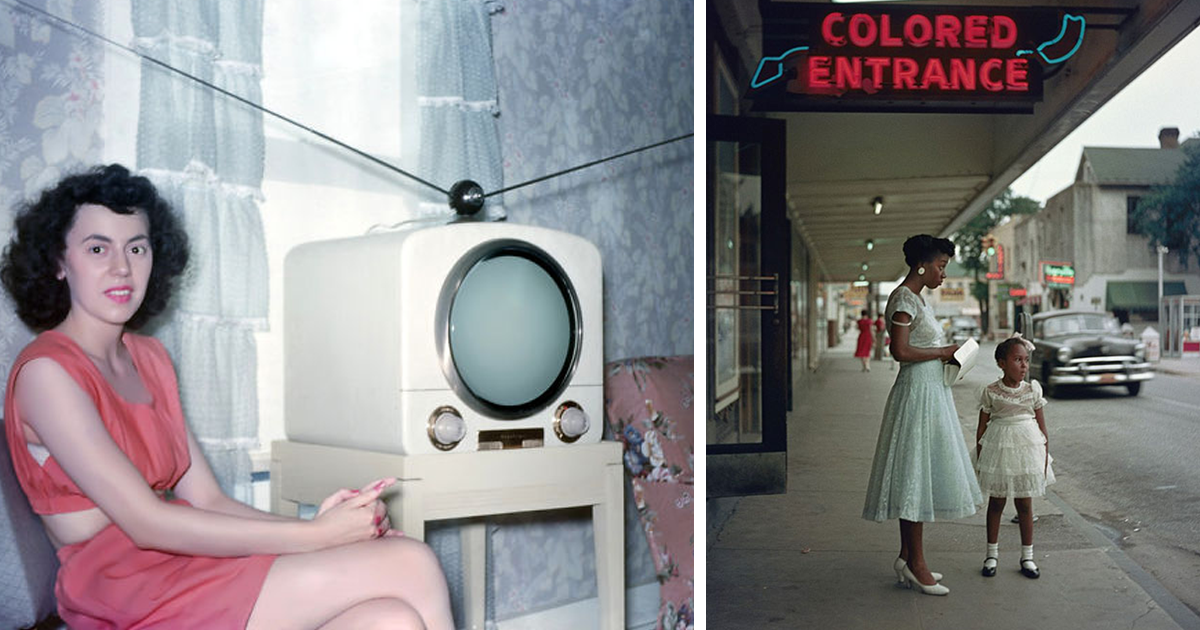
The 1950s in America can look deceptively simple in old photos: shiny Chevrolets, smiling families, tidy lawns, soda fountains, cat-eye glasses, and children riding bicycles without helmets, GPS trackers, or a parent texting “where are you?” every seven minutes. But behind those polished snapshots was a complicated decade of prosperity, pressure, invention, inequality, fear, and enormous social change.
These 20 rarely seen photos of America in the 1950’simagined through real historical moments, archival themes, and everyday scenes preserved by collections such as the Library of Congress and the National Archivesshow a country caught between old habits and modern life. The decade gave Americans television dinners, suburban ranch homes, interstate highways, rock ’n’ roll, civil rights activism, Cold War anxiety, and an obsession with appliances that could make any kitchen look like a small aircraft cockpit.
So pull up a chrome diner stool, order a milkshake tall enough to require structural engineering, and step into the world of 1950s America.
Why 1950s America Looks So Different Today
The 1950s followed the hardship of the Great Depression and World War II. Millions of families were ready for stability, and the postwar economy delivered more jobs, new homes, new consumer goods, and a sense that the American Dream could be bought with a mortgage, a washing machine, and perhaps a station wagon with suspiciously heroic tail fins.
Yet the decade was not equally comfortable for everyone. Many white middle-class families benefited from suburban expansion and federal housing programs, while Black Americans and other minorities often faced discrimination in housing, schools, employment, and public services. At the same time, the civil rights movement gained momentum, pushing the nation to confront the gap between its democratic ideals and daily reality.
20 Rarely Seen Photos Of America In The 1950’s
1. A Suburban Family Standing Proudly Beside a New Ranch House
One of the most recognizable images of 1950s America is the young family posed in front of a small, neat suburban home. The lawn is new, the trees are tiny, and the house looks like it was assembled by someone who believed rectangles were the peak of civilization.
Suburban communities expanded rapidly after World War II, supported by the G.I. Bill, new highways, mass-produced building techniques, and a cultural push toward homeownership. For many families, a house with a yard symbolized safety, success, and a fresh start. But these communities often excluded Black buyers through discriminatory practices, making the suburban dream far less universal than the photographs suggested.
2. Children Playing in the Street Until the Porch Light Came On
A photo of children playing stickball, hopscotch, or riding bicycles down a quiet neighborhood street captures a kind of childhood that feels almost prehistoric today. No smartphones. No bike lanes. No one documenting the moment for social media. Just kids, pavement, and the possibility of a scraped knee.
In many neighborhoods, children spent long hours outdoors with loose supervision. Families were larger on average than today, and streets often served as shared playgrounds. The image looks carefree, but it also reflects a more localized life, when social worlds were built around schools, churches, neighbors, and front porches.
3. A Mother in an Apron Beside a Brand-New Refrigerator
Few photos scream “1950s domestic life” like a woman smiling beside a refrigerator as if it had just proposed marriage. The postwar boom brought a flood of household appliances: refrigerators, washing machines, mixers, vacuum cleaners, and electric ranges. Manufacturers promised that technology would save time, reduce effort, and make the home more modern.
Of course, the appliances did not eliminate housework. They often raised expectations. A cleaner home, better meals, brighter laundry, perfectly packed lunchesmodern convenience sometimes came with a modern to-do list. The kitchen became a stage where consumer culture, gender roles, and advertising all performed at once.
4. Teenagers Crowded Around a Jukebox
A group of teenagers gathered around a glowing jukebox tells a powerful story about the birth of youth culture. The 1950s helped turn the teenager into a distinct consumer identity. Young people had music, fashion, slang, cars, and spending money, which made advertisers very happy and many parents deeply suspicious.
Rock ’n’ roll changed the sound of the decade. Artists like Elvis Presley, Chuck Berry, Little Richard, and Buddy Holly brought energy that felt electric, rebellious, and slightly dangerous to adults who preferred their music with fewer hip movements. The jukebox became a democratic machine: drop in a coin, choose your anthem, and irritate someone’s father.
5. A Drive-In Movie Theater Under a Summer Sky
The drive-in theater was pure 1950s genius: entertainment, automobiles, snacks, privacy, and mosquitoes all in one package. Families watched cartoons and double features from station wagons, while teenagers discovered that the back seat could be more interesting than the plot.
Drive-ins reflected the growing importance of the car in American life. As suburbs spread, so did car-centered entertainment and shopping. The automobile was not just transportation; it was a status symbol, a dating accessory, and sometimes a second living room with questionable upholstery.
6. A Busy Diner With Chrome Stools and a Soda Fountain
A 1950s diner photo usually contains all the ingredients of nostalgia: chrome, neon, swivel stools, milkshakes, hamburgers, pie under glass, and a server who looks like she has heard every bad joke in town. Diners and soda fountains were social hubs, especially for young people.
But these places were not just charming backdrops. They reflected changing eating habits, faster service, and the rise of casual dining. They also reveal social divisions. In many parts of the country, segregation shaped who could sit, eat, work, or be served in public spaces.
7. A Main Street Before the Shopping Mall Took Over
In photos of 1950s Main Street, you see department stores, drugstores, barbershops, movie marquees, and people dressed surprisingly well to buy toothpaste. Downtown shopping districts were still central to many communities, though suburban malls were beginning to change the pattern.
As families moved outward, retail followed. Shopping centers promised convenience, parking, and climate-controlled comfort. Main Street did not disappear overnight, but the balance shifted. The old walkable downtown began competing with the new world of asphalt, anchor stores, and food courts waiting patiently in the historical wings.
8. A Family Watching Television Together
A living room photo with the whole family staring at a small black-and-white television captures one of the biggest cultural shifts of the decade. TV ownership exploded during the 1950s, and the glowing screen became the new household hearth.
Programs like “I Love Lucy,” “The Ed Sullivan Show,” westerns, game shows, and televised news helped create shared national experiences. Television sold products, shaped politics, launched celebrities, and brought entertainment into the home. It also rearranged furniture forever, which may be its most underestimated historical achievement.
9. A Gas Station Attendant Checking Oil With a Smile
In a classic 1950s gas station photo, an attendant pumps fuel, checks oil, wipes the windshield, and possibly discusses baseball scores. Full-service stations were common, and the automobile economy supported millions of jobs, from mechanics to motel owners.
Car culture defined the decade. New highways, new suburbs, and new consumer habits were connected by wheels. The Federal-Aid Highway Act of 1956 helped launch the modern Interstate Highway System, transforming travel, commerce, commuting, and the geography of American life.
10. A Classroom With Rows of Desks and a Giant Map
A 1950s classroom photo often shows students seated in straight rows, a teacher at the board, and a map large enough to suggest that geography was not optional. Schools were expanding to accommodate the baby boom, and education became a major battleground for equality.
In 1954, the Supreme Court’s decision in Brown v. Board of Education ruled that racial segregation in public schools was unconstitutional. The ruling did not instantly integrate schools, especially in the South, but it became one of the defining legal turning points of the civil rights era.
11. Civil Rights Protesters Walking With Determination
Not every 1950s photo is about comfort and consumer goods. Some of the most powerful images show ordinary people demanding extraordinary change. The Montgomery Bus Boycott, sparked by Rosa Parks’ arrest in 1955, became a 13-month mass protest against segregated buses and helped bring Martin Luther King Jr. to national prominence.
These photos remind us that the decade’s polished surface hid deep injustice. While some Americans posed beside new cars, others risked jobs, safety, and freedom to challenge segregation. The 1950s were not a pause before the 1960s; they were the runway.
12. A Supermarket Aisle Filled With Packaged Foods
A supermarket photo from the 1950s looks both familiar and strange. Familiar because the aisles, carts, labels, and checkout counters resemble modern grocery shopping. Strange because the packaging seems cheerfully convinced that gelatin can solve nearly any dinner problem.
Frozen foods, prepared meals, canned goods, and branded products became more common. Food culture changed as families embraced convenience, refrigeration, advertising, and national brands. Dinner was becoming modern, which sometimes meant efficient, sometimes exciting, and occasionally suspended in lime gelatin for reasons history is still trying to process.
13. A Father Washing the Family Car in the Driveway
This photo is practically a 1950s ritual: Dad in rolled-up sleeves, hose in hand, polishing the car as if preparing it for a royal inspection. The family car was pride, freedom, and identity rolled into one shiny machine.
Automobiles influenced dating, vacations, shopping, housing, and work. The driveway became a symbol of middle-class arrival. Families took road trips, motels multiplied, and roadside restaurants learned that hungry travelers could be persuaded by a large enough sign shaped like food.
14. A Beauty Salon Full of Hooded Hair Dryers
A 1950s beauty salon photo is a marvel of style and machinery. Women sit beneath hooded dryers that look like friendly space helmets, reading magazines while their hair is engineered into waves, curls, and architectural optimism.
Fashion in the 1950s often emphasized polish: full skirts, gloves, hats, pearls, tailored suits, and carefully styled hair. Beauty culture was tied to femininity, respectability, and consumer products. Looking “put together” was not just a personal choice; it was often a social expectation.
15. A Man in a Gray Flannel Suit on the Commuter Train
The image of the 1950s office workerhat, briefcase, suit, newspapercaptures the rise of white-collar work and corporate culture. The phrase “organization man” came to represent the era’s emphasis on conformity, loyalty, and professional respectability.
Commuting became a daily rhythm for many suburban men. Home and work were increasingly separated by highways, trains, and schedules. The suburbs promised domestic peace, while the city remained a place of employment, commerce, and, depending on the train delay, muttered complaints.
16. A Polio Vaccination Line at a School or Clinic
A photo of children waiting for polio vaccinations shows a decade shaped not only by prosperity but also by fear. Polio outbreaks terrified families, closing pools and summer camps in some communities. The introduction of the Salk vaccine in the 1950s was a major public health milestone.
Public health campaigns, school clinics, and celebrity endorsements helped spread awareness. The image of vaccination lines reminds us that scientific progress was not abstract. It showed up in gymnasiums, doctors’ offices, and anxious parents hoping their children would be spared.
17. A Little League Team Posing With Dusty Knees
Baseball diamonds, scout troops, church picnics, school dances, and neighborhood clubs filled the social calendar. A Little League photo captures the decade’s emphasis on organized community life and childhood activities.
Sports offered discipline, teamwork, and local pride. They also reflected gender norms: boys were often steered toward athletics and leadership, while girls were more frequently encouraged toward domestic skills, appearance, and social grace. The photo may look simple, but the expectations behind it were anything but.
18. A Cold War Family Practicing “Duck and Cover”
Few images show the weirdness of the 1950s better than schoolchildren practicing nuclear drills under desks. The Cold War made atomic anxiety part of everyday life. Families built fallout shelters, schools ran drills, and public messaging tried to make the unthinkable feel manageable.
The result was a decade that could be sunny and nervous at the same time. A family might buy a new freezer, watch a comedy show, and worry about nuclear war before bedtime. The 1950s had optimism, yes, but it slept with one eye open.
19. A Record Store Window Filled With Rock ’n’ Roll Albums
A 1950s record store photo shows how music became a commercial and cultural force. Teenagers bought records, listened to radio DJs, learned dances, and formed identities through sound. Rock ’n’ roll crossed racial, regional, and generational lines, even as the music industry often profited unevenly from Black musical innovation.
To young fans, the music sounded like freedom. To anxious adults, it sounded like civilization loosening its tie. Both interpretations helped make it famous.
20. A Family Vacation Stop Beside a Roadside Attraction
The final photo might show a family standing beside a giant dinosaur, a painted motel sign, or a scenic overlook on a cross-country road trip. The 1950s helped popularize the family vacation by car, supported by better roads, motels, diners, maps, and a growing belief that leisure was part of the good life.
These road trip photos show a more mobile America. The country felt larger and smaller at once: larger because families could explore it, smaller because highways connected places faster than ever before. Someone still had to fold the map correctly, though, which historians agree was impossible.
What These Rare 1950s Photos Reveal About American Life
The most important thing about 1950s photos is that they do not tell one single story. They show abundance and exclusion, comfort and anxiety, conformity and rebellion. A shiny kitchen appliance can sit in the same decade as school desegregation battles. A smiling family road trip can exist alongside discriminatory housing practices. A jukebox can play the soundtrack of teenage freedom while civil rights activists fight for basic dignity.
That contrast is what makes the decade so fascinating. The 1950s were not just “simpler times.” They were changing times. Television reshaped politics and entertainment. Highways reshaped cities and suburbs. Consumer goods reshaped expectations. Civil rights activism reshaped the nation’s conscience. Teen culture reshaped music, fashion, and advertising.
How Different Life Was Before Smartphones, Streaming, and Same-Day Delivery
Daily life in the 1950s moved at a slower, more physical pace. People wrote letters, used rotary phones, read printed newspapers, visited bank tellers, developed film, and waited for things. If you missed a television show, it was gone unless someone described it to you the next day with poor accuracy and unnecessary enthusiasm.
Shopping required leaving the house. Directions required maps. Photos required patience. Music required records, radio, or a jukebox. News arrived through newspapers, radio, and evening broadcasts. Social life depended heavily on schools, churches, workplaces, clubs, and neighborhood networks.
There was less digital distraction, but that did not automatically mean less stress. Families worried about money, disease, war, discrimination, social expectations, and whether the new washing machine was worth the payments. The past may look peaceful in black and white, but black-and-white film has a sneaky way of hiding complications.
Experience Section: What It Feels Like To Look At 1950s America Through Photos
Looking at rare photos of America in the 1950’s feels a little like opening someone else’s family album and realizing the wallpaper has more confidence than most modern people. The first reaction is usually nostalgia. The cars are gorgeous. The clothes are sharp. The diners look cheerful. Even the refrigerators seem to have personalities. There is a visual charm to the decade that is hard to deny.
But after the first smile, the deeper experience begins. You start noticing details. A mother stands proudly in a kitchen, but you wonder how much choice she had in defining her life around that room. A suburban street looks safe and clean, but you wonder who was allowed to buy there and who was turned away. A classroom looks orderly, but you remember that the fight over school integration was reshaping the country. A bus stop looks ordinary, but in the 1950s, a bus seat could become a national symbol of resistance.
That is the emotional power of historical photography. Photos do not lecture. They wait. They let us bring questions to them. Why is everyone dressed up? Why are there so many cars? Why does the living room revolve around the television? Why do the advertisements look so cheerful? Why do some people appear everywhere in the record of prosperity while others appear mainly in the record of protest?
For modern viewers, 1950s photos also create a strange comparison with today. We live with instant communication, online shopping, remote work, digital entertainment, GPS, streaming music, and cameras in our pockets. A 1950s family might have owned one television; today a household may have five screens and still complain that there is nothing to watch. A teenager once waited by the family phone; now a teenager can ignore twelve messages in six different apps with Olympic-level skill.
Yet the photos also remind us that people have always wanted similar things: comfort, belonging, opportunity, safety, fun, dignity, and a future that feels better than the past. The tools change. The hairstyles definitely change. The desire for a good life remains.
One of the most meaningful experiences of studying these images is learning to hold two truths at once. The 1950s really did produce moments of warmth, creativity, community, and prosperity. It also placed heavy limits on many people based on race, gender, class, and geography. To look honestly at the decade is not to ruin nostalgia. It is to make it smarter.
That is why rare 1950s photos remain so compelling. They do not merely show old cars and vintage dresses. They show the roots of modern America: the suburbs we still live in, the highways we still drive, the television culture that became digital culture, the consumer habits that still shape our homes, and the civil rights struggles that continue to influence public life.
In the end, these images feel different because life was different. It was slower in some ways, stricter in others, more communal in some places, more unequal in many systems, and more visually polished than the messy reality underneath. The 1950s were not a postcard. They were a turning point wearing a hat, driving a two-tone car, and pretending not to worry about the future.
Conclusion
The 20 rarely seen photos of America in the 1950’s show a decade that was stylish, ambitious, anxious, unequal, inventive, and deeply influential. They reveal a country building suburbs, buying televisions, cruising highways, fighting segregation, fearing nuclear war, vaccinating children, dancing to rock ’n’ roll, and redefining what modern life could look like.
Before smartphones, online shopping, streaming platforms, and GPS, Americans built their routines around neighborhoods, cars, television schedules, paper maps, local stores, and face-to-face communities. Some parts of that world seem charming. Some seem restrictive. Some seem unfair. All of it helps explain how the America we know today came into focus.
So the next time you see a 1950s photo of a family beside a station wagon or a teenager leaning against a jukebox, look twice. The image may be cute, but it is also history waving from the curb.