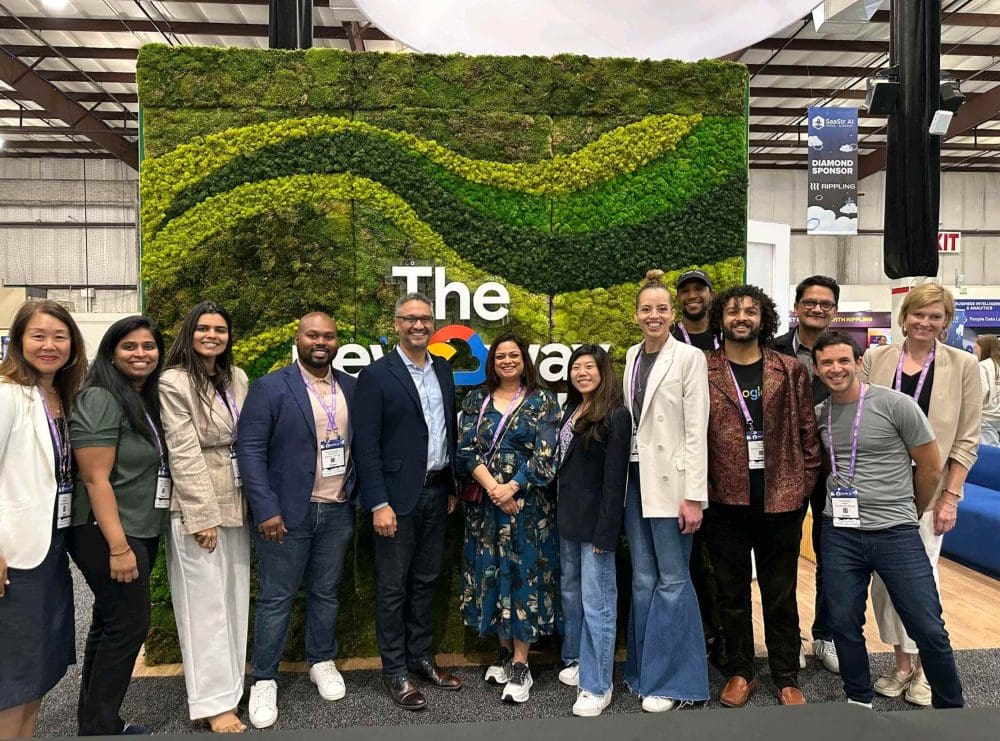
There are conference stats, and then there are conference stats that make every B2B marketer clutch a half-finished cold brew and whisper, “Wait… seriously?” This is one of those. According to SaaStr’s own post-event takeaway, 44% of SaaStr AI 2025 sponsors and partners had CEOs and COOs doing booth duty. Not floating around for five minutes. Not swinging by for a photo op. Actually working the booth.
That detail matters because it says something bigger about where SaaS and AI go-to-market is headed. In 2025, the booth was no longer just a branded rectangle full of banners, socks, and someone desperately guarding a bowl of mints. It became an operating theater for credibility, qualification, customer discovery, and pipeline creation. And when almost half the sponsors put top leadership on the floor, the message was loud and clear: the smartest companies now treat event presence as a serious revenue moment, not a side quest for junior staff.
At a major event like SaaStr Annual + AI Summit 2025 in San Mateo, where thousands of founders, executives, operators, and investors gathered, that shift was especially visible. This was not a sleepy regional expo where attendees wandered over because the booth had a wheel to spin. It was an intense B2B environment full of people evaluating vendors, exploring partnerships, comparing AI tools, and looking for answers fast. In a room like that, the person who knows the product best often wins the conversation. Surprise: that person is frequently the CEO, COO, or founder.
Why the 44% figure matters more than it first appears
On the surface, “leaders worked their own booth” may sound quaint. Almost old-school. But look closer and it is one of the sharpest signals from SaaS and AI events in years. It tells us that sponsors increasingly understand three truths.
First, buyers are arriving better informed than ever. They have already read your website, skimmed your pricing, asked peers for opinions, and maybe tested a competitor before they even walk the floor. That means they are not stopping by your booth for a generic pitch. They are stopping by with pointed questions, hidden objections, integration concerns, and a mental shortlist. When that happens, the person who can answer with confidence and nuance has a huge advantage.
Second, live events have become high-stakes qualification environments. A badge scan is nice. A real conversation about urgency, authority, use case, budget, adoption risk, and product fit is much nicer. Companies that treat conferences like pipeline engines rather than decorative brand exercises are naturally going to put stronger talent at the point of contact.
Third, AI has accelerated the premium on clarity. In AI especially, products can sound suspiciously similar from ten feet away. Everyone promises speed, automation, intelligence, orchestration, copilots, agents, transformation, and other words that now arrive in PowerPoint by the truckload. A senior leader can cut through that fog fast. They can explain the roadmap, the category thesis, the real customer problem, and the tradeoffs. That kind of clarity is magnetic.
Why CEOs and COOs suddenly make very good booth staff
Let’s be honest: “booth duty” does not exactly sound glamorous. It sounds like something assigned after a scheduling accident. But at a serious B2B event, the job is far more strategic than it looks.
They have instant credibility
When a prospect realizes the person across the booth is the CEO or COO, the conversation changes. The questions get better. The attention level rises. The attendee stops treating the interaction like a brochure exchange and starts treating it like a decision-making opportunity. In crowded software categories, trust is oxygen, and executives create trust faster than almost anyone else.
They know the product cold
SaaStr’s takeaway was blunt for a reason: don’t just send junior SDRs to man the booth. Real customers and prospects are there, and they deserve people who know the product cold. That is especially true in AI, security, infrastructure, compliance, analytics, and developer tooling, where a shallow answer can lose the deal before the follow-up email ever gets drafted.
They can qualify in real time
A strong operator can tell within minutes whether a visitor is merely curious or actually in-market. Better yet, they can adapt the conversation. If the person is a future customer, they can dig deeper. If the person is a partner prospect, they can steer toward ecosystem value. If the person is a talented candidate, they can recruit. A senior leader does not just “work traffic.” They route opportunity.
They hear the market without a filter
This may be the most underrated benefit. Founder-led sales and executive-led conversations create a direct line between the market and the company. The leader hears the objections, the feature requests, the confusion, the excitement, and the competitive mentions in their raw form. That feedback is gold. No summary deck can fully capture what happens when twenty sharp prospects ask the same uncomfortable question in one afternoon.
This is founder-led sales in conference clothing
The broader play here connects directly to founder-led sales. In startup and growth-stage software, founders often play an early and outsized role in winning customers because they bring unmatched product knowledge, passion, and credibility. The most effective versions of that model are not random bursts of founder charisma; they are structured learning systems. Leaders sell, listen, refine positioning, document what works, and eventually turn those lessons into repeatable go-to-market motions.
That is exactly why the SaaStr stat is so interesting. Booth duty, in this context, is not a low-level task. It is customer development with better shoes and worse coffee. Leaders are not there merely to smile beside a backdrop. They are there to sharpen messaging, pressure-test positioning, accelerate trust, and learn what the market actually cares about this quarter instead of what the internal roadmap meeting says it should care about.
In other words, the booth has become an extension of founder-led sales, field marketing, product marketing, and executive listening tours all rolled into one. Efficient? Very. Exhausting? Also yes.
Why the old “junior team plus swag” formula is losing ground
To be fair, junior reps still matter. Great SDRs and BDRs can be fantastic on the floor when they are prepared, coached, and supported by experienced leaders. The problem is the all-too-common version of event staffing where a company spends heavily on booth space, travel, shipping, graphics, and giveaways, then puts the least-informed people at the first point of contact. That is like building a beautiful restaurant and having the host answer every menu question with, “I think the chef is really passionate.”
Modern event strategy increasingly rewards companies that align booth staffing with business goals. If the objective is new pipeline, you need people who can qualify and schedule next steps. If the goal is customer expansion, you need product and account depth. If the goal is category positioning, you need compelling storytellers. If the goal is partner recruitment, you need someone empowered to make decisions. Sending a booth staffed only by people who cannot answer hard questions, tailor the message, or move the conversation forward is not lean. It is expensive confusion.
What smart sponsors likely did before the event
The 44% headline is fun, but it probably reflects something much less glamorous and much more important: preparation. Strong event performance rarely starts when the hall opens. It starts before the badges are printed.
High-performing sponsors usually identify target accounts in advance, pre-book meetings, build booth messaging around real buying questions, and define qualification criteria before anyone scans a badge. They decide what counts as a hot lead, what counts as an expansion opportunity, and what information staff needs to capture in the moment. They do not wait until the flight home to reconstruct what happened from memory and panic.
That preparation is another reason executive booth duty works. A CEO or COO stepping into a well-orchestrated event plan can multiply results because the conversations are already pointed at the right people. They are not just absorbing random booth traffic. They are meeting prospects who were warmed up before the show, responding to live interest, and accelerating deal motion face-to-face.
What this says about SaaS and AI buying in 2025
For years, people loved predicting the death of in-person events. Digital would replace them. Zoom would absorb them. Webinar funnels would dominate. Yet B2B buying never became purely digital; it became omnichannel. Buyers now move across self-serve research, remote demos, content, peer validation, and live conversations. In that world, conferences are not relics. They are force multipliers.
That is especially true in AI, where buyers often need more confidence before making a purchase. They want to understand implementation reality, data requirements, governance, ROI, integration friction, and the difference between a real product and a clever demo wearing a nice blazer. Live conversations help resolve uncertainty fast. And uncertainty is where senior leadership can be incredibly effective.
So the SaaStr number is not just a quirky event-floor anecdote. It reflects a larger market truth: when categories get noisy, trust becomes premium inventory. And one of the fastest ways to create trust is to put serious leaders in direct contact with serious buyers.
How to borrow this playbook without chaining your CEO to a folding stool
Now for the practical question: should every sponsor send the CEO to work the booth? Not necessarily. Some companies are large enough that other executives or deeply trained leaders can create the same effect. The point is not job titles for vanity’s sake. The point is putting knowledgeable, credible, empowered people in the highest-leverage conversations.
1. Put expertise where curiosity lands
Make sure the first thirty seconds of a booth interaction can lead somewhere useful. That means staffing with people who understand the product, the customer profile, and the next step.
2. Schedule leadership in blocks
Do not ask your CEO to stand at the booth for nine straight hours and then wonder why day two feels like a hostage video. Create high-intent windows for leadership presence around peak traffic, key meetings, and target account visits.
3. Build qualification into the live conversation
Have a shared definition of what matters. Is it buying authority? Timeline? Pain severity? Integration fit? Competitive displacement? Great event teams capture that context in the moment while it is still warm.
4. Personalize, don’t just pitch
Modern buyers do not want a booth monologue. They want relevance. Tailor the interaction around the attendee’s role, company stage, problem set, and reason for stopping.
5. Follow up fast enough that the event still feels real
Too many teams treat the trade show like the finish line. It is really the beginning of the sales sequence. The companies that win are the ones that turn strong booth conversations into fast, thoughtful next steps.
Related experiences from SaaS and AI event floors
Anyone who has spent time around B2B conference booths has seen the difference between a booth that is merely occupied and a booth that is actually alive. The dead booth is easy to spot. People are checking their phones. The backdrop is trying very hard. Someone is rearranging stickers with the concentration of a museum curator. Visitors glance over, sense the low-voltage energy, and keep walking.
The live booth feels different before you even hear the conversation. There is movement. There is eye contact. There is a sense that if you stop for thirty seconds, you might actually learn something useful. And when a senior leader is present, that energy changes again. Prospects lean in. Teammates sharpen up. Even neighboring booths start looking over as if to say, “Oh, they brought the grown-ups.”
One common experience at SaaS and AI conferences goes like this: an attendee arrives with a very specific question that would normally get lost in a generic pitch. Maybe it is about security reviews, deployment models, data retention, pricing structure after the trial period, or whether the product can handle a strange but very real edge case. A junior rep might promise to “get someone from the team.” A strong operator or founder can answer on the spot, ask a better follow-up question, and immediately figure out whether this is a real deal, a future deal, or a useful market signal. That speed matters. It keeps momentum alive.
There is also a subtler experience that event veterans know well: the emotional effect of leadership presence on the team itself. When a CEO or COO works the booth, everyone else tends to raise their game. The messaging becomes tighter. The handoffs become cleaner. Notes get taken more carefully. The team sees, in real time, how an executive handles objections, tells the company story, frames the roadmap, and gently but firmly qualifies interest. Booth duty becomes training, not just labor.
Another familiar moment happens late in the day, when energy dips and the floor starts to blur into a single giant cloud of branded stress balls and overpromising taglines. That is when weak staffing gets exposed. Tired teams default to surface-level conversations. Great teams do the opposite. They simplify. They listen harder. They stop chasing everyone and focus on the right conversations. Often that discipline comes from experienced leadership, because executives are usually less interested in booth vanity metrics and more interested in substance. They would rather leave with twelve excellent conversations than two hundred vague scans and a suitcase full of leftover hoodies.
And then there is the post-show experience, which is where many event dreams go to die. The best conference conversations feel electric in the moment, but they become expensive memories if the follow-up is slow, generic, or disconnected from what was actually discussed. Teams that involve senior leaders on the floor often avoid that trap because the key details have already been surfaced. The follow-up is clearer. The next owner is obvious. The internal urgency is higher. Nobody has to decode cryptic notes that say, “Met smart person from fintech, likes AI, maybe Q3?”
That is why the SaaStr stat resonates beyond one event. It captures something many operators have felt for a while: in modern B2B conferences, the best booths are not staffed to look busy. They are staffed to learn fast, qualify sharply, and move relationships forward while the conversation is still human.
Conclusion
So yes, the headline is a little funny. “44% of SaaStr AI 2025 Sponsors … Had CEOs and COOs Who Did Booth Duty” sounds like the kind of stat that should come with a lanyard and a slightly overpriced latte. But underneath the humor is a serious strategic lesson for SaaS and AI companies.
When competition is intense, buyers are educated, and trust is hard to earn, the booth stops being a side stage. It becomes a frontline revenue environment. The companies that understand this do not treat booth staffing as an afterthought. They treat it as go-to-market design. They put knowledgeable, credible, empowered people where the market is most likely to ask sharp questions. Sometimes that means the CEO. Sometimes it means the COO. Sometimes it means a killer product marketer, solutions engineer, or account leader who knows the customer and can move the deal.
But the principle stays the same: lead from the front. In 2025, the smartest sponsors did not hide their leadership behind the schedule. They put leadership on the floor. And judging by what happened at SaaStr AI 2025, that may be one of the clearest signs yet that modern B2B event marketing is no longer about showing up. It is about showing up with authority.