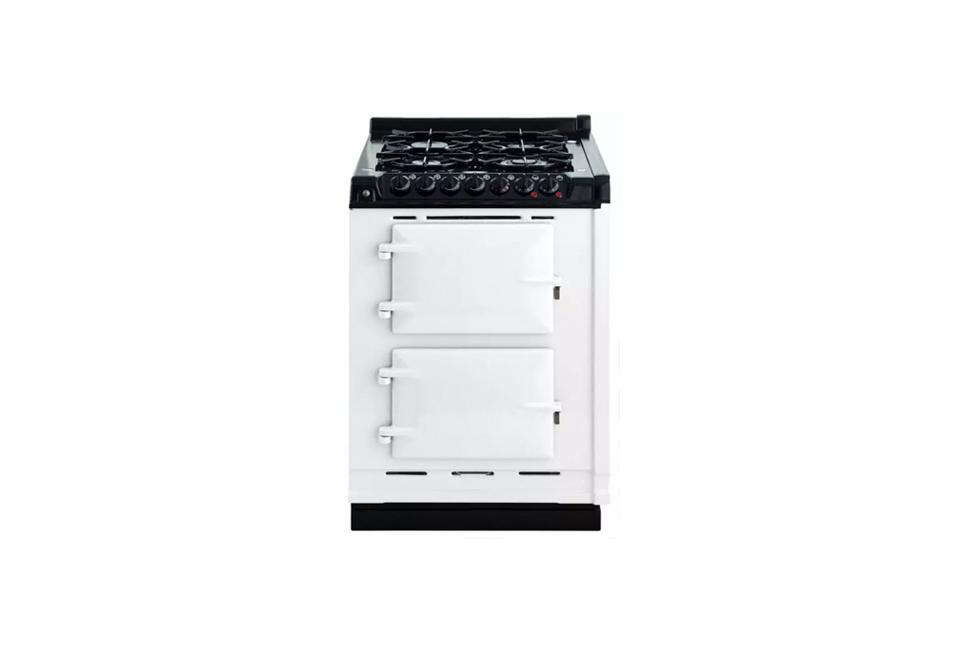
The Aga Companion Series Range proves that a stove does not need to occupy half the kitchen to become its main character. At approximately 24 inches wide, this compact dual-fuel range combines four gas burners, two electric ovens, British-inspired styling, and enough colorful enamel to make an ordinary stainless-steel appliance look slightly underdressed.
What Is the Aga Companion Series Range?
The Aga Companion Series Range was designed for cooks who loved the traditional appearance of a cast-iron Aga but wanted a more conventional, on-demand cooking experience. Rather than relying solely on the continuously heated radiant ovens associated with classic Aga cookers, the Companion uses familiar gas burners and individually controlled electric ovens.
The best-known U.S. version is a 24-inch dual-fuel range. It has four sealed gas burners on top, a conventional electric oven with an integrated broiler in the upper compartment, and a convection oven below. Historical specifications list approximately 3.0 cubic feet of total oven capacity, divided evenly between the two cavities.
Despite the name, it does not have to spend its life beside another Aga. It can function as a freestanding range in an apartment, cottage, guesthouse, or compact kitchen. It was also marketed as an additional cooking appliance for households with a larger heat-storage Aga. Think of it as the practical cousin who arrives at the family reunion wearing the same elegant coat but remembers to bring adjustable temperature controls.
Aga Companion Series Range Specifications
Exact measurements and ratings should be confirmed against the appliance data plate, but commonly published U.S. specifications include the following:
| Feature | Typical Specification |
|---|---|
| Range type | Freestanding dual-fuel range |
| Width | Approximately 24 inches |
| Height | Approximately 36 inches |
| Depth | Approximately 23.75 inches |
| Weight | Approximately 310 pounds |
| Cooktop | Four sealed natural-gas or propane burners |
| Burner output | Approximately 6,000 to 12,000 BTU |
| Upper oven | 1.5-cubic-foot conventional electric oven with broiler |
| Lower oven | 1.5-cubic-foot electric convection oven |
| Electrical supply | Commonly listed as 240/208 volts and 30 amps for U.S. models |
| Cleaning system | Manual cleaning |
The dimensions are wonderfully compact, but the weight deserves attention. A 310-pound range is not something to casually scoot across the floor while muttering, “Just two more inches.” Delivery professionals, proper lifting equipment, and a level, structurally suitable floor are sensible requirements.
How the Aga Companion Range Cooks
Four Gas Burners With a Useful Power Range
The sealed gas cooktop typically includes two moderate-output burners, one stronger rapid burner, and one high-output burner rated at approximately 12,000 BTU. This arrangement covers most everyday cooking jobs, from gently heating a sauce to boiling pasta water or stir-frying vegetables.
A 12,000-BTU burner is not as aggressive as the 18,000- or 20,000-BTU burners found on some modern professional-style ranges. However, it is entirely capable of routine home cooking. The visible flame also makes heat adjustments intuitive. Turn the knob, watch the flame respond, and enjoy the comforting knowledge that dinner is listening to you for once.
The 24-inch surface inevitably places cookware closer together than a standard 30- or 36-inch cooktop. Four modest pans fit comfortably, but combining a large stockpot, oversized skillet, Dutch oven, and wide sauté pan can become a metallic game of Tetris.
Upper Conventional Oven and Broiler
The upper cavity operates as a conventional electric oven and includes an integral broiler in the roof. Historical U.S. specifications list a seven-pass, 2,100-watt broiler element. The compartment is useful for roasting smaller dishes, browning casseroles, broiling fish, melting cheese, or producing toast without surrendering half the countertop to another appliance.
Because the oven is relatively short, food sits closer to the broiler. That can produce quick browning, but it also means garlic bread can progress from “beautifully golden” to “archaeological evidence” while you answer a single text message. Watch broiled foods closely.
Lower Convection Oven
The lower cavity uses a fan to circulate heated air. Convection can improve temperature distribution, encourage even browning, and make the oven especially useful for cookies, pastries, roasted vegetables, and smaller cuts of meat.
The oven is narrow compared with a typical American range, so pan compatibility matters. Before buying a Companion, measure the baking sheets, roasting pans, pizza stones, and casserole dishes you use most often. The outside width may be 24 inches, but the internal width of each historical oven is closer to 13.75 inches.
That compact chamber also has an advantage: there is less empty space to heat. For weeknight meals, a smaller oven can feel more appropriate than warming a cavern large enough to sublet.
Is the Companion a Traditional Heat-Storage Aga?
Not exactly. This distinction is essential because the Aga name covers several very different cooking systems.
A traditional cast-iron Aga cooks primarily through stored radiant heat. Its ovens are associated with specific cooking functions, and many classic models are designed to remain warm for extended periods. The Companion behaves more like a conventional dual-fuel range. Its gas burners provide direct flame, while its electric ovens are switched on and adjusted as needed.
That difference makes the Companion easier for many first-time Aga buyers to understand. Recipes generally translate more directly, temperatures can be selected conventionally, and the range does not need to remain continuously heated. You receive much of the visual charm without having to relearn every cooking instinct developed since childhood.
Main Advantages of the Aga Companion Series Range
Exceptional Style in a Small Footprint
The Companion’s greatest talent may be making a compact kitchen feel intentional rather than compromised. Its rounded doors, substantial handles, front-mounted controls, and glossy enamel finish create a strong architectural focal point. Historical models were produced in numerous colors, although availability varies by year.
Two Ovens in Only 24 Inches
Finding two genuinely useful ovens in a 24-inch range is unusual. Separate cavities allow a main course and dessert to cook at different temperatures, or let one dish bake while another broils. Holiday dinner becomes less of a traffic jam, although your largest turkey may still require a conversation about personal space.
Dual-Fuel Flexibility
Gas burners respond quickly and provide visual control, while electric ovens are valued for steady, consistent heat. This combination is especially appealing to cooks who sauté and simmer frequently but also bake bread, cookies, pies, or cakes.
Durable, Distinctive Construction
The enamel-covered exterior feels far more substantial than thin painted sheet metal. With appropriate care, vitreous enamel can remain attractive for many years. It is also relatively easy to wipe clean when spills are addressed promptly with nonabrasive products.
Potential Drawbacks to Consider
The Ovens Are Narrow
Two ovens sound generous until your favorite commercial-size baking sheet refuses to enter the building. The cavities work well for compact cookware, but owners accustomed to wide American ovens may need new pans or a revised approach to batch cooking.
It Requires Both Gas and Electricity
A dual-fuel installation generally needs a suitable gas or propane connection and a dedicated high-voltage electrical circuit. Converting a kitchen from an all-gas appliance can require electrical work, while converting from electric may require a new gas line. Either project can turn an apparently charming purchase into an unexpectedly educational relationship with local contractors.
No Modern Smart Features
The Companion comes from a more mechanical generation of appliances. It does not typically offer Wi-Fi controls, app notifications, air-fry presets, temperature probes, or a digital screen that sends motivational messages. For some buyers, that simplicity is delightful. Others may miss programmable cooking modes and self-cleaning cycles.
Parts and Service Need Investigation
Because the range is no longer prominent in Aga’s current U.S. catalog, local service coverage should be confirmed before buying. A beautiful used appliance is less romantic when the nearest qualified technician is three states away and communicates exclusively by carrier pigeon.
Installation and Buying Checklist
Whether purchasing old dealer inventory or a used Aga Companion range, complete these checks before money changes hands:
- Verify the model and serial numbers. Do not rely on color, appearance, or an online photo to identify the exact version.
- Confirm the fuel type. Determine whether the burners are configured for natural gas or propane and whether an approved conversion is possible.
- Check the electrical rating. Many U.S. examples are listed for 240/208 volts at 30 amps, but the data plate and installation guide must take priority.
- Measure the entire route. Check doorways, hallways, stairs, countertop openings, and delivery clearancesnot merely the final 24-inch space.
- Plan outdoor-vented exhaust. Cooking produces moisture and airborne particles, while gas combustion adds additional pollutants. A properly sized range hood vented outdoors is preferable.
- Inspect the enamel. Small surface marks may be cosmetic, but significant chips, cracks, or rust around damaged areas deserve closer examination.
- Test every function. Check burner ignition, flame stability, oven heating, convection fan operation, broiler performance, thermostats, door seals, indicator lights, and control knobs.
- Ask about replacement parts. Confirm access to igniters, thermostats, heating elements, seals, burner components, knobs, and fan assemblies.
- Use qualified installers. Gas, electrical, anti-tip, leveling, and ventilation work should comply with the manufacturer’s instructions and local codes.
Who Is the Aga Companion Range Best For?
The Companion is best suited to someone who values character, compact dimensions, tactile controls, and dual-fuel cooking more than enormous oven capacity or digital technology. It can be an excellent match for a cottage kitchen, historic renovation, smaller urban home, guesthouse, or design-focused space where a standard stainless-steel range would look about as charming as an office photocopier.
It is less suitable for households that routinely use extra-wide sheet pans, cook for large groups, demand ultra-high burner output, or need guaranteed access to same-day appliance service. Practical fit matters just as much as visual appeal.
Real-World Experience With an Aga Companion Series Range
The First Few Days
Daily life with a Companion begins with its physical presence. It looks heavier and more permanent than an ordinary compact range because it is. The enamel finish reflects light beautifully, the controls feel refreshingly direct, and the two-door layout attracts immediate attention. Guests tend to ask about the stove before asking what is for dinner, which is either flattering or a subtle warning about your cooking.
The cooktop feels familiar from the first meal. Gas ignition provides immediate feedback, and the different burner sizes make it easy to assign a small saucepan to gentle heat while using the stronger burner for boiling. The tighter spacing requires some planning, but owners of compact kitchens are usually already skilled in the ancient art of moving one pan three inches to the left.
Breakfast and Everyday Cooking
For breakfast, the Companion is in its element. A skillet can handle eggs while another burner warms oatmeal and a third heats water. The upper broiler is convenient for toast, tomatoes, or breakfast sandwiches, although the shallow cavity rewards attention. Broiling is fast, and distracted cooks may discover that smoke alarms are excellent but extremely judgmental kitchen timers.
Weeknight meals also suit the appliance well. The lower convection oven can roast vegetables while the upper oven heats a casserole at another temperature. That separation is more useful than the total cubic-foot figure suggests. Instead of one large oven doing everything imperfectly, two small ovens can complete different tasks simultaneously.
Baking and Roasting
The lower convection oven generally makes the strongest impression on bakers. Air circulation helps cookies brown consistently and gives pastries a crisp exterior. The compact cavity reaches useful cooking temperatures without heating a huge volume of unused space. However, recipes may need slightly shorter cooking times, particularly when adapted from a conventional oven.
The narrow interior becomes most noticeable during batch baking. A standard recipe may require additional rounds because fewer cookies fit on each tray. That is not a disaster, but it does mean the second batch may mysteriously contain fewer cookies after the household begins “quality control.”
Roasting works well when the pan fits. Chickens, vegetables, smaller roasts, and compact casseroles are natural choices. Oversized holiday cookware should be measured in advance rather than introduced to the oven on Thanksgiving morning.
Cleaning and Maintenance
The sealed burners simplify cleanup around the cooktop, but the glossy enamel should be treated gently. Let hot surfaces cool, wipe spills with a soft cloth or nonabrasive sponge, and avoid steel wool or aggressive cleaners. Abrasive tools can dull or scratch the finish, turning a quick cleanup into a permanent design contribution.
The ovens are manually cleaned, so spills are best handled before they become historic landmarks. The smaller cavities are easier to reach than a giant oven, although cleaning two separate compartments takes additional time. Burner caps, ignition ports, door seals, and ventilation openings also benefit from periodic inspection.
Living With the Compact Size
The 24-inch width is both the Companion’s superpower and its main compromise. It preserves valuable cabinetry and counter space, yet still provides four burners and two ovens. In a modest kitchen, this efficiency can improve the entire room. In a large household that regularly uses oversized pans, the same dimensions may feel restrictive.
After the adjustment period, the most satisfying part of ownership is the combination of beauty and straightforward operation. There are no complicated menus to navigate and no app demanding a firmware update while the onions burn. Turn a knob, choose an oven, and cook.
Final Verdict
The Aga Companion Series Range is not the right appliance for every kitchen, particularly now that buyers must carefully investigate availability, parts, and service. Nevertheless, a well-maintained example remains an appealing compact dual-fuel range. It offers responsive gas cooking, two independent electric ovens, durable styling, and a personality that modern appliances often attempt to manufacture with touchscreens.
Buy it because its dimensions, cooking layout, and service requirements fit your householdnot merely because the enamel color looks magnificent beside the cabinets. When those practical details align, the Companion can deliver what its name promises: a capable, dependable, and unusually handsome cooking partner.