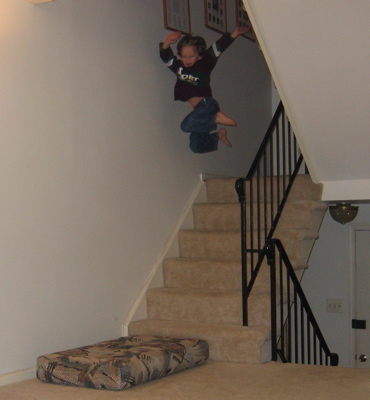
There are some joys in life so small, so specific, and so gloriously unnecessary that they almost feel illegal. Not actually illegal, of course. More like “this should not be this satisfying” illegal. And somewhere near the top of that list is the oddly wonderful thrill of jumping as many stairs as possible.
That is the magic of 1000 Awesome Things. It does not need fireworks, yachts, or a celebrity chef whispering over truffle foam. It notices the tiny wins. The everyday victories. The moments that make you feel like a champion even though, objectively, you are just moving through a building like a slightly overconfident raccoon with a purpose.
#708, “Jumping as many stairs as possible,” works because it captures something almost everybody understands instantly. You see a staircase, and a tiny part of your brain says, “What if we didn’t do this the boring way?” So you skip a step. Maybe two. Maybe you charge upward like you’re late to accept an award you definitely did not earn. Maybe you come down with that quick, springy rhythm that makes you feel ten years younger and 40% more cinematic.
And yes, the grown-up disclaimer arrives early: this is not an invitation to turn your apartment stairwell into an action movie audition. But as an idea, as a sensation, and as a symbol of everyday joy, this one deserves its place on the list. It is playful, physical, nostalgic, ridiculous, and just grounded enough in real life to be universal.
Why This Tiny Habit Feels So Big
The first reason this moment lands so well is simple: it breaks routine. Most of modern life is aggressively rectangular and painfully efficient. We sit in boxes, work on boxes, watch boxes, and carry little glowing boxes in our pockets that politely ruin our attention spans. Then a staircase appears, and suddenly your body gets a vote.
Instead of walking in the careful, measured rhythm of Responsible Citizen Mode, you bounce. You stretch. You leap a little. You turn a bland architectural feature into a tiny performance. It feels like freedom, but in a very manageable amount. Not “quit your job and buy a sailboat” freedom. More like “I just took three stairs in one stride and briefly became the main character” freedom.
That matters more than it sounds. Small moments of delight are often the most repeatable ones. They do not require planning. They do not cost money. They do not involve syncing five calendars and pretending everyone is “totally flexible.” They happen in the middle of ordinary life, which is exactly why they hit so hard.
There is also a low-stakes challenge built into the whole thing. How many can you clear? Can you take them two at a time? Can you glide up the last few steps without sounding like a walrus with a laptop bag? The staircase becomes a quick personal test of timing, coordination, and confidence. No scoreboard needed. Your reward is immediate, private, and deeply silly.
The Science Behind the Stair Obsession
Stairs are sneaky cardio
One reason this awesome thing feels so energizing is that stairs are real work. Even when they do not look dramatic, they demand effort. Climbing stairs asks your heart, lungs, glutes, calves, and quads to stop being decorative and start contributing. That is why one quick flight can make you feel both noble and mildly betrayed by your own breathing.
Health guidance from major U.S. organizations consistently treats physical activity as one of the best things adults can do for long-term health. Adults are generally encouraged to get at least 150 minutes of moderate-intensity activity per week, plus muscle-strengthening work on at least two days. Better yet, that movement does not have to happen in one perfect gym session. It can be broken into smaller chunks across the week, which is terrific news for people whose fitness plan is mostly “exist near stairs and occasionally make good choices.”
That is where this topic gets unexpectedly practical. Stair climbing is one of the easiest forms of built-in movement available in daily life. You do not need fancy equipment, a monthly membership, or a playlist titled Destroy Your Limits. You need stairs. That is it. Buildings have been quietly hiding free exercise in plain sight for centuries.
It trains more than your legs
Stair work is not just about burning energy. It can support balance, endurance, and lower-body strength. Because it is weight-bearing, it also has value for bone health. And unlike some higher-impact workouts, stair climbing can place less stress on certain joints than running, while still offering a serious challenge. In other words, stairs are like that humble coworker who never brags but somehow does the job of three people.
Even short bursts matter. Research and public-health messaging around physical activity have increasingly emphasized that movement accumulated in pieces still counts. A few energetic minutes here, a brisk climb there, one flight instead of the elevator, another trip later in the day, and suddenly you are not just surviving office life. You are collecting movement like tiny health coupons.
Some studies have even linked regular stair climbing with lower cardiovascular risk, including findings suggesting that people who climb more than five flights a day may have a lower risk of heart-related problems. That does not mean stairs are a magic spell. They are not broccoli with a handrail. But they are one of the simplest ways to sneak more vigorous effort into an otherwise sedentary day.
It can wake you up fast
Stairs also have that immediate “snap out of it” quality. You know the feeling. You are sluggish, foggy, maybe one email away from evolving into office furniture, and then you take the stairs quickly and arrive upstairs alert, warm, and just awake enough to remember your own password.
That is not just imagination. Movement can improve energy, support mood, reduce short-term anxiety, and help sleep over time. Some stair-based exercise guidance even points to quick post-meal stair walking as a useful way to support blood sugar control. So while jumping stairs feels playful, it also belongs to a bigger truth: tiny bursts of physical effort can make the body feel more alive almost immediately.
Why It Feels Like Childhood in Disguise
The emotional power of #708 is not only physical. It is nostalgic. It reconnects adults with the part of themselves that used to move for the joy of moving. Before every activity became “optimized,” “tracked,” “programmed,” or somehow turned into a subscription, people just ran, hopped, skipped, climbed, and launched themselves around because it was fun.
Jumping stairs pulls that version of you out of storage for a second. Suddenly the staircase is not a functional transition between floors. It is a challenge. A game. A tiny rebellion against dullness. That matters because play is not fluff. Playful physical movement helps people feel engaged, capable, and mentally refreshed. It introduces a little unpredictability into the day, and unpredictability, when safe and manageable, can feel invigorating.
There is also something deeply human about testing distance with your own body. Can I reach that step? Can I clear that gap? Can I make this climb smoother, faster, cooler? It is the same instinct that made kids hop sidewalk cracks, leap over puddles, and sprint for no reason other than “because.” Adults do not outgrow that instinct. We just bury it under email.
So when #708 celebrates stair-jumping, it is really celebrating the brief return of spontaneous physical joy. Not polished athletic greatness. Not a perfect workout. Just that sweet little spark that says your body is not only a machine for commuting and carrying groceries. It is also a toy box with knees.
Small Joys, Everyday Awe, and the Power of the Ridiculous
Another reason this awesome thing sticks is that it turns an ordinary environment into something emotionally brighter. Psychologists often point out that everyday moments can carry more meaning than we give them credit for. Small pleasures can improve well-being precisely because they are accessible. They do not wait for vacation. They do not depend on some giant life milestone. They are available on a Tuesday, between errands, while holding a coffee you should probably not have brought onto the stairs.
There is even a tiny form of awe here, though not the grand canyon kind. Not “I have glimpsed the infinite.” More like “wow, my body and brain just coordinated that weird little burst beautifully.” Awe does not always need mountains and galaxies. Sometimes it arrives as a quick jolt of wonder in the middle of regular life. A staircase becomes a stage. A building becomes a playground. Gravity becomes a rival. That is not enormous, but it is real.
And because the moment is so modest, it feels authentic. Nobody jumps stairs for clout when nobody is watching. Well, mostly nobody. Usually it is just for that private little hit of delight. That is what makes it so lovable. It belongs to the secret economy of everyday happiness, where the rewards are tiny but strangely powerful.
The Grown-Up Fine Print: Smart Beats Spectacular
Now for the part where we keep this awesome thing awesome instead of making it a story that begins with, “So there I was, wearing socks on a wooden staircase like a genius.” Stair joy works best when filtered through common sense.
Use the handrail when needed. Make sure steps are well lit. Watch for slippery surfaces, loose clutter, uneven edges, or anything blocking your view. If you have balance issues, joint pain, dizziness, or a medical condition that affects safe stair use, the sensible move is to keep it simple and steady. There is no shame in taking stairs normally. In fact, normal stair climbing is already a legit win.
The healthiest interpretation of #708 is not reckless leaping. It is spirited movement. It is taking the stairs with intention. Maybe that means two steps at a time on the way up when conditions are safe. Maybe it means choosing the staircase instead of the elevator. Maybe it means one extra flight a day because that is what your knees, lungs, schedule, and dignity can all agree on.
That approach fits modern exercise advice beautifully. Start where you are. Build up gradually. Let the habit become repeatable. The point is not to impress the stairwell. The point is to make ordinary life a little more active, a little more joyful, and a lot less sedentary.
Why #708 Still Deserves Its Spot on the List
The best entries in 1000 Awesome Things do two jobs at once. First, they make you laugh because they are weirdly specific. Second, they make you nod because they are absolutely true. This one nails both.
Jumping as many stairs as possible is funny because it sounds like a tiny, pointless, low-budget superpower. But it is also brilliant because it captures a real sensation: the happiness of using your body with a little flair. The pleasure of momentum. The thrill of doing something ordinary in a slightly extraordinary way.
It also reminds us that joy does not always arrive with an announcement. Sometimes it is hidden in a hallway. Sometimes it is waiting between floors. Sometimes it is the decision to take a staircase like your life has a soundtrack, even if the only sound is your shoes slapping the steps and your lungs filing a formal complaint.
And maybe that is the deepest reason #708 works. It gives us permission to enjoy being alive in small, unglamorous ways. Not later. Not when life is calmer. Not when we are fitter, richer, or more organized. Right now. On these stairs. In this body. On this weird little trip between one level and the next.
Longer Reflection: The Experience of Jumping as Many Stairs as Possible
There is a very specific moment that belongs to this experience, and almost everyone knows it. You are at the bottom of a staircase. You are not in danger. You are not training for anything. You are simply there, looking upward, and then a little electric thought flashes through your mind: “Let’s go.” Suddenly the staircase stops being architecture and becomes opportunity.
The first leap is always the most honest. It happens before overthinking arrives. Your foot lands a little farther than usual, your body tilts forward, and you feel that delicious instant where balance, effort, and momentum all shake hands. Now you are committed. You are no longer a person using stairs. You are a person attacking them with style.
Maybe you take two at a time on the way up, pumping your legs with that exaggerated determination that makes even a trip to the printer feel heroic. Maybe you are carrying nothing, so you feel lighter, faster, almost cartoonishly efficient. Maybe your coat swings behind you a bit. Maybe for three seconds you feel like the lead in a movie montage called Administrative Greatness.
And then there is the rhythm. That is the hidden pleasure. Not just the height, but the pattern. Thump, step, thump, step. Or maybe leap, plant, leap. Your body starts solving tiny equations on the fly: distance, timing, pressure, landing. It all happens faster than language. That is part of why it feels so satisfying. For a moment, the brain stops juggling ten thousand useless thoughts and focuses on one wonderfully immediate task: clear the next step.
That concentration can feel oddly cleansing. Bills disappear. Notifications vanish. You are not worrying about awkward texts from last night or wondering whether that meeting could have been an email. You are just moving. Just climbing. Just enjoying the brief, old-fashioned pleasure of being coordinated enough to pull off something simple and slightly dramatic.
The feeling often carries a memory with it, too. School stairwells. Apartment buildings. Stadium bleachers. Front porch steps. The old house where you used to bound upstairs two at a time because dinner was ready or because Saturday morning cartoons had already started. Jumping stairs has a way of bringing those earlier versions of yourself back online. It is not only movement. It is memory with sneakers on.
And then, when it is over, the reward is immediate. You reach the top and feel a little rush. Not a giant athletic triumph. Just that bright internal nod that says, “Yes, that was excellent.” Your heart is beating faster. Your breathing is a little louder. Your mood is weirdly better. You did not change the world. You barely changed floors. But somehow the day feels more alive.
That is the beauty of the whole thing. It is not impressive enough to become annoying. It is not serious enough to become work. It is just one of those fleeting experiences that proves life still has texture in it. A staircase gives you a chance to move with enthusiasm instead of obligation, and that tiny difference changes everything.
So yes, jumping as many stairs as possible is awesome. Not because it is extreme, and definitely not because it should become a reckless hobby. It is awesome because it is playful. Because it is physical. Because it wakes you up. Because it smuggles joy into the middle of an ordinary day and leaves you smiling at how ridiculously good such a small thing can feel.
Conclusion
#708, “Jumping as many stairs as possible,” is more than a funny observation. It is a compact theory of happiness. It says small pleasures count. It says movement matters. It says adulthood does not have to erase play. And it quietly reminds us that a staircase can be more than a route from one floor to another. It can be a burst of cardio, a flash of nostalgia, a micro-adventure, and a tiny act of rebellion against boredom.
That is why this everyday moment still resonates. It blends fun with function, instinct with health, and silliness with something genuinely meaningful. The next time you spot a flight of stairs, you may not need to launch yourself like an overcaffeinated gazelle. But taking them with a little extra energy, delight, and swagger? That still counts as living well.