There is a special category of tattoo that makes your brain applaud and file a formal complaint at the same time. The lines are clean. The shading is buttery smooth. The colors look rich enough to have their own investment portfolio. Unfortunately, the finished design might depict a seductive frog, a celebrity dressed as a magical schoolgirl, or a highly realistic rat sprinting across someone’s scalp.
Welcome to the wonderfully confusing world of awful tattoo ideas with great execution. These are not ordinary tattoo fails. A true tattoo fail usually involves shaky lettering, accidental anatomy, muddy colors, or a portrait that looks like it was drawn during an earthquake. The tattoos in this collection are different: the artists clearly knew what they were doing. The questionable part was the assignment.
Tattoos have become a normal form of self-expression in the United States. Pew Research Center found that 32% of American adults have at least one tattoo, while 24% of tattooed adults say they regret one or more of their pieces. That leaves plenty of room for meaningful memorials, beautiful artwork, impulsive decisions, and designs that make strangers whisper, “Technically impressive, but why?”
What Makes a Horrible Tattoo Design Technically Excellent?
Tattoo quality and tattoo taste are not the same thing. Quality can be judged through relatively practical details: consistent line weight, smooth gradients, saturated color, readable contrast, accurate proportions, thoughtful placement, and skin that has not been unnecessarily damaged. Taste, meanwhile, is personal. One person’s visual nightmare is another person’s proud conversation starter.
That distinction explains why these bizarre tattoos are so fascinating. You may never request a photorealistic cat rear end or a golf course stretched across your chest, but you can still appreciate the artist’s control. Tattooing is a demanding medium. The canvas moves, breathes, stretches, bleeds, heals, and occasionally asks for a snack break.
Body art also has a long history of representing identity, status, spirituality, remembrance, endurance, and cultural belonging. Modern novelty tattoos may look unserious, but the desire to permanently mark the body with a personally meaningful image is anything but new.
50 Awful Tattoo Ideas With Remarkably Good Execution
The following tattoos demonstrate what happens when excellent technique meets a concept that should probably have spent another night in the drafts folder. Some are clever, some are unsettling, and several are so strangely specific that they circle back around to being impressive.
Cartoons, Crossovers, and Childhood Memories Gone Rogue
- A permanent-warning cartoon: A startled yellow cartoon character is paired with a reminder that tattoos are permanent. The irony is practically wearing a name tag.
- The all-seeing eye: A realistic eye is rendered with beautiful highlights and convincing depth, ensuring that the wearer is never technically alone.
- The endless wine pour: A bottle appears to pour wine directly into a glass. The realism is excellent; the drinking logistics remain suspicious.
- The multiple-eye portrait: A face is given several overlapping sets of eyes, creating the visual equivalent of standing up too quickly.
- The mysterious yellow unicyclist: A tiny figure pedals proudly across an ankle with no explanation and apparently no destination.
- The chaotic underwater cartoon: A colorful mermaid-and-sea-creature scene is executed with care, even though the composition feels like an aquarium fever dream.
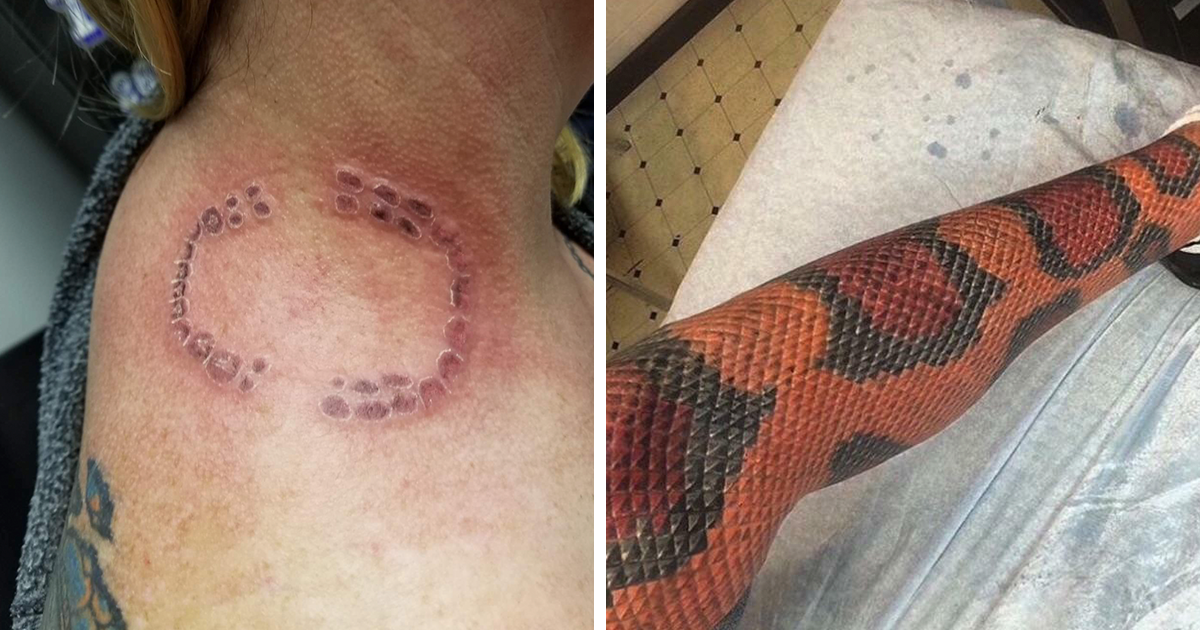
- The human snake-skin illusion: Meticulously shaded scales transform a section of skin into a reptilian surface that looks disturbingly touchable.
- The fantasy television crossover: Familiar children’s characters enter an epic fantasy setting nobody requested but everybody immediately understands.
- The dramatic football supporter: A highly detailed fan holding a flare turns an arm into a permanent stadium tribute.
- The aggressively customized Minion: A recognizable cartoon sidekick receives accessories and attitude far beyond anything its original creators likely imagined.
The first group ranges from optical illusions to cartoon mashups, proving that recognizable characters become even more memorable when placed in deeply unexpected situations.
Functional Tattoos That Solve Problems Nobody Had
- The plaid-pattern sleeve: Technically precise fabric lines wrap around an arm, creating the look of a shirt that can never be removed or washed.
- The fisherman’s measuring ruler: A ruler tattooed along the leg helps estimate a fish’s length, assuming the fish cooperates with the measuring procedure.
- Ringo meets Animal: Two famous drumming references are combined into one expertly shaded portrait that lands somewhere between tribute and visual pun.
- The chaotic SpongeBob lettering: A beloved cartoon character appears beside exaggerated alternating-case text, preserving an internet joke in permanent ink.
- The elegant blobfish: A beautifully shaded blobfish demonstrates that even nature’s saddest-looking marine celebrity can receive premium artistic treatment.
- The cartoon yin-yang hybrid: Two mismatched characters become a symbol of balance, harmony, and refusing to choose only one fandom.
- The arrow-in-the-knee reference: A gaming joke is positioned directly across the knee so the body itself becomes part of the punchline.
- The anatomically strategic cat: An otherwise charming cat design uses a body feature as the animal’s rear end. Subtle it is not.
- The incorrect skeleton sleeve: Bones are rendered with skill across an arm and hand, although the skeletal arrangement would make an anatomy professor reach for a red marker.
- The palm full of sunflower seeds: Tiny seeds are carefully scattered across a palm, turning every handshake into a confusing snack-related event.
These entries show how placement can become part of a tattoo’s joke. Knees, palms, belly buttons, joints, and natural body contours can make a design more dynamic, but they can also make it dramatically stranger.
Celebrity Portraits and Pop-Culture Decisions
- The majestic Nicolas Cage portrait: A startlingly good celebrity likeness covers a calf, honoring an actor whose face has already conquered every corner of the internet.
- The inflatable knee toad: A colorful toad is positioned so the knee changes the appearance of its throat whenever the leg bends.
- The puzzling Pikachu mashup: The electric cartoon creature becomes part of a personalized combination that may require a diagram and a family meeting to explain.
- The hardcore space-opera character: A familiar science-fiction universe is pushed into a bizarre visual direction with impressively polished details.
- The realistic bruise tattoos: Purple, blue, and red shading recreates the look of severe bruising so convincingly that concerned strangers may offer ice packs.
- Sailor DeVito: A recognizable actor’s face is merged with a magical anime heroine, answering a question that humanity had displayed admirable restraint in never asking.
- The retro dog portrait: A dog wearing sunglasses and a hat receives a geometric, neon-heavy treatment straight from an alternate 1980s timeline.
- The hand with hidden horns: A snarling face incorporates fingers and body position to create a clever horned illusion.
- The plastic-wrapped face: A highly realistic portrait appears trapped beneath transparent material, creating an effect that is technically brilliant and emotionally uncomfortable.
- The watercolor PlayStation tribute: Gaming symbols are surrounded by colorful splashes that look like a controller wandered into an art-school portfolio.
Portrait tattoos leave little room for error, which makes these examples especially impressive. Faces, expressions, transparent materials, and recognizable characters demand careful proportion and smooth shading, even when the underlying concept is gloriously strange.
Creatures That Should Not Be This Realistic
- The objectively best cartoon mystery: Several expressive characters create an energetic composition that is beautifully made and almost impossible to summarize politely.
- The skin-crawling knee snake: A serpent coils around a joint with realistic texture, making every bend of the leg look like reptile activity.
- Peppa Pig with human eyes: A simple children’s character receives disturbingly realistic eyes, instantly transforming preschool entertainment into psychological horror.
- The Ace Ventura vegetable moment: A famous comedy scene involving produce becomes a colorful permanent tribute to cinematic nonsense.
- Literal food pornography: A carefully colored root vegetable is arranged in an unmistakably adult composition. Farm-to-table has officially gone too far.
- The sentimental Family Guy collection: Cartoon characters are placed inside decorative hearts with the seriousness normally reserved for romantic portraits.
- The scalp rat: A richly colored rat appears to crawl across a shaved head, combining advanced tattooing with instant social distancing.
- The religious science-fiction mashup: Sacred portrait imagery meets a famous extraterrestrial hunter, producing something best described as “Predator, but make it devotional.”
- The streetwear cartoon character: A tiny blue character wears sneakers, a beanie, and urban accessories with enough detail to launch a fashion label.
- The belly-sized Krang: A large cartoon villain uses the wearer’s stomach as both canvas and special effect.
Realistic eyes, fur, scales, fabric, reflections, and transparent surfaces reveal genuine technical ability. Unfortunatelyor fortunately, depending on your sense of humorthat ability can make an unsettling idea much harder to ignore.
The Final Ten: Bold Choices With No Emergency Exit
- The cosmic Rick and Morty composition: Cartoon chaos, realistic elements, bright planets, and dimensional effects collide in a remarkably polished fandom piece.
- The centipede-and-scorpion forearms: Two detailed arthropods crawl across crossed arms, creating an image guaranteed to test everyone’s ability to remain calm.
- The banana astronaut: A fruit-shaped space explorer floats heroically through the universe because regular astronauts were apparently too predictable.
- The glamorous frog: A frog wearing fishnet stockings and red heels stretches across the lower back with confidence that most humans can only dream of possessing.
- The chest-sized golf course: A sprawling landscape turns the torso into a fairway, complete with enough detail to make golfers study the terrain.
- The husband’s bite mark: A ring of tooth impressions becomes a permanent romantic keepsake and an excellent way to alarm a dental hygienist.
- The belly-button platypus: A round, charming platypus uses the natural shape of the stomach to enhance its already generous proportions.
- The Hank-filled tank: Multiple cartoon heads ride inside a red military vehicle, producing a visual pun with surprisingly crisp execution.
- The famous soccer foul: A controversial championship moment is preserved in detailed ink, ensuring that the sporting argument never truly ends.
- The intensely expressive anime face: Dramatic eyes, sweat, blush, and an open mouth create an emotional image that may be difficult to explain at a family barbecue.
These final entries show why bizarre tattoos spread so widely online. They are readable in seconds, technically impressive, emotionally confusing, and almost impossible not to discuss.
Why People Choose Weird Tattoo Designs
Humor Can Be More Meaningful Than Elegance
Not every tattoo is intended to be timeless, solemn, or conventionally attractive. Some people would rather carry a joke than a rose. A strange tattoo can memorialize a friendship, reference a favorite show, celebrate an inside joke, or simply make the wearer laugh whenever life becomes too serious.
Being Memorable May Be the Entire Point
A tasteful design may earn a compliment. A realistic scalp rat earns a full conversation, several follow-up questions, and possibly a request to see it again from another angle. For outgoing wearers, that reaction is a feature rather than a bug.
The Artist May Love the Technical Challenge
Experienced tattooers often enjoy solving difficult visual problems. They must adapt a flat reference image to a curved, moving body part while anticipating how the tattoo will heal and age. A bizarre request involving reflections, optical illusions, unusual anatomy, or joint movement can be more technically interesting than another straightforward symbol.
How to Avoid Regretting a Technically Perfect Tattoo
Test the Idea Before Making It Permanent
Print the design, use a temporary version, or place the stencil on your body and study it from several angles. Wear it around the house. Look at it in different clothing. Ask yourself whether you still enjoy the joke when you are tired, stressed, or explaining it for the seventeenth time.
Choose an Artist for the Correct Style
A talented tattoo artist is not automatically talented in every technique. Review healed worknot only freshly photographed tattoosand look for experience with the style, placement, skin tone, color palette, and level of detail you want. Fresh ink can look sharper and darker than the same piece after healing, so healed photographs provide a more realistic preview.
Let the Artist Challenge the Design
A good tattoo consultation is not an order handed to a printer. Artists may recommend enlarging tiny details, simplifying a crowded composition, adjusting a pose, changing the placement, or using stronger contrast. That feedback is not an attack on your creative genius. It is professional help from someone who understands what ink does after living in skin for several years.
Think Beyond the Fresh-Tattoo Photograph
Fine details can soften, closely spaced lines can appear crowded, and areas exposed to friction or sunlight may fade faster. Hands, fingers, feet, and other high-contact areas can require touch-ups. A design that depends on microscopic lettering or hair-thin gaps should be planned with its future appearance in mind.
Tattoo Safety Still Matters, Even When the Design Is a Joke
A hilarious concept does not reduce the need for professional hygiene. Tattooing breaks the skin, so contaminated ink, reused equipment, or poor aftercare can contribute to infection. Allergic reactions, granulomas, keloid scarring, and other skin problems are also possible. Even sealed ink can become contaminated, which is why reputable studios take product handling and sterilization seriously.
Follow the aftercare instructions supplied by the artist. Keep the area clean, avoid picking at flakes or scabs, limit unnecessary friction, and protect healed tattoos from excessive sun exposure. Seek medical advice when redness, swelling, pain, discharge, fever, or other concerning symptoms worsen rather than improve.
Laser removal exists, but it should not be treated like an instant undo button. Removal can require multiple sessions and may involve pain, skin irritation, discoloration, infection, or scarring. Home removal methods can be ineffective and dangerous.
Experiences People Commonly Have With Bold or Questionable Tattoos
Living with an unusual tattoo can be very different from admiring it in a photograph. During the first few days, the wearer may experience an emotional adjustment period. A design that looked modest on a phone screen can suddenly feel enormous when it occupies an entire forearm. Bright colors may seem intense, swelling can temporarily alter the shape, and the surrounding skin may look irritated. Some people briefly panic even when the tattoo is exactly what they requested.
That initial uncertainty does not always become genuine tattoo regret. Once healing settles and the person becomes accustomed to seeing the image, the tattoo may begin to feel like a natural part of the body. The owner of a strange cartoon, celebrity mashup, or visual pun might grow more attached to it precisely because it is so distinctive. What initially seemed embarrassing can become a reliable source of laughter and an easy way to connect with people.
The opposite experience also occurs. A joke that felt hilarious during one phase of life may become tiring after hundreds of explanations. Pop-culture references can lose relevance. A romantic symbol may outlast the relationship it celebrates. A deliberately disturbing image may become inconvenient in workplaces, formal settings, family photographs, or ordinary moments when the wearer does not want to become the center of attention.
Placement strongly affects that experience. A bizarre tattoo on the thigh or upper arm can usually be revealed selectively. The same design on the hand, neck, scalp, or face becomes part of nearly every first impression. People who enjoy constant attention may welcome that visibility. More private personalities sometimes discover that they preferred the tattoo when it existed only as a sketch.
Another common lesson involves scale. Clients frequently request a small tattoo because they assume smaller means safer, cheaper, and easier to hide. However, reducing a complicated illustration can remove the negative space that keeps details readable. Over time, a tiny portrait or paragraph of script may become less clear. An experienced artist may recommend a larger piece not to increase the bill, but to give the design room to age.
People also learn that the tattooing experience influences how they feel about the finished work. Clear communication, respectful treatment, realistic expectations, and confidence in the artist can create positive memories around even the strangest image. Feeling rushed, ignored, pressured, or surprised by last-minute changes can attach unpleasant emotions to an otherwise competent tattoo.
Cover-ups offer another path when affection fades. A skilled cover-up artist may incorporate the old design into a larger, darker, or more strategically composed piece. However, not every tattoo can be hidden easily. Dense black ink, extensive color, scars, and awkward placement may limit the available options. Some clients use laser sessions to lighten the original tattoo before beginning a cover-up.
The most useful experience shared by long-term tattoo owners is simple: separate outside opinion from personal regret. The internet may declare a tattoo tasteless while the wearer continues to love it. A design does not need universal approval to be successful. At the same time, loving the idea does not require pretending the execution is flawless.
Ultimately, the best tattoo is not necessarily the most tasteful image in the room. It is one that was chosen deliberately, created safely, executed by the right artist, and accepted with a clear understanding of its visibility and permanence. A glamorous frog, banana astronaut, or magical Danny DeVito may never belong in a museumbut on the right person, it can still be a masterpiece.