Your backyard should sound like birds, breezes, laughter, and maybe the occasional sizzling burger. It should not sound like a highway auditioning for a monster-truck commercial. Unfortunately, outdoor noise has a way of barging into patios, decks, balconies, pools, and gardens like an uninvited guest who brought a leaf blower.
The tricky truth is that outdoor soundproofing is not the same as indoor soundproofing. Indoors, you can seal gaps, hang heavy curtains, add insulation, and close a door. Outdoors, sound has space to travel, bounce, sneak around fences, and drift over hedges like it owns the deed. So the goal is usually not total silence. The goal is smart noise reduction, better sound masking, and a more peaceful outdoor space that feels private, calm, and usable again.
This guide breaks down five practical tips for soundproofing your outdoor spaces, inspired by the kind of hands-on home improvement advice readers expect from Bob Vila-style problem solving. We will look at fences, plants, water features, layout tricks, acoustic materials, and real-world experience so you can stop shouting over traffic and start enjoying your yard like a civilized person with iced tea.
Why Outdoor Soundproofing Is Different
Before building a fortress around your patio, it helps to understand how noise behaves outside. Sound travels in waves. When it hits a hard surface, it may reflect. When it meets a dense barrier, some of it is blocked. When it passes through soft, irregular materials, some of its energy may be absorbed or scattered. Outdoors, however, sound can also travel over the top of barriers, around the ends, through gaps, and across open space.
That is why the best backyard noise reduction strategy is usually layered. A tall, solid fence may block direct sound. Dense evergreen shrubs may soften and scatter what remains. A fountain may mask sharp traffic noise with a gentler sound. A pergola, outdoor curtains, rugs, and cushioned furniture may reduce echoes inside the seating area. One solution helps. Several solutions working together are where the magic happens.
Think of it like dressing for winter. One sock is technically clothing, but nobody calls that a strategy.
Tip 1: Build a Solid Noise-Blocking Fence or Wall
If outdoor noise is coming from a road, pool pump, nearby business, barking dog, or lively neighbor, a physical barrier is often the first serious move. Not all fences are created equal, though. A decorative picket fence may look charming, but acoustically speaking, it is mostly a polite suggestion. Sound slips right through the openings.
Choose Mass, Height, and No Gaps
For a fence to reduce noise, it needs three important qualities: mass, height, and continuity. Mass means the material is heavy enough to block sound waves. Height matters because a barrier works best when it interrupts the line of sight between the noise source and the listener. Continuity means no cracks, open slats, loose boards, or cute little design gaps that let sound pour through like water through a pasta strainer.
Good options include masonry walls, concrete walls, stone walls, solid wood fences, composite privacy fences, and specialty acoustic fence panels. If you already have a wood fence, you may improve its performance by sealing gaps and adding density with exterior-rated acoustic materials such as mass loaded vinyl installed behind boards or between fence layers.
Place the Barrier Where It Works Hardest
A sound barrier generally performs best when it is close to the noise source or close to the area you want to protect. For example, if road noise is the problem, a solid fence near the property line may help. If an air conditioner or pool pump is the culprit, a smaller acoustic enclosure around the equipment may be more effective than trying to treat the whole yard.
Do not forget local codes. Many cities and homeowners associations limit fence height, materials, and placement. Before you build a backyard version of the Great Wall, check permits, setbacks, utility lines, and neighborhood rules. Peace and quiet are wonderful; a violation notice taped to your gate is less wonderful.
Tip 2: Add Dense Landscaping for Natural Noise Reduction
Plants are not magic earplugs for your yard, but they can help. Dense landscaping can scatter, absorb, and psychologically soften unwanted sound. It also blocks the view of the noise source, which matters more than many homeowners realize. When you cannot see the road, alley, or neighbor’s trampoline Olympics, the noise often feels less intrusive.
Use Evergreens for Year-Round Coverage
For sound buffering, choose plants that are tall, thick, and dense from top to bottom. Evergreens are especially useful because they do not disappear acoustically every winter. Arborvitae, holly, juniper, spruce, pine, yew, magnolia, viburnum, and dense hedging shrubs can all play a role depending on your climate and soil.
The best planting design is usually layered. Place taller evergreens in the back, medium shrubs in the middle, and ornamental grasses or lower shrubs in front. This creates a deep, textured buffer instead of a single thin row. A skinny hedge is nice for privacy, but a wide, layered planting bed is better for outdoor noise control.
Combine Plants With Barriers
Plants work best when paired with a solid fence, berm, wall, or trellis. A fence blocks direct sound. Plants soften reflections, add visual privacy, and make the barrier look less like you are preparing for a medieval siege. If space allows, plant shrubs on both sides of the fence or create a mixed border along the inside of your yard.
For small patios or balconies, use large planters filled with bamboo, tall grasses, compact evergreens, or climbing vines on trellises. Container plants will not stop traffic noise by themselves, but they can make a seating area feel more enclosed and less exposed.
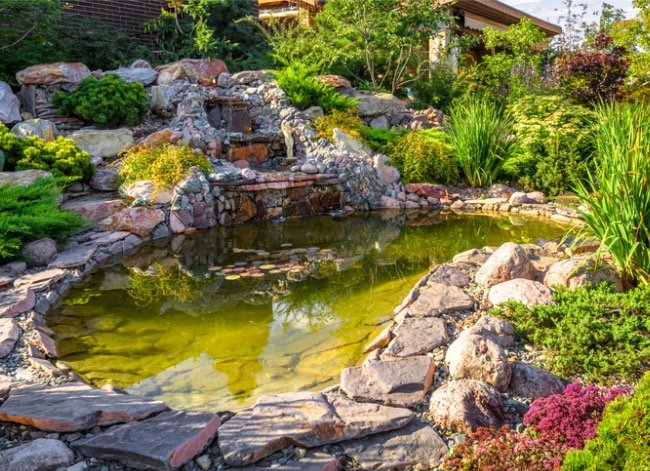
Tip 3: Use Water Features to Mask Annoying Noise
A water feature does not truly soundproof a yard. It will not block the neighbor’s lawn mower the way a masonry wall might. What it can do is mask unpleasant noise with a more pleasant sound. This is called sound masking, and it is the reason a bubbling fountain can make a patio feel calmer even when the same distant traffic still exists.
Pick the Right Type of Water Sound
Not all water features sound the same. A tiny tabletop fountain may whisper politely while the road roars like it has somewhere important to be. For outdoor noise masking, look for a fountain, waterfall, spillway, stream, or wall fountain that creates steady, broad, continuous sound.
Cascading water is usually more useful than a single silent trickle. Multi-tier fountains, rock waterfalls, and wall-mounted features can project sound better because the water falls from different heights and creates more movement. Place the feature near the seating area rather than far across the yard. The closer the pleasant sound is to your ears, the better it can compete with unwanted noise.
Keep the Sound Pleasant, Not Aggressive
The goal is not to replace traffic noise with “Niagara Falls: Suburban Edition.” Test the sound level before committing. A fountain that is soothing at 3 p.m. may feel dramatic at 10 p.m. when the world quiets down. Adjustable pumps are helpful because you can fine-tune the flow.
Also plan for maintenance. Outdoor fountains need cleaning, water refills, pump checks, and winter care in cold climates. A neglected fountain can become a mosquito spa, and nobody invited them.
Tip 4: Redesign the Outdoor Layout to Put Distance and Structure on Your Side
Sometimes the cheapest soundproofing move is not buying a product. It is moving the chairs. Outdoor spaces often become noisy because the seating area is placed in the most exposed part of the yard. If your patio sits right beside a busy street or directly across from the neighbor’s basketball hoop, every conversation becomes a small public address event.
Create an Outdoor Room
Try arranging your patio, deck, or garden as an outdoor room. Use a pergola, gazebo, privacy screens, trellises, outdoor curtains, tall planters, or partial walls to create boundaries. These structures help interrupt sound paths and make the space feel more sheltered. Add climbing plants such as jasmine, clematis, trumpet vine, or climbing hydrangea where appropriate for your region.
Soft materials matter too. Outdoor rugs, upholstered cushions, fabric shade panels, canvas curtains, and even thick chair pads can reduce harsh reflections from hard surfaces. Concrete, brick, glass, and bare fencing can bounce sound around. A few softer surfaces can make the area feel less echoey and more comfortable.
Use Distance Whenever Possible
Sound generally weakens with distance. If you can move your dining table, fire pit, reading bench, or hammock farther from the noise source, do it. Even a modest shift can improve comfort, especially when paired with a screen, hedge, or fountain.
For sloped yards, consider a sunken seating area or a patio tucked behind a retaining wall. Low walls, raised planting beds, and berms can help shield seating zones. Earth berms are particularly useful where space allows because soil has mass, and mass is a friend when dealing with sound.
Tip 5: Treat the Noise Source Whenever You Can
Blocking outside noise is useful, but reducing noise at the source is even better. If the annoying sound comes from something on your property, such as an HVAC unit, generator, pool pump, fountain pump, outdoor speaker, or workshop equipment, start there.
Quiet Mechanical Equipment
For HVAC condensers, pool pumps, and generators, never block ventilation or access. Equipment needs airflow, and repair technicians need room to work. Instead, consider a properly designed acoustic screen with open clearance, sound-absorbing panels rated for outdoor use, anti-vibration pads, and regular maintenance. A rattling panel, loose fan guard, or aging motor can make equipment much louder than necessary.
Pool pumps are often quieter when upgraded to variable-speed models, and they may run at lower speeds for longer periods instead of roaring at full blast. Timers can also help keep noisy equipment from running during outdoor gatherings or quiet evening hours.
Be a Better Neighbor With Outdoor Audio
If you use outdoor speakers, aim them toward your house rather than toward the property line. Keep bass levels reasonable, because low-frequency sound travels well and can turn a friendly playlist into a neighborhood diplomatic incident. Multiple smaller speakers placed near listeners are usually better than one loud speaker blasting from across the yard.
The same idea applies to parties, power tools, and late-night pool time. Outdoor soundproofing is partly about protecting your peace and partly about not becoming the noise problem. Nobody wants to be known as “the guy with the subwoofer and the leaf blower.”
Outdoor Soundproofing Materials That Actually Make Sense
There are many products marketed as soundproofing solutions, but outdoor use narrows the field. Materials must handle sun, rain, wind, temperature swings, pests, and general backyard chaos. Indoor foam panels are usually not suitable outdoors unless specifically rated for exterior conditions. They can absorb moisture, degrade, and look sad faster than a paper napkin in a thunderstorm.
Useful Outdoor Materials
Consider these practical materials for outdoor noise reduction:
- Solid wood fencing: Best when boards overlap or fit tightly with no gaps.
- Masonry or concrete walls: Heavy, durable, and effective, though often more expensive.
- Composite acoustic panels: Designed for outdoor sound barriers and often easier to maintain.
- Mass loaded vinyl: Adds density to fences or enclosures when installed correctly and protected from weather.
- Earth berms: Natural, heavy, and attractive when planted well.
- Outdoor-rated acoustic blankets or panels: Useful for temporary barriers, equipment screens, or specific problem zones.
The best material depends on the type of noise. Traffic and mechanical hum may require mass and height. Echo inside a courtyard may need soft surfaces and absorption. Neighbor noise may call for a combination of privacy screening, dense planting, and layout changes.
Common Outdoor Soundproofing Mistakes
One common mistake is building a fence with gaps. Even small openings can reduce performance because sound loves shortcuts. Another mistake is relying only on plants. A hedge may help, but if you can see through it, sound can usually pass through it too. Homeowners also sometimes place fountains too far away from the seating area, where the masking effect becomes weak.
Another problem is expecting total silence. Outdoor soundproofing is about improvement, not deletion. If your yard backs up to a six-lane road, a fence and shrubs may make the space more livable, but they will not turn it into a mountaintop monastery. Set realistic expectations and measure success by comfort: Can you hold a conversation more easily? Does the patio feel calmer? Do you use the space more often? Those are wins.
Real-Life Experience: What Actually Works in Outdoor Spaces
After working through many outdoor noise problems, one lesson becomes obvious: the best solution is rarely the prettiest single item on a shopping page. It is the combination. A homeowner may install a beautiful cedar fence and feel disappointed because the road is still audible. Then they add a line of arborvitae, move the seating area behind a pergola, place an outdoor rug under the table, and add a modest fountain near the chairs. Suddenly the space feels different. The noise is not gone, but it is no longer the main character.
In a small urban backyard, the biggest improvement often comes from creating a sense of enclosure. One patio I studied had brick walls on two sides, a wood fence on the third, and an open side facing an alley. The alley noise bounced directly into the seating area. The fix was not dramatic. A tall trellis with climbing vines, two large planters, and outdoor curtains changed the feel of the patio. The curtains did not “soundproof” the space in a laboratory sense, but they softened reflections and made conversations feel more private. The homeowner described it as “less like sitting in a parking lot,” which is not a technical acoustic rating but is absolutely a lifestyle victory.
For suburban homes near traffic, fence details matter more than people expect. A solid fence with overlapping boards usually performs better than a standard shadowbox fence because shadowbox designs have alternating gaps. Those gaps look stylish, but sound treats them as open invitations. If replacing the fence is not possible, adding a second inner layer, sealing obvious cracks, or installing mass loaded vinyl between layers can help. The improvement is most noticeable when the fence blocks the direct line of sight to the road.
Landscaping requires patience. A newly planted hedge may look like a row of green toothbrushes for the first year. That is normal. Choose plants based on mature size, local climate, maintenance needs, and density. Fast-growing plants are tempting, but some become invasive or high-maintenance. In many yards, a mixed planting of evergreens, shrubs, and ornamental grasses gives better long-term results than one aggressive species that needs constant trimming and occasional negotiation.
Water features are surprisingly personal. Some people love a strong waterfall sound; others find it busy. Before buying a large fountain, test different water sounds online or visit a garden center. Better yet, use a temporary pump and container to experiment with placement. The best location is usually near the listener, not near the noise source. A fountain beside the seating area can mask traffic more effectively than a louder fountain hidden at the far fence.
Mechanical noise deserves special attention because it can often be reduced without redesigning the whole yard. A vibrating pool pump, loose HVAC panel, or old generator can create more annoyance than expected. Maintenance, rubber isolation pads, equipment screens, and smarter scheduling may solve a large part of the problem. Always preserve airflow and service access. A too-tight enclosure can overheat equipment, and then your quiet backyard becomes an expensive repair story.
The most satisfying outdoor soundproofing projects share one trait: they make the space more enjoyable even when they are not acoustically perfect. A hedge adds beauty. A fence adds privacy. A pergola adds shade. A fountain adds atmosphere. Outdoor rugs and cushions add comfort. When these features work together, the yard becomes more inviting, and the unwanted sound becomes easier to ignore. That is the real goal. Not silence. Sanity.
Conclusion
Soundproofing your outdoor spaces is really about designing smarter layers between you and the noise. Start with a solid barrier when you need serious blocking. Add dense evergreen landscaping for year-round buffering and privacy. Use water features to mask irritating sounds with something more pleasant. Rearrange your outdoor layout to protect seating zones. Finally, treat noise at the source whenever it comes from your own equipment or entertainment setup.
The best backyard noise reduction plan does not have to make your yard look like a highway department project. With the right mix of fences, plants, structures, soft surfaces, and sound masking, your patio can feel calmer, your conversations can get easier, and your outdoor space can finally stop sounding like it is located inside a drum set.
Will your yard become silent? Probably not. Will it become more peaceful, private, and pleasant? Absolutely. And that is worth raising a quiet glass to.