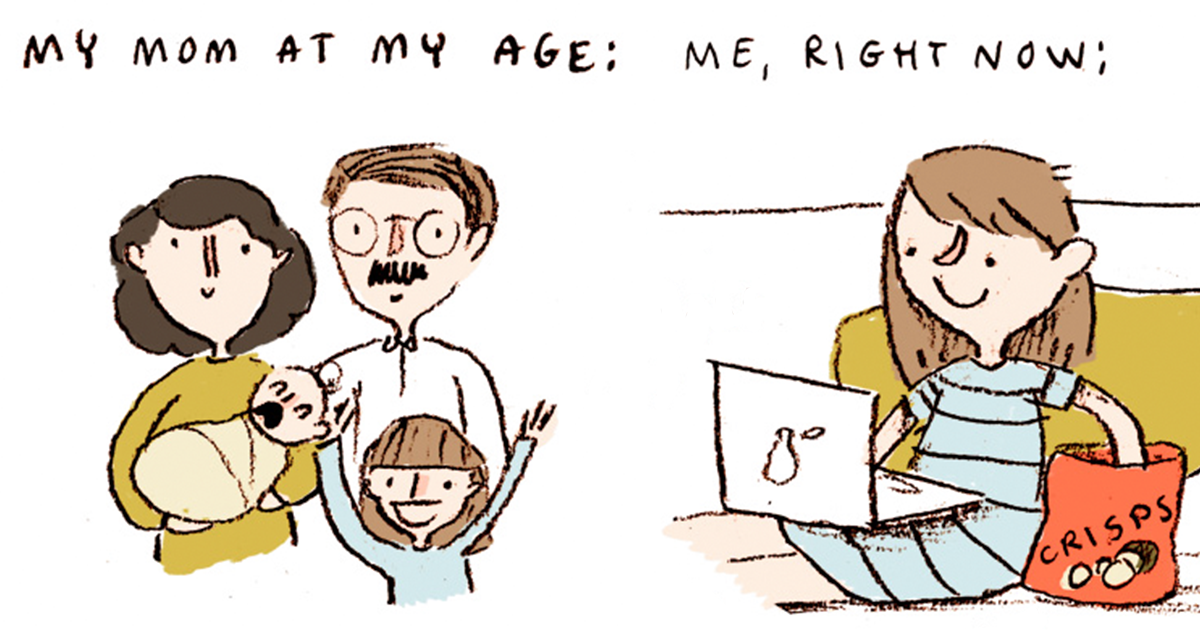
There is a myth that adulthood arrives with a neat little certificate, a sensible wallet, and the sudden ability to fold fitted sheets. In reality, many of us spend adulthood doing the social equivalent of speed-walking through wet cement: trying to look composed while quietly panicking over laundry, taxes, calendar invites, and the strange bill that says “balance forward” as if that phrase means anything to a tired human being. Humor works here because it gives the brain a softer place to land. Health and psychology sources repeatedly note that laughter, self-humor, and resilience-oriented coping can reduce stress, reframe embarrassment, and make pressure feel more survivable.
This article leans into that idea with 43 comic snapshots of modern adulthood: the tiny financial disasters, the domestic improvisations, the workday mask, and the nightly promise that tomorrow will finally be the day you become a person who owns matching containers. Spoiler: tomorrow is also suspicious.
Why adulthood feels like a joke with a straight face
Adult life is built from tiny performances. You answer emails like you know what you are doing. You buy groceries like someone who has already meal-planned. You say “no worries” when there are, in fact, many worries. That is why the funniest adulting stories usually feel painfully specific: the humor comes from recognition. Self-aware comedy works because it does not pretend to solve the mess; it simply turns the mess on, turns the lights up, and lets everyone laugh at the shared chaos together.
43 comics in which I try to be an adult but fail miserably
1–11: Money, bills, and the illusion of control
1. The Budget Spreadsheet of False Hope. I make a budget with color coding, motivational language, and a confidence that belongs in a movie trailer. By day three, the spreadsheet is accurate in the same way a weather forecast for next year is accurate.
2. The Rent Reminder I See at 11:58 p.m. Every month, I receive a payment reminder like it is a personal note from the universe saying, “Good evening. You were not nearly as prepared as you thought.”
3. The “This Will Be a Responsible Purchase” Speech. I stand in a store and justify a purchase I absolutely do not need. Sometimes the object is practical. Sometimes it is a kitchen gadget designed to slice one very specific fruit.
4. The Invisible Emergency Fund. I keep telling myself I have an emergency fund. Technically, yes. Realistically, it is a vague concept made of optimism and a few coins hiding in a coat pocket.
5. The Adult Conversation About Interest Rates. Someone mentions interest rates and I nod solemnly, as if I understand. My face says “financial literacy.” My soul says “please use smaller words.”
6. The Auto-Pay Betrayal. Auto-pay is supposed to be one of adulthood’s greatest inventions, right up until it quietly pays for something you forgot you subscribed to during a late-night optimism surge.
7. The Envelope System That Becomes a Theory. I try cash envelopes, digital trackers, and “mindful spending.” The only thing I can track with confidence is how quickly I abandon systems after one inconvenient afternoon.
8. The Tax Season Performance Art. Every year, taxes make me feel like I am being graded on a subject I was told existed but never actually attended class for.
9. The Grocery Receipt That Stares Back. I glance at the receipt and suddenly understand why historical empires collapsed. One cheese, one coffee, one bag of fruit, and somehow I need a moment of silence.
10. The Payday That Vanishes Immediately. Payday is not a celebration. It is a brief emotional weather event. It arrives, passes through, and leaves behind the faint scent of optimism and recurring charges.
11. The “I Deserve This” Purchase. I love the phrase “I deserve this,” because it makes a snack, a lamp, and a random online cart feel like self-care instead of financial improvisation.
12–21: Home life, chores, and the domestic stage play
12. The Dishes I Am Sure I Did Yesterday. I look at the sink and experience a classic adult horror story: how did there get to be this many dishes when I only cooked once and barely counted that as cooking?
13. The Laundry Mountain. Laundry is never one task. It is a geological feature. It develops layers, history, and a sense of permanence that should concern all of us.
14. The Fitted Sheet Wrestling Match. Folding a fitted sheet is proof that civilization has not fully solved its own mysteries. I can pay a bill online, but I cannot tame four elastic corners.
15. The “I’ll Just Clean for Ten Minutes” Lie. Ten minutes later, I am holding a stray charger, three missing socks, and a receipt from a place I no longer remember visiting.
16. The Plant I Named but Could Not Maintain. I buy a plant because I want a home that says “calm” and “grown-up.” The plant responds by becoming a long-term critique of my decision-making.
17. The Kitchen Drawer of Chaos. Every house has one drawer holding batteries, rubber bands, a takeout menu from a restaurant that closed two years ago, and a mysterious key no one claims.
18. The Smoke Alarm Judgment Call. Nothing makes me feel less like an adult than standing on a chair waving a towel at a smoke alarm while wondering whether this counts as a home maintenance skill.
19. The Furniture Assembly Trial. There is always a point in assembly where I realize the instructions were written for a version of me who had both patience and an Allen wrench collection.
20. The Fridge Full of Ingredients and No Plan. I open the refrigerator and discover an impressive array of ingredients that appear to have been purchased by someone with a grocery vision board and no execution strategy.
21. The “Just One More Storage Bin” Solution. I keep buying containers as if storage bins are a personality trait. This is not organization. This is moving clutter into smaller, prettier homes.
22–32: Work, meetings, and pretending the calendar is under control
22. The Calendar Invite Panic. I accept a meeting and immediately begin investigating whether I am expected to know things or merely appear awake. The uncertainty is the real agenda item.
23. The “Quick Call” That Was Never Quick. A quick call is the corporate version of “we should hang out sometime.” It sounds small. It is never small.
24. The Professional Voice I Borrow. I answer work messages in a voice that sounds like a confident executive, then close the app and return to my natural state, which is “person who forgot where the notes went.”
25. The Inbox That Reproduces Overnight. I leave work for a few hours and come back to an inbox that has somehow multiplied. I did not know emails were capable of this level of ambition.
26. The “Per My Last Email” Survival Skill. Some phrases sound more adult than they feel. “Per my last email” is just a polite way of saying, “I have now explained this three times and am considering a nap.”
27. The Notes App Graveyard. My notes app contains brilliant ideas, grocery items, passwords I later changed, and one lonely reminder that says “call dentist??” with the emotional energy of a threat.
28. The Webcam Angle of Shame. Video calls reveal the truth. My desk is cluttered, my lighting is accidental, and my camera angle suggests I am speaking from a basement haunted by deadlines.
29. The Lunch Break That Became More Work. I take a lunch break, meaning I answer one message, fix one problem, and then eat over the keyboard like I am being productive in a tragic, fluorescent-lit way.
30. The False Confidence of a Fresh Notebook. There is nothing more adult-looking than a new notebook. There is also nothing more disappointing than watching it become a graveyard for half-finished plans.
31. The Meeting Where Everyone Knows the Acronyms. I sit quietly while the room casually launches into acronym soup. At some point I decide my contribution will be strategic silence and a serious expression.
32. The Friday Email at 4:57 p.m. A late Friday email has the energy of a jump scare. It arrives with the confidence of someone else’s emergency becoming my weekend.
33–43: Body, bedtime, social life, and other daily negotiations
33. The Bedtime Routine That Starts Too Late. Every night I promise myself a proper bedtime routine. Then I spend 47 minutes doing everything except getting into bed, which is a fascinating personal flaw.
34. The Alarm Clock Negotiation. My alarm goes off and I begin negotiating with reality. I will wake up in five minutes, I say, as if five minutes has ever negotiated in good faith.
35. The Hydration Performance. I carry a water bottle like an athlete. I drink from it like a guest at my own wellness retreat. Then I forget it on the counter for six hours.
36. The Stretching Routine of One Uncertain Motion. I do one stretch, sigh deeply, and call it maintenance. If someone asks, I say I am taking care of my body. The body remains skeptical.
37. The Doctor’s Office Form. No form humbles me faster than the one that asks for insurance details, family history, and the exact date I “first noticed symptoms.” I barely notice what day it is now.
38. The Social Plans That Require Advanced Scheduling. As a child, I thought adults were spontaneous. As an adult, I now know that seeing a friend may require two calendar reminders, one confirmation text, and a weather check.
39. The “We Should Catch Up Soon” Ritual. This phrase is not a plan. It is a friendly fog machine. It sounds warm while hiding the terrifying fact that neither person is free until next month.
40. The Face I Make When Someone Mentions “House Insurance.” I try to look mature. I try to look informed. Instead, I look like someone whose brain is loading a page it has never visited before.
41. The Weekend That Vanishes in Two Errands. I tell myself the weekend will be restorative. Then I do one grocery run, one chore, one email, and suddenly it is Sunday night wearing a bad wig.
42. The Mirror Moment of Sudden Self-Awareness. Sometimes adulthood is simply catching your own reflection while holding mail, leftover food, and a receipt, then realizing you are the main character in a chaotic slice-of-life episode.
43. The “I’m Fine” Finale. In the last panel, I smile bravely, carry my bag, and whisper the adult mantra: I am fine. The subtext is a stack of unpaid tasks, a half-charged phone, and a mild desire for a nap.
What the joke is really doing
The point of these comics is not that adulthood is impossible. It is that adulthood is mostly made of ordinary messes that we are expected to handle with a straight face. Humor gives those moments shape. It turns a lonely feeling into a shared one. That matters. Research and health explainers often frame humor as a buffer against stress, a way to keep perspective, and a tool for resilience when life keeps throwing small failures at us faster than we can clean them up.
There is also a quiet lesson in the best self-deprecating comedy: the joke lands because it is kind. It is not about punishing yourself for being human. It is about saying, “Yes, I am clumsy with the basics, but I am still here, still trying, and still funny enough to survive the paperwork.” That mix of honesty and warmth is what makes adulting humor stick.
500-word reflection: the real-life experience behind the punchlines
If there is a universal adult experience, it is the feeling that everyone else received a private instruction manual and you got a coffee-stained sticky note with half the pages missing. You are supposed to know how to reply to email threads, how to sound calm on the phone, how to keep track of health appointments, how to maintain a home, and how to keep your budget from exploding after one “small treat.” Meanwhile, your brain is still busy forgetting whether the laundry is clean, whether you answered that message, and whether the thing you put in the fridge was dinner or a science experiment.
The funniest part is that adulthood is not one single disaster. It is a steady stream of tiny ones. You miss a bill reminder by one day. You overbuy groceries and undercook them. You promise to clean the kitchen before bed and then somehow end up reorganizing the same drawer three nights in a row. You sit in a meeting and realize that everyone else is using the same jargon with the confidence of a local dialect, while you are still translating it in your head.
That gap between how grown-up you feel and how grown-up you appear is exactly where the comedy lives. You can be competent at one thing and a total mess at another. You can be the person who solves a coworker’s problem in ten minutes and then spend forty minutes looking for the document you just downloaded. You can pay your taxes and still forget to buy soap. You can manage a deadline and still have no idea what to do with the weird smell in the refrigerator.
The point of laughing at it is not to excuse chaos forever. It is to make the chaos less humiliating. When you turn a failed errand, a ridiculous bill, or a socially awkward moment into a comic strip in your mind, the moment gets smaller. You stop treating every mistake like evidence that you are a fraud. Instead, you see it as proof that being an adult is not about becoming flawless. It is about becoming slightly better at recovering.
And recovery is its own kind of skill. You learn to make lists that actually help. You learn to admit when something is confusing. You learn that asking a question is less embarrassing than pretending to understand and getting it wrong later. You learn that a messy home does not mean a failed life, and a strange week does not mean you are broken. Sometimes “adulting” is simply showing up again, with a more honest calendar and a stronger sense of humor than you had yesterday.
That is why these comics matter. They do not flatten life into one joke. They make room for the truth that adult life is awkward, repetitive, expensive, and occasionally very funny. And if you can laugh at the moment you realize you bought the wrong detergent, replied to the wrong thread, and left the pasta boiling while you searched for your keys, then you are already doing better than you think.
Conclusion
Adulting will probably never become perfectly elegant. The bills will still arrive. The laundry will still multiply. The calendar will still judge you. But humor gives the whole operation a little breathing room. It lets the daily comedy of being a human feel less like failure and more like evidence that everyone is improvising, all the time.
Note: Original article, ready for web publishing.