Note: This article is based on real, publicly documented ossuaries, bone chapels, charnel houses, and catacombs around the world, rewritten in original American English for web publication.
Some travel destinations greet visitors with beaches, pastries, or skyline views. Ossuaries, on the other hand, greet you with skulls arranged like wallpaper and femurs stacked with the confidence of a very committed interior designer. Strange? Absolutely. Meaningless? Not at all. These bone-filled catacombs and chapels were usually created for practical reasons: overcrowded cemeteries, limited land, religious traditions, war, plague, or the old human habit of trying to make sense of mortality without completely losing our lunch.
An ossuary is a place built to hold human skeletal remains. Sometimes it is a small bone box. Sometimes it is a chapel. Sometimes it is a tunnel system containing the remains of millions of people. The most bizarre ossuaries are not merely storage rooms for the dead; they are architectural sermons. Their message is blunt: life is temporary, vanity is silly, and yes, that skull over there may once have cared deeply about hairstyle trends.
Below are 31 real ossuaries, catacombs, bone chapels, and charnel houses with bone-filled interiors that are haunting, historic, oddly beautiful, and occasionally so dramatic they make haunted houses look like amateur theater.
What Makes Ossuaries So Fascinating?
Ossuaries sit at the crossroads of architecture, religion, public health, and dark tourism. In medieval and early modern Europe, burial space was often limited, especially in walled cities or mountain villages. Bodies might be buried temporarily, then exhumed after decomposition so the bones could be moved into a shared charnel house. This freed grave space while keeping the dead within sacred ground.
In Catholic Europe, many bone chapels also served as memento mori, a reminder that death comes for everyone. The result is a travel category that feels part museum, part church, part horror movie set, and part philosophical slap in the face. These places are not simply creepy attractions. They tell stories about epidemics, urban overcrowding, warfare, faith, and the very human desire to be remembered.
31 Ossuaries and Bone-Filled Catacombs Around the World
1. Catacombs of Paris, France
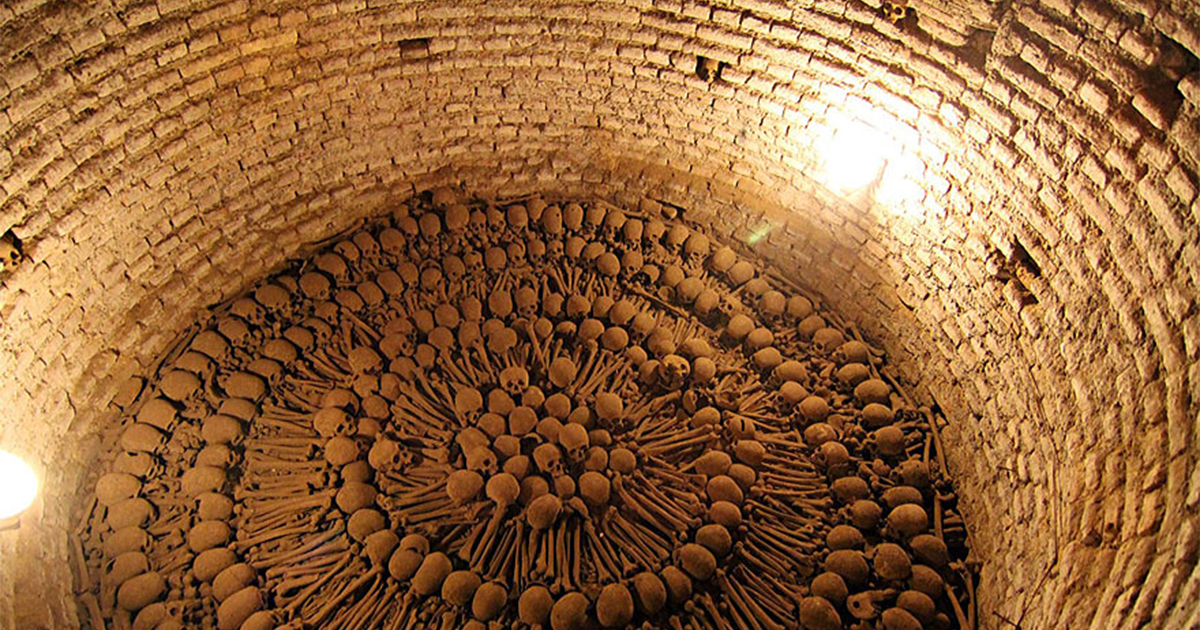
The Catacombs of Paris are the celebrity of the ossuary world. Beneath the French capital, former limestone quarries were transformed into an underground ossuary beginning in the late 18th century, when overflowing cemeteries became a public health nightmare. The remains of more than six million people were transferred below the city, where skulls and long bones were later arranged into solemn walls. Today, visitors walk through dim tunnels where the bones seem to stretch endlessly. Paris may be famous for romance, but under the streets, it also keeps a rather large reminder that nobody escapes the final checkout.
2. Sedlec Ossuary, Kutná Hora, Czech Republic
Sedlec Ossuary is often called the “Church of Bones,” and it earns the title with unsettling enthusiasm. Located beneath the Cemetery Church of All Saints, it contains the remains of tens of thousands of people. Its bone chandelier is the showstopper, reportedly using nearly every bone in the human body. The site became a desirable burial place after soil from the Holy Land was scattered there in the 13th century. Later, war and plague filled the cemetery beyond capacity. In the 19th century, woodcarver František Rint arranged the bones into garlands, pyramids, crosses, and decorative patterns that are both artistic and deeply sobering.
3. Brno Ossuary, Czech Republic
Rediscovered in 2001 beneath St. James Square, the Brno Ossuary is believed to contain the remains of more than 50,000 people, making it one of Europe’s largest ossuaries after Paris. Many of the dead were victims of plague, cholera, war, and medieval urban overcrowding. Unlike Sedlec, Brno feels less theatrical and more archaeological. Its stacks of bones are quieter, darker, and heavier in mood. The space reminds visitors that the city above was once a cramped, vulnerable place where epidemics could reshape entire communities.
4. Capela dos Ossos, Évora, Portugal
Évora’s Chapel of Bones is Portugal’s most famous bone chapel, built by Franciscan monks who faced overcrowded cemeteries and decided that ordinary reburial was not dramatic enough. The walls and pillars are covered with thousands of skulls and bones, arranged with eerie symmetry. At the entrance, an inscription roughly translates to: “We bones that are here await yours.” It is not exactly the warmest welcome sign, but it is effective. The chapel turns mortality into decoration, not to mock the dead, but to remind the living not to get too attached to their fancy shoes.
5. Capela dos Ossos, Faro, Portugal
Behind the Carmo Church in Faro is a smaller but unforgettable bone chapel built with the remains of more than 1,000 Carmelite friars. Its skulls and bones line the walls in tidy rows, creating an atmosphere that is intimate, quiet, and just spooky enough to make visitors lower their voices without being asked. The chapel’s message is similar to Évora’s: stop, look, and remember where every human story eventually goes.
6. Capela dos Ossos, Campo Maior, Portugal
Campo Maior’s Chapel of Bones is tied to local memory and legend. A devastating gunpowder explosion struck the town in the 18th century, and popular tradition long connected the chapel’s bones to that tragedy. Later study suggests the remains likely came from a churchyard rather than explosion victims. Either way, the chapel is a powerful example of how communities use bone spaces to process loss, disaster, and collective history.
7. Alcantarilha Chapel of Bones, Portugal
In the Algarve village of Alcantarilha, a small chapel beside the parish church holds carefully arranged human bones and skulls. It is less famous than Évora or Faro, which gives it a more hidden-away feeling. The charm, if one may use that word around a wall of skulls, is in its modest scale. It feels local, old, and quietly intense, like a whispered reminder from a village that has seen generations come and go.
8. Lagos Bone Chapel, Portugal
Lagos is better known for beaches, cliffs, and sunny vacation photos, but it also has a small bone chapel connected with the Church of São Sebastião. The contrast is part of the fascination: one minute, tourists are thinking about seafood and sea caves; the next, they are looking at skulls arranged in sacred silence. Portugal’s bone chapels show how deeply the memento mori tradition shaped religious art and local memory.
9. Capuchin Crypt, Rome, Italy
The Capuchin Crypt beneath Santa Maria della Concezione dei Cappuccini in Rome is one of the world’s most famous bone interiors. The remains of thousands of Capuchin friars are arranged into elaborate patterns across several small chapels. There are skull rooms, pelvis designs, arches made from bones, and even chandeliers made from skeletal parts. The friars intended the display as spiritual reflection, not Halloween decor. Still, it is hard not to feel that the decorators had a flair for the dramatic.
10. San Bernardino alle Ossa, Milan, Italy
San Bernardino alle Ossa began with a practical problem: a cemetery near a hospital ran out of room. The solution was an ossuary, later developed into a church and chapel whose walls are filled with human skulls and bones. The ossuary includes remains associated with hospital patients, religious members, prisoners, and others. The result is one of Milan’s strangest sacred interiors, combining Rococo ornament with a room full of human remains. Milan may be a fashion capital, but this chapel makes black look eternal.
11. Catacombs of San Gaudioso, Naples, Italy
The Catacombs of San Gaudioso are early Christian burial chambers beneath Naples, later reused in the 17th century for unusual noble burials. In some tombs, skulls were placed into walls while painted bodies below them represented the deceased’s clothing, status, or profession. It is part portrait gallery, part cemetery, and part reminder that Naples has never been shy about dramatic storytelling.
12. Catacombs of San Gennaro, Naples, Italy
The Catacombs of San Gennaro are less bone-decorated than some ossuaries, but they are essential to the history of underground Christian burial. These spacious tunnels and chambers contain tombs, frescoes, and early Christian art. They show how catacombs served not only as burial places but as sacred landscapes beneath the living city.
13. Capuchin Catacombs of Palermo, Sicily
The Capuchin Catacombs of Palermo are famous for mummified bodies rather than decorative bone walls, but they belong on any list of bizarre burial interiors. From the late 18th to 19th centuries, preserved bodies were displayed in corridors according to categories such as clergy, professionals, women, children, and families. The result is less “pile of bones” and more “silent underground society,” which is somehow even more unnerving.
14. Hallstatt Charnel House, Austria
Hallstatt’s bone house is known for its painted skulls. Because cemetery space in the mountain village was limited, remains were exhumed after years in the grave, cleaned, and placed in the charnel house. Many skulls were painted with names, dates, flowers, ivy, or crosses. The result is startlingly personal. Instead of anonymous bone walls, Hallstatt offers decorated identities, each skull a small biography in paint.
15. Skull Chapel, Czermna, Poland
The Skull Chapel in Czermna is one of Europe’s most haunting bone chapels. Built in the late 18th century, it contains skulls and bones from victims of wars, epidemics, hunger, and disease. Thousands of bones cover the walls and ceiling, while many more rest beneath the floor. It was created by a parish priest who spent years collecting and arranging remains. The chapel is not large, but emotionally it feels enormous.
16. Wamba Ossuary, Spain
The ossuary at the Church of Santa María in Wamba, Spain, contains thousands of human remains dating across centuries. Stacked skulls and bones line the chamber, giving it a raw, medieval power. Unlike some ornate bone chapels, Wamba feels direct and unpolished. It looks less like a designed artwork and more like history itself was swept into a room and told to stay there.
17. Rothwell Bone Crypt, England
Below Holy Trinity Church in Rothwell is one of Britain’s best-known surviving charnel houses. The crypt contains the bones of many individuals, including neatly stacked skulls and long bones. Local legend says it was rediscovered in alarming fashion when a gravedigger fell into the crypt. Whether that story is polished by folklore or not, it perfectly captures the shock of finding an underground room full of bones beneath a parish church.
18. Hythe Ossuary, England
The ossuary at St. Leonard’s Church in Hythe contains one of the largest collections of human bones in Britain. Rows of skulls and stacked bones fill the crypt-like space. The remains likely accumulated through centuries of cemetery clearance and reburial. Hythe is a reminder that bone houses were not only continental European curiosities; they were once part of English church life too.
19. St. Bride’s Church Crypt, London, England
St. Bride’s Church on Fleet Street has a crypt containing human remains and archaeological layers connected to centuries of London history. While not a decorative bone chapel in the Sedlec sense, it represents the deep relationship between churchyards, urban burial, and the crowded dead beneath old cities. London, like Paris, has always had more history underfoot than is polite to mention at dinner.
20. St. Catherine’s Monastery Ossuary, Sinai, Egypt
At St. Catherine’s Monastery near Mount Sinai, the harsh desert environment and limited burial space led to a functional ossuary where monks’ bones were gathered after exhumation. Skulls and bones are kept in a charnel space rather than arranged as decorative art. The effect is stark and monastic. It is not trying to entertain anyone. It simply says: this is the end of the body, and faith must make sense of what remains.
21. Catacombs of Kom el Shoqafa, Alexandria, Egypt
The Catacombs of Kom el Shoqafa are among Alexandria’s most fascinating ancient burial sites. Dating to the Roman period, they combine Egyptian, Greek, and Roman artistic traditions. While they are not a bone-wall ossuary like Paris or Évora, their underground burial chambers, shafts, and funerary architecture make them a major catacomb site. They show how cultures blended in death as vividly as they did in life.
22. Monastery of San Francisco Catacombs, Lima, Peru
Beneath the Basilica and Convent of San Francisco in Lima are catacombs that served as an underground cemetery during the colonial period. The bones of thousands of people are arranged in wells, pits, and geometric displays. Rediscovered in the 20th century, the catacombs are now a major historic attraction. They are beautiful in the way old libraries are beautiful, except the “books” are human femurs and the “reading room” is underground.
23. Skull Tower, Niš, Serbia
Skull Tower is not a chapel or catacomb, but it is one of the most chilling bone monuments in Europe. Built after the Battle of Čegar in 1809, the tower originally contained hundreds of Serbian rebel skulls embedded in its walls by Ottoman authorities as a warning. Today, far fewer skulls remain, and the structure is protected within a chapel. It has become a symbol of resistance, sacrifice, and national memory.
24. Oppenheim Ossuary, Germany
The ossuary beneath St. Catherine’s Church in Oppenheim contains a large collection of human bones from centuries of burials. Skulls and long bones were stored when cemetery space became limited. German ossuaries often feel less theatrical than Portuguese or Italian bone chapels, but they carry the same message: the dead remain part of the community, even after their graves are reused.
25. Eggenburg Charnel House, Austria
Austria has a rich charnel house tradition, and Eggenburg’s bone collection is one of the more memorable examples. Charnel houses often served as secondary burial places, especially where graveyards were small. These spaces reveal how practical cemetery management became tied to religious reflection and local identity.
26. Mělník Ossuary, Czech Republic
The ossuary beneath the Church of Saints Peter and Paul in Mělník holds remains from thousands of individuals. It is arranged with a mixture of order and solemnity, reflecting the Czech tradition of church ossuaries created from overcrowded cemeteries. Like Sedlec and Brno, it shows how Central Europe turned bone storage into a strangely powerful cultural form.
27. Křtiny Ossuary, Czech Republic
The Křtiny ossuary is known not only for its human remains but also for skulls marked with unusual drawings or symbols. Researchers have studied some of these marked skulls, adding a layer of mystery and scholarship to the site. It is a reminder that ossuaries are not only tourist attractions; they can also be valuable sources for anthropology, archaeology, and medical history.
28. Santa Maria dell’Orazione e Morte, Rome, Italy
This Roman church was connected with a confraternity devoted to burying abandoned or unclaimed bodies. Its crypt contains bone displays and funerary symbolism, reflecting a charitable mission as much as a macabre aesthetic. Rome has many famous churches, but this one speaks for the forgotten dead, which makes its bone-filled spaces especially moving.
29. Monastery Ossuaries of Mount Athos, Greece
On Mount Athos, monastic ossuaries preserve the bones of monks after exhumation. The practice is deeply tied to Orthodox tradition, humility, and remembrance. Skulls may be labeled with the monk’s name, preserving identity after the body has returned to bone. These spaces are not designed for casual tourism; they are spiritual archives of monastic life.
30. Church of the Holy Sepulchre Ossuary Traditions, Jerusalem
Jerusalem and the surrounding region have a long history of ossuary use, especially in ancient Jewish burial practices where bones were gathered into stone boxes after decomposition. While not a decorative bone chapel like Sedlec, the region’s ossuary tradition is essential to understanding how secondary burial shaped religious and archaeological history.
31. Kutná Hora Cemetery Complex, Czech Republic
Beyond the famous Sedlec Ossuary itself, the broader cemetery complex at Kutná Hora reflects centuries of sacred burial, exhumation, and memory. The site’s popularity grew from medieval religious belief, then expanded through epidemics and war. It remains one of the clearest examples of how a burial ground can become a major cultural landmark without losing its central message: every visitor is temporary.
Why Were So Many Bone Chapels Built?
The simplest explanation is space. Medieval towns, fortified cities, monasteries, and mountain villages often had limited burial land. Cemeteries filled quickly, especially during plague years, famine, wars, or urban population growth. Moving bones into ossuaries allowed communities to reuse graves while still treating remains with religious seriousness.
But practicality does not explain the chandeliers, skull arches, painted skulls, or poetic inscriptions. For that, we need theology and art. Bone chapels often taught humility. They reminded kings, merchants, monks, soldiers, and tourists with selfie sticks that death does not care about social rank. In a world before modern public health systems, antibiotics, and cheerful wellness podcasts, mortality was not abstract. It lived next door.
Are Ossuaries Respectful or Morbid?
The answer depends on the site, the visitor, and the behavior involved. Many ossuaries were created as sacred spaces, not shock attractions. They were intended to honor the dead, meditate on mortality, and preserve remains when cemeteries could no longer hold them. A respectful visitor treats these places like cemeteries, not escape rooms. That means no shouting, no touching bones, no goofy poses with skulls, and absolutely no “look, Mom, I found Uncle Steve” jokes near actual human remains.
At their best, ossuaries are deeply human places. They turn anonymous death into visible memory. They also challenge modern discomfort with mortality. In daily life, many people hide death behind hospital curtains, funeral logistics, and careful language. Ossuaries remove the curtain. They are blunt, sometimes beautiful, sometimes disturbing, and very difficult to forget.
Travel Experiences: What It Feels Like to Visit Bone-Filled Catacombs
Visiting an ossuary is not like visiting a normal museum. There is usually a moment when your brain stops treating the bones as “historic material” and remembers that every skull once belonged to a person who had a voice, a favorite food, an annoying neighbor, and probably at least one bad haircut. That moment can be uncomfortable, but it is also the point.
The first experience many travelers notice is the temperature. Catacombs and crypts tend to be cool, damp, and still. The air feels older underground. Sounds become smaller. Footsteps echo in a way that makes everyone suddenly aware of their own body. In places like the Paris Catacombs or Lima’s underground burial chambers, the descent itself becomes part of the experience. Stairs lead you away from traffic, sunlight, and everyday noise. By the time you reach the bones, the modern world feels far away.
The second experience is scale. A single skull is intimate. A wall of skulls is architectural. A tunnel lined with bones from millions of people is almost impossible to process. In Paris, the repetition becomes overwhelming. In Sedlec, the artistic arrangement creates a strange conflict: the designs are impressive, but the materials are human. In Hallstatt, painted skulls feel personal and tender. In Rome’s Capuchin Crypt, the elaborate bone patterns make visitors wonder where devotion ends and design begins.
The third experience is silence. Even tourists who enter joking often become quieter. Bone chapels have a way of improving manners. Maybe it is the religious setting. Maybe it is the skulls. Maybe it is the sudden realization that the dead are hosting and you are only a guest. Whatever the reason, these places encourage reflection better than most motivational posters ever could.
For travelers interested in history, ossuaries offer unusually direct contact with the past. A palace shows power. A battlefield shows conflict. An ossuary shows consequence. The bones may belong to plague victims, monks, aristocrats, prisoners, soldiers, townspeople, or unnamed children. They make history physical. You are not just reading that disease devastated a city; you are standing in a room shaped by that devastation.
For photographers and content creators, these sites require restraint. Many ossuaries restrict photography, and even where photos are allowed, the tone matters. The best approach is documentary, not theatrical. Capture the architecture, the light, the patterns, and the atmosphere. Avoid turning human remains into props. A bone chapel is already dramatic. It does not need jazz hands.
Practical preparation also helps. Some catacombs involve narrow stairs, low ceilings, uneven floors, or confined spaces. Visitors with claustrophobia should research before going. Comfortable shoes are a better choice than fashion footwear, unless your goal is to become a cautionary tale in a very ironic location. Many sites are religious spaces, so modest clothing and respectful behavior are appropriate.
The most meaningful way to visit an ossuary is slowly. Read the signs. Learn why the bones are there. Notice whether the space feels functional, devotional, artistic, or political. Compare the anonymous walls of Paris with the painted skulls of Hallstatt, the martyr-like memory of Niš, or the monastic humility of Mount Athos. Each place answers the same question differently: what should the living do with the dead?
By the end of a bone-catacomb visit, most people do not feel merely scared. They feel humbled. Ossuaries are bizarre, yes, but they are not empty spectacle. They remind us that every city is built over earlier lives, every cemetery tells an urban planning story, and every human body eventually becomes part of something larger than itself. That may sound grim, but it can also be strangely comforting. After all, the bones are still here, still teaching, still making travelers pause. Not bad for people who have been dead for centuries.
Conclusion
Ossuaries and bone-filled catacombs may look bizarre at first glance, but their purpose is rarely simple shock. These places were born from crowded cemeteries, epidemics, war, religious devotion, and the universal need to remember the dead. From the vast Catacombs of Paris to the painted skulls of Hallstatt and the bone chandeliers of Sedlec, each site turns mortality into architecture.
What makes these ossuaries unforgettable is not just the skulls. It is the tension between beauty and discomfort, storage and symbolism, fear and reverence. They ask visitors to slow down, behave respectfully, and consider the one topic everyone shares but nobody loves putting on the calendar. Strange as they are, bone chapels may be among the most honest places on Earth.