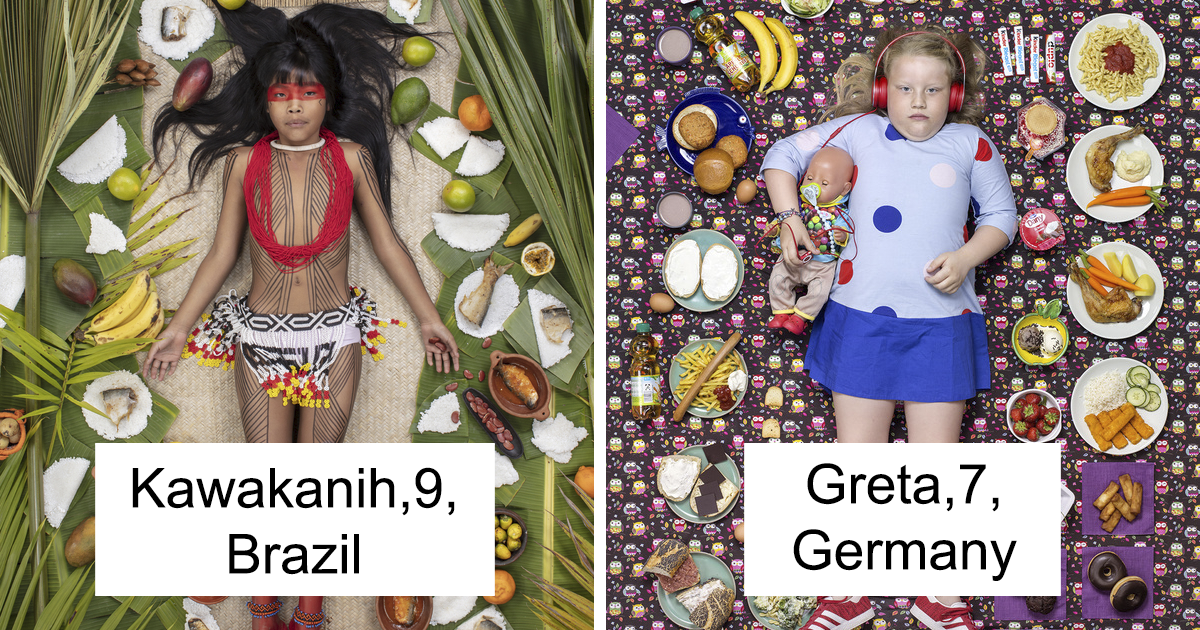
What does childhood look like on a plate? Sometimes it looks like a bowl of lentils, a stack of roti, and vegetables cooked from scratch. Sometimes it looks like pizza rolls, packaged snacks, sweet drinks, and the kind of cereal that seems engineered to survive a minor asteroid strike. In the photo project behind “25 Kids From Around The World Photographed With What They Eat In One Week,” American photographer Gregg Segal turns ordinary meals into a global conversation about culture, family, convenience, health, and the quiet power of habit.
The idea is simple enough to explain in one sentence: children from different countries keep a detailed record of everything they eat over seven days, and then they are photographed surrounded by those foods. But the result is anything but simple. Each portrait becomes a tiny edible biography. A child’s week of food reveals where they live, what their family can afford, what their culture celebrates, how much time adults have to cook, and how aggressively global brands have marched into local kitchens wearing sneakers and carrying a soda.
Segal’s wider project, Daily Bread: What Kids Eat Around the World, traveled across countries including the United States, India, Malaysia, Germany, France, Italy, Senegal, the United Arab Emirates, and Brazil. The images are colorful, funny, surprising, and occasionally uncomfortable. They invite viewers to ask a question that sounds easy until you actually try answering it: are we choosing our food, or is our food environment choosing for us?
What Is the “Daily Bread” Photo Project?
Daily Bread is a documentary photography project built around a striking visual method. Instead of photographing a single meal, Segal photographs an entire week of eating. The children lie in the center of the frame while their foods are arranged around them like a map, a halo, or in some cases, a snack-powered tornado. Fresh fruit, curries, rice, fish, bread, candy, noodles, packaged drinks, vegetables, fast food, and homemade dishes all become part of the portrait.
The brilliance of the project is that it does not need a lecture to make its point. You do not need a nutrition degree to notice patterns. Some children are surrounded by colorful whole foods and homemade dishes. Others are surrounded by highly processed snacks, wrappers, refined carbohydrates, and sugary drinks. Many fall somewhere in between, because real life is rarely a perfect salad bowl. It is more often a complicated lunchbox with one apple, one cookie, and a mysterious container no one wants to open.
The project focuses on children because eating habits often begin early. A child who grows up eating vegetables, beans, rice, fish, grains, spices, and home-cooked meals may develop a very different relationship with food than a child whose routine revolves around drive-through meals, snack packs, and sweetened beverages. That does not mean one family is “good” and another is “bad.” It means food is shaped by time, money, access, marketing, school schedules, work schedules, and culture.
Why These Photos Feel So Powerful
Most food photography makes meals look perfect. A burger shines under studio lights. A salad looks like it was arranged by a tiny architect. A smoothie bowl appears to have a better skincare routine than most adults. Segal’s portraits are different because they are not selling food. They are revealing a pattern.
When a child is photographed with a full week of meals, food stops being background noise. It becomes evidence. You can see the difference between a diet built around home cooking and one built around convenience. You can see how globalization has made pizza, fried chicken, chocolate bars, and soda familiar in places far from where those products originated. You can also see how traditional meals continue to survive, especially where families cook from scratch and rely on local ingredients.
The portraits are especially interesting because they challenge lazy assumptions about wealth and health. Many people assume that richer families automatically eat better and poorer families automatically eat worse. The photos suggest a more complicated story. In some places, families with fewer financial resources may still eat nourishing traditional meals because packaged fast food is expensive or less available. In other places, especially where processed food is cheap and convenient, families with limited time and money may be pushed toward less nutritious choices.
Food as Culture, Not Just Calories
One of the best things about this project is that it treats food as culture, not just fuel. A bowl of curry is not simply protein, vegetables, and spices. It may represent a parent’s daily labor, a grandmother’s recipe, a local market, a religious practice, a neighborhood, or a childhood memory that will come roaring back decades later when someone smells cumin in a hot pan.
In one portrait from India, a child’s diet may include lentils, roti, vegetable curries, and home-cooked dishes prepared with modest resources. In an American portrait, another child may be surrounded by pizza rolls, macaroni and cheese, orange chicken, sweets, or snack foods. In Malaysia, satay, herbs, cucumbers, peanut sauce, and tropical fruit tell a different story. In Germany, a child’s plate may include fish sticks, potatoes, bread, dairy, fruit, and familiar comfort foods. In Brazil, Indigenous food traditions may stand beside the environmental pressures surrounding land, farming, and globalization.
These examples show why the project is so memorable. Food is never just food. It is a family budget, a school lunch policy, a supermarket aisle, a farm system, a marketing campaign, a cooking skill, a celebration, and a habit. That is a lot of responsibility for one innocent-looking sandwich.
The Big Lesson: Childhood Diets Are Changing Everywhere
The portraits arrive at a time when children’s diets are changing quickly around the world. Global food companies have made packaged snacks, sweet drinks, fast food, and convenience meals more available than ever. In some homes, these foods are occasional treats. In others, they become everyday staples because they are fast, heavily advertised, and often designed to be very appealing.
At the same time, nutrition experts continue to emphasize the importance of vegetables, fruits, whole grains, protein foods, dairy or appropriate alternatives, healthy fats, and water. That sounds straightforward, but anyone who has tried convincing a tired child to choose broccoli over fries knows the gap between “straightforward” and “actually happening” can be wider than the cereal aisle.
Segal’s images do not shame children. That matters. Kids do not control global supply chains, school food contracts, grocery prices, advertising budgets, or whether a parent has enough time to cook after work. A child surrounded by packaged food is not a moral failure. The portrait is a clue about the world around that child.
What the 25 Portraits Tell Us About Family Life
The phrase “25 kids from around the world photographed with what they eat in one week” sounds like a visual curiosity at first, but the deeper message is about family life. Every portrait asks: who cooks, who shops, who decides, and who has time?
In some families, cooking is part of the daily rhythm. Meals are built from staple ingredients such as rice, beans, lentils, vegetables, fish, eggs, bread, herbs, spices, and seasonal produce. Children may eat what the household eats, and the household may eat what the region has eaten for generations. In other families, meals are shaped by school, commuting, sports practice, screen time, delivery apps, and convenience foods that promise to solve dinner in twelve minutes or less.
Neither reality should be judged too quickly. A working parent choosing frozen food may be doing their best. A family cooking from scratch may be relying on traditions that make nourishment affordable. A child who eats both homemade soup and packaged cookies may simply be living in the modern world, where the carrot sticks are in the fridge and the cookies are somehow always at eye level.
Traditional Diets Versus the Global Snack Machine
One of the strongest themes in the project is the tension between traditional diets and the global snack machine. Traditional diets are not automatically perfect, and modern foods are not automatically terrible. Still, the contrast is hard to miss. Meals built from whole ingredients tend to look different from meals built from packages.
Traditional eating patterns often include foods that are locally available and culturally familiar: grains, legumes, vegetables, fruit, fish, meat, fermented foods, soups, stews, flatbreads, herbs, and spices. They are usually connected to cooking skills passed through families. The global snack machine, on the other hand, is designed for speed, shelf life, flavor impact, and repeat purchases. It speaks every language fluently, especially the language of “limited edition cheese dust.”
The project does not argue that every child should eat the same way. In fact, it celebrates variety. The point is not to replace satay, curry, beans, rice, stews, pasta, or tortillas with one universal “healthy” menu. The point is to notice when local food cultures are being crowded out by ultra-convenient products that may be cheap in the short term but costly for long-term health.
What Parents and Readers Can Take Away
The practical lesson is not that every family needs to photograph a week’s worth of groceries on the living room floor, although that would definitely make for an unforgettable Saturday. The lesson is awareness. When you see a full week of food in one place, patterns become obvious. Are there vegetables most days? Is water the default drink? Are sweets occasional or constant? Are meals mostly cooked, assembled, delivered, or unwrapped?
Families can try a softer version of the Daily Bread challenge by writing down meals and snacks for a week. No guilt, no drama, no spreadsheet with scary red cells. Just observe. A food diary can reveal small changes that are realistic: adding fruit to breakfast, keeping water available, cooking one extra dinner at home, swapping one packaged snack for nuts or yogurt, or inviting kids to help choose vegetables at the store.
Children are often more curious about food when they are included in the process. Let them wash produce, stir batter, smell spices, pick between two vegetables, or help pack lunch. A child who rejects a food once may accept it later after repeated exposure. This is not magic, but it can feel like magic when a kid who once treated zucchini like a personal enemy suddenly eats three bites and asks if there is more.
How the Photos Can Start Better Conversations
These portraits are useful because they make nutrition visual. Instead of saying, “Eat better,” they ask, “What does your week actually look like?” That question is less bossy and more interesting. It opens a door to conversations about culture, privilege, access, marketing, family traditions, agriculture, school food, and the emotional comfort of favorite meals.
Teachers could use the project to discuss geography and culture. Parents could use it to talk about family recipes. Health writers could use it to explain why food environments matter. Even kids can compare the portraits and notice differences without turning the discussion into a lecture. Children are often excellent observers. They may notice color, variety, repetition, packaging, or foods they have never seen before.
The project also reminds us that healthy eating is not about perfection. A nourishing diet can include celebration foods, birthday cake, holiday sweets, and the occasional snack that leaves neon fingerprints. What matters is the overall pattern. A week tells a truer story than a single meal.
Experience Section: What This Topic Teaches Us in Real Life
Looking at 25 kids from around the world photographed with what they eat in one week can make you think differently about your own kitchen. The first experience many readers have is surprise. We often believe we know what we eat, but memory is a sneaky little editor. It remembers the salad from Tuesday and quietly deletes the handful of chips from Wednesday, the sweet drink from Thursday, and the “just one bite” dessert that somehow required a fork, a plate, and emotional commitment.
One useful real-life exercise is to create a family food snapshot for seven days. You do not need professional lighting or a dramatic fabric backdrop. Simply write down meals, snacks, and drinks. At the end of the week, look for patterns. Maybe breakfast is strong, but snacks are mostly packaged. Maybe dinners are balanced, but drinks are sugary. Maybe vegetables appear on Monday with heroic confidence and then vanish until Sunday like a side dish on vacation.
The goal is not to embarrass anyone. The goal is to notice. Once families notice patterns, small changes become easier. For example, if fruit rarely appears, keep washed apples, oranges, bananas, or berries where kids can see them. If water is not the default, make it easy to grab. If weeknight cooking feels impossible, prepare one flexible base such as rice, beans, roasted vegetables, grilled chicken, boiled eggs, or soup that can become several meals. Small systems beat big speeches almost every time.
Another experience this topic brings up is respect for cultural food. Many families already have deeply nourishing traditions: soups, stews, beans, lentils, fermented foods, grilled fish, vegetable dishes, herbs, spices, and grains. Sometimes people overlook these meals because they are ordinary at home. But ordinary can be powerful. A pot of beans, a tray of roasted vegetables, or a bowl of rice and fish may not look trendy on social media, but it may carry generations of practical wisdom.
For children, the project can become a fun learning activity. Ask them what foods they would want in their own weekly portrait. Would the photo include noodles, apples, tacos, cereal, eggs, rice, sandwiches, yogurt, cookies, soup, or all of the above? Then ask what colors would appear most. Green? Red? Beige? If the answer is “mostly beige,” congratulations, you have discovered the unofficial color palette of modern convenience food. That does not mean panic. It means there is room to add color.
Parents can also use this idea to reduce food battles. Instead of saying, “You need to eat healthier,” try saying, “Let’s make our week more colorful.” Children may respond better to a visual challenge than a nutrition lecture. Add one new vegetable, one fruit snack, one home-cooked meal, or one family cooking night. Let kids help choose a recipe from another country featured in the project. Food then becomes exploration, not punishment.
The most important experience is empathy. Every child’s weekly diet reflects a larger world: income, neighborhood stores, school meals, family time, advertising, cooking knowledge, and tradition. It is easy to judge a plate. It is harder, and more useful, to understand the story behind it. Segal’s portraits remind us that better food habits are not built by shame. They are built by access, patience, practice, and meals that people actually enjoy eating.
Conclusion
“25 Kids From Around The World Photographed With What They Eat In One Week” is more than a beautiful photography concept. It is a mirror held up to modern childhood. Through Gregg Segal’s portraits, we see how food connects children to family, place, culture, class, health, and globalization. The images are playful enough to catch your eye and serious enough to stay in your mind.
The biggest takeaway is not that every family must eat perfectly. Perfect eating is not only unrealistic; it is also terribly boring, like a lunchbox packed by a robot with a gym membership. The real takeaway is awareness. A week of food tells a story. When families, schools, and communities understand that story, they can make better choices: more whole foods, more cooking skills, more cultural pride, more water, more variety, and fewer everyday foods that come wrapped in marketing louder than a marching band.
Food is childhood memory in edible form. What kids eat today can shape what they crave, cook, and value tomorrow. That makes the dinner table, the lunch tray, and even the after-school snack more important than they first appear. The world may be changing fast, but a thoughtful meal still has the power to slow things down, bring people together, and teach children that nourishment is not just something you consume. It is something you inherit, practice, and pass on.