Hollywood loves a soldier of fortune: the mystequestionable passport, and a talent for arriving exactly when a government has run out of options. Real life, unsurprisingly, was messier. The most famous mercenaries were not always dashing heroes or comic-book villains. They were often professional soldiers, political opportunists, exiles, entrepreneurs, and deeply controversial figures who moved through wars where ordinary civilians paid the highest price.
This list explores 10 movie-worthy real-life mercenaries and soldiers of fortune whose stories seem designed for a giant screen, complete with failed coups, shifting alliances, sea battles, Renaissance power plays, and enough bad decisions to make a streaming service greenlight a six-part drama.
One important note before the history gets dramatic: the legal definition of a mercenary is narrower than the everyday use of the word. Some people below were clearly soldiers for hire. Others were military adventurers or foreign commanders serving under official commissions. In popular history, they are often grouped together because they fought outside their home countries, pursued paid military careers, and built reputations that traveled faster than their luggage.
What Makes a Real-Life Mercenary So Fascinating?
Mercenary history is rarely just about combat. It is about money, loyalty, ambition, and the strange moment when a person realizes that armies can become political businesses. Medieval Italian city-states hired condottieri because they needed experienced commanders. Ancient rulers hired foreign troops because professional fighters could be more reliable than reluctant farmers. Modern governments and private backers sometimes turned to armed outsiders when official forces were weak, divided, or politically inconvenient.
That does not make mercenary work glamorous. Many mercenary campaigns caused instability, prolonged conflicts, and harmed local populations. Still, the people involved left behind extraordinary stories. These 10 figures show why real-life mercenaries remain some of history’s most cinematic characters.
10 Movie Worthy Real-life Mercenaries and Soldiers of Fortune
1. Xenophon and the Ten Thousand
Few mercenary stories begin with a better opening scene than this one: a Greek army marches deep into Persia, its employer dies in battle, and the survivors suddenly realize they are stranded hundreds of miles from home. Xenophon was part of the Greek mercenary force hired by Cyrus the Younger in 401 BCE during his attempt to seize the Persian throne from his brother, Artaxerxes II.
After Cyrus was killed at the Battle of Cunaxa, the Greek force lost its original purpose, its political protection, and several senior leaders. Xenophon emerged as one of the men guiding the survivors through a brutal retreat toward the Black Sea. Their journey became famous through Xenophon’s account, Anabasis, which reads like a survival epic with fewer helicopters and considerably more sandals.
The Ten Thousand were not just a fighting force. They became a moving lesson in leadership, discipline, negotiation, endurance, and the uncomfortable truth that “temporary contract work” can occasionally involve crossing mountain ranges while surrounded by hostile armies.
2. Memnon of Rhodes
Memnon of Rhodes was a Greek commander in the service of the Persian Empire during Alexander the Great’s invasion of Asia Minor. He is one of history’s great “what if?” military figures because he appears to have understood Alexander’s weaknesses earlier than many of Alexander’s enemies did.
Memnon reportedly argued that Persian forces should avoid giving Alexander the kind of decisive battle he wanted. Instead, he favored denying supplies and creating pressure behind Macedonian lines. The Persian leadership rejected much of that approach, and Alexander’s campaign continued to gain momentum.
After the Persian defeat at Granicus, Memnon took command of naval operations and attempted to shift the conflict toward the Aegean. His death in 333 BCE removed one of the most capable commanders opposing Alexander. A film version of his life would practically write itself: a foreign-born strategist, suspicious allies, an unstoppable conqueror, and a plan that might have changed history if anyone had listened.
3. Roger de Flor
Roger de Flor had the kind of résumé that makes hiring managers nervous. He was associated with the Knights Templar, became a maritime adventurer, and later led the Catalan Company, one of the most feared mercenary forces of the early fourteenth century.
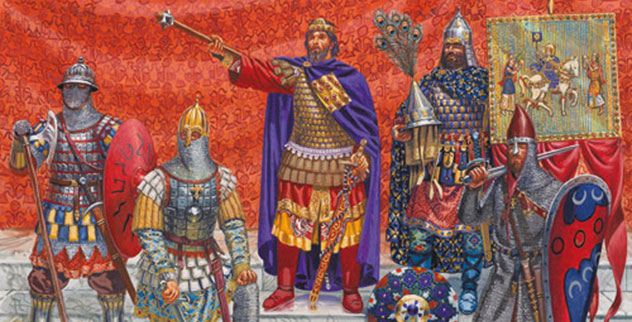
After the War of the Sicilian Vespers ended, many hardened fighters suddenly found themselves unemployed. Roger de Flor gathered these veterans into the Catalan Company and offered their services to the Byzantine Empire. Emperor Andronikos II hired them to fight Turkish forces threatening Byzantine territory in Anatolia.
The Catalan Company proved effective, but success created its own problem: mercenary armies with victories, weapons, and unpaid wages tend to become politically difficult roommates. Tensions between the company and Byzantine authorities escalated. Roger de Flor was assassinated in 1305, but his followers did not quietly submit a complaint to customer service. They retaliated violently and eventually established control over parts of Greece.
4. Sir John Hawkwood
Sir John Hawkwood was an English soldier who became one of the most famous condottieri, or mercenary captains, in fourteenth-century Italy. He began his military career during the Hundred Years’ War and later arrived in Italy with the White Company, a professional military force that sold its services to competing rulers and city-states.
Hawkwood became known in Italy as Giovanni Acuto, often translated as “John the Sharp” or “John the Clever.” That nickname was not handed out because he had an impressive pencil collection. Hawkwood built a career through negotiation, maneuver, intimidation, and the ability to make powerful cities worry about which side he might support next.
He served Florence, Milan, Pisa, the papacy, and other political powers during a period when Italy was a patchwork of rival states. Hawkwood’s legacy was complicated: he could be celebrated as a brilliant commander in one city and feared as a dangerous free captain in another. Florence later honored him with a famous painted monument by Paolo Uccello, proving that history occasionally gives even its most inconvenient employees a flattering retirement portrait.
5. Francesco Sforza
Francesco Sforza took the mercenary career path farther than almost anyone. He began as a condottiero, following in the footsteps of his father, the renowned military captain Muzio Attendolo Sforza. But Francesco did not stop at collecting contracts. He turned military skill into political power and eventually became Duke of Milan in 1450.
In Renaissance Italy, mercenary commanders were often powerful but temporary figures. They could win battles for a city-state, collect a large payment, and move on when the next contract looked more attractive. Sforza understood that real power required more than battlefield victories. He built alliances, married Bianca Maria Visconti, and used Milan’s political turmoil to establish his own dynasty.
His story is movie-worthy because it combines family ambition, shifting loyalties, palace politics, and a climb from hired commander to ruler. Sforza did not simply survive the mercenary world. He beat the game, bought the expansion pack, and took control of the map.
6. Thomas Cochrane
Thomas Cochrane was not a mercenary in the strictest sense, but he was one of history’s most daring foreign military adventurers. A British naval officer with a reputation for bold attacks and spectacular escapes, Cochrane later served independence movements in Chile, Brazil, and Greece.
After his political and legal troubles in Britain, Cochrane left for South America and took command of Chilean naval forces during its struggle for independence from Spain. He helped Chilean forces challenge Spanish control along the Pacific coast and later served Brazil during its fight for independence from Portugal.
Cochrane’s life had everything a historical adventure film wants: naval raids, political scandals, foreign revolutions, personal grudges, and a talent for making enemies in very expensive uniforms. He also inspired fictional naval heroes, including elements of characters created by writers such as Patrick O’Brian and C. S. Forester. In other words, he was already halfway to being cast before anyone invented casting.
7. Frederick Townsend Ward
Frederick Townsend Ward was an American adventurer who became one of the most unusual military figures of the nineteenth century. Born in Salem, Massachusetts, Ward traveled widely before arriving in China during the Taiping Rebellion, one of the deadliest civil wars in history.
Ward organized and commanded a force that became known as the Ever Victorious Army. The unit fought for Qing authorities and included Chinese soldiers led by foreign and Chinese officers. Ward’s force used modern weapons, mobile tactics, and intensive training to defend areas around Shanghai from Taiping forces.
Ward was killed in 1862 after being wounded in battle, but his legend continued. His story has been repeatedly described as nearly impossible to believe: an American sailor and adventurer becomes a military commander in China, trains a hybrid army, survives multiple wounds, and dies before reaching his full political potential. It sounds like a screenplay written at 2 a.m. by someone who just discovered both history and espresso.
8. William Walker
William Walker was not a conventional mercenary commander, but he was one of the most notorious American filibusters of the nineteenth century. Filibusters were private military adventurers who launched unauthorized expeditions into foreign territories, often hoping to seize land or create new governments.
Walker first attempted to create a breakaway state in northern Mexico. After that venture collapsed, he entered Nicaragua during a civil war in 1855 with a small group of followers. Through military success and political maneuvering, he eventually declared himself president of Nicaragua.
Walker’s rule was brief and destructive. He restored slavery, alienated local political groups, and triggered resistance from neighboring Central American states. He was eventually driven out and later executed in Honduras in 1860. His career is a reminder that the “adventurer” label can hide ugly realities: imperial ambition, racial ideology, and violence disguised as opportunity.
9. Bob Denard
Bob Denard became one of the best-known mercenary figures of the Cold War era. The French-born soldier of fortune was involved in political upheavals across Africa, but he became especially associated with the Comoros Islands in the Indian Ocean.
Denard played a major role in several coups and attempted coups connected to the Comoros between the 1970s and 1990s. At different moments, he portrayed himself as a protector, a political ally, or a military problem-solver. To critics, he represented the darker side of post-colonial intervention: armed outsiders influencing governments while operating in the blurry space between private ambition, foreign interests, and local power struggles.
Denard’s story is cinematic for all the wrong reasons. It includes secretive networks, shifting regimes, international pressure, and a man who repeatedly returned to the same islands as though history had issued him a loyalty card. His career also shows why mercenary activity remains controversial: private armed power can destabilize entire countries long after the headlines fade.
10. “Mad Mike” Hoare
Thomas Michael Hoare, widely known as “Mad Mike” Hoare, was a British-Irish mercenary commander whose exploits in Africa became legendary and deeply controversial. He led 5 Commando, a mercenary unit operating for the Congolese government during the Congo Crisis in the 1960s.
Hoare’s public image was carefully built around toughness, discipline, and adventure. His career later inspired parts of the fictional world of The Wild Geese, a story about hired soldiers on an African mission. Real life was considerably less romantic. The Congo conflict involved intense political turmoil, foreign intervention, atrocities, and devastating consequences for civilians.
Hoare later led a failed coup attempt in Seychelles in 1981. The operation collapsed, and he eventually served prison time. His life remains a cautionary example of how quickly a self-styled soldier of fortune can become a symbol of instability, failed political schemes, and very bad airport planning.
Why the Stories of Famous Mercenaries Still Matter
These real-life mercenaries and military adventurers matter because they reveal how often war has been shaped by people operating outside normal national armies. Their stories are not simply tales of bravery or tactical brilliance. They are also stories about power without accountability, contracts without loyalty, and the consequences of turning military force into a private service.
The most interesting historical lesson is that mercenaries often thrive when governments are weak, divided, or desperate. They arrive when institutions fail, but their presence can also make those failures worse. That tension is what makes their lives so compelling and so unsettling. A movie can end with a dramatic helicopter escape. History usually ends with civilians, political instability, and a bill nobody wants to pay.
A 500-Word Perspective: The Experience Behind Mercenary Legends
Reading about real-life mercenaries can feel like watching history through a cracked movie lens. The individual stories are gripping because they are packed with bold personalities, dangerous journeys, sudden reversals, and characters who seem allergic to ordinary careers. But the more closely you look, the less these lives resemble clean-cut adventure stories.
The experience of studying mercenary history often begins with fascination. A commander like John Hawkwood appears to be a medieval genius who could make rival Italian city-states compete for his services. Xenophon and the Ten Thousand seem like the original survival movie: a stranded army, hostile territory, harsh weather, and a long march toward safety. Thomas Cochrane looks like a naval hero who never met a dramatic entrance he did not enjoy.
Then the story becomes more complicated. Mercenary armies depended on payment, loot, political protection, and access to supplies. When those disappeared, discipline often disappeared with them. The people most affected by their movements were frequently not kings, generals, or wealthy sponsors. They were farmers, merchants, families, and towns caught between armies that saw the landscape as a source of food, money, and leverage.
This is why the best way to understand famous mercenaries is to hold two ideas at once. First, many were undeniably skilled. They understood training, morale, logistics, negotiation, and the psychology of war. They could take groups of strangers and turn them into forces capable of influencing states. Second, military skill does not automatically create moral legitimacy. A commander can be talented and still help create suffering on a huge scale.
The modern experience of reading these stories also changes how we think about private military power today. The uniforms, weapons, and legal arrangements may have changed, but the central question remains familiar: what happens when armed force is separated from public responsibility? Governments may hire outsiders because it seems efficient or politically convenient. Yet outsourcing violence can make responsibility harder to trace when things go wrong.
The lives of Bob Denard and Mike Hoare show how easily mercenary mythology can become tangled with coups, foreign influence, and personal ambition. Their stories are often told with dramatic nicknames and daring details, but the deeper lesson is less glamorous. Private military actors can affect national politics in ways that citizens never agreed to and cannot easily control.
That is what makes these 10 movie-worthy real-life mercenaries worth remembering. Their lives contain action, courage, strategy, and absurd levels of confidence. But they also reveal the human cost behind the legend. The strongest historical stories do not ask us to cheer every dramatic figure. They ask us to understand why such figures became powerful, who paid the price, and why the world keeps producing them.
Note: This article examines mercenary history for educational purposes and does not romanticize violence, coups, or private armed intervention.