Japanese folklore contains plenty of playful supernatural creatures. Some steal food, imitate household objects, or create the sort of minor chaos usually associated with an unsupervised cat. Others are considerably less adorable. They sink ships, devour travelers, freeze people alive, and occasionally remove souls with the efficiency of a supernatural pickpocket.
Many of these beings belong to the broad world of yōkai, a term covering mysterious creatures, spirits, transformations, and unexplained phenomena. The list also includes an oni, a Shinto mythological serpent, and a monster from Ainu tradition. Their stories vary by region and historical period, so there is rarely one official description. That uncertainty only makes them more unsettling.
Turn on the lights, stay away from suspicious piglets, and meet ten deadly Japanese monsters you would never want to encounter.
What Makes Japanese Monsters So Terrifying?
Japanese monsters frequently appear where the familiar world becomes unpredictable: mountain paths after dark, turbulent coastlines, isolated shrines, snowy forests, and rivers deep enough to conceal trouble. Many legends transformed real dangersdrowning, storms, hunger, exposure, or getting lostinto creatures that could be remembered and discussed.
These stories also reflect moral and social anxieties. Some monsters punish greed or disrespect, while others embody people who died violently or were denied proper funerary rites. Unfortunately, several creatures on this list require no moral justification whatsoever. Being nearby is apparently enough to ruin their eveningand yours.
10. Ushi-Oni: The Coastal Ox Demon
A Monster With an Identity Crisis
The name ushi-oni means “ox demon,” but that is where visual agreement ends. Regional traditions describe it as an ox-headed creature with the body of a spider, crab, sea monster, dragon, or enormous predatory animal. Horns, tusks, claws, and a generally unfriendly expression are recurring features.
Stories often place the ushi-oni near beaches, rivers, and fishing communities in western Japan. Some versions say it attacks people directly or poisons anyone who merely meets its gaze. In other tales, it works with the serpent-bodied nure-onna. She distracts a traveler with what appears to be a baby, leaving the victim unable to escape when the ushi-oni arrives.
The monster still has a cultural presence in places such as Uwajima, where enormous ushi-oni parade figures appear during festivals. Today they are colorful attractions. In folklore, they are a compelling reason to reconsider that peaceful midnight walk along the shore.
9. Shuten-Dōji: The Drunken Oni King
Kidnapper, Cannibal, and Terrible Host
Shuten-dōji is one of Japan’s most famous oni. His name is commonly interpreted as “drunken boy,” although his behavior is neither youthful nor charming. According to medieval legend, he lived with a band of demons in a mountain stronghold, abducting people from Kyoto and consuming his captives.
The warrior Minamoto no Yorimitsu, better known as Raikō, was sent to destroy him. Raikō and his companions disguised themselves as religious travelers and gained access to the demon’s residence. With divine assistance, they served Shuten-dōji enchanted sake that left him defenseless enough to be beheaded.
That should have ended matters. Instead, the severed head reportedly flew at Raikō and attempted one final bite. A protective helmet saved him. It is a wonderfully practical lesson: when hunting a cannibalistic demon king, dress for both the battle and the post-decapitation follow-up.
8. Otoroshi: The Hairy Guardian Above the Gate
Judgment With Fangs
The otoroshi is commonly depicted as a hunched, heavily furred creature with tusks, claws, and an expression suggesting that someone has violated a very important rule. Classic illustrations often show it perched on a shrine’s torii gate or another elevated structure.
Later folklore portrays the creature as a supernatural guardian. It waits above sacred entrances and drops onto people who approach with wicked intentions, crushing or devouring them. Respectful worshippers may pass safely, which technically makes the otoroshi less randomly murderous than several other Japanese monsters on this list.
Its precise origins and behavior are not consistently explained in early illustrated sources. Like many yōkai, its personality expanded as storytellers interpreted striking old images. The resulting message is still clear: enter sacred ground respectfully, behave yourself, and glance upward before walking beneath anything occupied by a fanged carpet.
7. Ikuchi: The Sea Serpent That Sinks Ships With Oil
The Longest Maritime Delay Imaginable
The ikuchi is a colossal serpentlike yōkai associated with Japan’s open waters. Edo-period accounts describe a creature so extraordinarily long that a ship might need days to sail past its body. Encountering it was not simply inconvenient; the monster could turn an ordinary voyage into a slow-motion maritime disaster.
As the ikuchi passed over or alongside a vessel, greasy oil reportedly dripped from its body. Sailors had to remove the accumulating liquid continuously. If they stopped bailing and scrubbing, the weight of the oil could overwhelm the ship and drag everyone beneath the waves.
The legend may reflect the immense, difficult-to-identify shapes and substances sailors encountered at sea. From a storytelling perspective, however, it invents an impressively stressful death: not one dramatic attack, but hours of frantic cleaning while an endless eel casually passes overhead. Even the monster’s murder method feels like mandatory overtime.
6. Mikoshi-Nyūdō: The Priest Who Never Stops Growing
Whatever You Do, Do Not Keep Looking Up
On a lonely road at night, a traveler encounters what appears to be a monk. The stranger seems tall, but then his neck begins rising. The more the victim looks upward, the larger he becomes. Eventually the traveler loses balance, becomes paralyzed by fear, or exposes the throat to the creature’s teeth and claws.
This is the mikoshi-nyūdō, a shape-shifting yōkai whose name plays on the act of looking upward or seeing beyond something. Some traditions say he tramples victims, bites them, or impales those who attempt to flee. Others preserve verbal formulas that can defeat him. Recognizing the trick, looking downward, or declaring that you have “seen past” him may cause the apparition to vanish.
The story turns a simple visual reflex into a trap. Humans naturally look up when something grows above them. The mikoshi-nyūdō weaponizes curiosity, making him history’s deadliest invitation to admire the ceiling.
5. Gashadokuro: The Giant Skeleton of the Forgotten Dead
When One Skeleton Is Not Nearly Enough
The gashadokuro is an enormous skeleton said to form from the bones and resentment of people who died in war or famine without proper burial. It wanders after midnight, seizes solitary travelers, and bites off their heads or drinks their blood. A rattling sound, chattering teeth, or sudden ringing in the ears may announce its approach.
Modern descriptions often make the creature many times taller than a human and nearly impossible to defeat by force. Its rage continues until the spiritual energy holding its bones together is exhausted. That is not a particularly encouraging survival plan when the angry skeleton pursuing you is taller than a building.
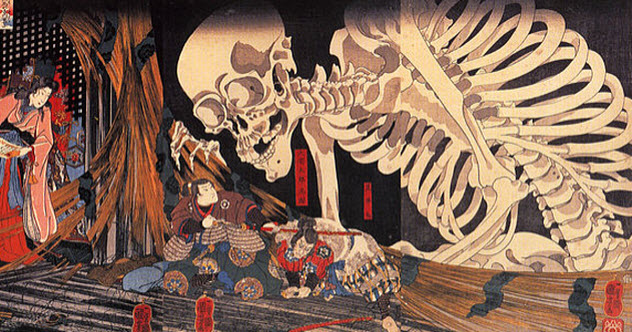
Although the gashadokuro looks ancient, researchers have traced its familiar named form largely to twentieth-century yōkai publications. Its imagery was strongly influenced by Utagawa Kuniyoshi’s famous nineteenth-century print of a giant skeleton. It is therefore a modern monster built from older artistic and folkloric bonesquite literally an assembled horror.
4. Akkorokamui: The Enormous Red Octopus
Terror Beneath Northern Waters
Akkorokamui comes from Ainu tradition associated with Hokkaido and should not be casually treated as an ordinary yōkai. It is generally described as a gigantic red octopus or octopuslike sea being inhabiting waters around Funka Bay. In some retellings, its size is so immense that its color can be seen from a great distance.
Legends connect the creature with powerful waves, capsized boats, and attacks on fishermen. Its many arms make escape difficult, while its ability to darken or discolor the surrounding water adds another unpleasant complication. A normal octopus is intelligent, flexible, and capable of manipulating objects. Enlarging one to legendary proportions feels like nature submitting a formal complaint.
Akkorokamui is also treated with reverence in some traditions, illustrating how supernatural beings can be dangerous without being simplistic villains. Respect, fear, and sacred power often occupy the same waters.
3. Yamata-no-Orochi: The Eight-Headed Serpent
Eight Heads, Eight Tails, and One Fatal Drinking Problem
Yamata-no-Orochi belongs to Japan’s foundational mythology. Ancient chronicles describe it as an immense serpent with eight heads and eight tails, its body extending across eight valleys and mountain peaks. Trees grew upon its back, while its belly was stained with blood.
Each year, the monster devoured one daughter of an elderly couple. When only Kushinada-hime remained, the storm deity Susanoo offered to defeat the serpent. He ordered eight containers of strong sake prepared behind a fence with eight openings. Orochi pushed a head through each opening, drank deeply, and passed out.
Susanoo cut the creature apart and discovered the sword later known as Kusanagi in one of its tails. The weapon became associated with Japan’s imperial regalia. Orochi may be interpreted as a symbol of flooding, uncontrolled natural power, or chaos. It is also enduring evidence that having eight heads does not guarantee eight sensible opinions about alcohol.
2. Katakirauwa: The Shadowless Demon Pig
A Small Monster With a Soul-Stealing Shortcut
Katakirauwa legends are particularly associated with Amami Ōshima in southern Japan. The creature resembles a black pig or piglet, but it may have only one ear and cast no shadow. It appears at night, often targeting people walking alone.
Instead of attacking with tusks, the katakirauwa runs between a victim’s legs and steals the person’s soul. Some versions suggest that the victim dies; others describe a ruined or empty existence afterward. Either outcome seems excessive for failing to step over a pig quickly enough.
Regional stories offer possible defenses, including crossing the legs or changing position before the creature completes its charge. The katakirauwa is memorable because it overturns expectations. Most people would notice a dragon approaching. A small animal in a dark street may seem harmless until it reveals its lack of shadow and deeply unreasonable interest in human souls.
1. Yuki-Onna: The Beautiful Killer in the Snow
Cold Weather Given a Human Face
Yuki-onna, the “snow woman,” appears in numerous regional traditions. She is usually described as an extraordinarily beautiful woman with pale skin, long hair, and white clothing that blends into a winter landscape. She may glide without leaving footprintsan elegant detail that should also be treated as a major warning.
In deadly versions of the legend, Yuki-onna freezes travelers with her breath, drains their vitality, leads them away from safe paths, or leaves them to die in a storm. Some stories depict her as compassionate or capable of forming a human family, while others make her merciless. Lafcadio Hearn’s famous retelling combines both qualities: she spares a young man but threatens death if he reveals their encounter.
Yuki-onna personifies the beauty and danger of severe winter weather. Snow can make the world silent, bright, and breathtaking moments before exposure becomes fatal. Giving that danger a lovely face ensures that the doomed traveler walks closer instead of running away.
A Folklore-Inspired Experience: One Night With Japan’s Deadliest Monsters
The following experience is an original fictional journey inspired by traditional legends.
From the Shrine Gate to the Snowy Road
Imagine beginning at twilight beside a forest shrine. The stone path is empty, the air smells of cedar, and the vermilion torii stands against a darkening sky. Everything feels peaceful until something shifts above the gate. A curtain of dirty hair hangs over the beam. Two tusks emerge. You remember the otoroshi and immediately review every questionable decision you have made since kindergarten.
You bow, enter respectfully, and hear no monster land behind you. So far, so good.
Beyond the shrine, the path narrows. A monk approaches through the mist. You offer a greeting, but his face rises higher. His neck stretches past the branches while his smile remains fixed on you. Every instinct says to look up. Folklore says otherwise. You stare at his feet and announce that you recognize the mikoshi-nyūdō. The road shudders, the apparition disappears, and you congratulate yourself far too early.
A black piglet trots from the bushes. It has one ear. More importantly, moonlight falls around it without producing a shadow. The katakirauwa charges. You jump sideways before it passes between your legs, preserving your soul but sacrificing most of your dignity.
The Coast Is Somehow Worse
You reach a fishing boat, reasoning that the open water must be safer than the haunted forest. This is poor strategic planning. Offshore, something longer than the visible horizon slides across the waves. Oil begins raining onto the deck. The crew grabs buckets and scrapers. For hours, everyone removes the ikuchi’s supernatural grease while reconsidering careers in agriculture.
Then the sea turns red.
A vast shape rises beneath the boat, followed by curling arms. Whether it is Akkorokamui or simply the largest octopus ever to object to maritime traffic becomes academically unimportant. The captain turns toward shore as tentacles disturb the water behind you.
You land beside a woman holding a bundled infant. Her hair is soaked, although there is no rain. She asks you to carry the child. The bundle becomes heavier with every second, pinning your arms. Something with horns and a spiderlike body moves along the beach. You have walked directly into the nure-onna and ushi-oni partnership.
Dropping the impossible bundle, you flee inland. Behind you comes the sound of hooves, claws, and what may be supernatural laughter.
The Final Walk Through the Snow
Winter arrives with dreamlike speed. Snow covers the road, and an elegant woman in white waits beneath a tree. She leaves no footprints. Her breath becomes a glittering cloud.
You know she is Yuki-onna, but regional legends offer conflicting advice. Speak and she might attack. Remain silent and she might also attack. Folklore has provided atmosphere but no reliable customer support.
A clattering noise interrupts the decision. A skeleton rises over the trees, assembled from countless bones. Its enormous hand reaches down as Yuki-onna dissolves into the storm. You run until dawn, never looking back at the gashadokuro.
Morning reveals an ordinary road, a quiet coastline, and a harmless pig wandering near a farm. The experience leaves one lasting lesson: Japanese monster stories make landscapes feel alive. Mountains, rivers, snow, darkness, and the sea are not empty backgrounds. They watch, transform, and occasionally grow teeth.
Conclusion
The deadliest Japanese monsters are frightening because they represent more than inventive creature design. Yuki-onna gives winter a face, the ikuchi turns maritime danger into an endless serpent, and the gashadokuro embodies forgotten victims of catastrophe. Otoroshi guards sacred boundaries, while Yamata-no-Orochi transforms destructive natural power into a dragon-slaying myth.
Their legends have changed through oral storytelling, art, literature, theater, film, manga, anime, and games. No version is universal, but the underlying warnings remain recognizable: respect nature, honor the dead, approach unfamiliar places carefully, and never assume a shadowless piglet is merely having a strange evening.