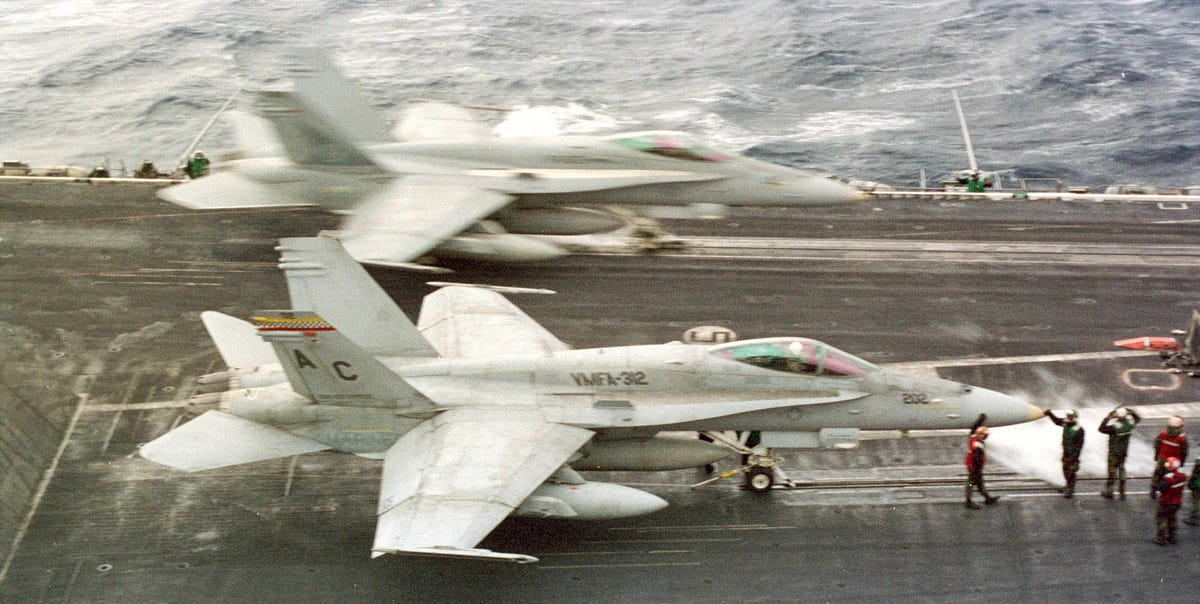
At the 20-year anniversary of the Kosovo air campaign in 2019, Operation Allied Force already looked like a hinge between two eras of American air warfare. It began with Cold War aircraft, cautious political assumptions, paper-heavy targeting procedures, and a coalition that had to agree before it could pull the trigger. It ended with stealth bombers flying directly from Missouri, satellite-guided bombs striking through clouds, unmanned aircraft watching the battlefield, and expeditionary units rotating into combat on short notice.
The campaign did not invent precision warfare, stealth, drones, or multinational air operations. What it did was force all of them into the same crowded laboratoryover mountainous terrain, in miserable weather, against active air defenses and under intense political scrutiny. The laboratory occasionally caught fire, but the results helped shape U.S. operations in Afghanistan, Iraq, Libya, Syria, and beyond.
Operation Allied Force Was Supposed to Be Brief
NATO began Operation Allied Force on March 24, 1999, after negotiations failed to stop Serbian and Yugoslav forces from attacking and expelling ethnic Albanian civilians in Kosovo. Alliance leaders hoped a limited series of strikes would pressure Yugoslav President Slobodan Milosevic into accepting a settlement. In other words, the opening concept was less “major air war” and more “firmly worded memo, but with cruise missiles.”
Milosevic did not yield after the first few nights. NATO therefore expanded the campaign from attacks on air defenses and selected military facilities to a broader effort against command networks, transportation routes, military units, government infrastructure, and targets in and around Belgrade. The campaign lasted 78 days. NATO aircraft flew 38,004 sorties, including 10,484 strike sorties, while the U.S. Air Force accounted for more than 30,000 missions of various kinds.
The campaign ended after Milosevic accepted terms requiring the withdrawal of Yugoslav military, police, and paramilitary forces from Kosovo, the deployment of an international security presence, and the return of refugees. NATO had reached its immediate political objective without launching a large allied ground invasion, although diplomatic pressure, Russian involvement, the worsening economic damage, and the possibility of further escalation also influenced the outcome.
Airpower Became a Strategic Lead, Not Merely Support
A campaign built around aircraft
Before Kosovo, American doctrine commonly placed airpower inside a broader joint campaign dominated by ground maneuver. Aircraft established air superiority, attacked supply lines, and supported soldiers moving toward physical objectives. Operation Allied Force reversed the familiar picture. Air operations were not preparing the battlefield for an immediate NATO invasion; they were the principal military instrument used to compel a political decision.
That made Kosovo enormously important to Air Force thinking. It suggested that airpower could sometimes do more than soften an enemy for ground forces. Under particular conditions, it could impose mounting strategic costs, isolate military formations, disrupt national infrastructure, and create enough pressure to alter an adversary’s choices.
The qualification “under particular conditions” matters. RAND’s assessment found that NATO had serious difficulty locating and destroying dispersed Yugoslav ground forces in Kosovo. Decoys, concealment, forests, villages, cloud cover, and mobile air defenses turned tactical targeting into a frustrating game of hide-and-seekexcept the other side had surface-to-air missiles and was not required to play fairly.
Kosovo therefore did not prove that aircraft could solve every political crisis by themselves. It showed that sustained air operations could be strategically decisive when the enemy was geographically exposed, economically vulnerable, diplomatically isolated, and unable to retaliate effectively against NATO territory. That was a powerful lesson, but not a universal recipe.
The B-2 and JDAM Made Their Combat Debuts
Global strike became more than a presentation slide
One of the campaign’s most enduring changes arrived in the shape of the B-2 Spirit. During Operation Allied Force, B-2 crews flew roughly 30-hour round trips from Whiteman Air Force Base in Missouri to targets in Yugoslavia and back. The missions demonstrated that a stealth bomber could launch from the continental United States, penetrate defended airspace, deliver precision weapons, refuel repeatedly, and return home without relying on a nearby bomber base.
The B-2 was not simply an exotic black aircraft making a dramatic entrance. Air Force records credit it with destroying approximately one-third of the Serbian targets struck during the campaign’s first eight weeks. It offered decision-makers a way to attack important targets early without waiting for a large forward deployment.
Kosovo also marked the combat debut of the Joint Direct Attack Munition, or JDAM. The system added GPS and inertial guidance to conventional bombs, allowing aircraft to strike fixed coordinates accurately through clouds, smoke, or darkness. B-2s released more than 600 JDAMs during the operation.
This was a major improvement over laser-guided weapons, which could be disrupted by clouds or obscured targets. Kosovo’s stubborn weather made the advantages obvious. A bomb that did not need to see the target in the traditional optical sense was extremely useful when the Balkans decided to wrap themselves in cloud cover for what seemed like the entire war.
JDAM later became a workhorse in Afghanistan and Iraq. It also helped transform bombers from platforms associated mainly with preplanned strategic targets into flexible precision-attack aircraft able to support rapidly changing operations.
Drones Moved Closer to the Center of Warfare
Remotely piloted aircraft were still experimental by later standards in 1999, but Kosovo gave the Air Force an early look at their potential. Predator aircraft provided persistent surveillance and helped commanders search for mobile units and other fleeting targets. The Air Force flew hundreds of unmanned-aircraft missions during Allied Force, making the campaign its first significant combat employment of remotely piloted systems.
The experience exposed a problem that would dominate future air campaigns: finding a target was not enough. Information had to move quickly from a sensor to analysts, commanders, targeteers, legal advisers, and finally an aircraft carrying the correct weapon. By the time everyone completed the digital and bureaucratic relay race, a mobile target could be parked somewhere elsepossibly beneath a bridge, beside a house, or next to an inflatable decoy wearing a very convincing tank costume.
Kosovo pushed the Air Force toward shorter sensor-to-shooter timelines, persistent intelligence coverage, networked command centers, and aircraft capable of attacking time-sensitive targets. Those ideas later matured into armed Predator and Reaper operations, integrated intelligence cells, dynamic targeting teams, and real-time video distributed across continents.
The Enemy Proved Stealth Was Not Magic
Yugoslav air defenses were less technologically advanced than the systems fielded by the United States, but they were disciplined, mobile, and difficult to eliminate. Operators frequently moved their equipment, limited radar transmissions, used decoys, and relied on short bursts of activity. NATO achieved control of the air, yet it never completely destroyed the opposing surface-to-air missile network.
The downing of an F-117 Nighthawk on March 27 became the campaign’s sharpest warning. Stealth reduced detection and targeting opportunities, but it did not make an aircraft invisible. Predictable routes, repeated operating patterns, intelligence leaks, poor mission coordination, or a well-timed radar activation could create a vulnerable moment.
A second dramatic incident occurred when an F-16 flown by then-Lieutenant Colonel David Goldfein was hit during a mission against air-defense sites. Goldfein ejected and was recovered by combat search-and-rescue forces. The rescue reinforced the importance of coordinating fighters, helicopters, electronic-warfare aircraft, tankers, intelligence platforms, and special operators before a pilot ever needed help.
The broader lesson was uncomfortable but healthy: advanced technology still required disciplined tactics. Kosovo encouraged greater attention to electronic warfare, suppression of enemy air defenses, route variation, intelligence preparation, operational security, and the rescue of isolated personnel.
Coalition Warfare Became a Core Air Force Skill
Nineteen governments, one air campaign, many opinions
Operation Allied Force was conducted by an alliance, not a single nation. Nineteen NATO members supported the operation, and aircraft from 13 countries participated. That political unity gave the campaign legitimacy among participating governments and access to essential bases, airspace, personnel, and infrastructure.
It also made targeting slower and more complicated. Some governments restricted where their aircraft could fly, which targets they could attack, and which weapons they could employ. Sensitive targets might require approval at several political levels. National caveats, legal concerns, civilian-risk calculations, and arguments over escalation all influenced the air tasking order.
The United States supplied 700 of the 1,055 aircraft ultimately deployed, more than 90 percent of the aerial-refueling capability, much of the airlift, and all tactical jamming. The imbalance exposed a widening gap between American capabilities and those of many European allies, particularly in precision weapons, secure communications, intelligence collection, all-weather attack, and operational sustainment.
For the Air Force, integration became a mission in itself. It was not enough to arrive with the best aircraft. The service had to build a combined air operations center, protect sensitive information, distribute usable intelligence, coordinate incompatible systems, and produce missions that each participating country could legally and technically execute.
Those experiences influenced later coalition air campaigns. They also remain relevant whenever the United States operates with partners whose aircraft, data links, weapons, security rules, and political tolerances differ. Coalition warfare is a little like organizing a family road trip with 19 drivers, except everyone has a veto and several cars cannot use the same fuel nozzle.
The Air Expeditionary Force Concept Passed Its First Major Test
The post-Cold War Air Force was smaller than its predecessor but was being dispatched to more locations. No-fly zones over Iraq, deployments in the Balkans, and other commitments placed repeated strain on pilots, maintainers, intelligence specialists, tanker crews, and support personnel.
Operation Allied Force became the first major combat test of the Air Expeditionary Force concept. Units rotated into Aviano Air Base and other locations as organized expeditionary packages rather than as an endless series of improvised personnel replacements. The approach aimed to make deployments more predictable while combining the aircraft, maintenance, logistics, communications, and support needed for sustained operations.
The campaign proved the value of expeditionary organization, but it also revealed how thin the force had become. Preferred munitions ran low. Experienced crews and spare parts were pulled from stateside units. Tankers, reconnaissance aircraft, electronic-warfare platforms, and other specialized assets faced intense demand. The Air Force could generate impressive combat power, but doing so for 78 days required borrowing heavily from tomorrow’s readiness.
Basing and Logistics Became Strategic Weapons
Aircraft cannot operate on inspirational speeches and jet noise alone. They need runways, fuel, munitions, maintenance equipment, spare engines, secure communications, housing, diplomatic clearances, and enough parking space to prevent an air base from becoming the world’s most expensive used-car lot.
GAO investigators found that the United States lacked a detailed advance plan for basing the expanding combat force. Because requirements changed as the campaign grew, some airfields became congested and units had to be repositioned. Host-nation agreements and access to European bases were therefore not background administrative details; they directly affected the speed and scale of combat operations.
Kosovo helped reinforce a lesson that remains central to modern Air Force planning: logistics networks are part of combat power. Tanker availability determines fighter range. Runway access determines sortie generation. Maintenance capacity determines whether a sophisticated aircraft is a weapon or a very stylish lawn ornament.
Precision Created Higher Expectations
The growing use of precision-guided weapons allowed NATO to attack individual facilities with far greater accuracy than earlier air forces could achieve. Yet precision did not eliminate mistakes, faulty intelligence, mechanical failures, target misidentification, or the human consequences of attacking infrastructure.
Several strikes caused civilian casualties, including attacks involving a passenger train, a refugee convoy, a bridge, and the Chinese Embassy in Belgrade. These incidents demonstrated that a weapon could land exactly where it was directed and still produce a strategic disaster if the coordinates, intelligence, or target decision were wrong.
The campaign accelerated the development of stricter target validation, collateral-damage estimation, legal review, positive identification, and real-time command oversight. It also changed public expectations. Once governments advertised “surgical” bombing, every error appeared not as an unavoidable feature of war but as evidence that someone had failed to operate the scalpel correctly.
Precision warfare consequently became both more effective and more demanding. The ability to hit a window did not answer whether the building should be struck, who might be inside, or how television images of the damage would affect coalition unity.
Kosovo’s Joint-Warfare Lesson Was More Complicated
Operation Allied Force triggered an intense debate over whether airpower had “won alone.” Supporters emphasized that NATO achieved its immediate goals without a major ground invasion. Critics argued that diplomatic pressure, the Kosovo Liberation Army, economic damage, and the growing possibility of ground action also shaped Milosevic’s decision.
The campaign also revealed friction between Air Force and Army concepts. Task Force Hawk, built around Army Apache helicopters, deployed to Albania but did not conduct its planned deep-attack missions. The deployment identified more than 100 issues requiring remedial attention, including command relationships, intelligence sharing, communications, logistics, and the integration of Army aviation into an air-led campaign.
The useful conclusion was not that one service had become unnecessary. It was that joint forces needed flexible command arrangements suited to the actual campaign rather than inherited assumptions. Kosovo showed airpower operating as the lead military instrument, but it also showed how much airmen depended on ground intelligence, special operations, logistics, diplomacy, and allied access.
What Airmen Experienced and Carried Forward
Long flights, short decisions, and no room for complacency
For the crews involved, Kosovo’s technological revolution did not feel like a tidy diagram connecting a satellite, an aircraft, and a target. It felt like fatigue, uncertainty, radio traffic, changing weather, and decisions that had to be made before the situation on the ground changed again.
B-2 crews departed Missouri knowing they would remain airborne for roughly 30 hours. Multiple aerial refuelings divided the journey into long blocks of preparation, waiting, system management, and concentrated activity near the target area. Inside the aircraft, glamorous notions of stealth gave way to practical concerns: navigation, radar interpretation, fuel calculations, communications, threat updates, and the precise release of weapons. The aircraft might have looked like science fiction, but the crew still had to stay alert after enough hours awake to make a normal person argue with a coffee cup.
Fighter pilots faced a different pressure. Yugoslav air-defense operators often remained silent, moved their launchers, and activated radars only briefly. A quiet threat display did not mean the danger had disappeared. Pilots had to assume that someone below was waiting for a favorable moment. The loss of the F-117 and the shootdown of Goldfein’s F-16 confirmed that complacency could be punished quickly.
Combat search-and-rescue crews lived with another reality: their most important mission would begin when someone else’s had gone terribly wrong. Rescue helicopters could not simply rush across the border. They needed fighter protection, electronic support, refueling, intelligence, and a reliable understanding of the survivor’s location. Airmen who recovered downed pilots demonstrated how training conducted far from public attention could become the thin line between rescue and captivity.
Maintainers experienced the campaign as a relentless contest against time. Sortie schedules expanded while aircraft accumulated flight hours. Components failed, replacement parts moved through crowded bases, and crews worked through darkness and bad weather to return aircraft to service. Every successful strike depended on hundreds of less cinematic tasks: checking tires, loading weapons, repairing avionics, testing communications, inspecting low-observable surfaces, and finding the one missing tool that had apparently joined the opposing side.
Intelligence personnel confronted the difficulty of interpreting incomplete images. A shape beneath foliage might be a tank, a tractor, a decoy, or nothing more threatening than an inconvenient shadow. Analysts had to combine imagery, electronic signals, pilot observations, unmanned-aircraft video, and reports from the ground. Their judgments affected whether aircraft attacked, waited, or abandoned a target.
Command-center personnel experienced political warfare in real time. Target lists changed. National representatives raised objections. Weather canceled carefully planned missions. Civilian-risk concerns required new reviews. A target approved in the morning could be restricted by afternoon, while a mobile unit spotted minutes earlier might disappear before authorization arrived.
These experiences shaped the generation that led the Air Force through the wars after September 11. Airmen carried forward a preference for persistent surveillance, rapid targeting, expeditionary organization, precision weapons, integrated rescue, and communications that connected operators across long distances. They also carried a healthy suspicion of easy predictions. Kosovo had been expected to last a few days. It lasted 78.
How Kosovo Changed the U.S. Air Force Forever
Operation Allied Force did not produce one dramatic transformation. It accelerated several changes already underway and proved which ones mattered in combat.
It validated global precision strike through the B-2 and JDAM. It moved remotely piloted aircraft toward a central role in surveillance and targeting. It strengthened the expeditionary-force model. It exposed shortages in tankers, intelligence platforms, munitions, and trained personnel. It demonstrated the importance of coalition integration, overseas access, combat search and rescue, electronic warfare, and rapid information sharing.
Just as importantly, Kosovo exposed limits. Stealth aircraft could be shot down. Precision weapons could hit the wrong coordinates perfectly. Air superiority did not guarantee that mobile ground forces would be easy to find. Coalition unity could slow operations, while unilateral control could weaken coalition trust. Airpower could deliver strategic leverage, but it could not remove politics from war.
The modern U.S. Air Forcewith long-range bombers, satellite-guided weapons, remotely piloted aircraft, expeditionary wings, networked operations centers, and elaborate target-review proceduresowes part of its identity to lessons learned over the Balkans. Kosovo was not the final model for future warfare. It was the moment the Air Force realized that the future had already arrived, carrying a GPS receiver, requesting tanker support, and complaining about the weather.
Note: This article synthesizes information from 13 public historical, government, military, and defense-research sources, including materials from the U.S. Air Force Historical Support Division, Air Force fact sheets, Air University, Air Force Global Strike Command, the U.S. Government Accountability Office, RAND Corporation, Air & Space Forces Magazine, Department of Defense historical studies, and Popular Mechanics.