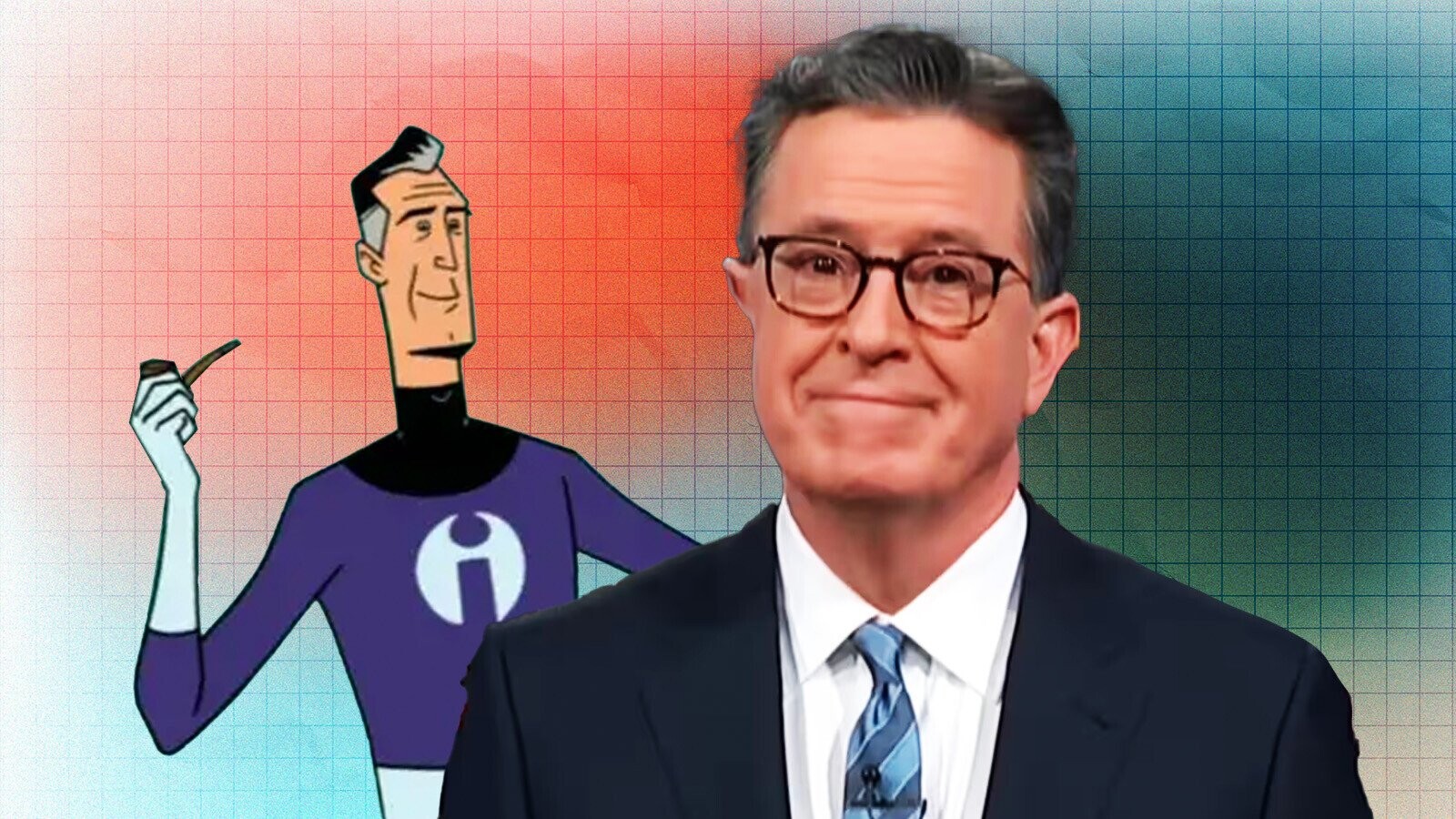
Hollywood rejection usually arrives wearing soft shoes. A performer is “unavailable.” A project is “not the right fit.” Schedules “could not be aligned,” which is entertainment-industry language for anything from a genuine calendar conflict to “please stop calling this number.”
Then there was the response reportedly sent by a member of Stephen Colbert’s representation when the creators of The Venture Bros. asked him to return as Professor Impossible: “Stephen has neither the time nor the interest in participating in your project.”
That sentence did not merely close a door. It closed the door, locked it, changed the security code and mailed the doormat back without postage. More importantly, it became a wonderfully awkward chapter in the history of one of Adult Swim’s most beloved animated shows.
A Rejection Colder Than a Supervillain’s Laboratory
The story surfaced while Jackson Publick, the professional name used by series co-creator Christopher McCulloch, and Doc Hammer were preparing the third season of The Venture Bros. in late 2007. They wanted to bring back the actors who had helped populate the show’s increasingly complicated universe, including Colbert, who had voiced Professor Richard Impossible during the first two seasons.
Publick understood that securing him might be difficult. Colbert had become dramatically more famous since his earlier recording sessions. Nevertheless, the creators reached out, hoping that the disruption caused by the 2007–2008 Writers Guild of America strike might leave him with an opening.
Instead, Publick said he was passed among assistants, agents and managers before receiving the now-famous response. The objection was not that Colbert lacked time alone. His representative added that he lacked “interest,” a small word that transformed an ordinary scheduling problem into what sounded like a review of the entire production. Contemporary reports from Cracked, ComicsBeat and Maximum Fun preserved both the wording and Publick’s amused irritation.
To be clear, there is no public evidence that Colbert personally wrote, dictated or approved the message. Even people connected to The Venture Bros. acknowledged that the wording may have originated with a representative who barely knew what the series was. The cruelty belonged to the sentence, not necessarily to the celebrity whose name appeared in it.
Who Was Professor Impossible?
Professor Impossible was an ideal character for Colbert’s particular vocal talents. Brilliant, self-important and emotionally refrigerated, Richard Impossible sounded like the sort of man who would explain your own childhood to you and then charge a consulting fee.
The character and his family were an intentionally miserable parody of Marvel’s Fantastic Four. Richard could stretch his body like Mister Fantastic, but his scientific achievements were accompanied by arrogance, neglect and a nearly supernatural inability to behave like a decent husband. Other members of the Impossible family possessed similarly distorted versions of familiar superhero powers, usually with painful or impractical consequences.
That combination of authority and absurdity fit Colbert beautifully. His booming certainty could make Richard sound impressive for several seconds before the character’s vanity, cruelty or incompetence punctured the illusion. Professor Impossible appeared to be a heroic super-scientist from across the room. Up close, he was a workplace complaint wearing a lab coat.
Colbert voiced him in early episodes including “Ice Station Impossible” and “Twenty Years to Midnight.” The role was not enormous, but The Venture Bros. was built from memorable supporting characters whose histories continued expanding long after their first appearances. Professor Impossible was therefore more than a disposable celebrity cameo; he was another crooked load-bearing beam in the Venture universe.
Why Stephen Colbert Had Become So Difficult to Book
When Colbert first recorded for The Venture Bros., he was widely recognized as a correspondent on The Daily Show, but he had not yet become the center of his own media empire. That changed when The Colbert Report premiered in 2005.
By 2007, his fictional television-pundit persona had turned into a cultural phenomenon. The character was loud, patriotic, proudly misinformed and powered almost entirely by ego. Colbert’s performance invited audiences to join an elaborate game in which everyone understood the joke except the man supposedly hosting the program.
A Vanity Fair profile published in September 2007 described a production supported by dozens of employees and an audience regularly exceeding one million viewers. The program’s influence extended beyond television through viral campaigns, political satire, books and audience-participation stunts. It later received a Peabody Award for its blend of parody, punditry and media criticism.
In other words, the creators of a labor-intensive cult cartoon were no longer calling the same performer they had booked during the show’s early days. They were calling one of America’s most recognizable comedians while he was producing four topical television episodes every week.
The Writers Guild strike did interrupt that production cycle, but it did not magically create a relaxing vacation. The strike lasted 100 days and centered partly on compensation for work distributed through emerging digital platforms. Late-night programs faced uncertain production schedules, staff concerns and difficult decisions about returning without their writers. Publick’s hope that Colbert might suddenly have spare animation time was understandable, but perhaps optimistic.
The Three Words That Made the Rejection Ruthless
“Neither the time” was perfectly reasonable
No sensible person could have objected to the first half. A nightly comedy show depends on constant writing, rehearsal, production and last-minute revision. Even a relatively brief voice-acting appearance requires scheduling, script preparation, studio coordination and possible retakes.
“Stephen does not have the time” would have ended the conversation cleanly. Publick himself indicated that he expected fame and scheduling pressure to make Colbert’s return unlikely.
“Nor the interest” changed everything
The second half was unnecessary because it answered a question nobody had asked. It did not simply communicate unavailability; it appeared to announce emotional indifference.
That is why the rejection remained funny. “No time” means the project lost to a calendar. “No interest” means the project lost to the human spirit.
The wording also clashed with Colbert’s previous participation. He had already recorded the character for the series, so the message sounded as though someone had retroactively downgraded that work from a professional credit to an embarrassing favor.
James Urbaniak, the voice of Dr. Venture, responded by jokingly placing Colbert “on notice,” borrowing a recurring gag from The Colbert Report. Urbaniak also emphasized that the representative probably was not quoting Colbert directly and may not have understood the show. That distinction helped keep the incident in the realm of nerdy comedy rather than genuine celebrity warfare.
The Venture Bros. Did What It Did Best: It Adapted
A different series might have removed Professor Impossible or quietly avoided mentioning him again. The Venture Bros. simply recast the part and continued building its universe.
Publick took over the role during the third season. Bill Hader later voiced the character in the fourth. Because all three performers approached Richard Impossible differently, the changes were audible, especially to devoted fans. Still, the character survived.
That flexibility reflected the unusual production culture of The Venture Bros.. Publick and Hammer wrote nearly the entire series themselves, voiced numerous characters and spent long periods crafting seasons dense with callbacks. A minor gag in one episode could become an emotional plot point years later. A background villain might eventually acquire a family history, professional rivalries and a deeply specific opinion about progressive rock.
The creators repeatedly discussed how much time the show required, even during the long gaps when viewers assumed little was happening. Interviews with Wired and Georgia Public Broadcasting described a tiny creative operation committed to continuity and to the principle that events in the story remained consequential.
Recasting Professor Impossible therefore became another example of the series turning a production complication into part of its evolving identity. The voice changed, but the universe kept its paperwork.
Then Stephen Colbert Came Back Anyway
The funniest ending to the rejection story arrived in 2015, when Colbert returned to voice the character in the hour-long special “All This and Gargantua-2.” By then, Professor Impossible had become associated with the Revenge Society and was also known as Professor Incorrigible.
The special brought together an enormous collection of characters and long-running storylines. Adult Swim described it as an adventure involving the Ventures and nearly everyone they had encountered, while contemporary reviews singled out Colbert’s return as a particularly entertaining casting surprise.
There was no dramatic public apology tour, no televised reconciliation summit and no scene in which Professor Impossible read an assistant’s email while sad violins played. Colbert simply returned, performed the role and gave the anecdote a better ending than resentment ever could.
The comeback also supported the theory that the infamous reply reflected a temporary combination of scheduling pressure and overzealous gatekeeping rather than permanent hostility. Colbert may not have had time in 2007. He clearly had enough timeand sufficient interestwhen the special was recorded years later.
Why Fans Still Remember the Stephen Colbert Venture Bros. Rejection
The incident has endured because it condenses several recognizable entertainment-industry experiences into one elegant sentence.
It exposes the strange power of gatekeepers
Creators often communicate with representatives rather than directly with performers. An assistant, agent or manager may determine whether an invitation reaches the person it concerns. One blunt email can therefore create years of apparent hostility between people who may never have personally disagreed.
It captures how quickly careers can change
Colbert’s rise between his early voice sessions and the third season was enormous. A performer who once had room for a niche animated role had become responsible for a nationally discussed television program. Success rearranged the practical relationship, even if nobody intended disrespect.
It sounds like dialogue from the show
The response is so pompous that it could have come from Professor Impossible himself. Richard would absolutely reject a request by explaining that he possessed neither the time nor the intellectual tolerance for it. Reality accidentally wrote a perfect Venture Bros. line.
It received a satisfying final punchline
Most stories about professional rejection end with silence. This one ended with Colbert returning. The years between refusal and reunion turned a minor casting dispute into a compact comedy about celebrity, communication and the dangers of adding one unnecessary phrase to an email.
What This Story Teaches About Rejection in Creative Work
The Stephen Colbert and The Venture Bros. story is entertaining because the people involved were famous, but its underlying experience is painfully ordinary. Writers, artists, filmmakers, designers and independent creators regularly send invitations that disappear into corporate fog.
You may spend three days writing a thoughtful proposal and receive six automated words in return. You may ask a respected collaborator to join a project and hear that the opportunity does not fit “their current strategic direction,” as though your comedy podcast accidentally applied to become a pharmaceutical company.
The first emotional reaction is usually personal. A harsh reply can make a creator question the project, the pitch and occasionally every decision made since kindergarten. Yet the Venture story demonstrates why the wording of a rejection should not be confused with a final verdict on the work.
Experience One: The gatekeeper may not share the artist’s opinion
Imagine inviting a performer who previously enjoyed working with you. The message goes to an assistant who is processing dozens of requests. That assistant sees a small production, compares it with major television commitments and sends the fastest possible refusal. The performer may never see the invitation.
From your side, the response feels definitive. From inside the other organization, it may have been administrative housekeeping completed between lunch and a conference call. A creator cannot assume that a representative’s tone reveals the private feelings of the person represented.
Experience Two: A “no” can describe the moment rather than the relationship
Timing matters more than pride likes to admit. A person can genuinely admire a project and still lack room for it during a particular season of life. Productions collide, contracts restrict appearances, family responsibilities expand and seemingly simple commitments become complicated.
Colbert’s eventual return illustrates this perfectly. The earlier rejection did not prevent a later collaboration. Circumstances changed, and the door that appeared welded shut turned out to have ordinary hinges.
Experience Three: Keep the project alive without the dream participant
Creative teams sometimes treat one desired collaborator as the entire project’s oxygen supply. When that person declines, everyone starts behaving as though the building has been condemned.
The Venture Bros. followed a healthier approach. The creators recast the role, adjusted to different performances and continued telling the story. This was not denial; it was production. A project that can survive casting changes, budget limitations and bruised feelings has a better chance of becoming meaningful than one built around perfect conditions.
Experience Four: Humor can stop rejection from becoming bitterness
Publick and Urbaniak responded with jokes. They mocked the unnecessary wording, turned Colbert’s own “on notice” routine against him and allowed fans to enjoy the absurdity. Humor did not erase the disappointment, but it prevented the incident from hardening into a grand moral crusade.
That response is useful beyond television. When a rejection is genuinely rude, laughing at its theatrical excess can restore perspective. You are still allowed to be annoyed. You simply do not have to build a summer home inside the annoyance.
Experience Five: Avoid writing the extra cruel sentence
The lesson also applies to anyone delivering a rejection. Declining respectfully costs almost nothing. “We cannot participate because of current commitments” communicates everything necessary. Adding that someone has no interest may feel efficient, but it can embarrass the recipient and misrepresent the person on whose behalf you are speaking.
A rejection should close the present request without burning down every possible future collaboration. The entertainment world is small, careers are unpredictable and today’s obscure cartoon may become tomorrow’s cherished classic. Also, screenshots live forever and possess neither mercy nor a sense of proportion.
Conclusion: Professor Impossible Achieved the Possible
Stephen Colbert’s absence from the third season of The Venture Bros. was understandable. By 2007, he was leading a demanding, culturally influential television production, and the Writers Guild strike created uncertainty rather than leisurely free time.
What made the incident memorable was not the refusal itself. It was the brutal efficiency of “neither the time nor the interest,” language that turned a routine scheduling decision into one of animation fandom’s most quotable rejection stories.
Fortunately, The Venture Bros. survived the recasting, Professor Impossible continued evolving and Colbert ultimately returned for “All This and Gargantua-2.” The result was a reconciliation perfectly suited to the show: no sentimental speeches, just a revived character, a complicated space-station disaster and one final joke delivered years after everyone thought the conversation was over.