Editor’s note: This article reflects verified public information available through July 19, 2026. References to criminal charges describe allegations; defendants are presumed innocent unless proven guilty.
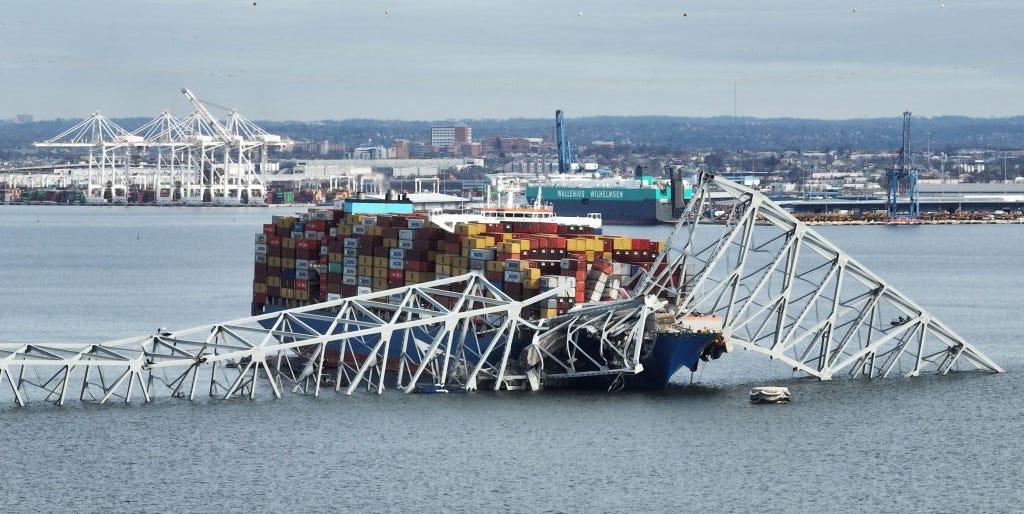
In the darkness before dawn on March 26, 2024, Baltimore lost a familiar piece of its skyline in a matter of seconds. The container ship Dali struck a supporting pier of the Francis Scott Key Bridge, sending much of the steel structure into the Patapsco River.
The images looked almost unreal: lights flickering aboard a ship nearly 1,000 feet long, a massive truss folding downward, and sections of roadway disappearing into black water. Yet behind the shocking video was a very real human tragedy. Six highway workers were killed while performing overnight maintenance on the bridge.
The collapse also severed part of Interstate 695, disrupted Baltimore-area travel, temporarily blocked a major shipping channel, and triggered investigations into maritime maintenance, emergency communication, bridge protection, and the growing size of modern cargo ships.
More than two years later, investigators have identified the probable cause, the Port of Baltimore has resumed operations, legal cases continue, and plans for a replacement bridge are being reworked. Here is what we know about the Baltimore bridge collapse, what went wrong aboard the Dali, and what the disaster may change far beyond Maryland.
What Happened on the Morning of the Key Bridge Collapse?
The Singapore-flagged Dali departed the Port of Baltimore in the early hours of March 26, carrying containers and heading toward Sri Lanka. Two local harbor pilots were aboard to guide the vessel through Baltimore’s waterways.
As the ship approached the Francis Scott Key Bridge, it suffered an electrical blackout. Lighting went dark, essential equipment lost power, and the vessel was deprived of propulsion and steering at the worst possible location: close to a major bridge pier with very little time or waterway available for recovery.
The crew restored some electrical power, but a second blackout followed. The ship’s heading swung toward Pier 17, one of the supports beneath the central bridge spans. The pilots and bridge team attempted emergency maneuvers, including using the rudder, ordering the anchor dropped, and requesting tug assistance. Their actions could not redirect a vessel of that size quickly enough.
At approximately 1:29 a.m., the bow of the Dali struck the pier. The impact destroyed critical structural support, and the central truss spans collapsed onto the ship and into the Patapsco River. In maritime language, a moving vessel hitting a stationary object is technically called an “allision.” It sounds like someone misspelled “collision,” but nautical vocabulary has been confusing landlubbers for centuries.
The National Transportation Safety Board later concluded that the pilots and the ship’s bridge team responded promptly. However, because propulsion and steering had been lost so close to the bridge, their actions could not prevent the impact.
The Human Toll of the Baltimore Bridge Disaster
A seven-person road maintenance crew and an inspector were on the bridge when the ship struck. The workers had been repairing potholes during the overnight period, when traffic was relatively light.
Six members of the maintenance crew died. Another worker survived but suffered serious injuries, while the inspector escaped without physical injury. One of the 23 people aboard the Dali sustained minor injuries.
The relatively low number of vehicles on the bridge was not merely a matter of luck. Approximately one minute after the first blackout, a pilot aboard the ship contacted a shoreside dispatcher and requested that traffic be stopped. Maryland Transportation Authority police officers positioned at both ends of the bridge immediately blocked approaching vehicles.
Investigators determined that the bridge had been cleared of ordinary traffic about 48 seconds before the collision. Those rapid decisions almost certainly prevented additional motorists from driving onto the span during its final moments.
The maintenance workers, however, did not receive an equally fast evacuation warning. The NTSB found that if they had been notified when police were ordered to stop traffic, they might have had enough time to drive toward a section of the bridge that remained standing. The tragedy therefore involved not only a shipboard power failure, but also a gap in emergency communication with people working directly in danger.
Why Did the Dali Lose Power?
Early coverage understandably focused on broad questions: Was the fuel contaminated? Did the pilots make an error? Was the weather a factor? Had the crew been impaired? Did the ship simply “turn off” without warning?
The final NTSB investigation produced a much more specific answer. The initial blackout was caused by a loose signal wire inside the ship’s high-voltage switchboard.
A Small Electrical Connection Caused an Enormous Failure
Investigators found that wire-label banding had been improperly positioned near the end of a signal wire. The banding prevented the wire from being fully inserted into a terminal block’s spring-clamp connection. That left the connection vulnerable to becoming electrically disconnected.
When the wire disconnected, a high-voltage breaker opened. Power to the ship’s low-voltage bus was interrupted, shutting down lighting and machinery that supported the steering pumps and main engine. The result was a loss of both steering and propulsion.
It was an alarming example of how a tiny component can sit at the beginning of a catastrophic chain. Modern ships contain miles of wiring and thousands of connections. Most work quietly for years. One improperly seated wire, however, can become the engineering equivalent of removing the wrong block from a very large game of Jenga.
Why the Second Blackout Mattered
After the first loss of power, the ship’s engineering crew worked to restore electrical service. The NTSB considered that initial response timely, but other equipment configurations made recovery more difficult.
Two online diesel generators depended on a flushing pump for pressurized fuel. That pump was designed primarily for maintenance work, not as the normal fuel-service pump for operating generators. It lacked redundancy and was not designed to restart automatically after losing power.
When the flushing pump failed to restart, fuel pressure to the generators dropped and a second blackout occurred. Investigators also found that certain high-voltage breakers were set to manual rather than automatic mode. Automatic operation would not have prevented the blackouts, but it could have reduced the first blackout from approximately 58 seconds to about 10 seconds, giving the crew more recovery time.
The emergency diesel generator also took longer than required to connect. According to investigators, an issue involving the indication of a radiator damper’s position likely contributed to that delay.
What the NTSB Identified as the Probable Cause
In its final findings, the NTSB determined that the probable cause of the Dali striking the Francis Scott Key Bridge was the electrical blackout created by the loose signal-wire connection. The blackout caused the loss of propulsion and steering close to the bridge.
Investigators said several conditions contributed to the consequences:
- The bridge lacked protective countermeasures sufficient to reduce its vulnerability to impacts from large ocean-going vessels.
- The Maryland Transportation Authority had not completed a recommended vessel-collision vulnerability assessment.
- The maintenance workers did not receive effective, immediate instructions to evacuate.
- Shipboard systems and operating practices made rapid blackout recovery more difficult.
The NTSB also ruled out several widely discussed possibilities. Environmental and waterway conditions were not considered causal. Investigators did not find crew or pilot impairment from alcohol or tested drugs. Fuel quality, fuel-switching procedures, and mariner credentialing were also excluded as contributing factors.
Importantly, investigators did not conclude that the bridge collapsed simply because it contained so-called fracture-critical or non-redundant steel members. The decisive event was the destruction of a major support pier by a vessel far larger than ships commonly calling at Baltimore when the bridge opened in 1977.
Was the Francis Scott Key Bridge Properly Protected?
The original Key Bridge was built during an era when container ships were dramatically smaller. The Dali was 984 feet long, and the scale of its mass and momentum overwhelmed the pier it struck.
Protective structures such as large fenders, dolphins, artificial islands, or reinforced barriers can sometimes absorb energy, redirect a vessel, or keep it away from a bridge’s most vulnerable supports. Such systems cannot guarantee that every collision will be harmless, but they can substantially change the outcome.
The NTSB found that the Key Bridge’s calculated risk of catastrophic collapse from a vessel strike was almost 30 times higher than the threshold contained in relevant bridge-design guidance. A vulnerability assessment recommended under industry guidance could have brought that risk to the transportation authority’s attention and supported decisions about protective measures.
The finding has national implications. In March 2025, the NTSB urged the owners of 68 bridges in 19 states to conduct or update vessel-strike vulnerability assessments. Bridge owners were also encouraged to consider systems that can detect an errant ship and automatically warn or stop motorists before they enter a threatened structure.
That is the larger lesson: a bridge may pass routine structural inspections and still face a separate, inadequately measured risk from changing vessel traffic. A clean inspection report is valuable, but it is not a magical force field.
How the Port of Baltimore Recovered
The collapsed steel, concrete, roadway material, and immobilized ship blocked the main federal navigation channel. Commercial vessels could not move normally into or out of the Port of Baltimore, creating an immediate concern for port employees, trucking companies, warehouses, manufacturers, vehicle exporters, and businesses throughout national supply chains.
Unified Command brought together the U.S. Coast Guard, U.S. Army Corps of Engineers, Maryland agencies, salvage specialists, engineers, divers, contractors, and other responders. Temporary channels were opened first for limited vessel traffic while crews tackled the much larger job of removing wreckage.
A controlled demolition removed a section of bridge truss from the bow of the Dali. Tugboats later moved the ship away from the collapse site. Crews ultimately cleared more than 50,000 tons of material from the river.
The full Fort McHenry Federal Channel700 feet wide and 50 feet deepwas restored in June 2024. The work took 78 days and involved more than 1,500 people across federal, state, local, and private organizations.
Reopening the channel did not replace the missing highway connection, but it prevented a temporary maritime emergency from becoming a prolonged shutdown of one of the East Coast’s most important ports.
What Is Happening With the Key Bridge Rebuild?
Replacing the Francis Scott Key Bridge is an unusually complex project. Designers must create a crossing suitable for modern highway traffic while protecting its primary supports from ships much larger than those of the 1970s.
Maryland’s updated planning calls for a longer main span, taller towers, improved navigational clearance, and a far more robust pier-protection system. In November 2025, the Maryland Transportation Authority placed the estimated cost at approximately $4.3 billion to $5.2 billion, with an anticipated opening to traffic in late 2030.
Those figures were substantially higher and later than the earliest emergency estimates. That is not entirely surprising. Cost forecasts produced days after a disaster are closer to informed triage than finished construction budgets. Detailed surveys, geotechnical work, engineering requirements, labor costs, materials, environmental reviews, and protective systems all become clearer as design advances.
The delivery plan changed again in April 2026. Maryland announced that it would seek new construction partners and rebid the second phase of the project following federal concerns about rising costs and schedule delays. The state also began reorganizing work into separate construction packages.
The rebuilt bridge therefore remains a moving infrastructure program rather than a fixed blueprint carved into ceremonial concrete. Public estimates may change as bids are received and contracts are finalized. The consistent goals are to reconnect I-695, protect navigation through the port, and make the new bridge significantly more resistant to vessel strikes.
Who Is Being Held Legally Responsible?
The collapse generated civil claims involving the ship’s owner, operator, insurers, government agencies, businesses, workers, and victims’ families.
In October 2024, Grace Ocean Private Limited and Synergy Marine Private Limited agreed to pay approximately $101.98 million to resolve a federal civil claim covering government costs associated with clearing the channel and restoring port access. That settlement did not cover the cost of rebuilding the bridge, which Maryland owned.
In 2026, federal prosecutors announced criminal charges against two Synergy corporate entities and a technical superintendent. The indictment alleges conspiracy, failures to report a hazardous condition, obstruction, false statements, environmental violations, and conduct connected with the six deaths.
The defendants are presumed innocent, and an indictment is not proof of guilt. The criminal proceeding is separate from the NTSB’s safety investigation, whose purpose is to identify causes and prevent future accidents rather than determine criminal liability.
What the Collapse Means for Bridge and Maritime Safety
The Francis Scott Key Bridge collapse exposed a mismatch between older infrastructure and modern commercial shipping. Many bridges were designed when vessels were shorter, lighter, and carried far fewer containers. Ports have evolved quickly; concrete, steel, and regulatory assumptions do not update themselves overnight.
The NTSB issued recommendations addressing electrical inspections, wire installation, generator fuel systems, emergency power, redundant propulsion and steering, voyage-data recorders, bridge-warning technology, worker evacuation procedures, and vessel-strike risk assessments.
One recommendation involved using infrared thermal imaging during preventative electrical maintenance. A weak or poorly seated connection can generate abnormal heat that may be detected before the connection fails. Other recommendations focused on ensuring that essential breakers operate automatically and that emergency generators start within required time limits.
On land, investigators called for better systems to close bridges rapidly and warn both motorists and maintenance crews. Police officers happened to be stationed near the Key Bridge because of the overnight work. A future emergency may occur when no officers are conveniently waiting at both entrances.
Technology cannot eliminate every accident. It can, however, detect danger faster, remove unnecessary single points of failure, and buy the seconds that separate a near miss from a national disaster.
Experiences and Practical Lessons From the Key Bridge Collapse
Experience 1: Familiar Infrastructure Can Disappear Without Warning
For Baltimore-area residents, the Key Bridge was not an abstract engineering asset. It was part of the commute, the industrial landscape, family trips, delivery routes, and the glowing nighttime view across the harbor. Many people had crossed it hundreds of times without consciously considering the piers beneath them.
The experience of suddenly losing such a familiar structure changed how people viewed everyday infrastructure. Roads and bridges can feel permanent because they outlast jobs, cars, and sometimes entire generations. In reality, their safety depends on continuous inspection, maintenance, updated risk analysis, and emergency preparation.
Experience 2: Seconds of Communication Can Save Lives
The officers who blocked traffic had little time to debate procedure or request a meeting about scheduling another meeting. They received a warning and acted. Their response prevented additional vehicles from entering the bridge.
At the same time, the failure to warn the road crew demonstrated that an emergency plan is only as strong as its final communication link. Organizations responsible for bridges, tunnels, rail lines, factories, and ports should ask a blunt question: Can every exposed worker receive an understandable evacuation order immediately, including contractors working overnight?
Experience 3: Small Maintenance Details Deserve Serious Attention
The probable cause began with a loose signal wire, not a dramatic explosion or exotic mechanical failure. That detail is useful far beyond shipping. Maintenance teams in aviation, manufacturing, utilities, data centers, hospitals, and transportation systems regularly manage thousands of ordinary components.
Routine work can feel boring precisely because successful maintenance produces no spectacle. A properly seated wire never becomes famous. A correctly configured fuel pump earns no documentary series. Yet safety is often built from these unglamorous victories.
Experience 4: Businesses Need More Than One Route
The port’s temporary restrictions and the loss of the highway crossing forced trucking companies and other businesses to adjust routes, delivery schedules, staffing, inventory, and customer expectations. Nearby tunnels could absorb some road traffic, but trucks carrying hazardous materials faced additional restrictions and longer detours.
The practical lesson is resilience. Companies tied to ports or major transportation corridors should identify alternative terminals, suppliers, warehouses, carriers, and routes before an emergency occurs. A contingency plan created during a quiet Tuesday is generally better than one improvised at 3 a.m. while everyone refreshes the same traffic map.
Experience 5: Recovery and Grief Move at Different Speeds
Salvage milestones arrived quickly: temporary channels opened, wreckage was lifted, the Dali was moved, and the main channel returned to service. Economic activity could be measured in vessels, cargo volumes, work shifts, and reopened terminals.
Human recovery cannot be placed on the same project schedule. Families lost loved ones who were simply doing their jobs during a night maintenance shift. For them, reopening the port did not “close” the disaster.
Public discussions about costs, contracts, lawsuits, and construction deadlines should therefore keep the six workers at the center of the story. Infrastructure is built to serve people. When safety systems fail, the most important accounting is not measured in steel tonnage or insurance payments, but in lives that cannot be replaced.
Conclusion
The Francis Scott Key Bridge collapse was not caused by one simple failure. A loose electrical connection initiated the blackout, but shipboard operating practices, limited system redundancy, inadequate bridge protection, and incomplete emergency communication shaped the outcome.
The quick mayday call and the immediate closure of bridge traffic prevented an even larger loss of life. The rapid reopening of the Port of Baltimore demonstrated what coordinated emergency work can accomplish. The investigation, however, showed that older bridges across the country may face risks that have not been fully calculated for today’s enormous vessels.
Baltimore’s replacement bridge will eventually restore the missing connection across the Patapsco River. Its deeper legacy should be broader: better electrical maintenance, stronger maritime safety systems, protected bridge piers, faster warning technology, and emergency plans that reach every workernot merely every vehicle.