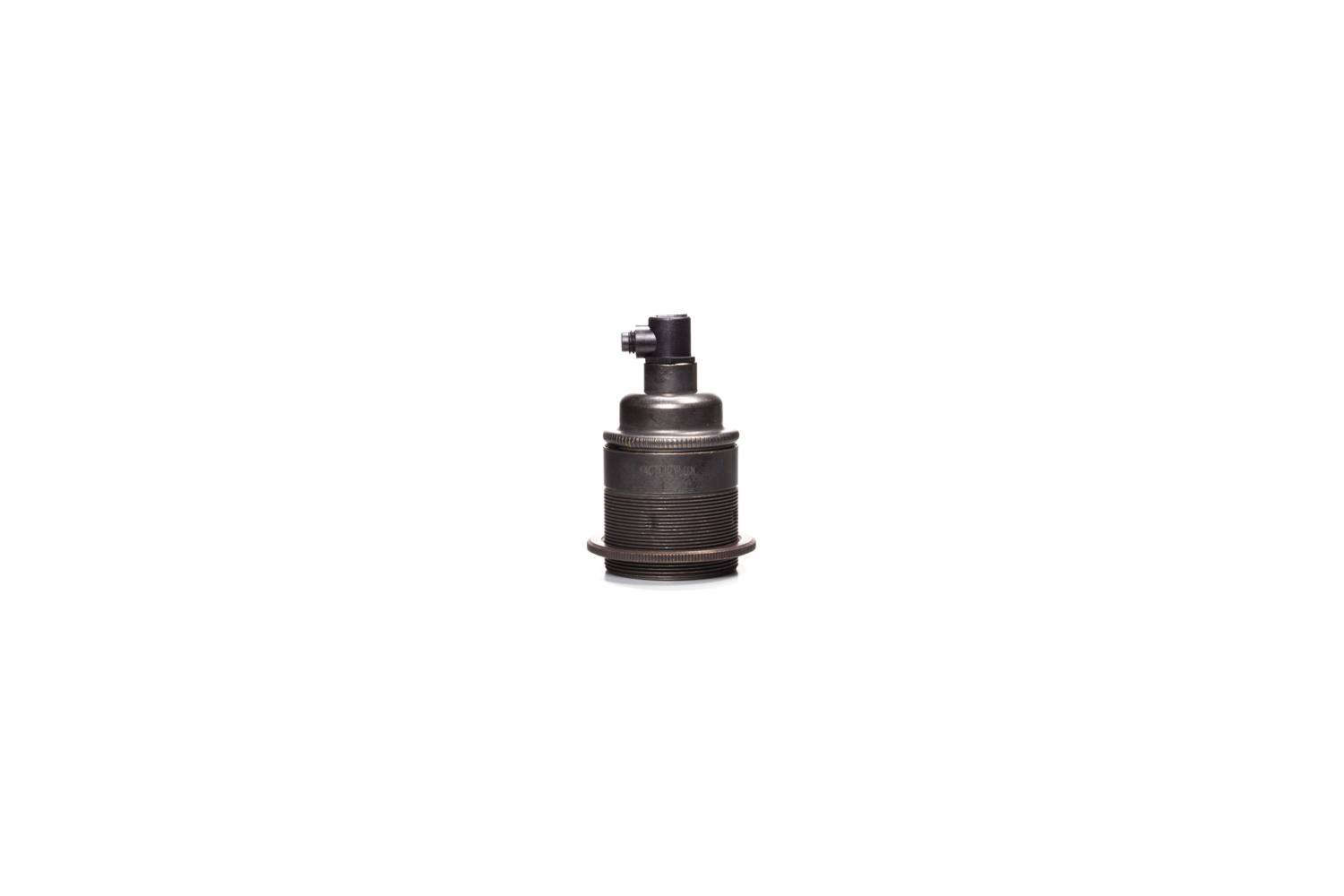
A cord grip E27 lamp holder may be small enough to disappear behind a stylish bulb, but it performs several impurrent, protects the internal connections, and helps stop the cord from being yanked directly against the terminals. That is a lot of responsibility for a component that often costs less than lunch.
These lamp holders are especially popular in pendant lights, exposed-bulb fixtures, table lamps, hanging bedside lights, retail displays, restaurant lighting, and do-it-yourself projects. Their simple shape works beautifully with vintage-style LED bulbs, fabric-covered cable, metal shades, glass globes, and minimalist interiors. Unfortunately, their simplicity can also tempt buyers to treat every socket as interchangeable. It is not.
The base size, voltage rating, cord diameter, temperature rating, material, mounting method, certification, and intended location all matter. Choosing correctly produces a neat, dependable light fixture. Choosing by color alone may produce a very attractive electrical problem.
What Is a Cord Grip E27 Lamp Holder?
A cord grip E27 lamp holder is a screw-type light socket designed to accept a bulb with an E27 Edison screw base. The letter “E” refers to the Edison screw system, while “27” indicates a nominal base diameter of approximately 27 millimeters.
The cord-grip portion is the fitting through which the electrical cable enters the socket. When properly matched and tightened, it holds the outer jacket of the cord so that pulling, twisting, or moving the fixture does not transfer force directly to the internal terminal screws or conductor connections.
In plain English, the cord grip is the bouncer at the door. It keeps physical stress away from the delicate electrical business happening inside.
The Main Parts
Although designs vary, a typical cord grip E27 lamp holder includes:
- An E27 threaded socket for the bulb
- A center electrical contact
- A threaded shell contact
- Internal terminals for the conductors
- An insulating body or insert
- A cable-entry opening
- A compression grip, clamp, gland, or retaining mechanism
- An optional shade ring or pair of shade rings
- An optional decorative outer shell
Some models arrive as complete assemblies. Others use several pieces that must be combined with compatible cord, canopy hardware, threaded tubing, or strain-relief fittings. Mixing random parts because “they almost fit” is not an approved engineering method, even when accompanied by determined optimism.
Why the Cord Grip Matters
Flexible cords move. Pendants swing slightly, table lamps are repositioned, cords get bumped, and people sometimes unplug equipment by pulling the cable instead of the plug. Without strain relief, those forces can reach the electrical terminals inside the lamp holder.
Over time, repeated pulling may loosen a terminal, damage conductor insulation, expose copper, or create a poor electrical connection. A loose connection can generate heat and arcing. The purpose of a properly fitted cord grip is to secure the cable jacket before that movement reaches the terminals.
The grip should hold the outer cord covering, not crush the individual insulated conductors. It must also match the cord’s shape and outside diameter. A gland designed for a round cable may not reliably secure flat lamp cord, while an oversized opening may tighten completely without actually gripping anything.
Strain Relief Is Not Always Structural Support
A cord grip can provide strain relief without being designed to support a heavy pendant, oversized glass shade, planter, shelf, or experimental chandelier assembled during a burst of weekend creativity.
For hanging fixtures, confirm whether the complete socket and cord assembly is rated to carry the intended load. Heavy shades and decorative components may require separate mechanical support. Electrical conductors should never be treated as invisible steel cables.
E27 Versus E26 in the United States
E27 and E26 bases are extremely close in physical size. E26 is the standard medium Edison base commonly used for household lighting in the United States, where typical branch-circuit voltage is about 120 volts. E27 is widely associated with lighting systems used in countries operating around 220 to 240 volts.
Because the thread dimensions are similar, many bulbs and sockets appear to fit one another mechanically. That does not automatically make every E26 and E27 component electrically interchangeable. The complete product must be rated for the supply voltage, bulb type, current, temperature, and installation conditions.
In the U.S. market, products are sometimes advertised as “E26/E27 compatible.” Treat that wording as the beginning of your investigation, not the end. Read the actual markings and technical documentation. A socket that accepts the threads is not necessarily approved for your wiring method or voltage.
What to Verify
- The marked operating voltage
- The maximum wattage or current
- The accepted bulb-base designation
- The conductor size and type
- The permitted cord diameter
- The temperature rating
- The dry, damp, or wet-location rating
- The certification or listing status
Never assume that an imported E27 holder is automatically suitable for direct installation in a U.S. fixture. Product documentation should specifically support the intended use.
Common Lamp Holder Materials
Thermoplastic
Thermoplastic lamp holders are lightweight, affordable, and available in numerous colors. They work well in many LED pendant and table-lamp applications when used within their marked temperature and wattage limits.
Quality varies widely. A well-made certified thermoplastic holder is very different from an unmarked socket with thin internal parts and mysterious specifications. Inspect the terminal design, cord grip, threads, and labeling rather than judging only by the glossy product photograph.
Phenolic or Heat-Resistant Resin
Phenolic-style lamp holders are common in utility lighting, traditional lamp repairs, and fixtures where improved heat resistance is useful. They are generally sturdy and less decorative than polished metal holders, although modern versions can still look clean and intentional.
Ceramic or Porcelain
Ceramic lamp holders tolerate higher temperatures than many plastic alternatives and are often selected for hotter bulbs or demanding fixtures. However, ceramic is brittle. It can crack if dropped, overtightened, or installed under uneven mechanical stress.
A ceramic body also does not magically make the entire assembly suitable for unlimited wattage. The terminals, cord, insulation, shade, enclosure, and bulb must all remain within their individual ratings.
Metal-Shell Lamp Holders
Brass, aluminum, steel, and other decorative metal shells are popular in exposed pendant fixtures. They can create industrial, vintage, modern, or luxury looks, depending on the finish.
The important detail is electrical insulation. In many designs, the visible metal cover is separated from the energized socket components by an insulating insert. Metal parts that could become energized may require grounding or other protective construction. Use only a complete assembly designed for that purpose, and do not improvise insulation with tape, cardboard, or positive thinking.
Shade Rings and Fixture Compatibility
Many cord grip E27 lamp holders include one or two threaded shade rings. These rings clamp a compatible shade around the outside of the socket. They are commonly used with metal shades, glass shades, wire cages, fabric shades, and decorative collars.
Before ordering, check the shade opening and the diameter and thread style of the lamp holder’s ring section. Product listings often use phrases such as “European fitter,” “UNO fitter,” or “socket ring,” but terminology is not perfectly consistent between manufacturers.
Also consider the shade’s weight. A lightweight metal cone may be appropriate for a socket-ring system, while a thick glass globe may require dedicated fitter hardware. When a shade seems determined to fall, adding another ring is not always the correct solution.
How to Choose the Right Cord Grip E27 Lamp Holder
| Feature | What to Check | Why It Matters |
|---|---|---|
| Base type | E27, E26, or documented dual compatibility | Ensures proper mechanical and electrical matching |
| Voltage rating | Must cover the actual supply voltage | Reduces insulation and spacing risks |
| Wattage rating | Must equal or exceed the bulb’s actual wattage | Helps control heat at the socket |
| Cord range | Correct diameter, shape, and conductor type | Allows the strain relief to grip properly |
| Material | Plastic, phenolic, ceramic, or insulated metal | Affects heat resistance, durability, and appearance |
| Location rating | Dry, damp, or wet location as required | Prevents indoor-only parts from being exposed to moisture |
| Shade support | Ring size, fitter type, and allowable weight | Keeps the shade mechanically secure |
| Certification | Recognized testing or certification mark | Provides evidence of evaluation to applicable requirements |
Choose for the Bulb You Will Actually Use
A 9-watt LED may be marketed as a “60-watt replacement,” but its electrical load is still approximately 9 watts. When checking the socket’s limit, use the bulb’s actual wattage rather than its incandescent-equivalent marketing number.
Heat remains important even with LEDs. LED electronics can suffer when trapped inside enclosed shades or poorly ventilated fixtures. Select a bulb approved for enclosed fixtures when the design restricts airflow, and follow both the bulb and lamp-holder instructions.
Consider Dimming Compatibility
The lamp holder itself is normally a passive connection point, but the entire lighting system must still work together. A dimmable LED bulb requires a compatible dimmer, appropriate supply voltage, and proper wiring. An incompatible combination may flicker, buzz, flash, or refuse to dim smoothly.
That romantic café glow becomes less romantic when the pendant starts performing Morse code.
Installation and Safety Considerations
Electrical work should comply with applicable codes, product instructions, and local requirements. Disconnect power before servicing a fixture, verify that the circuit is de-energized, and use a qualified electrician whenever the installation involves permanent building wiring, grounding questions, unfamiliar conductors, damaged components, or uncertain product ratings.
In a polarized lamp circuit, correct conductor orientation helps keep the accessible threaded shell connected to the neutral side rather than the energized side. Because cord markings and terminal designs differ, follow the manufacturer’s diagram rather than relying on wire color guesses.
The cord grip must clamp the cord jacket securely without cutting, flattening, or damaging it. After assembly, there should be no exposed copper, loose strands, cracked insulation, pinched wires, or terminal screws pressing against the outer housing.
Do not install a lamp holder that is chipped, melted, corroded, loose, or missing parts. Do not use a household pendant outdoors unless every component is specifically rated for the environment. Moisture, ultraviolet exposure, heat, grease, and dust can turn a charming indoor fixture into a short-lived outdoor experiment.
Signs That a Lamp Holder Needs Attention
- The bulb flickers when the cord moves
- The socket or cord grip feels loose
- The cord slips through the entry fitting
- The socket is discolored or smells scorched
- The bulb base becomes unusually hot
- You hear buzzing or crackling
- The threaded shell is bent or corroded
- The cord jacket is cut, crushed, or frayed
Turn off and unplug the fixture if any of these symptoms appear. A loose connection does not improve through continued use. It simply gains confidence.
Design Ideas for Cord Grip Lamp Holders
When selected and assembled correctly, cord grip lamp holders are wonderfully flexible design components. A matte-black holder with black fabric cable suits industrial kitchens and lofts. Brass paired with warm-white filament LEDs creates a softer vintage appearance. White porcelain and twisted cord work well in farmhouse or Scandinavian-inspired spaces.
Multiple pendants can be grouped above a dining table, kitchen island, stairwell, or reception desk. Varying the drop lengths adds movement, but each cord should be independently supported and arranged so bulbs cannot collide.
For bedside lighting, a simple cord-grip pendant can free space on a narrow nightstand. For retail displays, exposed sockets can highlight products without bulky fixtures. In restaurants, small pendants can establish intimate pools of light, although commercial projects should use suitable listed assemblies and professional installation.
Common Buying Mistakes
Buying by Appearance Alone
Finish matters, but markings matter more. A beautiful antique-brass shell is not useful if it does not fit the cord, shade, voltage, or bulb.
Assuming E26 and E27 Always Mean the Same Thing
The threads are close, but the system ratings may differ. Confirm compatibility rather than depending on a product title written entirely in capital letters.
Ignoring the Cord Diameter
An oversized grip may fail to hold a thin cord. An undersized grip may damage a thick cable or refuse to assemble correctly.
Using an Indoor Holder in a Damp Area
Bathrooms, covered porches, greenhouses, and outdoor kitchens may expose fixtures to moisture even when rain never directly reaches them. Use components rated for the actual environment.
Exceeding the Shade or Socket Rating
A large bulb can trap heat near the socket or sit too close to a shade. Check both electrical wattage and physical clearance.
Practical Experiences and Lessons From Real-World Projects
Experience 1: The Cord That Looked Secure but Was Not
A common pendant-light problem begins with a cord grip that appears tight from the outside. The installer pulls gently, nothing moves, and the project seems finished. Several weeks later, normal cleaning and repositioning cause the cord to slide by a fraction of an inch. The bulb begins flickering whenever the pendant swings.
The usual lesson is that a compression fitting must match the cord’s actual outside diameter and shape. Tightening an oversized gland until the threads stop does not guarantee that the jacket is clamped. On some decorative fabric cords, the outer textile covering can also bunch while the insulated cable underneath remains loose. A proper fit should retain the cable without cutting or distorting it.
Experience 2: The Beautiful Metal Socket That Became Too Hot
Another familiar story involves a polished brass holder, a compact metal shade, and a high-output decorative bulb. The fixture looks excellent in photographs, but after an hour of operation the socket and shade become uncomfortable to touch.
Switching to a lower-wattage LED often reduces the heat dramatically, but the correct solution still requires checking every rating. The socket may tolerate the bulb’s wattage while the enclosed shade traps heat around the LED electronics. The bulb may then dim, discolor, flicker, or fail early. This experience teaches an important distinction: low energy consumption does not mean zero heat, and a socket rating does not override the bulb manufacturer’s enclosure restrictions.
Experience 3: The Shade Ring That Almost Fit
DIY lighting projects frequently combine a shade from one supplier with a socket from another. Measurements look close, and the shade opening seems to rest on the lamp holder. Unfortunately, “close” can mean a few millimeters of wobble, uneven pressure, or threads that engage for only half a turn.
At first, the shade may remain in place. Later, vibration from a closing door or an accidental bump causes it to tilt. The better approach is to confirm the fitter diameter, ring thread, shade thickness, and allowable weight before buying. A secure shade should sit evenly and remain stable without extreme tightening. Glass shades deserve particular care because concentrated pressure can create cracks that are difficult to see until gravity files its complaint.
Experience 4: The Imported E27 Holder in a U.S. Project
An inexpensive E27 holder may arrive with attractive styling and very little documentation. The bulb screws in perfectly, encouraging the assumption that everything is compatible. Then the buyer notices a voltage marking intended for another market, terminals designed for different conductors, or no recognizable certification mark.
The practical lesson is to evaluate the entire component, not merely the Edison-screw opening. A mechanically compatible bulb does not confirm that the holder is appropriate for a 120-volt U.S. lamp, a particular cord type, or permanent installation. For a decorative project, selecting a documented E26 or E26/E27 assembly intended for the U.S. market usually saves time, uncertainty, and the need to explain to an electrician why the product page contained more adjectives than specifications.
Experience 5: The Pendant That Used the Cord as a Support Cable
A lightweight bulb and socket can often hang from a properly designed pendant cord set. Trouble begins when a heavy glass shade, metal cage, and decorative hardware are added without checking the assembly’s load rating. The cord grip may initially hold everything, but long-term tension can deform the cable jacket or stress internal parts.
Successful projects separate electrical strain relief from structural support. Heavy components are carried by approved fixture hardware, cable supports, chains, or mounting systems, while the electrical cord remains protected from damaging tension. This approach also makes the pendant easier to level and service. The broader lesson is simple: a cord grip is a safety component, not a tiny construction crane.
Final Thoughts
Cord grip E27 lamp holders combine practical cable retention with the familiar Edison-screw format, making them useful for pendant lights, decorative fixtures, restorations, and custom lighting designs. Their clean appearance can make a project seem simple, but safe selection requires more than choosing a finish and screwing in a bulb.
Verify the base type, voltage, wattage, cord range, temperature rating, location rating, shade compatibility, mechanical load, and certification. Use a bulb suitable for the fixture’s ventilation and operating conditions. Most importantly, make sure the cord grip genuinely secures the cable jacket so that movement is not transferred to the electrical terminals.
When the components are properly matched, the result can be elegant, reliable, and delightfully uncomplicated. When the components are selected by wishful thinking, the lamp may still look fantasticright up until it starts flickering like a haunted restaurant.