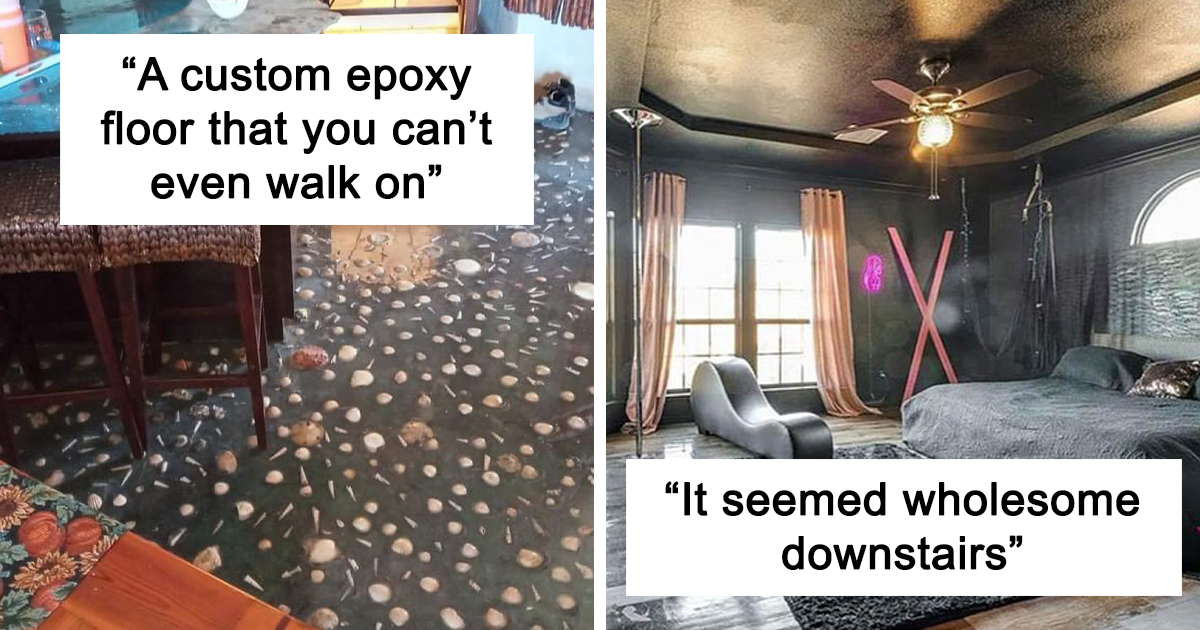
Editorial note: This article is based on real public information about unusual home-listing culture, the Instagram account “What the Crazy House,” viral real estate pages, online home-shopping behavior, and current American interior design trends. No source links have been inserted, as requested.
Some people look at a house and ask, “How many bedrooms?” Others ask, “Is that a staircase to nowhere, a bathtub in the kitchen, or a medieval throne room where the breakfast nook should be?” For the second grouparguably the more emotionally resilient groupthe Instagram account What the Crazy House has become a wonderfully strange corner of the internet.
The page, known for sharing wild, epic, bizarre, and occasionally logic-defying houses, celebrates the homes that make you stop scrolling and whisper, “A human did this on purpose.” From interiors that look like time capsules to rooms filled with questionable objects, architectural experiments, maximalist dreams, and design choices that require a support group, this kind of content has become a full-blown online obsession.
And honestly, it makes sense. In an era of identical gray floors, white subway tile, and “modern farmhouse” signs that have seen things, weird houses feel alive. They have stories. They have personality. Sometimes they have indoor bridges, fake caves, jail cells, spiral staircases that seem personally angry at knees, or a bathroom with enough mirrors to summon a committee of ghosts.
Why Weird Houses Are So Addictive Online
The appeal of bizarre house photos is not just “look at this mess.” It is curiosity, design psychology, humor, nostalgia, and a tiny bit of real estate fantasy all rolled into one. A strange house is basically a mystery novel with plumbing. Every photo asks a new question: Who built this? Why is there a castle turret in a suburban living room? Why does the basement look like a pirate restaurant? Is that a bedroom or a villain’s waiting room?
Instagram is perfect for this kind of content because unusual homes are instantly visual. You do not need a long explanation to understand why a carpeted bathroom is controversial. One image does the work. According to recent American social media research, Instagram remains a major platform for visual discovery, especially among younger adults. That helps explain why odd homes, strange interiors, and jaw-dropping listing photos travel so quickly from niche accounts to group chats, design blogs, and real estate conversations.
These posts also tap into a familiar modern habit: online house hunting as entertainment. Many people scroll listings even when they are not buying a home. It is cheaper than therapy and comes with more sunrooms. Zillow, Realtor.com, Redfin, Instagram, TikTok, and design sites have turned property browsing into a hobby, and the strangest homes tend to win the attention economy because they are impossible to ignore.
Meet the Internet’s Favorite Category: Houses With Main Character Energy
A normal house says, “Welcome, please remove your shoes.” A wild house says, “Welcome, the second-floor bathroom is behind the suit of armor.” That is the energy accounts like What the Crazy House capture so well.
The account’s charm comes from its willingness to embrace the full spectrum of odd: ugly houses, eccentric interiors, retro rooms, strange furniture, questionable renovations, confusing layouts, and objects that make you wonder whether the homeowner was decorating, collecting, or slowly losing an argument with a flea market.
But what makes these homes fun is not simply that they are “bad.” Many are creative, personal, and genuinely impressive. Some look like folk-art museums. Some are architectural experiments. Some are homes where the owner clearly chose joy over resale value, and honestly, that deserves at least a small parade.
1. The Time Capsule Home
Time capsule houses are among the most beloved weird-home finds. These are homes where the 1960s, 1970s, or 1980s never really left. Think avocado kitchens, conversation pits, shag carpeting, wood paneling, patterned wallpaper, orange appliances, mirrored walls, and bathrooms that look like a disco ball joined a country club.
These homes fascinate people because they feel untouched by the algorithm. While modern interiors often chase trends, time capsule homes preserve a specific era with total commitment. They remind us that taste is temporary, but a harvest-gold refrigerator is apparently forever.
2. The Maximalist Wonderland
Then there are houses that follow the sacred design principle of “more is more, and then more again just to be safe.” Maximalist homes might feature layered patterns, bold color, shelves packed with collectibles, painted ceilings, sculptural furniture, vintage art, animal lamps, neon signs, and enough texture to make minimalism file a complaint.
Design experts often point out that successful maximalism works best when it has intention. The best wild interiors are not random piles of stuff; they are personal worlds. A room can be loud and still be thoughtful. It can be chaotic and still be loved. The problem begins when every object is trying to be the lead singer in a band called “No Visual Rest.”
3. The “Wait, Why Is That There?” House
This category is where the internet truly thrives. A bathtub in the bedroom. A toilet with a scenic view. A staircase that appears to start a journey and then immediately regret it. A kitchen island shaped like a spaceship. A living room with restaurant booths. A basement bar that looks like a pirate ship got a liquor license.
These details become viral because they are funny, but they also reveal something deeper: homes are shaped by human habits, hobbies, jokes, budgets, mistakes, and dreams. Sometimes the dream is “open-concept family room.” Sometimes the dream is “indoor waterfall next to a taxidermy bear.” Who are we to judge? We are absolutely judging, but warmly.
How Bizarre Homes Became Real Estate Entertainment
The popularity of strange home accounts is part of a bigger shift in how people interact with real estate online. Listings are no longer just practical documents for buyers. They are entertainment, design inspiration, conversation starters, and sometimes viral comedy.
Accounts such as Zillow Gone Wild helped make unusual real estate a mainstream social media genre. That account, created by Samir Mezrahi in 2020, became famous for highlighting homes with unexpected featuresjail cells, castles, massive themed interiors, unusual architecture, and luxury listings that look like someone handed a blank check to a very confident child. The concept became so popular that it inspired an HGTV series hosted by Jack McBrayer, proving that America’s appetite for strange houses is not a niche snack. It is a buffet.
Architectural and design publications have also explored how viral home listings can affect real estate marketing. A strange property might get a flood of views, shares, and comments. That attention can help a unique home reach the one buyer who actually wants a concrete cylinder house, a dome compound, or a converted structure with a backstory. But going viral is not a magic spell. More views do not always mean more serious buyers, and public comments can be brutal. The internet loves personality until it finds a carpeted bathroom, and then all mercy leaves the building.
Why Personality Is Winning Over Perfectly Neutral Design
For years, homeowners trying to sell were told to neutralize everything. Beige walls. Safe fixtures. Simple furniture. Remove personality. Hide the weird lamp. Pretend no one has ever lived here, only lightly hovered.
But recent design and housing trends suggest that personality is becoming valuable again. Zillow-related trend reporting has shown growing buyer interest in character-filled features such as exposed beams, vintage details, arched doorways, stained glass, Tudors, Victorians, A-frames, mid-century homes, cabins, and other architectural styles with storybook appeal. In other words, buyers may still want updated systems and livable layouts, but they also want homes with a pulse.
This helps explain why wild-house content feels so refreshing. It is the opposite of generic. Even when a home is not “tasteful” by traditional standards, it is memorable. And in the crowded world of online listings, memorable matters.
The Rise of Dopamine Decor
Dopamine decor is another trend that overlaps with the wild-house phenomenon. The idea is simple: design for joy. Use color, pattern, personal objects, and playful choices to make a space feel emotionally energizing. That does not mean every room needs a hot-pink ceiling and a lamp shaped like a lobster, although the lobster lamp would like to be considered.
It means homeowners are increasingly willing to decorate for themselves rather than for an imaginary future buyer with a clipboard and commitment issues. The best bizarre homes often reflect this exact attitude. They are not asking, “Will everyone like this?” They are asking, “Will I smile every time I walk in?” That is a different design goaland a much more interesting one.
The Objects Inside Weird Houses Are Half the Fun
Architecture gets the first gasp, but the objects inside these homes often steal the show. Strange furniture, vintage collections, oversized art, novelty fixtures, handmade sculptures, antique oddities, and themed rooms can transform a house from unusual to unforgettable.
Objects tell us what the homeowner values. A wall of clocks may suggest a collector’s passion, a fear of being late, or a desire to make every guest feel mildly supervised. A room filled with cat art tells a clear story. A medieval dining room says, “We take soup seriously here.” A jungle-themed bathroom says, “Nature called, and we decorated accordingly.”
The most fascinating interiors often blur the line between home and personal museum. They are filled with objects gathered over years, sometimes decades. These pieces may not match, but they carry emotional weight. That is why viewers can laugh at a room and still admire the commitment behind it.
When Weird Design Worksand When It Really, Really Does Not
Not every unusual house is a hidden masterpiece. Some are simply confusing. A strange home can be charming, but it can also be impractical, unsafe, expensive to maintain, or difficult to sell. There is a big difference between “quirky” and “the stairs require a liability waiver.”
Wild design tends to work best when it balances personality with function. A colorful kitchen can be delightful if it still has smart storage and decent lighting. A themed basement can be fun if it does not smell like a haunted sponge. A dramatic staircase can be beautiful if people can climb it without texting their loved ones goodbye.
Some viral homes become cautionary tales because their design choices ignore basic livability. Too many levels, poor lighting, awkward bathrooms, strange ceiling heights, or rooms with no clear purpose can turn “unique” into “why is this happening?” Still, even the failures are useful. They remind us that a home is not just a photo opportunity. It is a place where someone must eventually locate the laundry basket.
Specific Examples That Explain the Obsession
Across viral real estate culture, certain examples keep proving why people love bizarre homes. HGTV’s Zillow Gone Wild has featured homes with highly unusual histories and designs, including properties like missile-silo conversions, storybook-style cottages, auto-themed homes, dome homes, and castle-like estates. A Michigan dome home known as “Bubbletopia” recently attracted attention for its interconnected dome structure and strong “wild factor.” Other viral properties have included concrete cylinder homes, historic houses with original features, and old buildings repurposed into unusual residences.
These examples show that a wild house can be many things: an architectural experiment, a preservation project, a collector’s dream, a personal fantasy, or a renovation that took one unusual turn and then never found the brakes.
The most shareable homes usually have one of three qualities. First, they surprise people. Second, they show extreme commitment. Third, they make viewers imagine a completely different life. A castle makes you think about hosting dinner parties with dramatic candles. A dome house makes you wonder whether furniture placement is a geometry exam. A time capsule ranch makes you want to put on bell-bottoms and serve fondue.
What These Houses Say About Us
Wild houses are funny, but they also reveal something sincere about the way people relate to home. A house is never just walls and a roof. It is identity, memory, status, comfort, creativity, anxiety, and aspiration. It is where people display what they love, hide what they fear, and occasionally install a bathroom sink shaped like a seashell because life is short.
Scrolling through bizarre homes gives us permission to imagine more colorful lives. Maybe we would not personally buy a house with a mirrored bedroom ceiling and a cave shower, but we enjoy knowing it exists. These homes break the monotony of standardized design. They remind us that not every space has to be optimized, staged, flipped, and filtered into sameness.
They also create a rare form of internet humor that is mostly harmless. Instead of arguing about politics or watching strangers fight in comment sections, we can gather around a photo of a kitchen with twelve chandeliers and ask, as a community, “Are they okay?” That is healing, in its own odd way.
How to Enjoy Wild House Inspiration Without Turning Your Home Into a Meme
If bizarre house photos inspire you, the goal is not to recreate the strangest thing you have ever seen. Please do not install a moat unless you have permits, a plan, and a very understanding mail carrier. Instead, borrow the confidence.
Start With One Statement Feature
Choose one memorable element: a bold paint color, vintage light fixture, unusual chair, patterned wallpaper, funky mirror, or dramatic piece of art. Let it anchor the room. Not every object needs to scream. Some can use their indoor voices.
Mix Personality With Practicality
The best homes are both expressive and livable. A room can be fun without becoming a storage unit for impulse purchases. Before adding something strange, ask: Does it make me happy? Does it serve a purpose? Will I still love it when the internet moves on to mushroom lamps, cabbage decor, or whatever “core” arrives next?
Keep the Story Clear
Great maximalist rooms often work because they have a story. Maybe the theme is vintage travel, coastal color, old Hollywood glamour, folk art, cozy library, or 1970s conversation pit energy. When the story is clear, even bold choices feel connected.
Experience Section: What It Feels Like to Fall Down the Wild-House Rabbit Hole
Anyone who has spent time scrolling through wild house accounts knows the experience has stages. Stage one is curiosity. You see a normal-looking exterior, maybe a brick ranch or a modest suburban home, and you think, “How strange can it be?” This is how the house gets you. It waits politely on the outside, wearing shutters and pretending to understand zoning.
Stage two is the first interior photo. Suddenly, the living room has red carpet, mirrored columns, a statue of a horse, and a ceiling fan that looks like it was designed during a thunderstorm. You lean closer. You have questions. You also have responsibilities, but those are now postponed.
Stage three is emotional investment. By the time you reach the kitchen, you are no longer a casual viewer. You are a detective. You notice the tile choices. You analyze the furniture placement. You wonder why there are three microwaves. You begin forming theories about the owner. Was this a family home? A vacation rental? A former banquet hall? A magician’s retirement plan?
Stage four is sharing. No one should experience a bathroom with black carpet alone, so you send it to a friend. The friend replies with one word: “No.” Then, five seconds later: “Send the listing.” This is how communities are built.
My favorite thing about these homes is not that they are strange. It is that they are brave. Even when the design is questionable, there is something refreshing about a home that refuses to apologize. In a world where so many interiors are staged to look like no one has ever eaten soup, owned a hobby, or had a favorite color, wild homes feel deeply human.
They also make you think about your own space differently. Maybe you do not need a sunken lounge shaped like a seashell. Maybe you do not need a basement tiki bar guarded by a wooden parrot named Gary. But maybe you do need one room that feels more like you. Maybe your home could use a little color, a weird thrift-store lamp, a gallery wall, a vintage chair, or a shelf filled with objects that actually mean something.
That is the real magic of accounts like What the Crazy House. They are not just galleries of strange houses. They are reminders that homes do not have to be perfect to be fascinating. They can be awkward, loud, funny, sentimental, confusing, and wonderful. They can reflect a person’s entire life, including the phase where that person apparently became very passionate about indoor fountains.
After enough scrolling, you may even develop a new appreciation for design risks. You start rooting for the oddballs. The pink bathrooms. The castle doors. The retro kitchens. The unnecessary columns. The rooms that make no sense but somehow have soul. You realize that while good taste is nice, personality is what makes a home unforgettable.
Conclusion
The popularity of wild, epic, and bizarre house photos proves that people are hungry for homes with personality. Accounts like What the Crazy House succeed because they turn architecture and interior design into entertainment without losing the human story behind each space. These houses may be strange, but they are rarely boringand in the current sea of safe, staged sameness, that is a powerful thing.
Whether you laugh, gasp, admire, or quietly question the structural decisions involved, these homes remind us that design is personal. Sometimes it is elegant. Sometimes it is chaotic. Sometimes it is a kitchen with medieval lighting and a suspicious number of doors. But at its best, a home tells the truth about the person who made it.
So the next time you see a bizarre house online, do not just ask, “Who would live there?” Ask, “What story is this place telling?” Then send it to your group chat immediately, because a carpeted bathroom is not something one should process alone.