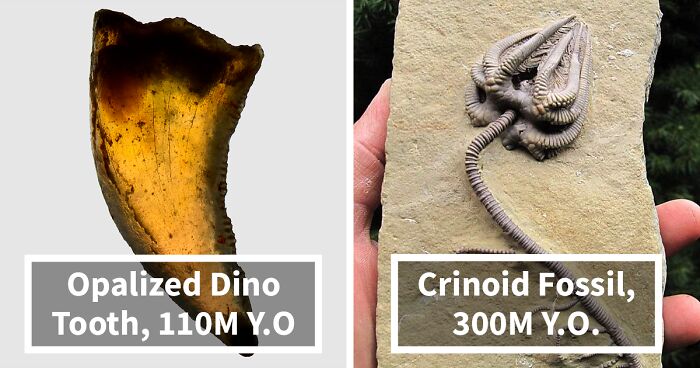
Some fossils are scientifically important. Others are visually spectacular. The very best do both while making your brain briefly forget how calendars work. They reveal creatures with five eyes, fish with wrist-like bones, dinosaurs sitting protectively on nests, and human ancestors whose footprints survived volcanic ash for millions of years.
This tour of 19 ancient fossils travels from microbial structures more than three billion years old to Ice Age tracks left by people walking among mammoths. Along the way, these famous fossil discoveries show how paleontology reconstructs prehistoric life from bones, teeth, skin impressions, chemical traces, and even a muddy step that happened at exactly the right time.
Fossils From the Earliest Chapters of Life
1. Stromatolites: The Layer Cakes That Helped Change a Planet
Stromatolites do not have jaws, claws, or dramatic movie-trailer music. They are layered structures built when microbial mats trapped sediment and minerals accumulated within the layers. Yet evidence of these structures reaches back roughly 3.5 billion years. Their makers helped shape Earth’s early environments, and oxygen-producing microbes eventually contributed to an atmosphere capable of supporting complex life. In other words, these lumpy rocks helped prepare the planet for almost everything else on this list. Quiet overachievers, basically.
2. Dickinsonia: The Ribbed Pancake With an Identity Crisis
About 558 million years ago, Dickinsonia rested or moved across Ediacaran seafloors, leaving oval, segmented impressions that resemble a quilted bath mat designed by aliens. Scientists debated for decades whether it was an animal, fungus, giant protist, or something belonging to an entirely vanished branch of life. Chemical evidence from preserved organic material supports an animal interpretation, although its exact place in the animal family tree remains puzzling. Few fossils make “What is that?” feel like such a serious scientific question.
The Cambrian Ocean Was Apparently Designed Without Adult Supervision
3. Opabinia: Five Eyes and a Vacuum-Hose Face
Opabinia looked as though several unrelated animals had been combined during a power outage. It had five eyes, a fan-shaped tail, and a long flexible proboscis ending in a grasping structure. Fossils from the Burgess Shale preserve details that normally vanish during decay, giving researchers an unusually sharp view of Cambrian soft-bodied life. The animal was not huge, but size is irrelevant when your face resembles a claw machine attached to a noodle.
4. Hallucigenia: The Fossil Scientists First Put Upside Down
The name Hallucigenia is not subtle, and neither was the animal. Its tiny wormlike body carried paired walking limbs and tall defensive spines. Early reconstructions famously placed the spines underneath as legs and the softer appendages above as tentacles. Better-preserved specimens eventually helped paleontologists turn the creature right-side up and connect it with the broader lineage that includes velvet worms. It is a perfect reminder that fossils do not arrive with assembly instructions.
5. Anomalocaris: A Predator Reassembled From “Different” Animals
Before paleontologists understood Anomalocaris, separate body parts were described as though they belonged to different creatures. Its circular mouth, grasping frontal appendages, swimming flaps, and large eyes finally came together into one extraordinary Cambrian predator. It was among the giants of its ecosystem, hunting in seas where many animals were only a few inches long. Imagine discovering that a shrimp, a jellyfish, and a mysterious disk in three museum drawers are actually pieces of the same swimming nightmare. That is the energy here.
6. The Tully Monster: Illinois’ Favorite Biological Question Mark
Tullimonstrum gregarium, the Tully monster, lived about 300 million years ago in the tropical coastal environment now preserved at Mazon Creek, Illinois. Its fossils show stalked eyes and a long proboscis ending in a toothy, claw-like mouth. A major analysis of thousands of specimens argued that it was a jawless vertebrate related to lampreys, although its classification has continued to inspire debate. Whatever its family connections, the state fossil of Illinois looks like a creature invented after someone lost a bet.
Fossils That Capture Evolution in Motion
7. Tiktaalik: The Fish With a Neck and Wrist-Like Bones
Discovered in Arctic rocks and dated to about 375 million years ago, Tiktaalik roseae combines fish features with traits associated with early land vertebrates. It had scales and fins, but also a mobile neck, a flattened head, sturdy ribs, and limb bones arranged in ways that could support the body in shallow water. Calling it “the fish that walked onto land” oversimplifies the story, but its anatomy beautifully documents a transitional stage. It is also evidence that your wrists have a very long and surprisingly fishy résumé.
8. Archaeopteryx: Feathers, Teeth, Claws, and One Famous Mosaic
Archaeopteryx fossils preserve elegant feather impressions alongside unmistakably dinosaurian features, including teeth, clawed fingers, and a long bony tail. Living around 150 million years ago, the animal became an enduring example of how evolution produces mosaics rather than tidy halfway creatures. It was not simply “half dinosaur, half bird.” It was an early avialan with its own complete way of life, and its limestone slabs remain among the most recognizable fossils ever uncovered.
9. Microraptor: The Four-Winged Dinosaur With Iridescent Feathers
Pigeon-sized Microraptor had long feathers on both its front and rear limbs, giving it the appearance of a tiny four-winged dinosaur. Exceptionally preserved fossils even retain microscopic structures that allowed researchers to infer glossy black, iridescent plumage similar to a crow’s. Whether it mainly glided, flapped, or used a combination of aerial behaviors remains a lively subject, but the fossil demonstrates that dinosaur feathers were not merely fuzzy insulation. Some were sophisticated, aerodynamic, and apparently fashionable.
10. Citipati on a Nest: The “Egg Thief” That Was a Parent
Early explorers found an oviraptorid dinosaur near eggs and assumed the animal had been raiding the nest, inspiring the name Oviraptor, or “egg thief.” Later discoveries transformed the scene. Fossils of close relative Citipati were preserved crouched over nests with arms spread across the eggs in a birdlike brooding posture. Embryos confirmed that the eggs belonged to these dinosaurs. A fossil once interpreted as evidence of criminal snacking became evidence of parental carea spectacular scientific plot twist written in stone.
Big Bodies, Bigger Teeth, and Extremely Bad News for Prey
11. SUE the T. rex: A Skeleton Full of Biography
SUE is not merely a large Tyrannosaurus rex; the specimen is an unusually complete record of one animal’s life. More than 40 feet long and roughly 90 percent complete by bone volume, SUE preserves evidence of healed injuries, disease, and the stresses endured by a massive predator. Rarely recovered bones, including the wishbone and belly ribs, helped researchers refine reconstructions of tyrannosaur anatomy. A great fossil shows a species. An exceptional fossil also shows an individualand SUE had clearly been through some things.
12. Denali’s Dinosaur “Dance Floors”
Skeletons reveal anatomy, but footprints reveal moments. Denali National Park contains areas with so many dinosaur tracks that researchers have nicknamed them “dinosaur dance floors.” Trackways can preserve direction, stride, body posture, group movement, and the presence of adults and younger animals. Some even include tail-drag marks. These trace fossils turn a rock surface into a scene: dinosaurs crossed wet sediment, perhaps together, and the ground recorded their passage like geological security footage.
13. A Megalodon Tooth Embedded in Whale Bone
Megalodon teeth are impressive on their own, with the largest reaching around seven inches along the diagonal. A tooth lodged in fossil whale bone is even more dramatic because it preserves an interaction between predator and prey. Whale fossils also carry deep gashes matching the serrated teeth of this enormous shark. Shark skeletons are mostly cartilage and rarely fossilize well, so teeth become the principal evidence. One tooth can reveal size, diet, evolutionary relationships, and a prehistoric day that went very badly for a whale.
14. Titanoboa Vertebrae: A School-Bus-Sized Snake From a Hotter World
The fossil vertebrae of Titanoboa cerrejonensis look modest until researchers compare them with the same bones from a modern anaconda. Scaling from those vertebrae suggests a snake roughly 45 feet long, possibly longer in the largest estimates, and weighing well over a ton. It lived about 60 million years ago in a tropical South American ecosystem alongside giant turtles and crocodile relatives. The fossil is both monster evidence and climate evidence because such an enormous cold-blooded animal required a warm environment.
Ice Age Fossils That Feel Uncomfortably Recent
15. The La Brea Dire Wolf Collection: Thousands of One Predator
La Brea Tar Pits in Los Angeles has produced fossils from more than 600 animal species, but its dire wolves are especially overwhelming. More than 4,000 individuals have been found there. Natural asphalt trapped herbivores, and struggling prey attracted carnivores, creating a repeated ecological trap. The resulting abundance lets scientists study variation, injuries, disease, diet, and population-level patternsnot just admire one glamorous skull. A wall of dire wolf fossils is where “rare glimpse of the past” becomes “the past has filled the entire room.”
16. Lyuba the Baby Mammoth: Deep Time With Eyelashes
Lyuba, a woolly mammoth calf discovered in Siberia in 2007, lived more than 40,000 years ago and was preserved with astonishing completeness. Skin, soft tissue, and internal structures allowed researchers to use medical and industrial CT scanners to examine development without dismantling the mummy. Unlike a mounted skeleton, Lyuba retains the vulnerable proportions of a very young animal. That intimacy changes the emotional scale of paleontology: the Ice Age stops being a chart and becomes one small mammoth with folded legs, a trunk, and a face.
Fossils That Put Our Own Story Underfoot
17. Lucy: A Partial Skeleton That Reframed Human Evolution
Lucy, specimen AL 288-1, is a roughly 3.2-million-year-old Australopithecus afarensis skeleton found in Ethiopia. Her anatomy combines clear adaptations for upright walking with traits useful for climbing, including long, curved toe bones. Lucy did not represent a simplistic missing link or a direct snapshot of modern humanity waiting to happen. Instead, she revealed a successful hominin body plan adapted to varied environments. Her skeleton helped make bipedalism feel less like a sudden invention and more like a long evolutionary experiment.
18. The Laetoli Footprints: A Family-Album Moment 3.6 Million Years Old
At Laetoli in Tanzania, early hominins walked across damp volcanic ash, and later ashfall helped preserve their tracks. The trail includes about 70 footprints extending nearly 88 feet. Foot shape and nearby fossils strongly associate the makers with Australopithecus afarensis. Bones can demonstrate that a species was capable of walking upright, but footprints show the act itself: heel down, weight forward, toes pushing off. They are not merely anatomical evidence. They are a sequence of ancient decisionsstep, balance, continue.
19. White Sands Footprints: Humans and Megafauna Sharing a Landscape
White Sands National Park preserves an extraordinary concentration of Ice Age tracks across the ancient Lake Otero basin. Human footprints occur in a landscape also crossed by mammoths, giant ground sloths, camels, dire wolves, and American lions. Some trackways capture behavioral clues rather than isolated steps, allowing researchers to investigate how people and large animals moved through the same wetlands. The fossils feel startlingly immediate because a footprint is not a body after death. It is a living person’s weight, briefly pressed into mud and carried across thousands of years.
The “Whoa” Experience: What Ancient Fossils Do to Your Sense of Time
The most memorable fossil experiences often begin with scale. You enter a museum gallery expecting “old bones,” then find yourself beneath the ribs of an animal longer than a city bus. A megalodon tooth looks less like a tooth than a polished chef’s knife. SUE’s skull is not simply large; it occupies space with the architectural confidence of a small vehicle. Numbers such as 66 million years are intellectually understandable, but a fossil gives them weight, texture, cracks, and shadows.
Then the smaller specimens steal the show. A feather impression around Archaeopteryx can be more astonishing than a giant skeleton because it records something delicate that should have disappeared. The fine limbs of Hallucigenia, the eye stalks of the Tully monster, or the microscopic structures that reveal Microraptor’s color make fossilization feel almost impossible. You start noticing how many unlikely events were required: rapid burial, limited decay, mineral-rich water, geological survival, erosion at the right moment, and finally a person looking at precisely the right patch of rock.
Footprints create a different reaction. A skeleton is an object; a trackway is an event. Standing near fossil tracks, you instinctively follow their direction. You wonder whether the animal was alone, whether the ground was slippery, whether it slowed, turned, hunted, carried something, or noticed danger. At Laetoli and White Sands, the emotional distance shrinks further. The track makers were not abstract “specimens.” They shifted weight from one foot to another. They crossed a place because they were going somewhere.
Fossils also teach the pleasure of being wrong productively. Scientists once reconstructed Hallucigenia upside down. Anomalocaris was assembled from parts initially assigned to separate animals. Oviraptorids were branded egg thieves before nesting fossils exposed them as attentive parents. These corrections are not embarrassments to hide; they are paleontology working properly. New evidence does not ruin the story. It makes the story better, stranger, and more precise.
Finally, ancient fossils create a useful kind of humility. Nearly every organism in the fossil record lived in a world that would be unfamiliar to usdifferent continents, climates, coastlines, predators, plants, and atmospheric conditions. Yet connections remain. Birds carry the dinosaur story into modern parks and parking lots. Human wrists reflect evolutionary structures inherited through deep vertebrate history. A step across wet ground still looks like a step, whether it happened this morning or millions of years ago.
That is the real “whoa.” Fossils are not dead things sitting outside time. They are surviving pieces of motion, growth, injury, feeding, parenting, migration, and ordinary life. The deeper you look, the less prehistoric life resembles a parade of monsters and the more it resembles a planet full of organisms solving problemssometimes with four wings, five eyes, seven-inch teeth, or a face shaped like a vacuum hose.
Conclusion: The Past Was Weirderand More FamiliarThan We Imagine
These 19 ancient fossils span billions of years, yet each compresses deep time into something visible and specific. Stromatolites record microbial engineering. Cambrian fossils preserve evolutionary experimentation at its most flamboyant. Transitional forms document major anatomical changes, while nests, wounds, bite marks, mummies, and footprints reveal behavior and individual lives. That combination is why famous fossils matter: they do not merely decorate natural history museums. They give prehistoric life evidence, personality, and occasionally an alarming number of eyes.