If your lower back feels like it spent the night sleeping on a stack of textbooks (and then asked for a second job),
you’re not alone. “Stiff lower back” is one of the most common complaints in modern liferight up there with “my phone battery is at 9%”
and “why does my body hate chairs?”
The good news: in many cases, gentle movement helps more than freezing up like a startled deer. The key word is
gentle. Your goal today isn’t to “stretch it until it behaves.” Your goal is to restore motion, wake up supporting muscles,
and tell your nervous system, “Hey, we’re safeno need to guard this area like it’s the last slice of pizza.”
Below are 8 of the best lower back pain stretches and exercises for relieving stiffness, improving mobility, and building the kind of core-and-hip support
that makes your back feel less cranky. No fancy equipment. No complicated choreography. Just practical moves you can actually do.
Before You Start: A 30-Second Safety Check
Most back pain improves with conservative care, but some symptoms mean you should pause the DIY routine and get medical advice urgently.
Don’t be a herobe a grown-up with a plan.
- Go to urgent care/ER now if you have new bowel/bladder control problems, numbness in the groin/inner thigh (“saddle” area), or rapidly worsening weakness.
- Call a clinician soon if pain follows major trauma (fall, car crash), comes with fever, unexplained weight loss, pain that’s intense at night, or pain with significant leg symptoms.
- Stop any exercise that causes sharp, escalating pain, pins-and-needles that intensify, or symptoms that spread further down the leg.
Why Your Lower Back Feels Stiff (Even If You “Did Nothing”)
Lower back stiffness is often a teamwork problem: joints, muscles, and your nervous system all contribute. Many “stiff back” flare-ups aren’t a single
dramatic injurythey’re the result of small, repeated stressors. Think: long sitting, rushed lifting, weekend-warrior workouts, stress, poor sleep,
or suddenly deciding you’re a gardening influencer for eight straight hours.
Common (and fixable) contributors
- Tight hips (hip flexors) from sitting: When the front of your hips stays shortened, your pelvis can tip in ways that irritate the lower back.
- Tight hamstrings: These can tug on the pelvis and make the back feel like it has to “do the moving” for everything else.
- Sleepy glutes and deep core muscles: If they don’t fire well, your lower back may overwork to stabilize you.
- Guarding (protective tension): Pain can make muscles tighten reflexively, which reduces motion and increases stiffness.
How to Use This List (So It Actually Works)
- Start small: Two to five minutes is still a win if you do it consistently.
- Move like you’re turning a dimmer switch: Slow, controlled range of motion beats aggressive yanking.
- Breathe: Exhale during effort. A held breath often equals a held back.
- Pick the “direction” your back likes: Some people feel better with gentle flexion (knees-to-chest, child’s pose). Others feel better with gentle extension (press-ups). If one direction clearly increases symptoms, skip it for now.
- Consistency > intensity: The best routine is the one you’ll repeat tomorrow.
8 Best Lower Back Pain Stretches and Exercises
You can do these as a sequence or pick 3–5 that feel best. If you’re very stiff, start with mobility (Cat–Cow),
then stretching (Child’s Pose, Hip Flexor, Hamstrings), then strengthening (Bridge, Bird Dog).
1) Cat–Cow (Spinal Mobility Reset)
Think of this as “oil for your spine.” It gently moves your back through flexion and extensionoften easing stiffness without forcing anything.
How to do it
- Start on hands and knees: hands under shoulders, knees under hips.
- Cow: Inhale, gently arch your back, lift your chest, and let your belly soften.
- Cat: Exhale, round your back, gently tuck your pelvis, and draw your belly in.
- Move slowly and smoothlyno snapping into position.
Dosage: 6–10 slow cycles, 1–2 rounds.
Tip: If wrists complain, do this on fists or forearms, or place hands on a couch/bench to reduce load.
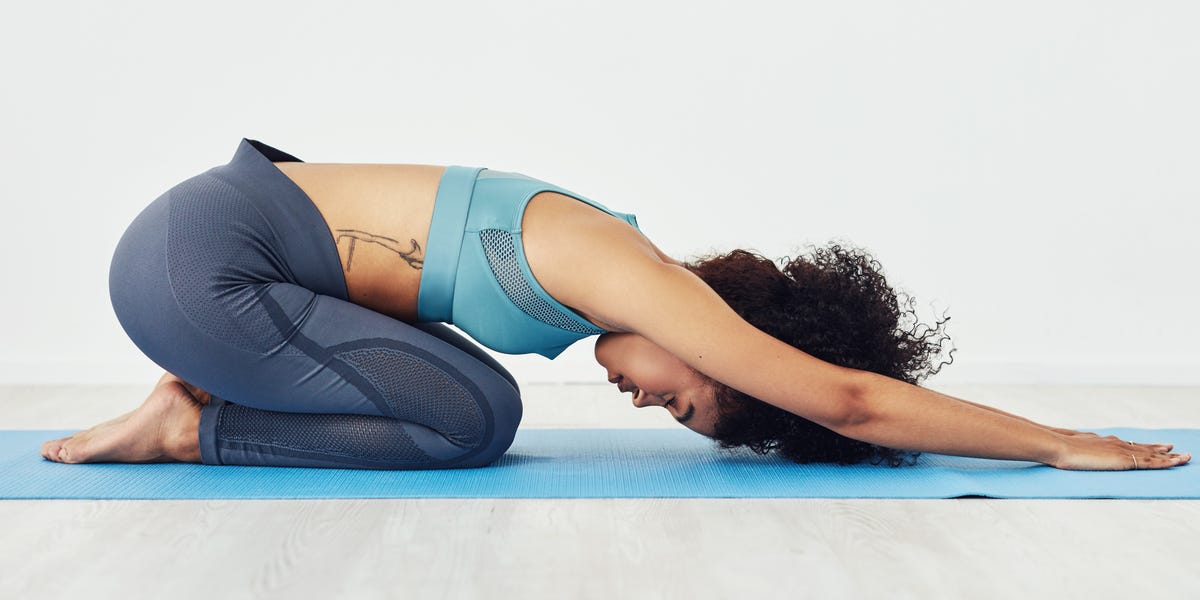
2) Child’s Pose (Back-and-Hip Decompression)
This is a calming stretch that lengthens the muscles along your back and can feel especially good after sitting or standing all day.
How to do it
- From hands-and-knees, bring big toes together and knees comfortably apart.
- Sit your hips back toward your heels.
- Walk hands forward and rest your forehead on the floor (or a pillow).
- Breathe slowlyaim for “soft ribs, soft shoulders.”
Dosage: Hold 10–30 seconds, repeat 2–3 times.
Modify: Put a pillow between hips and heels if knees are tight, or widen knees if your hips feel pinched.
3) Single Knee-to-Chest (Lower Back & Glute Stretch)
This is a classic for a reason: it gently stretches the lower back and buttock area and can reduce the “stuck” feeling after long sitting.
How to do it
- Lie on your back with knees bent, feet on the floor.
- Bring one knee toward your chest, holding behind the thigh or on the shin.
- Keep the other foot down for stabilityor extend the other leg if that feels better.
- Stay relaxed in the neck and jaw (yes, your jaw can absolutely make your back grumpy).
Dosage: Hold 5–10 seconds, repeat 5–10 times per side. Or hold 20–30 seconds for 2–3 rounds.
Option: If it feels great, you can try double knee-to-chestonly if it doesn’t increase symptoms.
4) Prone Press-Up (McKenzie-Style Extension for “Sitting Back”)
If your back hates sitting and loves standing or walking, gentle extension can sometimes feel like hitting “undo.”
This move may also help some people with symptoms that centralize (leg discomfort moves closer to the back).
If extension worsens your symptoms, skip it.
How to do it
- Lie on your stomach, forehead resting on hands for a moment. Breathe.
- Place hands under shoulders like you’re about to do a push-up.
- Press your upper body up while keeping hips/pelvis heavy on the floor.
- Only go as high as comfortableno pinching, no sharp pain.
- Lower back down with control.
Dosage: 5–10 reps, pausing 1–2 seconds at the top.
Modify: Start on forearms (a smaller “cobra”) if full press-ups are too much.
5) Half-Kneeling Hip Flexor Stretch (The “Sitting Tax” Refund)
Tight hip flexors can pull your pelvis forward and make the lower back feel overworked. This stretch targets the front of the hipoften a huge missing piece.
How to do it
- Kneel on one knee, other foot in front (a comfortable lunge stance).
- Tuck your pelvis slightly (think: “zip up jeans,” not “dramatic butt squeeze”).
- Shift forward until you feel a stretch in the front of the kneeling hip.
- Keep ribs stacked over hipsavoid leaning back like you’re dodging responsibility.
Dosage: Hold 20–45 seconds, 2 rounds per side.
Add-on: Raise the arm on the kneeling side and reach slightly overhead for a deeper stretch.
6) Supine Hamstring Stretch (With a Towel or Strap)
When hamstrings are tight, they can tug the pelvis and contribute to that “pulled-tight” low back feeling.
A strap version keeps the stretch controlled and back-friendly.
How to do it
- Lie on your back with one knee bent, foot on the floor.
- Loop a towel/strap around the other foot.
- Slowly straighten and raise that leg until you feel a hamstring stretch (back of thigh).
- Keep the stretch mild-to-moderateno shaking, no grimacing.
Dosage: Hold 20–45 seconds, 2 rounds per side.
Modify: Keep the knee slightly bent if straightening the leg pulls on your back.
7) Glute Bridge (Build the Support Your Back Wishes It Had)
Bridges strengthen glutes and help share the workload so your lower back isn’t doing unpaid overtime.
The goal is hips doing the lifting, not your spine doing gymnastics.
How to do it
- Lie on your back, knees bent, feet flat about hip-width.
- Gently brace your core (imagine tightening a wide belt).
- Squeeze glutes and lift hips until your body forms a straight line from knees to shoulders.
- Pause for a breath or two, then lower slowly.
Dosage: 8–12 reps, 2–3 sets.
Form check: If you feel it mostly in your lower back, reduce range of motion and focus on glute squeeze + core brace.
8) Bird Dog (Core Stability Without the Crunch Drama)
Bird Dog trains the deep core and back-supporting muscles to stabilize your spine while your arms and legs moveaka real life.
It’s one of the best “teach your back to chill” exercises.
How to do it
- Start on hands and knees.
- Brace lightly through the coreimagine balancing a glass of water on your low back.
- Extend one leg behind you while reaching the opposite arm forward.
- Hold briefly, then return with control and switch sides.
Dosage: 6–10 reps per side, 1–3 sets. Hold each rep 2–5 seconds.
Modify: Do just legs or just arms if coordination or back sensitivity is an issue.
A Simple 10-Minute Routine for a Stiff Lower Back
If decision fatigue is real (it is), try this sequence 4–6 days per week for two weeks:
- Cat–Cow: 8 slow cycles
- Child’s Pose: 20 seconds x 2
- Hip Flexor Stretch: 30 seconds per side
- Hamstring Stretch: 30 seconds per side
- Glute Bridge: 10 reps x 2
- Bird Dog: 6 reps per side
Optional: If your back feels better with extension, add 5 gentle press-ups after Cat–Cow.
Common Mistakes That Keep Stiffness Sticking Around
- Going to 100% range on day one: Stiff tissues don’t love surprises. Build gradually.
- Stretching only the back: Hips and upper legs often drive the problemand the solution.
- Holding your breath: If you’re not breathing, your nervous system reads “danger,” not “relief.”
- Doing nothing between workouts: Short movement breaks (even 60 seconds) can beat a single long session.
When to Get Extra Help (And What to Ask For)
If your back pain lasts more than a few weeks, worsens, keeps returning, or limits normal life, it’s reasonable to consult a clinician or physical therapist.
You can ask about movement-based rehab, core/hip strengthening, and a personalized home programbecause “just rest” is rarely the whole answer.
Real-Life Experiences: What Actually Helps a Stiff Lower Back (and What Doesn’t)
If you asked a room full of people with recurring lower back stiffness what finally helped, you’d hear a pattern:
it usually wasn’t one magical stretch. It was a handful of small changes done consistentlyplus a little humility.
(Yes, even the guy who “never stretches” eventually stretches. He just doesn’t call it that.)
A common story starts at a desk. Someone sits for hours, stands up, and their back feels like a rusty hinge.
They try a big forward bend to “loosen up,” feel a quick pull, and decide stretching is overrated.
What tends to work better is the unglamorous combo: gentle Cat–Cow for motion, a short hip flexor stretch to undo the sitting posture,
and then a few bridges to wake up the glutes. People often describe the first week as “fine, I guess,” and the second week as
“wait… why is getting out of the car easier?”
Another classic experience is the weekend-warrior flare-up: cleaning the garage, moving boxes, or doing yardwork like you’re training for the Olympics.
The back tightens up later that day, and the instinct is to go full statue mode. But many people notice that careful, frequent movement beats total rest.
A short routinetwo minutes here, five minutes therecan calm things down faster than one intense session.
They’ll often say walking helps, too, especially when it’s easy and steady instead of a speed-walk fueled by frustration.
Gym-goers have their own version: heavy lifting with great intentions and questionable warm-ups.
When stiffness hits, some immediately blame squats or deadlifts. Sometimes the issue isn’t the liftit’s the setup around it:
sitting all day, then going from zero to heavy without restoring hip motion or core control.
People who do best long-term often add a “boring but effective” warm-up: hip flexor stretch, hamstring stretch, a few bridges, and Bird Dogs.
It doesn’t feel heroic. It just makes their back feel less like it’s auditioning for a drama series.
Then there’s the sleep factor. Plenty of people notice their lower back stiffness is worse after poor sleep or high stress.
That doesn’t mean the pain is “all in their head.” It means the nervous system is part of the equation.
When stress is high, muscles guard more, breathing gets shallow, and recovery slows down.
In practice, adding slow breathing during Child’s Pose or taking a calm walk can reduce the intensity of stiffness
in a way that “stretch harder” never could. Many people describe it as flipping the body from “alarm mode” to “repair mode.”
Finally, there’s the biggest unlock: learning what your back likes today. On some days, flexion moves like knees-to-chest feel amazing.
On other days, gentle press-ups are the only thing that makes standing feel normal.
People who improve tend to stop treating the back like a stubborn machine that needs forceand start treating it like a system that responds to signals.
The best signal is consistent, respectful movement. The worst signal is panic (followed closely by wrestling your hamstrings like they owe you money).
If you take one practical lesson from all these experiences, let it be this: your lower back usually doesn’t need punishment.
It needs cooperationfrom your hips, your core, your daily habits, and your patience. Annoying? Sometimes. Effective? Very.
Conclusion
A stiff lower back is often your body asking for better movement optionsnot a lifetime sentence.
Use the 8 stretches and exercises above to restore mobility, address tight hips and hamstrings, and strengthen glutes and core.
Start gently, stay consistent, and treat discomfort as feedbacknot a dare.