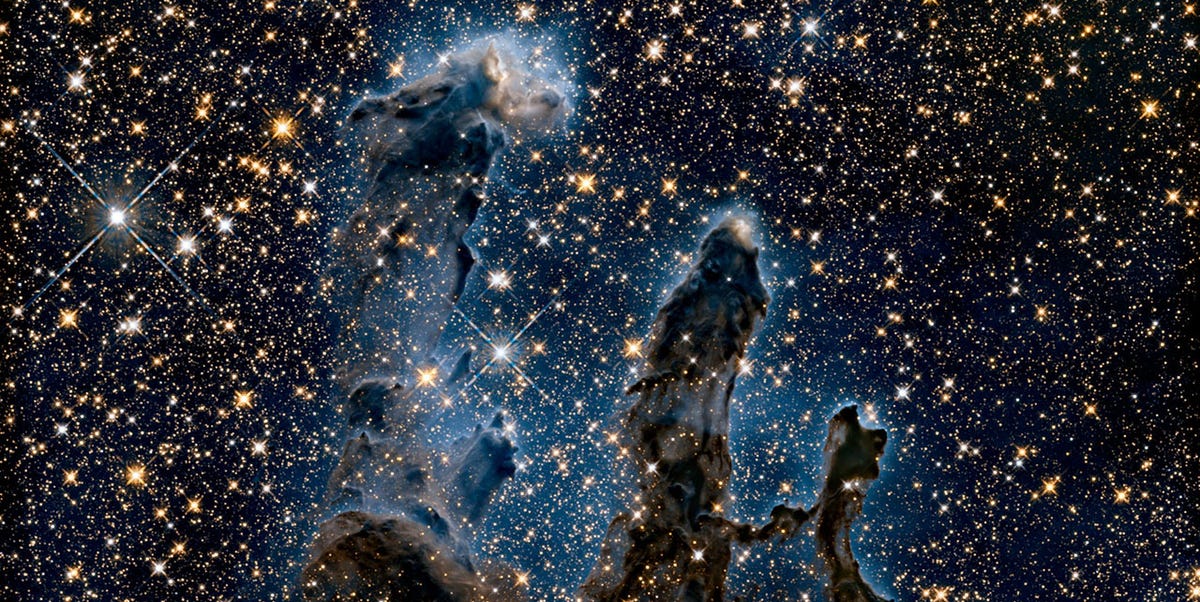
Some space images make us say, “Wow.” Others make us stop mid-scroll, forget our coffee, and suddenly feel like tiny philosophical specks with Wi-Fi. The Pillars of Creation belong firmly in the second category. These towering columns of gas and dust inside the Eagle Nebula have become one of the most beloved astronomy images ever captured, not only because they are beautiful, but because they tell a dramatic story about birth, change, time, and the universe’s astonishing talent for visual poetry.
Located in Messier 16, also known as the Eagle Nebula, the Pillars of Creation sit roughly 6,500 to 7,000 light-years from Earth in the constellation Serpens. They are not “pillars” in the stone-and-marble sense, of course. They are immense clouds of cool interstellar gas and cosmic dust, sculpted by radiation and stellar winds from young, hot stars nearby. Yet the nickname fits perfectly. They rise like cathedral towers, cosmic cliffs, or the universe’s own slightly overdramatic stage set.
So why do we love the Pillars of Creation so much? Because they are science and art sharing the same telescope. They are a star nursery, a natural sculpture, a lesson in impermanence, and a reminder that the universe is not empty darkness. It is busy. It is creative. It is, apparently, very good at branding.
What Are the Pillars of Creation?
The Pillars of Creation are dense formations inside the Eagle Nebula, a region where new stars are forming. These structures are made mainly of hydrogen gas and dust, the basic cosmic ingredients from which stars can be born. Inside and around the pillars are small, dense pockets where gravity can pull material together. Over time, some of these clumps may collapse enough to form young stars.
The name became famous after the Hubble Space Telescope captured the region in 1995. The image showed three dramatic columns rising from a glowing nebular background. Scientists already knew such star-forming regions existed, but Hubble gave the public a detailed, unforgettable look. Suddenly, a distant astrophysical process had a faceor at least a very photogenic silhouette.
The Eagle Nebula: The Pillars’ Cosmic Neighborhood
The Eagle Nebula is a large emission nebula, meaning it glows because energetic radiation from young stars excites gas in the surrounding cloud. The nebula spans dozens of light-years, while the famous Pillars of Creation are only one feature within it. In other words, they are the celebrity guests at a much larger cosmic party.
At the heart of this region are young, massive stars that blast ultraviolet light and stellar winds into the surrounding gas. This energy carves, compresses, and erodes the nebula. The pillars survive because they contain denser material than their surroundings. Less dense gas is stripped away more quickly, leaving behind these striking towers. Nature, it turns out, has been doing slow-motion sculpture long before humans invented museums.
Why the Hubble Image Became an Icon
The 1995 Hubble image of the Pillars of Creation became one of the most recognizable space photographs in history. It appeared in textbooks, documentaries, classrooms, posters, museum exhibits, screensavers, science magazines, and probably at least one teenager’s bedroom next to a glow-in-the-dark solar system mobile.
Part of its power comes from composition. The pillars look almost architectural. They have height, texture, contrast, and mystery. The human brain loves patterns, and the Pillars of Creation offer just enough familiarity to invite comparison: mountains, towers, smoke, waves, fingers, temples, trees, and storm clouds. But they are none of those things. They are stranger, bigger, and older than ordinary experience.
A Perfect Blend of Beauty and Meaning
Many astronomical images are beautiful, but the Pillars of Creation carry a built-in story. They are not just pretty clouds. They are places where stars are being formed while the same forces that encourage star birth are also slowly destroying the structures themselves. Creation and destruction happen together. That tension gives the image emotional depth.
It is easy to understand why people respond to the image even without knowing the science. The scene looks sacred, ancient, and alive. Add the knowledge that those wispy towers may hide newborn stars, and the image becomes more than scenery. It becomes a visual metaphor for beginnings hidden inside darkness.
How the James Webb Space Telescope Changed the View
When the James Webb Space Telescope revisited the Pillars of Creation, it did not simply remake Hubble’s famous image. It revealed new layers. Webb observes primarily in infrared light, which can pass through dust more effectively than visible light. That means Webb can peer into regions that appear opaque in Hubble’s visible-light images.
Webb’s Near-Infrared Camera, known as NIRCam, showed thousands of stars shining through and around the pillars. Some appear as bright young objects near the edges of the clouds. Webb’s Mid-Infrared Instrument, or MIRI, produced a moodier view, emphasizing cooler dust and dense structures. If Hubble gave us the grand portrait, Webb handed us the backstage pass.
Why Infrared Light Matters
Visible light is what human eyes detect, but space hides many secrets behind dust. Infrared astronomy helps scientists study objects and regions that would otherwise remain obscured. In the Pillars of Creation, infrared observations help reveal young stars, dusty cocoons, and the structure of the clouds in greater detail.
This matters because star formation is not a clean, simple process. It is messy, turbulent, and slow. Gas collapses, radiation pushes outward, magnetic fields complicate the picture, and gravity patiently tries to win the argument. Webb’s observations help astronomers build better models of how stars form in environments like the Eagle Nebula.
The Science Behind the Beauty
The Pillars of Creation are beloved partly because they look magical, but the science is even better. These columns are shaped by a process called photoevaporation. Ultraviolet radiation from hot young stars heats the surface of the gas clouds, causing material to stream away into space. The result is a glowing, eroding edge around the pillars.
At the same time, dense knots inside the clouds can resist erosion. Some of these knots are called evaporating gaseous globules, often shortened to EGGs. Yes, astronomers named star-forming clumps “EGGs.” Science can be serious and still enjoy a pun. These EGGs may contain young stellar objects or material that could eventually collapse into stars.
Creation and Destruction in the Same Frame
The phrase “Pillars of Creation” is poetic, but the region could just as easily be called the “Pillars of Creation and Gradual Cosmic Sandblasting.” The same radiation that reveals and shapes the pillars also eats away at them. This makes the image a snapshot of a temporary phase in a much longer story.
That impermanence is part of the appeal. We are looking at structures that are changing, even if the changes happen on timescales far longer than a human life. The pillars are not permanent monuments. They are clouds caught in the act of becoming something else.
Why the Pillars Feel Personal
It may seem strange to call a region thousands of light-years away “personal,” but the Pillars of Creation touch something deeply human. We love beginnings. We love hidden possibilities. We love seeing evidence that the universe is still making things. In a world where many headlines feel like poorly written disaster trailers, the Pillars remind us that creation is not finished.
There is also the simple thrill of scale. The largest structures in the Pillars of Creation stretch several light-years. A light-year is the distance light travels in one year, and light is not exactly strolling. When we say one pillar is several light-years tall, we are describing a size so large that ordinary language starts sweating.
A Cosmic Mirror for Human Curiosity
The Pillars of Creation are not only objects of study; they are symbols of curiosity. They show what happens when humans build tools powerful enough to extend our senses. Hubble and Webb do not merely take pictures. They translate the universe into forms we can study, share, and feel.
That translation matters. Most people will never calculate stellar wind pressure or analyze nebular emission lines. But they can look at the Pillars and ask, “What is happening there?” That question is the doorway to science. Wonder often arrives before understanding, wearing a very dramatic cape.
Why We Keep Returning to This Image
One reason the Pillars of Creation remain popular is that each new telescope view changes the story. The 1995 Hubble image introduced the icon. Hubble’s later high-definition revisit sharpened the structure and allowed astronomers to compare changes over time. Webb’s infrared observations opened deeper views into the dusty clouds. NASA’s 3D visualization, created using Hubble and Webb data, helped audiences imagine the pillars as real three-dimensional structures rather than flat artwork.
Every return adds context. The image does not become old; it becomes richer. Like a favorite song heard through better headphones, the Pillars reveal new details when technology improves.
The Pillars as Public Science
The Pillars of Creation are also a triumph of science communication. They help explain concepts that can otherwise feel abstract: stellar nurseries, nebulae, infrared astronomy, interstellar dust, radiation, gravity, and cosmic timescales. A single image can invite millions of people into astronomy without requiring them to first survive a college physics textbook.
That does not make the image “just pretty.” It makes it powerful. A good astronomy image can educate, inspire, and emotionally connect people to research. It can turn a distant cloud into a shared cultural landmark.
How the Pillars Teach Us About Star Formation
Stars form when regions of gas and dust become dense enough for gravity to pull material inward. As the material collapses, it heats up. Eventually, if conditions are right, nuclear fusion ignites in the core, and a new star begins its life. The Pillars of Creation offer astronomers a dramatic environment for studying parts of this process.
However, the pillars do not provide a simple “star factory” diagram. Some regions may actively form stars, while others may be too disrupted by radiation. The surrounding young stars can both trigger and halt star formation. By compressing gas, radiation may help create dense clumps. By eroding gas, it may also remove material before stars can fully form. The universe is efficient, but it is not tidy.
Why Astronomers Compare Different Wavelengths
Different wavelengths of light reveal different physical features. Visible light highlights glowing gas and dark dust lanes. Near-infrared light shows stars hidden behind dust. Mid-infrared light emphasizes cooler dust and dense cloud structures. X-ray observations can reveal energetic young stars and hot plasma. By comparing these views, astronomers build a more complete picture of the region.
This is why the Pillars are not just one famous image. They are a multiwavelength laboratory. Hubble, Webb, Chandra, and other observatories each contribute a different chapter. Together, they show that space is not silent emptiness; it is a layered, energetic environment where matter is constantly being reshaped.
The Emotional Power of Cosmic Scale
The Pillars of Creation make us feel small, but not in a gloomy way. They make us feel small in the way standing beside the ocean does: humbled, refreshed, and slightly suspicious that our inbox is not as important as it claimed this morning.
Cosmic scale can be comforting because it rearranges perspective. A region 7,000 light-years away does not solve everyday problems, but it does widen the room in which those problems exist. The Pillars remind us that reality is larger than schedules, bills, traffic, and the mysterious disappearance of matching socks.
Beauty That Belongs to Everyone
Another reason we love the Pillars is that no one needs special permission to appreciate them. You do not need to be a scientist, a student, or an expert in astrophotography. You can simply look and feel awe. Then, if curiosity strikes, the science is there waiting.
This is one of astronomy’s greatest gifts. It offers beauty first and complexity second. The Pillars invite everyone in, then reward deeper attention with richer meaning.
Experiences That Help Explain Why We Love the Pillars of Creation
Imagine seeing the Pillars of Creation for the first time in a classroom. The lights are dimmed, the projector hums, and suddenly a glowing cosmic landscape fills the screen. Maybe the teacher explains that those towering shapes are made of gas and dust where stars are forming. Maybe half the class is impressed, while the other half is pretending not to be impressed because middle school has strict emotional regulations. But the image sticks. Years later, someone may not remember the quiz, but they remember those pillars.
For many people, that is the real magic of the Pillars. They create a first doorway into astronomy. A child who sees them may start asking what nebulae are, how stars form, or why telescopes need to orbit Earth. A teenager may discover astrophotography. An adult may return to space science after years of thinking it was “too complicated.” The image works like a cosmic invitation: come closer, there is more to learn.
There is also the experience of encountering the Pillars during a quiet late-night scroll. You are looking for nothing in particular, perhaps after reading three recipes, two news alerts, and one comment section that should have been sealed in a lead container. Then the Pillars appear. For a moment, the internet becomes what it promised to be: a window to wonder. The image interrupts ordinary noise with extraordinary scale.
People also love comparing the Hubble and Webb versions. Hubble’s visible-light image feels grand, painterly, and iconic. Webb’s infrared view feels more intimate and revealing, like the universe agreed to turn on a few hidden lamps. Looking at them side by side creates a satisfying “before and deeper” moment. It shows that science does not replace wonder with facts; it expands wonder by adding layers.
Another powerful experience is realizing that the Pillars are not frozen sculptures. They are changing. Radiation is eroding them. Stars may be forming inside them. Light from the region has traveled thousands of years to reach us. We are seeing ancient light, but the processes it shows are part of the ongoing life cycle of matter. That thought can make the image feel almost alive.
The Pillars also make an excellent shared experience. Families can look at them together and talk about space. Teachers can use them to explain light-years and star birth. Writers can use them as metaphors. Artists can study their colors and textures. Scientists can analyze their structure. The same image can belong to a museum wall, a research presentation, a phone wallpaper, and a child’s science fair project. Very few objects can handle that much career diversity.
Perhaps the deepest experience is emotional. The Pillars of Creation remind us that beauty does not have to be close to matter. Something unimaginably distant can still move us. Something made of dust can still feel majestic. Something temporary can still become iconic. That is why the Pillars continue to matter. They are not merely columns in a nebula; they are proof that the universe can be understood and still remain astonishing.
Conclusion: Why the Pillars Still Matter
We love the Pillars of Creation because they do what the best cosmic images do: they make the invisible feel intimate. They show star formation as both a scientific process and a visual wonder. They connect Hubble’s legacy, Webb’s new vision, and humanity’s endless curiosity about where we came from and what the universe is still becoming.
The Pillars are beautiful, but beauty is only the beginning. They teach us that stars are born in darkness, that creation and destruction can happen in the same place, and that even dust can become something luminous. They are a reminder that the universe is not a finished object. It is a story still being written, one cloud, one star, and one breathtaking telescope image at a time.