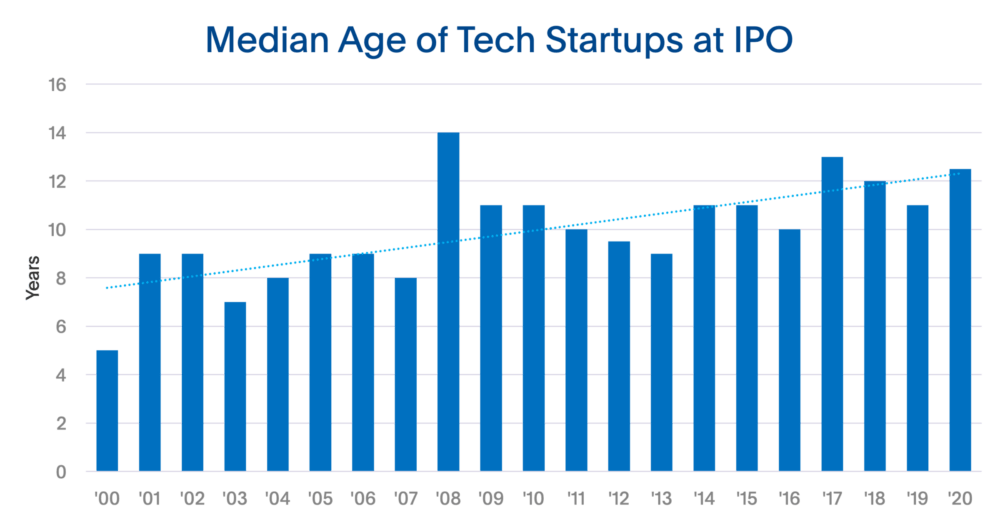
In startup years, 12 years can feel like several geological eras. A founder begins with a laptop, a stubborn belief, and coffee strong enough to negotiate enterprise contracts. A dozen years later, the same company may have thousands of customers, a serious finance team, and a ticker symbol waiting in the wings.
That long arc is not a failure of ambition. It is how subscription software usually earns the right to become public. A 2025 review of 78 SaaS IPOs found a median journey of 11 years from founding to listing and an average of 12 years. The average is pulled upward by a few marathon companies, but the message is clear: SaaS success is usually built over a decade, not a launch weekend.
For founders, employees, and investors, the useful question is not, “How do we squeeze 12 years into three?” It is, “What must be true at year three, year seven, and year eleven so the business is ready when the public-market window opens?”
Why the Average SaaS IPO Takes 12 Years
A SaaS company does not go public simply because it has a clever product or a massive total addressable market. It must prove that recurring revenue is durable, customer demand can be repeated, growth can be financed sensibly, and leadership can operate under public scrutiny.
Recurring Revenue Must Become Predictable Revenue
Monthly recurring revenue looks lovely in a dashboard, but public investors want to know what supports it. Are customers renewing? Are they spending more over time? Is revenue spread across a healthy base of accounts? Does growth come from genuine value or from sales incentives that would make a carnival barker blush?
That is why mature SaaS companies track ARR, net revenue retention, gross retention, churn, bookings, gross margin, customer acquisition cost, and payback periods. No single metric is a golden ticket. Together, they show whether a company has built a compounding revenue engine rather than rented a temporary one.
Time matters because subscription quality becomes visible only after renewal cycles. A customer who signs in January is promising. A cohort that renews, expands, recommends the product, and stays through a budget freeze is evidence.
Enterprise Trust Is Earned Slowly
Business software buyers tend to move carefully. A deal can require security approval, legal review, procurement clearance, data-processing agreements, integrations, training, and a champion willing to defend the purchase when someone asks, “Can’t Excel do this?”
Winning that customer is only the beginning. The vendor must deliver uptime, responsive support, sensible pricing, and a roadmap that does not treat every customer request as an emergency sculpture project. Over time, these operational wins create reference accounts, partner channels, expansion opportunities, and a defensible reputation.
Scale Creates New Problems Before It Creates New Valuation
Early SaaS is a search for product-market fit. Late-stage SaaS is a test of organizational design. The business must hire leaders who can manage leaders, formalize go-to-market motions, forecast with less wishful thinking, and preserve product velocity while serving a much larger customer base.
Founder intuition does not replace financial discipline. Heroic all-nighters do not replace controls. A sales process that lives in one executive’s memory is not a sales process; it is a campfire story with commission expense.
What Public-Market Investors Want From a SaaS IPO
There is no universal revenue threshold that automatically unlocks the Nasdaq gates. Still, historical SaaS IPO research points to a familiar profile: meaningful revenue scale, strong growth, durable retention, a believable path to profitability, and an understandable equity story.
One historical benchmark described the median SaaS company at IPO as roughly 10 years old, with nearly $100 million in run-rate revenue, rapid growth, and continuing losses. That is useful context, not a checklist carved into a venture-capital tablet.
Efficient Growth Beats Growth at Any Cost
The “growth at any cost” era produced exciting charts and nervous CFOs. Today’s public investors are more selective. They want growth that survives closer inspection: expansion from existing customers, reasonable sales efficiency, healthy gross margins, and a cost base that can eventually produce free cash flow.
That does not mean every IPO candidate must already be highly profitable. It means losses need a coherent explanation. Spending can make sense when it creates durable market share, expands a proven product, or serves a large opportunity with clear unit economics. It becomes harder to defend when it merely turns revenue into an expensive magic trick.
Modern SaaS analysis increasingly emphasizes the balance between growth and profitability rather than top-line growth alone. A study of 115 software IPOs noted how macro conditions and investor preferences shifted toward efficient growth, while cloud-market research continues to show that sustainable growth and free cash flow both influence valuation.
The Equity Story Must Be Easy to Explain
Public investors do not need every internal spreadsheet. They do need clear answers: What problem does the company solve? Why do customers pay repeatedly? Why is the market large enough to support continued growth? What makes the business difficult to replace? Where will margin improvement come from?
Klaviyo offers a useful example of the long-game pattern. Founded in 2012 and public in 2023, it spent about 11 years building a recurring-revenue platform around commerce marketing and customer data. Rubrik, founded in 2014 and public in 2024, took roughly a decade to reach the market with a data-security story shaped by the growing importance of cyber resilience. OneStream’s 2024 debut came after roughly 14 years of building financial-close and performance-management software. Different products, different routes, same lesson: public readiness grows through years of execution, not one thrilling quarter.
Governance Is Part of the Product Now
Going public changes the company’s operating system. A registered offering requires a registration statement, and the prospectus must provide investors with material information about the business, finances, risks, and governance. That level of discipline cannot be assembled from spare parts the weekend before filing.
Companies need reliable close processes, auditable financial data, disclosure controls, board oversight, security practices, and leaders who can communicate bad news without hiding it under a motivational poster. Public-company readiness should begin well before an S-1 is drafted.
How the 12-Year SaaS IPO Timeline Usually Unfolds
Years 0–3: Find a Painkiller, Not a Party Trick
The opening phase is about solving a problem that is frequent, expensive, urgent, or deeply annoying. A “nice-to-have” can attract compliments; a painkiller earns budget. Founders should test pricing early, identify the buyer and user, and resist confusing feature requests with product-market fit.
The practical goals are demanding but clear: validate willingness to pay, find a repeatable customer profile, measure early retention, and build a product customers would miss if it disappeared tomorrow.
Years 3–6: Make Sales and Retention Repeatable
Once the product works, the next task is proving that it sells repeatedly without the founder dragging every deal across the finish line. Build a focused go-to-market motion, document qualification criteria, improve onboarding, and learn which channels produce customers who actually renew.
The tempting mistake is expanding too broadly. A company that sells to everyone often discovers it sells efficiently to no one. The stronger move is to dominate a wedge, build customer proof, and expand from credibility.
Years 6–9: Turn Momentum Into a System
At this stage, leadership must professionalize without becoming allergic to speed. The business needs a finance function that can forecast, a customer-success team that protects renewals, a product organization that prioritizes intelligently, and a leadership bench that can carry responsibility beyond the founders.
ARR growth should be accompanied by better visibility into retention, expansion, segment economics, and capacity planning. New products, international markets, channel partners, and acquisitions should reinforce the core story rather than turn the company into a garage after a yard sale.
Years 9–12: Build Optionality
The final stretch is about becoming ready before the company needs to be. Management should be able to pursue an IPO, remain private, raise more capital, or consider a strategic transaction without looking desperate.
Bessemer’s cloud-company guidance has emphasized substantial revenue scale and a path toward free-cash-flow breakeven before public markets become realistic. The exact threshold varies, but the principle is durable: build the company so an IPO is a financing and ownership choice, not an emergency exit door.
Why Market Timing Can Add Years
An IPO is not a graduation ceremony scheduled by the company alone. It depends on interest rates, comparable-company valuations, investor appetite, recent listing performance, and broader economic conditions. A company can be operationally ready while the market is emotionally unavailable.
That is why similar companies may list years apart. One may enter when software multiples are strong and investors want growth. Another may wait through a market reset, focus on efficiency, and emerge with a better-balanced story. The healthiest strategy is to prepare early, operate with public-company discipline, and choose the timing deliberately.
Common Mistakes That Stretch the Road to an IPO
- Confusing revenue growth with business quality: Revenue without retention, margin discipline, or a durable sales model eventually attracts difficult questions.
- Over-hiring before repeatability: Adding sellers does not fix an unclear ideal customer profile. It only creates a more expensive unclear profile.
- Ignoring customer concentration: A few large accounts can accelerate early growth but create serious risk when they dominate revenue.
- Delaying finance and security investment: Clean books, controls, privacy practices, and reporting systems are easier to build in layers than in a pre-IPO panic.
- Treating the IPO as the finish line: A public listing begins the recurring work of earning investor trust every quarter.
Should Every Successful SaaS Company Pursue an IPO?
No. An IPO is one path, not a merit badge. Some SaaS businesses are better served by staying private, selling to a strategic acquirer, accepting private-equity capital, or operating independently with healthy profitability.
The more useful ambition is IPO readiness rather than IPO obsession. IPO-ready companies tend to have better reporting, clearer strategy, stronger governance, disciplined unit economics, and more choices. Those strengths improve the business whether it lists, sells, or happily remains private.
Experiences From the Long SaaS Journey: What 12 Years Really Feels Like
Experience teaches a lesson that dashboards often hide: the SaaS journey is emotionally uneven. The first few years are full of tiny victories that feel enormous. A customer replies to an email. A product works in a real workflow. A renewal arrives without begging. A respected buyer says, “We are rolling this out to another team.” Nobody rings a bell for these moments, yet they become the building blocks of a future IPO.
By the middle years, the work changes. Founders stop being the only people who know where every wire is buried. They learn to delegate decisions, hire executives who may be better than they are in particular functions, and accept that a company can no longer be run through heroic improvisation. This is often the least glamorous stage. The product is no longer a secret, but the company is not yet famous. The team must keep improving onboarding, pricing, infrastructure, forecasting, and support while outsiders wonder why the rocket has not already reached the moon.
Veteran operators often describe a second kind of patience: patience with people. A great account executive may need time to learn a complex industry. A new product leader may need several quarters to repair a roadmap distorted by customer noise. A customer-success team may need a full renewal cycle before the company understands whether its onboarding changes actually work. Leaders who demand instant proof from every initiative can accidentally destroy the evidence they need.
There is also a practical lesson about capital. When money is plentiful, it is easy to mistake fundraising for validation. When money tightens, companies rediscover the calming beauty of customers who pay, renew, and expand. The goal is not to avoid investment; it is to ensure each dollar strengthens a business that can stand without constant applause from the next financing round.
Employees experience the 12-year journey differently. Early employees may watch their job transform three or four times. They join a 20-person business and later help build systems for hundreds or thousands of colleagues. Equity can be meaningful, but it should not be treated like a lottery ticket with a company logo. The most resilient teams value the skills, relationships, and customer impact they gain along the way, because any outcomeIPO, acquisition, or independent growthtakes time and is never guaranteed.
For founders, the most useful mindset is to build a company worth owning for 12 years, not merely one that can survive until an IPO. That means choosing a market you can keep learning, creating products customers genuinely rely on, communicating honestly during rough quarters, and making decisions that improve the next five years rather than the next five tweets. Public markets may eventually reward that discipline. More importantly, customers and teams usually do first.
Conclusion: Build for Durability, Then Earn the Right to Choose
The average SaaS IPO taking 12 years is not a warning label. It is a reminder that enduring software companies are assembled through repeated proof. They earn renewals, build trustworthy systems, evolve their teams, refine their economics, and develop a public-market story that can survive more than a charismatic launch day.
Founders should plan for a long road, invest in durable fundamentals, and make IPO readiness a byproduct of excellent operating discipline. The prize is not only a ticker symbol. It is a company with enough quality, resilience, and optionality to decide what comes next.