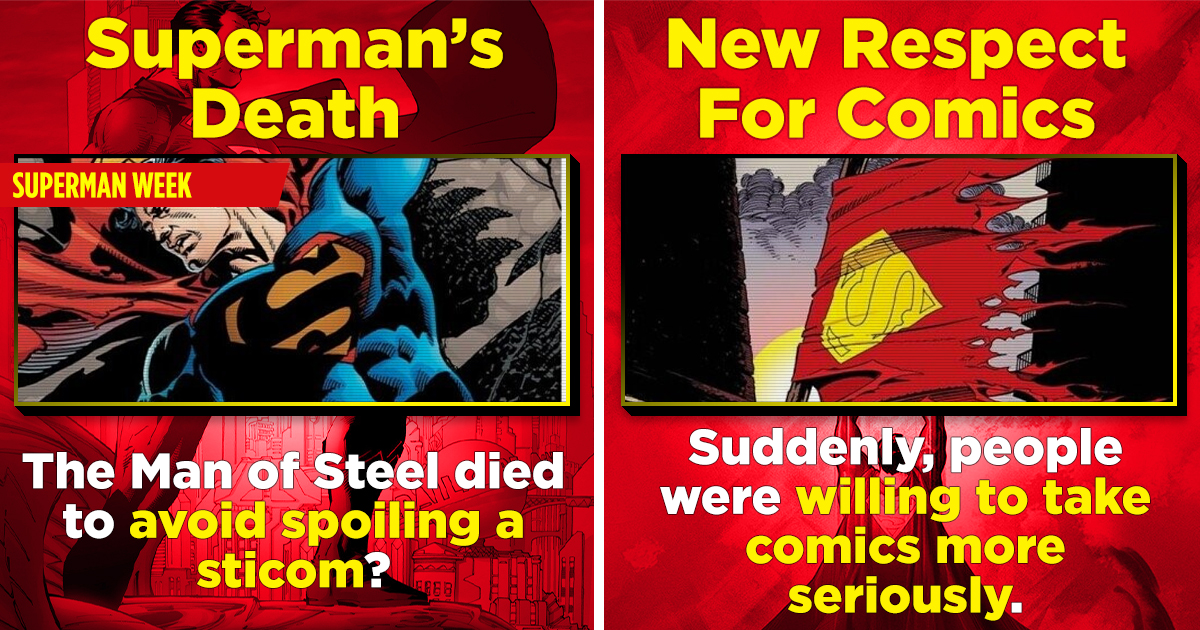
The Death of Superman was supposed to be a shocking comic book event. It became something bigger, stranger, louder, and far more influential than anyone at DC Comics could have neatly planned. In 1992, the Man of Steel faced Doomsday, a walking disaster with bone-like spikes, a bad attitude, and absolutely no interest in subtle storytelling. By the end of Superman #75, Superman was gone, Lois Lane was devastated, and comic shops were suddenly dealing with crowds that looked less like Wednesday regulars and more like people lining up for concert tickets.
What made the event fascinating was not only that Superman died. Comics had killed, rebooted, and resurrected characters before. The surprise was that mainstream America reacted as if a national monument had fallen over. Newspapers covered it. TV news discussed it. People who had not bought a comic book in years rushed to stores. Some bought a copy to read. Others bought one to seal away forever, apparently believing college tuition might someday be paid in mint-condition polybags.
Looking back, The Death of Superman is not just a famous superhero storyline. It is a pop culture earthquake that accidentally predicted the modern entertainment economy: event marketing, cinematic universes, legacy heroes, collector hype, temporary deaths, viral mourning, and the endless cycle of “no one is ever really gone.” The story may have been born in a comic book writers’ room, but its aftershocks reached movies, television, fandom, retail, and the way audiences talk about fictional icons.
Why the Death of Superman Hit So Hard
Superman was not simply another caped character. Since his 1938 debut in Action Comics #1, he had become the basic template for the superhero: alien origin, secret identity, bright costume, moral code, impossible strength, and a logo so recognizable it could probably survive a trip through a washing machine. He was not just a character people liked; he was part of the visual language of American pop culture.
That is why his death felt different. Batman could be broody, Spider-Man could be unlucky, the X-Men could be complicated, but Superman represented stability. He was the guy who caught the plane, saved the city, and still remembered to call his mother. Killing him was like announcing that the Statue of Liberty had decided to retire, move to Boca Raton, and stop holding the torch.
The creative team behind the event understood that Superman’s absence mattered more than the punch that ended the fight. The story was structured in three major emotional movements: the battle with Doomsday, the world without Superman, and the rise of several replacement Supermen. That middle section, often remembered as Funeral for a Friend, gave the event its real weight. It asked a deceptively simple question: what does the world look like when its most dependable hero is gone?
The answer changed pop culture in at least four major ways, many of them accidental.
1. It Turned Comic Book Storylines Into Mainstream News Events
Before The Death of Superman, comic book events were usually news inside comic book culture. Big crossovers mattered to readers, retailers, and collectors, but they did not always break into the broader public conversation. Superman’s death changed that. Suddenly, a monthly comic issue became the kind of story that newspapers, television segments, and casual readers could understand immediately.
The headline sold itself: Superman dies. No complicated continuity required. No need to explain multiverse history, Crisis reboots, or why Lex Luthor had once worn a green-and-purple battle suit that looked like a rejected kitchen appliance. Everyone knew Superman. Everyone understood what it meant for him to fall.
This helped create a new model for superhero publicity. A comic book story was no longer only a serialized adventure; it could be packaged as a cultural moment. Publishers learned that audiences responded to big, clean, emotionally charged hooks: a hero dies, a hero returns, a hero is replaced, a hero turns villain, a city is destroyed, a universe is rebooted. In other words, The Death of Superman helped teach the industry how to speak in headline form.
Modern superhero marketing still uses that language. Movie trailers tease the fall of a hero. Streaming shows announce “the end of an era.” Comic publishers build countdown campaigns around weddings, betrayals, deaths, and relaunches. Social media now does in minutes what newspapers and TV segments did in 1992, but the basic strategy is familiar: make the fictional event feel like real-world news.
The Accident: DC Did Not Just Sell a Comic; It Sold a Public Ritual
The story also made audiences participate in a collective mourning ritual. People bought the issue not only to read it, but to own a piece of the event. The black polybag edition, complete with memorial-style extras, turned the comic into an object of ceremony. It was not merely a book; it was a souvenir from the day Superman “died.”
That idea now drives huge portions of fandom. Limited-edition releases, exclusive covers, commemorative merchandise, premiere-night collectibles, convention variants, and “I was there” moments all operate on the same emotional frequency. Fans want the story, yes, but they also want proof that they were present when the story became history.
2. It Supercharged Collector Culture and Exposed Its Weaknesses
One of the most unforgettable parts of the Death of Superman phenomenon was the collector frenzy. Superman #75 arrived during the comic book speculation boom, a period when many buyers believed certain issues would become valuable simply because they were important, sealed, shiny, numbered, embossed, holographic, glow-in-the-dark, or otherwise dressed like a Las Vegas magician.
The black polybag edition was irresistible bait for that moment. It looked collectible. It felt historic. It came with extras. Most importantly, it asked buyers to make a choice: open the bag and read the comic, or keep it sealed and preserve the fantasy that it might one day become wildly valuable.
That tension became a perfect symbol of 1990s comics. Was a comic book a story, an art object, a childhood memory, or an investment vehicle? The answer, unfortunately, was often “yes,” followed by “please buy six copies.”
The sales were enormous, but the long-term lesson was more complicated. Many people bought copies assuming scarcity would create value. But when millions of copies exist, scarcity takes a coffee break. The event helped reveal a painful truth about collectibles: something is not automatically rare just because it is sealed in plastic and looks dramatic. A comic’s emotional value and financial value are not the same thing, even if your local shop in 1992 may have briefly made them feel identical.
The Accident: It Became a Warning Label for Hype
The collector boom did not collapse because of Superman alone, but The Death of Superman became one of the clearest examples of its excess. Publishers saw that special packaging could move huge numbers. Retailers saw lines around the block. New buyers saw the possibility of quick profit. Then the market learned that demand based on hype can disappear faster than Clark Kent when someone yells “falling helicopter.”
That lesson still applies today. Sneaker drops, limited vinyl, trading cards, steelbook movies, Funko exclusives, variant comics, and online collectibles all run on similar energy. The product matters, but the story around the product often matters more. The Death of Superman helped write the modern pop culture collector playbook: make it limited, make it emotional, make it feel historic, and watch fans decide whether to open it or preserve it like a tiny museum exhibit.
3. It Made Replacement Heroes and Legacy Characters Feel Bigger
The most interesting part of the event may not be Superman’s death at all. It may be what happened after. In Reign of the Supermen, four figures emerged in Superman’s absence: Steel, Superboy, the Eradicator, and Cyborg Superman. Each represented a different interpretation of what Superman could mean.
Steel carried the moral legacy. He was not Kryptonian, not invulnerable, and not pretending to be Clark Kent. He was a human being inspired by Superman’s example, building armor and stepping into danger because someone had to. Superboy represented youth, attitude, and genetic experimentation with a leather-jacket swagger that practically screamed “1993.” The Eradicator embodied Kryptonian power and alien severity. Cyborg Superman twisted the iconography into something sinister, proving that wearing the symbol did not automatically make someone worthy of it.
This was more than a mystery about which Superman was real. It was a pop culture laboratory for legacy. What makes a hero: powers, costume, values, public trust, sacrifice, branding, or all of the above? The storyline understood that Superman’s symbol could be inherited, misused, reinterpreted, and challenged.
That idea became central to later superhero storytelling. Batman was replaced after being broken in Knightfall. Green Lantern’s mantle shifted. Spider-Man’s clone saga played with identity and legitimacy. Decades later, audiences would embrace Miles Morales, Sam Wilson as Captain America, Jane Foster as Thor, Kamala Khan as Ms. Marvel, and many other legacy characters who ask similar questions: who gets to carry the symbol?
The Accident: It Helped Normalize the Hero as a Mantle
Superman was once treated as almost indivisible from Clark Kent. The Death of Superman saga complicated that. It suggested that a superhero identity could be a moral idea larger than the person wearing the cape. Today, that concept is everywhere. Superhero stories frequently explore succession, replacement, mentorship, and public meaning. A hero can be a person, but also a role, a myth, a community promise, and sometimes a marketing department’s happiest dream.
The legacy-hero model gives franchises flexibility. It lets publishers and studios continue a brand while introducing new perspectives. Done well, it deepens the mythology. Done lazily, it feels like someone changed the batteries in a famous costume. Reign of the Supermen showed both the risk and the reward. Not every replacement was meant to last, but several became important parts of DC history.
4. It Became a Blueprint for Superhero Adaptations
Once Hollywood and animation studios realized superhero stories could be treated as major mythic events, The Death of Superman became hard to resist. The premise is simple, visual, emotional, and dramatic: the strongest hero faces the unstoppable monster and pays the ultimate price. That is blockbuster grammar. You can almost hear the trailer music swelling by itself.
The storyline influenced multiple adaptations, including animated projects such as Superman: Doomsday, The Death of Superman, and Reign of the Supermen. Its DNA also appears in live-action superhero cinema, most obviously in the use of Doomsday and Superman’s death in Batman v Superman: Dawn of Justice. Whether fans loved or disliked those adaptations, the persistence of the idea says something important: the death-and-return structure became one of Superman’s defining modern myths.
That is remarkable because Superman was originally famous for survival, not mortality. He was the impossible rescue, the last-second save, the reassuring smile in the sky. After 1992, one of his most famous modern stories became the one where he could not simply shrug off the danger. Pop culture became obsessed with proving that even gods can fall, especially if the third act needs emotional stakes.
The Accident: It Helped Create the “Temporary Death” Problem
The downside is obvious: once audiences learn that death is often temporary, dramatic stakes become tricky. Comic book fans now greet many superhero deaths with a raised eyebrow and a calendar. The question is rarely “Will this character return?” It is “Will this character return before the next movie, relaunch, or anniversary issue?”
Still, the temporary death trope remains powerful when handled with emotional honesty. The value is not always in whether the character stays gone. The value is in what the absence reveals. Who steps up? Who breaks down? Who exploits the moment? Who carries the symbol? Who realizes, too late, what the hero meant?
That is where The Death of Superman still works. The event’s best idea was not that Superman could die. It was that people finally understood why he mattered.
What Pop Culture Learned From the Man of Steel Falling
The accidental legacy of The Death of Superman is a strange mix of brilliance and chaos. It gave comics a mainstream spotlight, but also encouraged stunt-driven storytelling. It brought new readers into shops, but fed speculation that later hurt the market. It expanded Superman’s mythology, but made resurrection feel almost routine. It inspired adaptations, but also created a challenge for storytellers trying to make superhero deaths feel meaningful again.
In that way, the event is perfectly 1990s: oversized, sincere, commercial, dramatic, and slightly ridiculous in the most lovable way. It gave readers a monster named Doomsday, a sealed black bag, a funeral, four replacement heroes, and a cultural moment that people still discuss decades later. Not bad for a story that began as a bold answer to a basic creative question: what happens if the world loses Superman?
Why the Story Still Matters Today
Superhero culture now dominates film, television, games, streaming, merchandise, conventions, and online debate. The modern audience is trained to expect interconnected events and emotional turning points. In that environment, The Death of Superman feels less like an oddity and more like an early prototype.
It predicted the way fans would gather around fictional milestones. It predicted the media appetite for superhero drama. It predicted the tension between storytelling and collectibility. It predicted the importance of legacy heroes. It even predicted the way superhero franchises would use death as both an ending and a temporary doorway to the next phase.
Most importantly, it reminded readers that Superman is not compelling because he is invincible. He is compelling because he chooses responsibility again and again. His death worked because his life had meaning. Without that foundation, the story would have been noise. With it, the event became a mirror showing how much culture had invested in one fictional man with a cape.
Experiences Related to “Death of Superman”: How the Event Feels From a Fan’s Perspective
Experiencing The Death of Superman is different depending on when you encounter it. For readers who were there in 1992, it was not just a storyline; it was a public happening. You might remember a local comic shop displaying the black-bagged issue behind the counter like it was radioactive treasure. You might remember adults who usually ignored comics suddenly asking, “So, did they really kill Superman?” You might remember the strange thrill of holding a sealed copy and wondering whether opening it made you a reader or ruined your future retirement plan.
For younger readers discovering the story later, the experience is more archaeological. You already know Superman comes back. The shock is gone. The question becomes: why did this become such a big deal? Reading it now feels like opening a time capsule from a decade when comics were loud, muscular, dramatic, and deeply convinced that extra packaging could solve almost anything. The art has that full-force 1990s energy. The pacing is blunt but effective. Doomsday is not exactly a subtle villain; he is less a character than a natural disaster wearing knuckles. But that is also why the story works. Superman is not debating philosophy with him. He is standing between destruction and everyone else.
The most memorable experience often comes from the aftermath. The funeral issues slow everything down. The world reacts. Lois grieves. Friends and heroes feel helpless. Citizens realize that the person they took for granted was the person holding the sky together. Those quieter moments give the event its emotional spine. Without them, The Death of Superman would be only a long fight. With them, it becomes a story about absence.
Then comes the fun part: the replacement Supermen. This is where the reading experience turns into a mystery box. Steel feels noble and grounded. Superboy feels like someone bottled teenage confidence and shook it too hard. The Eradicator feels severe and alien. Cyborg Superman feels wrong in a way that gets more interesting as the story unfolds. Each one makes you ask what you actually want from Superman. Do you want power? Kindness? Symbolism? Certainty? A jawline with excellent lighting?
From a pop culture perspective, revisiting the event today can also make modern superhero media easier to understand. When a movie kills a major character, when a show introduces a successor, when fans argue over whether a mantle should be passed on, or when a studio teases a resurrection, the shadow of The Death of Superman is nearby. The story trained audiences to treat superhero mythology as something public, emotional, collectible, and endlessly renewable.
The best way to experience it now is not to ask whether the death “counts.” Of course Superman returns. He is Superman. The better question is whether the story makes you feel the weight of a world without him. At its strongest, it does. And that is why, despite the hype, the gimmicks, the plastic bags, and the collector-market circus, The Death of Superman still has power. It captures a rare moment when pop culture paused to ask what one symbol meantand then accidentally built a roadmap for the next thirty years of superhero storytelling.
Conclusion
The Death of Superman accidentally changed pop culture because it did more than remove a hero from the page. It changed how people talked about comics, how publishers sold major events, how collectors treated single issues, how superhero stories handled legacy, and how adaptations approached mythic stakes. Some of its influence was inspiring. Some of it was messy. Some of it came sealed in a black polybag and should probably have been opened and read immediately.
But that is the charm of the whole saga. It is a sincere superhero epic wrapped in 1990s spectacle. It is both a meaningful story and a marketing thunderclap. It is a warning about hype and a celebration of why icons matter. Superman died, pop culture panicked, and the superhero industry learned lessons it is still using today.