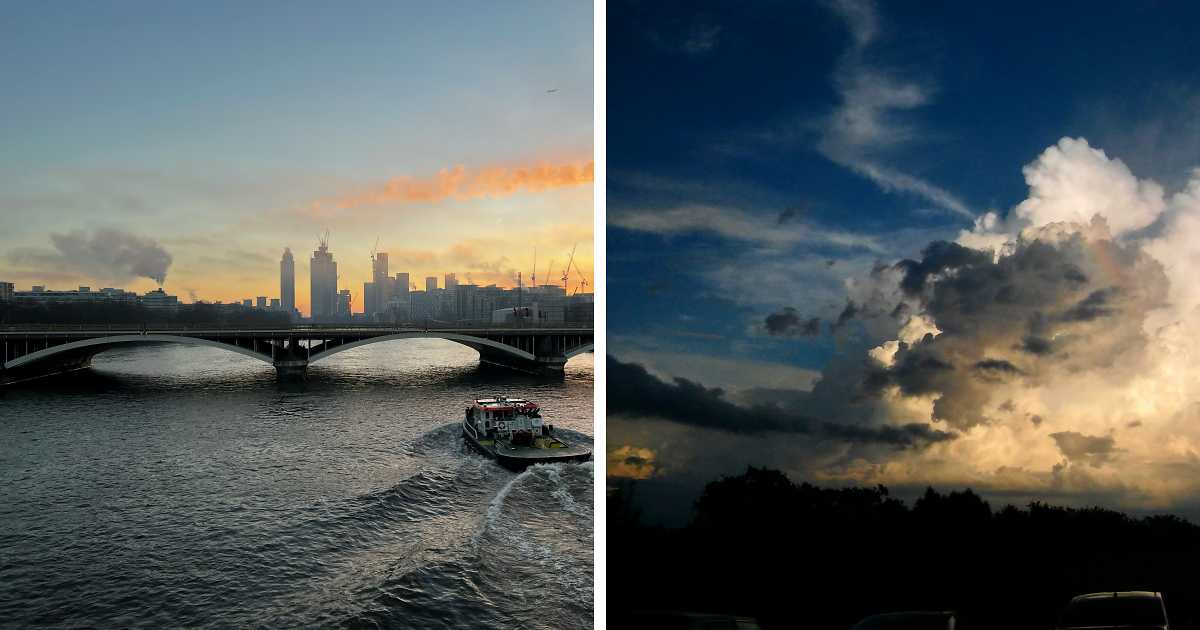
There is something wonderfully democratic about the sky. It h backyards, and that convenience store where you stopped only because the gas light was becoming emotionally threatening. Anyone can look up. Anyone can take a picture. And every so often, the atmosphere rewards that simple act with a scene that looks as though nature hired an expensive visual-effects department.
The best sky photos are not always technically perfect. Some are slightly crooked. Some contain power lines, dusty windows, or the corner of a neighbor’s roof. Yet they still capture a moment worth remembering: a thunderhead glowing like a mountain, a pink sunset reflected in a puddle, a moon balanced above a chimney, or a cloud shaped suspiciously like a duck wearing a hat.
So, Pandas, consider this an invitation. Search your camera roll, revisit the sunsets you could not resist, and share the most beautiful, strange, dramatic, or hilarious sky pictures you have taken.
Why We Never Seem to Get Tired of Sky Photos
The sky is familiar, but it is never truly repetitive. Light, moisture, wind, temperature, season, and location constantly rearrange the view. Even two photographs taken from the same porch can look completely different if one was captured during a calm blue morning and the other beneath a towering summer storm.
Clouds alone offer an enormous range of visual personalities. NOAA groups common clouds by form and altitude, including wispy cirrus, layered stratus, puffy cumulus, and rain-bearing nimbus formations. Knowing their names is optional, but recognizing their shapes can help photographers anticipate whether the sky may become colorful, moody, soft, or dramatically chaotic. otography also encourages attention. A person who regularly photographs clouds begins noticing small changes: light slipping beneath a cloud bank, the first hint of a rainbow, or the way a thin crescent moon becomes visible before sunset. The camera is useful, but the real skill begins with looking.
What Makes a Sky Picture Memorable?
Dramatic Light
Sunrise and sunset remain popular for a good reason. When the sun sits close to the horizon, its light travels through more of the atmosphere, often producing warm reds, oranges, pinks, and golds. High or broken clouds may catch that light long after the sun itself has disappeared, creating the kind of display that makes an entire parking lot stop pretending not to take the same photo.
Do not leave immediately after sunset. Some of the richest color can appear several minutes later, when the underside of higher clouds begins to glow. Blue hourthe cooler period of twilight before sunrise or after sunsetcan be equally rewarding because the light is soft, balanced, and less likely to create harsh highlights. eground That Gives the Sky Context
A spectacular sky can carry a photograph by itself, but a thoughtful foreground often turns a pretty picture into a story. Trees, rooftops, mountains, streetlights, barns, shorelines, and human silhouettes provide scale and a sense of place.
NASA’s lunar photography guidance similarly recommends including a recognizable Earth-based element when photographing the moon. A moon above a local bridge or between city buildings feels more personal than an isolated bright circle floating in a black frame. Landscape photography advice also emphasizes foreground layers because they add depth and keep an image from appearing flat. g, Patience, and a Little Luck
Excellent sky photography is partly preparation and partly meteorological roulette. You can check the forecast, scout a location, clean the lens, charge the battery, and arrive earlyonly to watch one enormous cloud sit directly in front of the sun like it paid for a reserved seat.
Still, preparation improves the odds. Watch the direction in which clouds are moving. Note where the sun or moon will appear. Return to promising locations in different seasons. Most importantly, keep looking behind you. Photographers sometimes become so focused on the setting sun that they miss softer pink clouds developing on the opposite horizon.
Sky Photos Worth Searching for in Your Camera Roll
Sunrises and Sunsets
Sunset photographs are the cheerful celebrities of the sky-photo world. They are colorful, widely available, and rarely object to being photographed. The strongest sunset pictures usually protect detail in the brightest portions of the frame rather than exposing only for the darker land below.
On a phone, tap the brightest part of the sky and reduce the exposure slightly if the colors look washed out. On a camera, check the histogram and consider exposure bracketing when the land and sky differ greatly in brightness. A slightly darker image often preserves more color and highlight detail than an overexposed one.
Cloud Formations
Clouds can resemble waves, feathers, staircases, spaceships, dragons, faces, or a giant potato having a difficult afternoon. Their temporary nature makes them irresistible subjects.
Cumulus clouds often look best with side lighting, which reveals their rounded volume. Thin cirrus clouds can form delicate patterns at sunset. Lenticular clouds may appear smooth and saucer-like near mountains, while iridescent clouds can show pastel colors when tiny droplets or ice crystals diffract sunlight. s, Lightning, and Rainbows
Storm skies produce some of the most dramatic images, but no photograph is worth standing in an unsafe location. Lightning can strike beyond the area of heavy rain, so photographers should move into a substantial building or enclosed vehicle when thunder is heard. Porches, isolated shelters, open fields, and trees are not safe observation points. raph storms from a protected place and let a window, doorway, or distant overlook provide the composition. After rain, look toward the part of the sky opposite the sun for a possible rainbow. A darker storm background can make the colors stand out beautifully.
The Moon
The moon may appear large to the eye but surprisingly tiny in a phone photograph. To make it visually important, use optical zoom when available, stabilize the device, and expose for the moon rather than the dark surroundings. Photographing near moonrise or moonset also makes it easier to include buildings, trees, hills, or people.
The moon moves across the frame faster than many beginners expect, so excessively slow shutter speeds may create blur. Spot metering, manual focus, and a stable support can improve clarity when using a dedicated camera. , Meteors, and the Milky Way
Night-sky photography requires more patience, but modern phones can capture far more than many people realize. NASA recommends stabilizing the phone, using a night or manual mode when available, and beginning with an exposure lasting a few seconds. A tripod is ideal, although a wall, backpack, bench, or carefully positioned shoe can become emergency camera equipment. traditional camera, a wide aperture, elevated ISO, manual focus, and an exposure of several seconds provide a practical starting point. Longer exposures gather more light but may also show the apparent movement of stars caused by Earth’s rotation. Star-trail photography deliberately uses that movement to create circular or curved lines across the sky.
How to Take Better Sky Photos With a Phone
Clean the Lens
This sounds insultingly simple until you discover that half your sunset photographs have the dreamy glow of a 1980s music video because your camera lens was covered in fingerprints. Wipe it gently before shooting.
Use the Exposure Control
Tap the sky on the screen, then slide the exposure control downward until cloud texture and color reappear. Phones often brighten a scene automatically, which can turn a richly colored sunset into a pale peach smudge.
Avoid Excessive Digital Zoom
Digital zoom usually enlarges pixels rather than recording more detail. Take the wider photograph and crop later unless your phone has a genuine telephoto camera. When photographing the moon, resting the phone against a stable object can help more than zooming to a heroic but blurry 50 times magnification.
Try More Than One Composition
Capture a horizontal image, a vertical image, a close view, and a wider environmental scene. Place the horizon low when the sky is the main subject. Place it higher when reflections, landscapes, or silhouettes are equally important.
Use Reflections
Lakes are lovely, but sky reflections can also appear in puddles, wet pavement, glass buildings, car roofs, and polished tables. Lowering the camera close to a reflective surface can make an ordinary location look unexpectedly cinematic.
Camera Techniques for More Creative Results
Experiment With Focal Length
A wide-angle lens captures an expansive sky and foreground, making it useful for storms, stars, and sweeping sunsets. A telephoto lens compresses distant layers and enlarges the sun or moon relative to foreground objects. Neither approach is automatically better; they tell different visual stories.
Use a Tripod When the Light Fades
A tripod allows slower shutter speeds and lower ISO settings, producing cleaner images during twilight and at night. Use a timer or remote shutter release so pressing the button does not shake the camera.
Consider a Polarizing Filter Carefully
A circular polarizer can deepen blue skies, reduce reflections, and increase contrast between clouds and the background. However, it can create uneven dark patches when used with an extremely wide lens. Rotate the filter while looking through the viewfinder and stop when the effect appears natural.
Protect Highlights
Bright cloud edges and the area around the sun can lose detail quickly. Slight underexposure is usually easier to correct than a completely white, featureless highlight. Shooting in RAW format provides more editing flexibility when the scene contains both bright sky and dark land.
Photograph the Sun Safely
Never look directly at the sun through an optical viewfinder or magnifying lens. Dedicated solar photography requires a properly certified solar filter attached to the front of the optical system. Ordinary sunglasses and standard neutral-density filters are not substitutes for equipment designed specifically for solar viewing.
Editing Sky Photos Without Turning Nature Into Neon Soup
Editing should help the photograph resemble what the moment felt like, not necessarily transform it into an interplanetary nightclub. Start with small adjustments to exposure, contrast, highlights, shadows, white balance, and saturation.
Recover bright cloud detail by lowering highlights. Lift shadows only enough to reveal useful foreground information. Add clarity or texture moderately, since aggressive settings can create crunchy cloud edges and halos around trees or buildings.
Color is especially easy to overdo. A sunset can be vivid without making the viewer wonder whether Earth has entered the atmosphere of Jupiter. Compare the edited image with the original, take a brief break, and look again. If the clouds seem radioactive, move the saturation slider gently back toward civilization.
Removing a dust spot or straightening the horizon is generally unobtrusive. Replacing the entire sky is a different creative choice. There is nothing inherently wrong with a composite when it is presented as digital art, but transparency matters when the image is described as a real event.
How to Share Your Best Sky Pictures
A strong community post does not need an elaborate technical explanation. A short caption can make the image more engaging by describing where it was taken, what caught your attention, or how quickly the scene changed.
You might write, “I saw this storm cloud while taking out the trash and forgot the trash entirely,” or, “The sunset lasted less than five minutes, but everyone on the beach stopped to watch.” These small details allow viewers to experience the moment rather than merely observe the colors.
When posting, avoid revealing precise locations if the site is environmentally fragile, located on private property, or unsafe for crowds. Ask permission before featuring identifiable strangers prominently. Most importantly, share your own work and credit collaborators when someone helped create the image.
Community photo collections are enjoyable because they combine professional-looking landscapes with spontaneous phone pictures taken from kitchens, buses, sidewalks, and office windows. Bored Panda’s previous sky and night-photography features have similarly highlighted how personal storytelling and community participation can make ordinary viewing locations feel extraordinary.
Experiences From Chasing the Perfect Sky Photo
The following field-note-style stories are composites inspired by common experiences shared by sky photographers.
The Sunset That Almost Got Deleted
The evening began with an unimpressive gray horizon. The camera stayed in the bag while mosquitoes treated the photographer’s ankles as an unlimited buffet. Then, just as packing up seemed sensible, a narrow opening appeared beneath the clouds.
For about three minutes, sunlight poured through that gap and lit the entire cloud ceiling from below. Gray became orange, orange became red, and the wet sand reflected everything. The first few frames looked too dark on the camera screen, but the highlights were intact. Later, a modest exposure adjustment revealed the color and texture that had seemed invisible in the field.
The lesson was simple: do not judge a sunset too early, and do not delete underexposed-looking photographs until viewing them on a larger screen.
The Moon Above the Grocery Store
Another memorable picture happened with no planning at all. A huge orange moon was rising behind a row of ordinary businesses. There was no tripod, no telephoto camera, and no charming mountain cabin conveniently available for the foreground.
The photographer steadied a phone against the roof of a parked car and included the illuminated grocery-store sign beneath the moon. Technically, the image was imperfect. The moon lacked fine crater detail, and a shopping cart wandered into the corner. Yet the familiar setting made the photograph personal. It recorded not just the moon, but the surprising experience of seeing something magnificent during an entirely routine errand.
The Storm Picture Taken From Safety
A summer thunderstorm once produced a layered shelf cloud that seemed to stretch across the entire horizon. The first instinct was to walk into an open field for a cleaner view. Thunder quickly suggested that this plan belonged in the category of “beautiful but deeply unwise.”
Instead, the photograph was taken from inside a building through an open doorway, with the camera positioned well away from wind-driven rain. A road in the foreground acted as a leading line toward the cloud. Moments later, heavy rain erased the entire scene.
The resulting picture was dramatic, but the better outcome was returning home without becoming part of a lightning-safety presentation.
The Night the Stars Refused to Cooperate
Night photography can expose every weakness in a plan. On one attempt, the tripod slowly sank into soft soil, autofocus searched helplessly, and a nearby car repeatedly illuminated the landscape with headlights. The first images contained blurry stars, tilted horizons, and one mysterious glowing object that turned out to be an insect near the lens.
After switching to manual focus, shortening the exposure, and moving farther from the road, the photographs improved. The final image was not an award-winning Milky Way panorama. It showed a modest field, several bright stars, and a dark line of trees. Still, it felt successful because the camera had recorded more stars than the eyes initially noticed.
The Cloud That Looked Like Something Else
Not every great sky picture needs to be majestic. One afternoon, a compact white cloud formed what appeared to be a perfect running rabbit. Within seconds, the rabbit became a teapot, then a boot, then an entirely ordinary cloud.
The picture was taken through a slightly dirty window, but it became one of the most frequently shared images in the photographer’s collection. Viewers debated whether the shape resembled a rabbit, a dog, or a dinosaur carrying groceries.
That experience offered perhaps the best reason to photograph the sky: beauty matters, but curiosity and humor matter too. The atmosphere is constantly creating temporary scenes. A camera lets us save a few of them before the wind edits everything again.
Conclusion: Look Up Before the Moment Changes
The best sky photos are not reserved for photographers with expensive cameras or plane tickets to remote deserts. They can happen above apartment buildings, school parking lots, farm roads, city skylines, and back porches. A clean lens, thoughtful composition, safe location, and willingness to wait can transform an everyday view into a photograph people remember.
So check the forgotten corners of your camera roll. Find the sunsets, rainbows, moons, stars, strange clouds, lightning flashes, and accidental masterpieces that made you stop and look up. Share the story behind the frame, including the imperfect details. Sometimes the best picture is not the one with flawless settings. It is the one that reminds everyone else to pay attention to the sky.