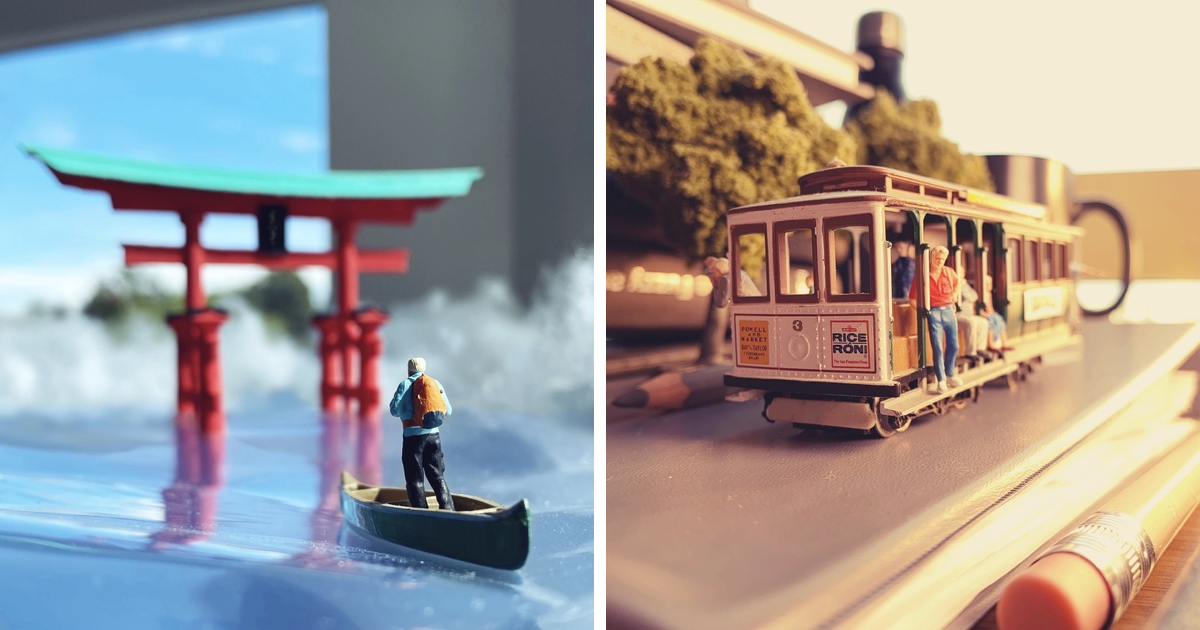
Not every passport needs a stamp. Some just need a paper palm tree, a toy scooter, and the kind of patience usually reserved for assembling furniture with instructions written by a poet. That is the delightfully odd magic behind miniature photography: it turns an ordinary desk into a globe-trotting stage set where a pencil becomes a skyline, sugar turns into snow, and a coffee stain can pass for the Mediterranean if you shoot it with enough confidence.
“I Travel Around The World On My Desktop With Miniatures (19 Pics)” is the kind of title that sounds like a joke until you realize it is actually a pretty accurate description of modern visual storytelling. A tiny world can capture the mood of a city, the rhythm of a market, or the romance of a rainy street without anyone leaving the room. It is part travel fantasy, part craft project, part photography experiment, and part proof that creativity thrives when space is limited and your budget says, “Let’s not book a flight today.”
Miniatures work because they invite the eye to slow down. They let you study scale, texture, color, and atmosphere in a way that full-size life often rushes past. A miniature bicycle leaning against a matchbox café can feel more cinematic than a real street corner because every detail has been chosen on purpose. Nothing is accidental. Even the crumbs are suddenly working overtime as rugged landscape features.
Why Miniatures Feel Like Real Travel
Travel is not only about distance. It is also about perspective. The best trips change the way you look at familiar things, and miniature scenes do exactly that. A desk lamp becomes the sun over a desert road. A cracked notebook cover turns into an ancient stone wall. A spoon can become a silver river if you catch the reflection just right. The shift is small in size but huge in effect.
That is why miniature photography and desktop travel have such strong appeal online. They combine the romance of travel storytelling with the satisfaction of making something by hand. You are not just consuming a place; you are building an impression of it. Instead of saying, “Here is Paris,” you say, “Here is what Paris feels like when reduced to a few inches of light, texture, and charm.” That difference matters. One is documentation. The other is interpretation.
There is also a lovely honesty to small-scale illusion. Nobody expects a desktop Eiffel Tower made from wire and cardboard to outdo the real one. The point is not perfect realism. The point is emotional accuracy. If the scene suggests morning light, café culture, narrow streets, and a hint of stylish chaos, then congratulations: your desk just booked a trip to France.
Miniatures also make global inspiration feel accessible. Not everyone can hop from Tokyo to Marrakesh to New York in a month, but nearly anyone can build a small world inspired by those places using paper, foam, clay, household objects, and a mildly concerning amount of glue. It is travel by imagination, and imagination is still the cheapest airline in the business.
How a Tiny Scene Sells a Big Illusion
The secret sauce is not just the miniature itself. It is the way the scene is photographed. Toy photography and diorama photography depend on a few reliable tricks: controlled depth of field, strong composition, believable textures, and careful lighting. In other words, the camera is not merely recording the scene. It is finishing the lie in the most beautiful way possible.
Depth of field does a lot of heavy lifting
A shallow focus can make a small object feel large, intimate, and cinematic. A deeper focus can turn a compact arrangement into something that feels like a real environment. The choice depends on the mood. Want dreamy romance in a miniature Venice canal? Blur the background and let the tiny gondola steal the show. Want a bustling street market in Mexico City? Keep more of the frame sharp so the eye can wander and discover details.
Composition tells the viewer where to “travel”
Good composition makes a scene feel intentional rather than cluttered. The rule of thirds, leading lines, negative space, and balance all matter here. A miniature road leading toward a tiny temple or train station gives the viewer a destination. Suddenly the image is not just a cute setup. It has movement, direction, and a story.
Texture is the passport stamp of realism
Miniatures become convincing when surfaces feel right. Sand should look dry. Water should catch light properly. Snow should not resemble grated cheese unless your destination is a very dramatic pizza. The more believable the materials, the more immersive the image becomes. That is why artists working in this space obsess over foam, paper, resin, fabric scraps, paint finishes, and the occasional gloriously stolen herb from the spice rack.
Lighting creates the weather, the time, and the mood
A warm side light can turn a simple paper alley into golden hour in Lisbon. Cool overhead light becomes a foggy London morning. Strong contrast suggests neon nightlife in Seoul. Soft light can make a miniature village feel nostalgic, while hard shadows can turn it into a moody noir set where a tiny detective is clearly having a difficult week.
The 19 Pics: Tiny Destinations, Big Personality
Now for the fun part. Imagine a 19-image gallery where the whole world fits on one desktop and every scene is part postcard, part optical mischief, part love letter to travel. Here is what those “pics” are really doing when they work.
- Paris in a pencil cup: A wire tower rises beside a saucer café, and suddenly office supplies become a Left Bank afternoon.
- Tokyo crosswalk from keyboard keys: Tiny pedestrians march across black-and-white stripes built from keycaps, proving rush hour can fit beside your mouse.
- Santorini from painted foam blocks: White cubes and blue domes transform into a cliffside sunset with all the drama and none of the hotel bill.
- New York in stacked notebooks: Book spines become skyscrapers, yellow paper scraps become cabs, and the city somehow still looks like it has no parking.
- Venice in a baking tray canal: Glossy resin or reflective glass turns into water while a tiny gondola glides past buildings made from cardstock and stubborn optimism.
- Cairo on a sandy corkboard: Pyramids made from folded paper triangles feel grand once shadows hit them at the right angle.
- Swiss Alps from torn foam: A dusting of powder and a toy train create the sort of mountain serenity that makes people whisper for no reason.
- Marrakesh market from beads and fabric: Rich color, patterned cloth, and tiny lanterns create visual abundance in the best possible way.
- London in the rain: Gloss varnish on black paper becomes wet pavement, and a miniature umbrella instantly supplies mood and national character.
- Bangkok street food on a coaster: Tiny stools, skewers, and bright signs make a scene that feels alive, warm, and gloriously impossible to walk past hungry.
- Sydney harbor in a glass dish: A paper bridge arcs over reflective water while a tiny ferry suggests movement and scale.
- Rome among broken plaster ruins: Fragments become history, and every crack starts acting like it deserves museum lighting.
- Mexico City festival scene: Confetti, banners, and miniature musicians turn a small setup into a loud, joyful burst of color.
- Reykjavík winter from cotton and blue light: Cool tones and quiet spacing make the scene feel crisp, clean, and just one wool sweater away from perfection.
- Istanbul rooftop tea moment: Layered buildings, tiny cups, and warm evening light create a scene with instant atmosphere.
- San Francisco on a sloping desk: The incline becomes a hill, toy cars become local drama, and somewhere a cable car ring is heard in spirit.
- Kyoto garden from moss and pebbles: Minimal elements carry maximum calm, which is a useful reminder that not every strong image needs ten props and emotional chaos.
- Cape Town coastline with torn blue paper: Bold shape, crisp contrast, and tiny hikers do a lot with very little.
- A final “around the world” collage: All the tiny landmarks share one frame, and the desk stops being furniture and starts being a map.
What makes these scenes memorable is not just the craftsmanship. It is the storytelling. Every destination is distilled into a few recognizable visual cues, and the viewer fills in the rest. That participation is part of the charm. The audience is not merely looking at a miniature world; they are mentally stepping into it.
How to Build a Better Desktop World
If you want to create your own version of travel around the world with miniatures, the smartest move is to think like a film set designer, not a souvenir shop. Start with mood before objects. Ask what makes the place feel like itself. Is it the color palette? The architecture? The weather? The street activity? The food? The geometry? The answer will help you choose props that suggest a location without overloading the frame.
Next, keep the scale consistent enough that the eye does not rebel. Tiny chairs beside enormous cups can work if the absurdity is intentional, but most scenes become more convincing when the proportions play nicely together. Materials matter too. Cardstock, polymer clay, foam board, textured paint, moss, fabric scraps, wire, beads, and clear acrylic all earn their keep in miniature setups. So do humble household heroes like sugar, salt, flour, cardboard, and cotton. Your pantry may be one decent lighting setup away from becoming an art department.
Finally, shoot more than you think you need. Miniature scenes reward experimentation. Move the light. Lower the camera. Change the focal point. Add steam, reflection, shadow, or a tiny figure. Sometimes the difference between “cute craft” and “convincing tiny destination” is one inch of camera movement and a willingness to look ridiculous while crouching over your desk.
Why This Trend Keeps Pulling People In
The popularity of miniature travel scenes is not hard to understand. They combine nostalgia, craftsmanship, photography, and escapism in one neat package. They also offer a gentle kind of control that real travel rarely does. In miniature art, the weather behaves, the crowds stay cooperative, and the best table in town is always available because you literally glued it there.
More importantly, small worlds make viewers feel big in the best way. They invite curiosity. They reward close looking. They remind us that wonder is often a matter of scale, attention, and a tiny bit of trickery. In an online world full of noise, a carefully built miniature scene feels refreshingly deliberate. It says, “Look closer.” And that may be the most travel-like instruction of all.
My Experience Traveling the World on a Desktop With Miniatures
The first time I tried building a miniature travel scene, I was not aiming for art. I was aiming for distraction. I had a cluttered desk, an overworked brain, and exactly zero interest in answering another email that began with “just circling back.” So I grabbed a few office supplies, a toy bicycle, a torn envelope, and a lamp, and tried to make a tiny European street. It looked less like Paris and more like a stationery store after a windstorm, but something clicked. For the first time in days, I was paying full attention to light, shape, and mood instead of deadlines.
That is the strange power of miniature scenes. They slow you down without making you feel stuck. When I build a desktop destination now, I am not really trying to copy a place exactly. I am trying to recreate the feeling of being there. For Tokyo, that means compressed energy, glowing signs, and orderly chaos. For Santorini, it is bright white surfaces, blue accents, and enough open space to let the scene breathe. For New York, it is vertical lines, impatient movement, and at least one object that looks like it has somewhere important to be.
I have learned that the smallest details often do the most emotional work. A tiny café chair placed at a slight angle feels more human than an entire row of perfectly aligned buildings. A miniature suitcase beside a bench suggests a story before anything even happens. A crooked sign can make a scene feel lived in. Real places are full of imperfections, and miniatures become more believable when they stop trying to be spotless. Apparently, even fake cities need personality flaws.
There is also a playful freedom in using ordinary objects as landscapes. Crumpled paper becomes cliffs. Sugar becomes snow. A blue folder becomes the sea. An upside-down bowl becomes a hill. Once you start seeing objects that way, your desk turns into a warehouse of possible locations. Every item begins auditioning for a role. The stapler wants to be architecture. The paper clips want to be bicycles. The coffee mug believes it can play a harbor, and honestly, with the right lighting, it deserves the part.
What surprises me most is how personal these scenes become. Even when I am building a version of Rome or London or Bangkok, the final image always reflects my own mood. Some scenes come out bright and playful. Others lean cinematic and quiet. A miniature world is never just about the place it represents; it is also about the person arranging it. That is why two artists can build the same destination and produce completely different emotional results.
And yes, there is humor in the process. A palm tree will fall over. A tiny scooter will refuse to stand upright. Glue will get somewhere it absolutely should not. You will spend fifteen minutes adjusting a shadow that nobody else will consciously notice. But when the shot finally works, it feels ridiculously satisfying. For one frame, the illusion holds. Your desk disappears. The miniature breathes. And you get that brief, wonderful sensation that creativity has outsmarted reality by several inches.
That is why I keep coming back to these tiny worlds. They remind me that travel is not always about movement across geography. Sometimes it is movement across attention. It is the decision to look harder, imagine bigger, and treat a small patch of space like it matters. On the right afternoon, with the right light and the right miniature figure, a desk can become a coastline, a market, a mountain pass, or a rainy street half a world away. Not bad for a surface that usually just holds chargers and bad decisions.
Final Thoughts
I Travel Around The World On My Desktop With Miniatures (19 Pics) is more than a catchy headline. It captures a creative practice that blends miniatures, travel inspiration, toy photography, and hands-on world-building into something deeply enjoyable and surprisingly moving. Tiny scenes can carry enormous atmosphere. They can make viewers laugh, lean closer, and remember that scale has very little to do with emotional impact.
When done well, miniature travel photography feels both escapist and intimate. It gives you the thrill of seeing somewhere new and the comfort of making it yourself. So no, your desk may not come with airport security, in-flight snacks, or baggage claim. But it can still take you somewhere. And unlike most airlines, it rarely loses your tiny luggage.