Some buildings disappear quietly. Others leave the world with the dramatic flair of a theater actor exiting through a trapdoor while the orchestra panics. Lost architecture has a strange power over us because it turns brick, marble, iron, glass, and timber into memory. A vanished train station, a burned palace, a demolished skyscraper, or a temple reduced to one lonely column can feel more haunting than a ruin that still stands proudly under the sun.
The fascination behind “nothing here survived to the present day” is not just nostalgia. It is a reminder that architecture is never guaranteed a future. Cities rebuild. Empires collapse. Wars erase neighborhoods. Fires do what fires have always done, which is behave like terrible editors. Developers chase profit. Governments choose roads, dams, stadiums, parking lots, or office towers. And suddenly, a place that once held weddings, prayers, markets, performances, arrivals, departures, and awkward first dates becomes a photograph passed around online with a caption that basically says, “Well, this hurts.”
Online communities devoted to lost architecture have made this feeling more visible. People share images of grand hotels, old bridges, temples, train halls, theaters, department stores, and entire streetscapes that no longer exist. The results are beautiful, maddening, educational, and occasionally enough to make anyone whisper, “Who approved this demolition?” Let’s walk through 30 spectacular examples of architecture that vanished, and what their losses teach us about beauty, memory, and preservation.
Why Lost Architecture Captures the Internet’s Imagination
Lost architecture appeals to both the historian and the drama-loving neighbor inside us. It gives us before-and-after stories with emotional weight. A building is not only a structure; it is a public stage. When a station like New York’s original Pennsylvania Station disappears, people do not mourn just the stone columns. They mourn the feeling of entering a city through grandeur instead of fluorescent confusion. When a sacred site is destroyed, the loss is spiritual, cultural, artistic, and human all at once.
These vanished places also reveal how design reflects values. The Crystal Palace celebrated industrial confidence with iron and glass. The Temple of Artemis expressed religious devotion and civic ambition. Palmyra’s monuments showed how cultures could meet and blend across trade routes. The Chicago Stock Exchange Building demonstrated that even a financial building could wear ornament like a botanical daydream. Architecture tells us what a society wanted to impress upon visitors. Its destruction tells us what later generations failed, or were forced, to protect.
30 Spectacular Examples of Architecture That Vanished
1. The Original Pennsylvania Station, New York City
Completed in 1910, the original Penn Station was a Beaux-Arts masterpiece by McKim, Mead & White. Its soaring spaces and monumental columns made travel feel almost ceremonial. Demolished in the 1960s, it became one of America’s most famous preservation wake-up calls.
2. The Crystal Palace, London
Designed by Joseph Paxton for the Great Exhibition of 1851, the Crystal Palace was a revolutionary glass-and-iron structure. After being moved to Sydenham Hill, it burned in 1936. It looked like the future, then vanished like a Victorian mirage.
3. The Temple of Artemis at Ephesus
Once counted among the Seven Wonders of the Ancient World, this enormous Greek temple was famous for its scale, marble columns, and religious importance. Today, only fragments remain. Ancient travel influencers would have been devastated.
4. The Lighthouse of Alexandria
The Pharos of Alexandria guided ships into one of the ancient Mediterranean’s busiest harbors. Earthquakes gradually brought it down, but its reputation survived so well that “pharos” became a word for lighthouse in several languages.
5. The Mausoleum at Halicarnassus
Built as a monumental tomb for Mausolus, ruler of Caria, this structure was so famous that “mausoleum” became a general word for grand tombs. Earthquakes and reuse of stone eventually reduced it to archaeology and imagination.
6. The Colossus of Rhodes
This huge bronze statue of Helios stood near Rhodes’ harbor and symbolized civic pride after military victory. It fell after an earthquake and was later dismantled. It lasted only decades, but its legend has been standing for centuries.
7. The Statue of Zeus at Olympia
Created by the sculptor Phidias, the seated Zeus was one of antiquity’s most celebrated religious images. Its exact end is uncertain, but the statue no longer exists. Sometimes the most famous rooms in history are now empty.
8. The Hanging Gardens of Babylon
The Hanging Gardens are the most mysterious ancient wonder. Scholars still debate their location and even their existence. Whether they were real, exaggerated, or confused with another site, the idea of terraced greenery in a desert city remains irresistible.
9. The Great Library of Alexandria
More than a single room of books, Alexandria’s scholarly complex represented one of the ancient world’s great intellectual centers. Its decline happened over time, not in one tidy movie-scene fire, which is honestly less cinematic but more historically believable.
10. The Temple of Bel, Palmyra
Palmyra’s Temple of Bel was one of Syria’s most important ancient monuments, blending Greco-Roman and local architectural traditions. Its destruction in the 21st century was a global cultural tragedy and a reminder that heritage can still be vulnerable.
11. The Arch of Triumph, Palmyra
This 2,000-year-old arch framed one of the ancient city’s grand colonnaded streets. Its loss showed how a single architectural gesture can carry the identity of an entire place. A gateway can be more than an entrance; it can be a symbol.
12. The Chicago Stock Exchange Building
Designed by Adler & Sullivan and completed in 1894, the Chicago Stock Exchange was a masterpiece of early skyscraper design and ornament. Demolished in 1972, parts of its trading room and ironwork were preserved in museums, proving rescue can sometimes happen in pieces.
13. The Singer Building, New York City
When completed in 1908, the Singer Building was among the tallest buildings in the world. Its ornate tower was demolished in the late 1960s for a larger office block. Progress, in this case, arrived wearing a very plain suit.
14. The Old Madison Square Garden, New York City
Stanford White’s Madison Square Garden, completed in 1890, featured a famous tower inspired by Seville’s Giralda. It was demolished in 1925. Even entertainment palaces, it turns out, can have tragically short runs.
15. Frank Lloyd Wright’s Imperial Hotel, Tokyo
Opened in 1923, Wright’s Imperial Hotel mixed modern engineering with Mayan Revival influences. It survived the Great Kanto earthquake impressively, yet was demolished in 1968. Its reconstructed lobby remains a treasured fragment of a lost masterpiece.
16. Kowloon Walled City, Hong Kong
Kowloon Walled City was not polished architecture in the classical sense. It was dense, improvised, chaotic urbanism stacked into a concrete maze. Demolished in the 1990s, it still fascinates architects, photographers, game designers, and anyone who loves a good urban legend.
17. The Euston Arch, London
Built as a grand entrance to Euston Station, the Doric Euston Arch was demolished during railway redevelopment in the 1960s. Its loss helped fuel modern preservation campaigns in Britain. Sometimes a demolished arch becomes a rallying cry.
18. Haiti’s National Palace, Port-au-Prince
Haiti’s National Palace was severely damaged in the devastating 2010 earthquake and later demolished. Its collapse was not only architectural; it became an image of national trauma and the long struggle to rebuild cultural and civic life.
19. The Cliff House, San Francisco, 1896 Version
The grand Victorian Cliff House looked almost too dramatic for a windswept ocean cliff, which is exactly why people loved it. It survived the 1906 earthquake but burned in 1907. The Pacific view remained; the fantasy castle did not.
20. St. Peter’s Hospital, Bristol
Originally a late medieval merchant’s house, St. Peter’s Hospital became one of Bristol’s historic architectural treasures. It was destroyed during the Bristol Blitz in 1940, showing how wartime bombing erased not only military targets but centuries of domestic history.
21. The Salzhaus and Haus Frauenstein, Frankfurt
These richly decorated old houses in Frankfurt were masterpieces of timber-framed urban architecture. Destroyed during World War II bombing, they represent the loss of historic city centers where craftsmanship once turned ordinary streets into open-air museums.
22. The Cathedral of Christ the Saviour, Borki
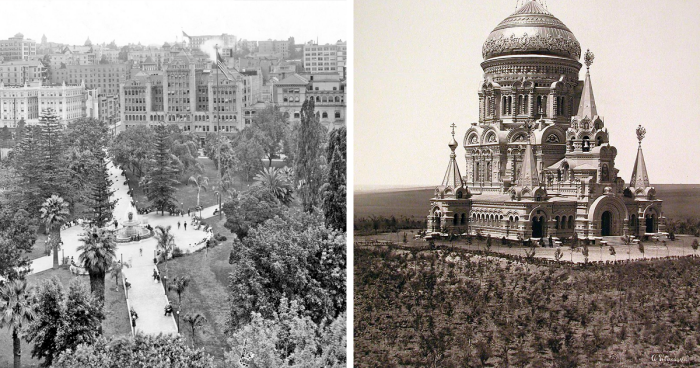
Located near modern-day Kharkiv, Ukraine, this cathedral was tied to imperial Russian history and religious memory. Destroyed during World War II, it survives largely through old photographs, where its domes still look freshly polished by time.
23. Park Hotel Bremen
The Park Hotel in Bremen, built in the late 19th century, was lost to fire in 1907. Hotels are especially poignant in lost architecture because they are designed for temporary stays, yet we expect the buildings themselves to remain.
24. The Neue Elbbrücke, Hamburg
This 19th-century bridge once gave Hamburg a powerful industrial-era silhouette. Replaced in the 20th century, it reminds us that infrastructure can be beautiful before it becomes obsolete. Bridges do not just carry traffic; they carry civic personality.
25. Old Times Square, New York City
The early 1900s version of Times Square was a different creature: theatrical, electric, crowded, and architecturally layered. Many of its original buildings and signs disappeared as redevelopment reshaped the district. The lights stayed; much of the old texture left.
26. Los Angeles’ Lost 1910s Streetscapes
Historic photographs of downtown Los Angeles often show blocks of buildings, streetcars, hotels, and theaters that no longer exist. Urban renewal, parking demand, highways, and redevelopment reshaped the city so dramatically that some old views feel like alternate history.
27. The Fortress of Buhen, Nubia
Buhen was an ancient Egyptian fortress near the Nile, part of a network of Nubian defensive sites. The construction of the Aswan High Dam and the creation of Lake Nasser submerged many landscapes and archaeological places, changing preservation forever.
28. Nohmul Pyramid, Belize
The Maya site of Nohmul suffered a shocking modern loss when much of a pyramid was destroyed for road-building material in 2013. It is one of those stories that makes preservationists stare silently at a wall for several minutes.
29. The Old Summer Palace, Beijing
Yuanmingyuan, known as the Old Summer Palace, was a vast imperial garden and palace complex. It was looted and burned in 1860, with later destruction compounding the loss. Its ruins remain powerful because absence has become part of the monument.
30. The Tuileries Palace, Paris
The Tuileries Palace stood beside the Louvre and served French monarchs and emperors for centuries. Burned during the Paris Commune in 1871 and demolished in 1883, it left behind one of Paris’ most famous architectural “missing pieces.”
What These Vanished Buildings Teach Us
The most obvious lesson is that architecture is fragile. Stone feels permanent until politics, weather, neglect, fire, war, or money decides otherwise. The second lesson is that photographs matter. Many lost buildings are known today because someone stood in the right place with a camera before the wrecking crew, flames, or bombs arrived. That person may have thought they were simply documenting a street corner. A century later, they became a time traveler with excellent timing.
The third lesson is that preservation usually begins before a crisis, not during one. By the time a landmark is fenced off, stripped, or sold for redevelopment, public outrage may be loud but too late. The stories of Penn Station, the Euston Arch, and the Chicago Stock Exchange show that losing a beloved building can inspire stronger preservation laws and activism. Still, it is a painful way to learn. Nobody wants to protect architecture by first sacrificing the best example.
Experience: Looking at Lost Architecture in the Real World
There is a particular feeling that comes from standing where a famous building once stood. You look at the modern replacement, then at an old photograph on your phone, then back at the present-day view. Your brain tries to line up columns, roofs, windows, towers, and streets. Sometimes it works. Sometimes the city has changed so completely that the past refuses to fit. That mismatch is the emotional engine of lost architecture.
Walking through a place shaped by demolition can make you more attentive. A plain office tower may sit on the footprint of a vanished theater. A parking garage may occupy the site of a school, a hotel, or a mansion. A traffic circle might cover old foundations. Suddenly, the city becomes a layered document. The current page is visible, but older pages have been scraped away, reused, or buried under concrete. You start to notice plaques, odd surviving walls, relocated fragments, and decorative stones that seem slightly too fancy for their current job.
Lost architecture also changes the way you travel. Instead of only chasing famous landmarks, you begin looking for what almost disappeared, what was saved at the last minute, and what exists only as a reconstructed piece. A museum room from a demolished building can feel strangely intimate. A preserved staircase, arch, lobby, or façade fragment is like meeting one sentence from a burned book. It cannot tell the whole story, but it proves the story was real.
For writers, designers, photographers, and everyday city lovers, these losses offer a useful warning: document the ordinary before it becomes rare. The corner diner, the old cinema, the mid-century motel sign, the neighborhood church, the train shed, the tiled lobby, the weird little municipal building everyone ignoresthese are future memories being created in real time. Not every structure can or should be preserved forever, but every place deserves to be understood before it is erased.
The experience of studying vanished architecture is not only sadness. It can also be motivating. It encourages better adaptive reuse, smarter planning, and deeper respect for craftsmanship. It reminds us to ask hard questions before demolition: Can this building be converted? Can its best parts be saved? Does the replacement improve public life, or is it just taller, cheaper, and allergic to charm? Lost architecture turns regret into responsibility. The past cannot be rebuilt perfectly, but the next loss can sometimes be prevented.
Conclusion
“Nothing here survived to the present day” sounds like a caption, but it is really a warning label. The world’s vanished architecture proves that beauty alone does not guarantee survival. Some masterpieces were destroyed by disaster. Others were erased by war. Many were removed because someone decided the land was worth more than the memory. Yet these buildings still matter because they continue to shape how we think about cities, heritage, and public space.
From the ancient wonders to Penn Station, from Palmyra to the Crystal Palace, lost architecture invites us to admire what humans can build and question what humans choose to destroy. It is history with dust on its shoes and a slightly judgmental expression. And if these 30 examples teach one practical lesson, it is this: take the photograph, save the drawing, support preservation, and never assume the beautiful building down the street will still be there tomorrow.