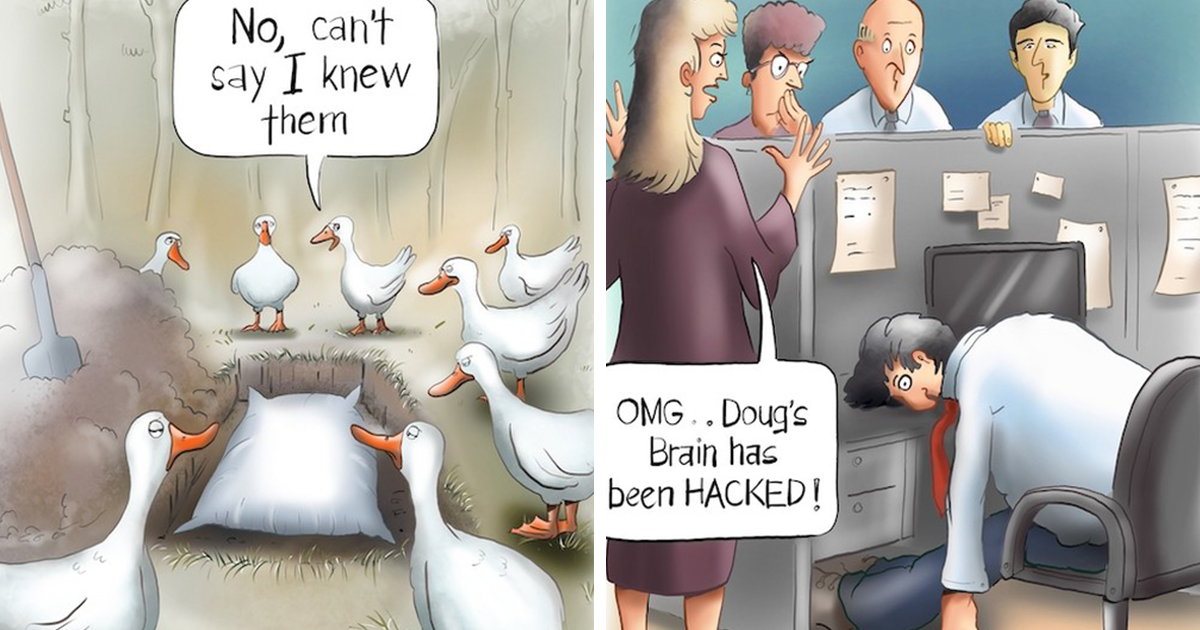
Some artists paint sunsets. Some sculpt marble. And then there are the brave souls who look at an ordinary human momentstanding in line, making small talk, trying to exist in public without becoming emotionally flammableand think, “Yes, but what if this got delightfully weird?” That is the energy behind George Webster’s SplitzSense, a single-panel cartoon series that turns familiar situations into surreal stories with the timing of a stand-up comic and the visual restraint of a magician who knows the trick lands harder when he doesn’t overexplain it.
The appeal of these 29 single-panel cartoons is not just that they are funny. Plenty of things are funny. A squirrel slipping off a fence can be funny. A typo in a text can be funny. But Webster’s work hits a more satisfying nerve because it starts where real life starts: in the painfully recognizable. The setup feels mundane, almost harmless. Then the idea swerves into absurdity, and suddenly the cartoon becomes a tiny theatre of surprise. It is the kind of humor that makes you laugh first, then nod, then think, “Honestly, that’s not how my Tuesday went, but emotionally? Pretty close.”
That blend of the everyday and the surreal is what gives these cartoons their staying power. They are quick to read, but they do not feel disposable. They stick in the brain like a catchy song, except instead of a chorus you get a single image and one strange, perfect joke. The result is a form of comedy that feels light on its feet but sharp in its thinking.
Why Single-Panel Cartoons Still Hit So Hard
Single-panel cartoons are one of the oldest and sneakiest forms of modern humor. They look simple because they are compact, but compact does not mean easy. In one frame, the artist has to establish the world, shape the mood, set the trap, and spring the joke. That is a lot of pressure for one little rectangle. And yet the format has endured for generations because, when it works, it delivers a near-perfect burst of comic efficiency.
American cartoon history has long made room for this kind of compressed wit. The tradition includes old-school gag cartoons, magazine humor, and the kind of visual one-liners that can capture a whole social mood in a frozen second. The beauty of the format is that it asks very little from the reader in terms of time, but often gives a lot back in terms of recognition. A good single-panel cartoon can feel like a lightning-fast one-act play. Everything is held in suspension: the facial expression, the awkward silence, the ridiculous premise, the exact second before your brain catches up and laughs.
That is why Webster’s cartoons feel so contemporary while still fitting neatly into a classic form. They are not trying to overwhelm readers with lore, continuity, or a cinematic backstory the size of a streaming franchise. They do not need twelve episodes and a companion podcast. They need one image, one idea, and enough confidence to let the weirdness do the work.
George Webster’s Surreal Humor Works Because It Starts Small
Webster’s SplitzSense cartoons have been described as quirky, offbeat, and old-school, and that label fits because the humor feels both fresh and rooted. The jokes are surreal, yes, but they are not surreal in a random-for-random’s-sake way. They begin with situations people already understand: a conversation, a routine, a social expectation, a tiny human frustration. Then Webster tilts the angle just enough for the everyday scene to become gloriously unhinged.
That is a crucial distinction. A lot of weak absurdist humor mistakes confusion for comedy. It throws a toaster into a bathtub, puts shoes on a pineapple, and waits for applause. Webster’s cartoons appear to understand a more useful principle: absurdity lands best when it grows out of something recognizable. The reader needs a normal floor before the joke can remove it.
And that is exactly what these one-panel comics do so well. They operate like trapdoors hidden beneath common life. The reader steps onto solid ground, sees something ordinary, and then the cartoon quietly opens into a dream logic that still somehow feels emotionally true. That balance is the whole game. Too normal, and the joke is flat. Too strange, and the joke becomes air without oxygen. Webster finds the sweet spot where the bizarre still feels relatable.
The Science of Why Mundane Moments Become Funniest When They Go Sideways
Humor research has spent a long time circling a simple idea: we laugh when our expectations are violated in a way that feels surprisingly right. Theories of incongruity explain that comedy often comes from a clash between what we expect and what actually appears. In plain English, your brain starts walking in one direction and the joke casually pushes it into a hedge. That sudden shift creates the spark.
Webster’s surreal single-panel cartoons are built for that spark. They invite the reader into a scene that looks familiar enough to decode quickly. Then they introduce a twist that scrambles the logic just enough to force a second look. The cartoon becomes funny not because it makes no sense, but because it makes a different kind of sense for one suspended comic second.
That is also why surreal humor and observational humor make such a good team. Observational comedy gives you the shared human baseline. Surrealism gives you the sideways leap. Put them together, and you get something more memorable than either approach alone. The cartoon feels grounded, but not predictable. It mirrors life without merely copying it. It exaggerates reality until reality finally admits, under pressure, that it has always been a little ridiculous.
In other words, Webster’s cartoons understand a truth many people learn by age thirty and fully confirm by age forty: normal life is already halfway to absurd. Art just has to nudge it the rest of the way.
From Newspaper Gags to Scroll-Stopping Web Comics
The internet did not invent weird humor, but it did build a luxury freeway for it. In earlier eras, single-panel cartoons lived in newspapers and magazines, where readers encountered them alongside editorials, crosswords, and probably someone yelling about inflation. Today, one-panel comics travel through feeds, screenshots, group chats, and late-night doomscrolling sessions that begin with one meme and end with a person accidentally learning medieval bread history at 2:14 a.m.
This matters because Webster’s style is unusually well suited to the digital age. A single-panel cartoon is instantly legible on a phone screen. It does not ask for a time commitment. It asks for attention, timing, and a willingness to enjoy one strange idea. That makes it highly shareable, but the best examples also resist becoming disposable. They do not vanish after the first chuckle. They invite rereading.
That reread factor is important. The strongest surreal comics are not just punchlines. They are compact worlds. You see the joke, then the details, then the attitude. You notice how much mood fits inside one frame. That is a big reason why these 29 cartoons feel satisfying rather than flimsy. They are built for the speed of the internet but crafted with the patience of cartooning as an art form.
What Makes These 29 Cartoons More Than Just “Random Funny”
Calling a cartoon “random” is sometimes praise and sometimes surrender. In Webster’s case, it misses the craft. The humor may look effortless, but there is design underneath it. A successful single-panel cartoon relies on structure: what the viewer notices first, how the eye travels, when the caption clicks, and how the concept resolves. Timing in cartooning is invisible, which is why people underestimate it. But timing is everything.
Webster’s cartoons work because they understand that a joke can be visually quiet and mentally loud. The panel does not need chaos everywhere. It needs one strong comic distortion. One idea has to bloom. One ordinary ritual has to become impossible in exactly the right way. That discipline is what keeps the humor from collapsing under its own cleverness.
It also helps that the cartoons never seem desperate to impress. They are confident enough to be dry. They do not scream the joke at the audience with fireworks and five exclamation points wearing party hats. They trust the reader to meet the premise halfway. That trust makes the humor feel smarter, and honestly, more fun.
The Emotional Side of Surreal Cartoons
It may sound dramatic to say a one-panel cartoon can carry emotional weight, but it can. Not in a violin-solo, rain-on-the-window kind of way. More in the way that humor often softens the edges of ordinary stress. Surreal comedy lets people laugh at the mismatch between how life is supposed to work and how it actually works. It takes discomfort, confusion, social awkwardness, and routine frustration, then turns them into a small visual release valve.
That is part of why these cartoons feel so readable. Even when the premise is bizarre, the emotional core is familiar. The joke may be strange, but the feeling underneath it usually is not. It might be embarrassment, impatience, loneliness, irritation, confusion, or the low-grade absurdity of trying to function politely in a world that clearly did not workshop its interface with actual humans.
In that sense, Webster’s cartoons do what the best humor always does: they make people feel less alone in their weirdness. Or, maybe more accurately, they remind people that weirdness is not a side effect of life. It is part of the operating system.
Why Readers Love Art That Turns the Ordinary Into the Uncanny
Readers are drawn to art that re-enchants ordinary life. Not because daily life is boring, but because familiarity can dull perception. You pass the same objects, repeat the same routines, hear the same phrases, and eventually your brain turns the whole thing into beige wallpaper. A surreal cartoon interrupts that autopilot. It makes you look again.
That is exactly what Webster’s 29 single-panel cartoons accomplish. They take mundane moments and restore strangeness to them. Suddenly, routine feels theatrical. Conversation feels unstable. Social rituals feel like they were invented by a committee of anxious aliens trying their best. It is funny because it is exaggerated, but it is powerful because the exaggeration reveals something real.
There is a long tradition of cartoonists doing thisusing one image to expose the silliness inside normal behaviorbut Webster’s version feels especially effective because it avoids heavy-handed commentary. The cartoons do not lecture. They do not explain the joke until the joke files a complaint. They simply present a warped little reality and let the audience enjoy the collision.
Final Thoughts: A Small Frame Can Hold a Big Imagination
SplitzSense proves that a single panel can still do a remarkable amount of work. George Webster’s cartoons show that you do not need a sprawling narrative to tell a memorable story. Sometimes all it takes is one image, one well-placed idea, and one comic turn sharp enough to make the ordinary suddenly look wonderfully suspicious.
These 29 cartoons succeed because they understand both the mechanics of humor and the texture of daily life. They know that readers do not just want jokes; they want recognition, surprise, and the pleasure of seeing reality remixed into something stranger and smarter. Webster gives them exactly that. He starts with the mundane, sneaks in the surreal, and leaves behind the kind of laugh that feels both spontaneous and oddly earned.
And maybe that is the secret. Surreal stories do not always come from escaping everyday life. Sometimes they come from staring at everyday life a little longer than usual, until it finally admits it has been weird this whole time.
Related Experiences: Why Surreal Single-Panel Cartoons Feel Weirdly Personal
Reading a collection like this often produces a very specific experience, and it is not just laughter. It is recognition with a side of surprise. You scroll past a cartoon expecting a quick joke, but instead you get that rare little jolt where the image feels stranger than life and somehow more accurate than life at the same time. It is like seeing your own brain translated into a visual language you did not know you spoke.
That sensation is part of what makes surreal one-panel cartoons so addictive. They mimic the way modern life actually feels on the inside. Externally, a day may look routine: wake up, answer messages, pretend to understand email tone, heat up leftovers, survive one awkward interaction, repeat. Internally, though, the day can feel like a bizarre dream stitched together by stress, memory, politeness, and whatever song got trapped in your head at breakfast. Surreal cartoons close the gap between those two realities. They make the inner weirdness visible.
There is also a comfort in how quickly these cartoons work. In a world full of content that demands a commitmentwatch this series, finish this ten-part explainer, read this 4,000-word thread from a stranger who somehow became an expert in your attention spana single-panel cartoon offers a complete experience in one glance. Yet the best ones do not feel shallow. They feel concentrated. They give you the comic equivalent of espresso: small, intense, and surprisingly effective at restarting your soul.
For many readers, the experience is also social. You see a panel, laugh, and immediately want to send it to someone with the message, “This is unhinged and also basically your entire personality.” That impulse matters. It means the cartoon has crossed from private amusement into shared language. It becomes a tiny cultural object, a shortcut for describing moods and frustrations that are otherwise annoyingly hard to explain. A surreal single-panel cartoon can say, in one image, what a five-minute rant cannot.
Another reason these cartoons resonate is that they give readers permission to be amused by the absurdity of ordinary existence. That may sound lofty for a joke format, but it is real. People are tired, overscheduled, digitally distracted, and expected to behave like fully optimized productivity machines while still somehow maintaining charm, emotional intelligence, and a functioning calendar. Against that backdrop, cartoons that distort everyday life feel less like nonsense and more like honesty wearing a funny hat.
And then there is the aftereffect. The best single-panel cartoons do not vanish once you scroll away. They pop back into your mind later, usually at the exact wrong timewhile waiting in line, sitting in traffic, or enduring a meeting where someone says “circle back” as if language itself has not suffered enough. That replay value is a sign of quality. It means the cartoon did more than land a joke. It changed how you saw something familiar.
That is the lasting pleasure of art like Webster’s. It turns mundane moments into surreal stories on the page, and then it sends readers back into their own routines with slightly altered vision. The grocery store looks a little funnier. The office sounds a little stranger. Small talk starts to resemble performance art. The ordinary world remains ordinary, of course, but it no longer feels fixed. It feels bendable, open to reinterpretation, maybe even secretly hilarious.
So yes, these cartoons are entertaining. But they also do something a little richer. They remind readers that imagination is not reserved for epic fantasies or prestige drama or giant cinematic universes full of capes and glowing sky portals. Imagination can happen in a hallway, at a dinner table, in a throwaway conversation, or in the exact expression somebody makes when reality stops cooperating. That is a wonderful thing to remember. And honestly, it makes the day more interesting.