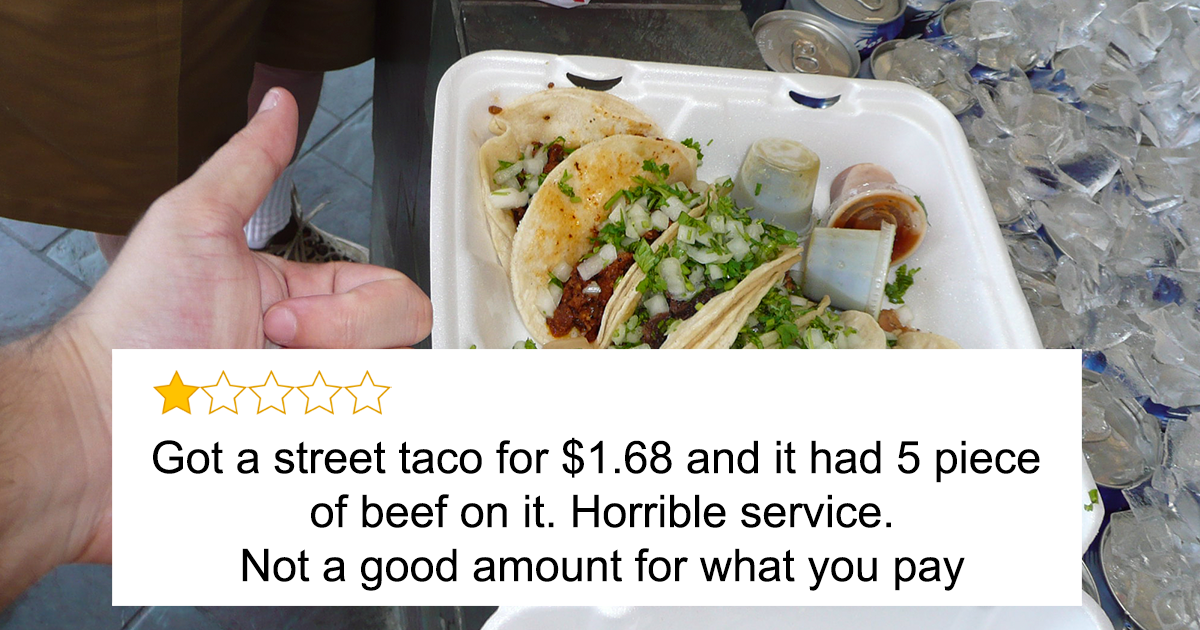
A taco can be tiny, delicious, affordable, and somehow still capable of launching a full-scale economic debate worthy of a cable-news panel. One online restaurant review did exactly that after a customer blasted a business for charging $1.68 for a street taco that they believed had too little meat. The restaurant owner responded with a breakdown of costs and a pointed final detail: the customer had paid with a credit card.
Suddenly, a humble taco was no longer just a taco. It became a symbol of the awkward modern relationship between diners and independent restaurants. Customers want fair portions, friendly service, and prices that do not make them feel as though they accidentally ordered dinner from the moon. Restaurant owners, meanwhile, are trying to cover food, wages, rent, utilities, packaging, insurance, taxes, repairs, and payment-processing fees without turning a $1.68 taco into a luxury item served under a glass dome.
The viral exchange is funny because it is so familiar. Everyone has had a meal that felt overpriced. Nearly every restaurant owner has faced a review that made them wonder whether the customer expected a handmade meal, a personal apology, and a small parade for the price of loose change.
The Taco Review That Turned Into a Restaurant Economics Lesson
The customer’s complaint centered on a low-cost street taco. According to the widely shared review screenshot, the diner argued that the taco contained too little beef and accused the restaurant of shortchanging customers. The review also criticized the service, claiming that a worker did not respond when the customer raised concerns about the portion.
That part matters. A customer can reasonably dislike a portion size. They can be disappointed by service. They can decide a taco was not worth the price. A review is supposed to communicate that experience to other diners, not require customers to become amateur accountants before ordering lunch.
But the owner’s reply highlighted the other side of the counter: a restaurant does not keep the entire menu price as profit. The price of a taco has to help pay for tortillas, meat, onions, cilantro, cooking fuel, labor, rent, supplies, cleaning products, insurance, taxes, equipment maintenance, and the cost of accepting digital payments.
The owner’s central message was essentially this: “You paid less than two dollars, and there are more people involved in making that taco than you may realize.” It was a sharp comeback, but it also revealed a truth many diners do not see. The menu price is not a deposit into a tiny treasure chest labeled “Owner’s Yacht Fund.” For most independent restaurants, it is a very crowded paycheck.
Why a Cheap Taco Does Not Automatically Mean a Huge Profit
Restaurant pricing can look suspiciously simple from the dining room. You see a taco priced at $1.68 and think, “That cannot cost more than a few cents to make.” Sometimes the ingredients may indeed be inexpensive on paper. But paper has never had to pay a dishwasher, replace a refrigerator compressor, or call a plumber at 10:45 p.m. because the sink suddenly decided it had dreams of becoming a fountain.
Restaurant operators often divide costs into several categories:
- Food costs: Meat, tortillas, produce, spices, oil, sauces, and beverage ingredients.
- Labor costs: Cooks, servers, cashiers, dishwashers, managers, payroll taxes, and benefits.
- Occupancy costs: Rent, property taxes, utilities, maintenance, and repairs.
- Operating costs: Cleaning products, packaging, software, uniforms, licenses, insurance, marketing, and equipment.
- Payment costs: Credit card processing fees, point-of-sale charges, and transaction-related expenses.
Industry research has repeatedly shown that restaurant margins are typically thin. Food and labor alone can consume a large share of every sales dollar, while rent, utilities, maintenance, supplies, and payment processing take another meaningful bite. By the time a restaurant pays every bill, a small independent operation may be left with only a modest pre-tax profit margin.
That does not mean every restaurant price is automatically fair. A customer can still receive a skimpy taco, a cold burrito, a watered-down drink, or service so uninterested it feels like the staff is auditioning for a museum exhibit called “Employees Who Have Seen Too Much.” But it does mean a menu price cannot be judged only by the visible ingredients.
Credit Card Fees Are Small Per Transaction but Big Over Time
The owner’s line about credit card payment was dramatic, but the underlying issue is real. Credit card processing generally involves a percentage of the sale plus a fixed transaction amount. The actual cost varies by processor, card type, payment method, and contract, but even a seemingly minor fee can matter when the item itself costs less than two dollars.
For a high-ticket sale, a transaction fee may feel manageable. For a low-priced taco, coffee, cookie, or side dish, the fixed portion of the fee can eat into the sale more noticeably. A restaurant that sells hundreds of low-cost items per day may see those charges add up quickly.
Still, blaming the customer for paying with a credit card is not the best hospitality strategy. Card payments are normal. Customers should not feel guilty for using the payment method a business accepts. The smarter lesson is that restaurant owners need menu prices that account for payment costs before the customer ever reaches the register.
Was the Customer Wrong, Was the Owner Wrong, or Were They Both Having a Bad Taco Day?
The honest answer is that both sides may have had a point.
The customer had every right to feel disappointed if the taco looked noticeably underfilled or if their concern was ignored. A low price does not erase the expectation that food should feel intentional, fresh, and worth ordering again. Street tacos are naturally smaller than oversized American-style tacos, but customers still expect enough filling to make the tortilla feel like part of the meal rather than a decorative napkin.
The owner also had a legitimate frustration. People often compare restaurant prices to grocery-store prices without considering the labor and overhead behind prepared food. Buying a pound of beef at a supermarket is not the same as receiving cooked beef, prepared tortillas, chopped onions, cilantro, condiments, counter service, kitchen equipment, seating, sanitation, and someone else handling the dishes.
Where the owner’s reply risks going sideways is tone. Public review responses are not only messages to the unhappy customer. They are messages to every future customer reading the exchange. A response that sounds defensive can make a restaurant seem hostile, even when the owner’s financial argument is correct.
A better response could have said:
“We are sorry the taco did not meet your expectations. Our street tacos are traditionally portioned and priced to stay accessible, but we never want a guest to feel ignored or disappointed. Please contact us directly so we can learn more about your visit and make it right.”
That reply does not surrender the restaurant’s pricing model. It simply keeps the conversation focused on the guest experience rather than turning the comment section into a miniature business-school debate with onions.
Why One-Star Restaurant Reviews Matter So Much
For a major chain, one negative review may disappear into thousands of ratings. For a family-owned taco shop with only a handful of online reviews, one angry post can have a much larger effect. Research on restaurant reviews has found that rating changes can influence revenue, particularly for independent businesses with less advertising power and fewer ways to control their public image.
That is why restaurant review management is no longer optional. A review may be unfair, exaggerated, emotional, incomplete, or downright bizarre, but potential customers often read it before deciding where to eat. They may not remember every detail of the complaint, but they will remember whether the owner sounded calm, thoughtful, sarcastic, or ready to challenge someone to a duel behind the salsa bar.
What Restaurant Owners Should Do Instead of Clapping Back
A strong response to a negative review should follow a few simple rules:
- Respond promptly, but not while angry. Draft the reply, take a break, then reread it like a customer who has never met you.
- Acknowledge the experience. You do not have to agree with every claim to recognize that the guest was unhappy.
- Address the specific concern. Mention portion size, wait time, service, billing, or cleanliness rather than sending a generic copy-and-paste apology.
- Offer a practical next step. Invite the customer to contact the restaurant privately if there is a realistic way to resolve the issue.
- Avoid personal attacks. Winning an argument online can still lose future customers.
Restaurants can also reduce complaints before they happen. Clear menu descriptions help customers understand whether a taco is a snack, a traditional street taco, or a full meal. Good photos can show portion sizes. Staff members can explain popular menu items. A simple note such as “traditional street taco, served on two corn tortillas” may prevent someone from ordering with burrito-sized expectations.
How Diners Can Write Better Restaurant Reviews
Customers have power, and reviews are part of that power. A useful negative review can help a business identify problems and help other diners decide what to expect. The key is writing with detail rather than heat.
Instead of saying, “This place is a scam,” a stronger review might say:
“I ordered two street tacos for $1.68 each. The flavor was good, but the beef portion felt very small for the price. I also asked about the serving size and did not receive a response. If you prefer larger tacos, you may want to order several.”
That gives readers useful information. It explains the complaint, describes the product, and avoids turning a personal disappointment into a declaration of war against the entire restaurant industry.
Before posting a one-star review, diners can also consider a few questions: Was the price clearly listed? Was the dish meant to be a small traditional item? Did the problem involve the food, the service, or both? Did the restaurant have an opportunity to fix the issue while you were there? And most importantly, would your review help another person make a better ordering decision?
Not every disappointing meal deserves a five-paragraph thunderstorm. Sometimes the best answer is simply, “Not for me.” Other times, especially when a restaurant is unsafe, dishonest, discriminatory, or repeatedly careless, a detailed review is absolutely appropriate.
The Real Lesson: Value Is More Than a Number on the Menu
The taco debate is not really about whether $1.68 is cheap or expensive. It is about value. Customers measure value through portion size, taste, service, convenience, and how they feel when they leave. Restaurant owners measure value through ingredient costs, labor, rent, payment processing, and whether enough money remains to open the doors tomorrow.
Both perspectives can be true at the same time. A restaurant can be under intense financial pressure and still need to improve its portions or service. A customer can be disappointed by a taco and still underestimate what it costs to run a restaurant.
The best restaurants make that gap smaller. They price honestly, describe food clearly, train staff well, listen to complaints, and avoid treating every unhappy customer like an enemy of commerce. The best diners, meanwhile, remember that a restaurant is not a vending machine with chairs. It is a complicated human operation trying to deliver lunch before the lettuce wilts, the fryer breaks, and someone asks why guacamole costs extra.
Experiences From Both Sides of the Counter
The following scenarios are representative experiences drawn from common restaurant and diner situations. They are not descriptions of specific people involved in the viral taco-review exchange.
One customer walks into a neighborhood taqueria after seeing a sign advertising low-priced street tacos. They expect something similar to the tacos they have eaten at a food truck: small tortillas, seasoned meat, onion, cilantro, and maybe a squeeze of lime. They order three tacos, enjoy the flavor, but are surprised by how quickly the meal disappears. Their expectation was “cheap dinner,” while the restaurant’s promise was really “small traditional taco.” Nobody lied, but nobody explained the difference either.
Another diner orders one taco because the price looks incredibly low. When it arrives, they see two small corn tortillas and a modest portion of beef. They feel annoyed because they assumed one taco would be filling. The restaurant sees a correctly portioned street taco. The customer sees what appears to be a snack wearing a dinner costume. This is not always a pricing problem. Sometimes it is a menu-description problem.
On the owner’s side, imagine a small restaurant that sells several hundred tacos on a busy Saturday. The owner is proud of keeping prices low because many regular customers live nearby and rely on affordable lunch options. But the numbers are tight. Beef costs more than it did a few years ago. Rent rises. Utilities rise. Payroll rises. Delivery packaging rises. A broken refrigerator requires an emergency repair. Card-processing charges arrive whether the tacos were excellent, average, or secretly the best tacos in the county.
Then a one-star review appears. The owner reads it after a long shift, probably while standing near a stack of dishes that has developed its own postal code. The review says the restaurant should not be in business because the taco did not contain enough meat. The owner feels attacked, not merely criticized. That emotional reaction is understandable. But the public reply still matters more than the private frustration.
Some restaurant owners learn to treat negative reviews as a form of free market research. If multiple guests say the tacos are too small, perhaps the portion is technically traditional but practically confusing. Maybe the restaurant can create a combo plate, add clearer menu language, include an order suggestion, or offer a larger premium taco. A complaint does not always require an apology; sometimes it requires a better explanation or a better product option.
Customers can learn something too. A restaurant may offer small tacos because that is the style, not because it is trying to trick anyone. A handmade taco is not priced only by the weight of its meat. The kitchen work, overhead, preparation, service, and payment system all exist behind the counter, even when the final food item fits comfortably in one hand.
The healthiest outcome is not “the customer always wins” or “the owner always wins.” It is a restaurant culture where customers can speak honestly and owners can respond professionally. A diner should be able to say, “This was not enough food for me,” without being mocked. An owner should be able to explain, “This is how we price traditional street tacos,” without sounding like they are sending an invoice for emotional damages.
At the end of the day, the taco is still a taco. It should be tasty, fairly described, and served with basic courtesy. But the next time a menu price seems strange, it may be worth remembering that the cost of a meal includes more than what is piled on the tortilla. And the next time a restaurant owner feels tempted to win a review battle with a devastating comeback, it may be worth remembering that future customers are watching too.
Final Thoughts
The viral taco review captured a real cultural clash: diners want value, while restaurants are fighting to survive on narrow margins. The customer’s concern about portion size was valid. The owner’s concern about costs was valid. The mistake was letting a small taco become a public argument where neither side felt heard.
Restaurants earn trust through clear pricing, consistent food, responsive service, and professional review replies. Customers help everyone when they write specific, fair, useful feedback. That is how a one-star complaint becomes something more valuable than internet drama: a chance to improve the next meal.