Note: This article is written for fan-art inspiration, creative discussion, and drawing practice. Artists should use references responsibly, avoid tracing official artwork, and credit any inspiration when sharing their own Wednesday Addams drawings online.
There are characters who enter pop culture politely, and then there is Wednesday Addams, who arrives wearing black, blinking once, and somehow making everyone else feel overdressed emotionally. The prompt “Hey Pandas, Draw Your Best Wednesday Addams” is more than a fun art challenge. It is an invitation to capture one of the most recognizable gothic girls in American pop culture: deadpan, sharp-braided, allergic to cheerfulness, and somehow more expressive when she refuses to express anything at all.
For artists, Wednesday is a dream subject. She has a strong silhouette, a limited but dramatic color palette, a face that says “I have already judged your sketchbook,” and enough cultural history to support dozens of different interpretations. You can draw her as a classic cartoon child, a 1960s sitcom oddball, the iconic 1990s deadpan queen, or the modern Nevermore Academy mystery solver. The fun is not simply copying her black dress and braids. The real challenge is drawing her attitude.
Why Wednesday Addams Is the Perfect Drawing Challenge
Wednesday Addams began as part of cartoonist Charles Addams’ deliciously strange Addams Family universe, a world where the spooky was ordinary and the ordinary was suspicious. Over the decades, Wednesday has evolved through television, movies, animation, stage productions, and the Netflix series Wednesday, where Jenna Ortega’s version introduced the character to a new generation of fans. Each era adds a different artistic flavor, but the essence remains the same: calm, clever, morbid, and impossible to ignore.
That makes her ideal for a community art prompt. A good Wednesday Addams drawing does not need to be hyper-realistic. It needs to be readable. If someone can look at the sketch and immediately think, “Ah yes, that child could absolutely win a staring contest with a haunted doll,” you are on the right track.
What Makes a Great Wednesday Addams Drawing?
1. A Strong Silhouette
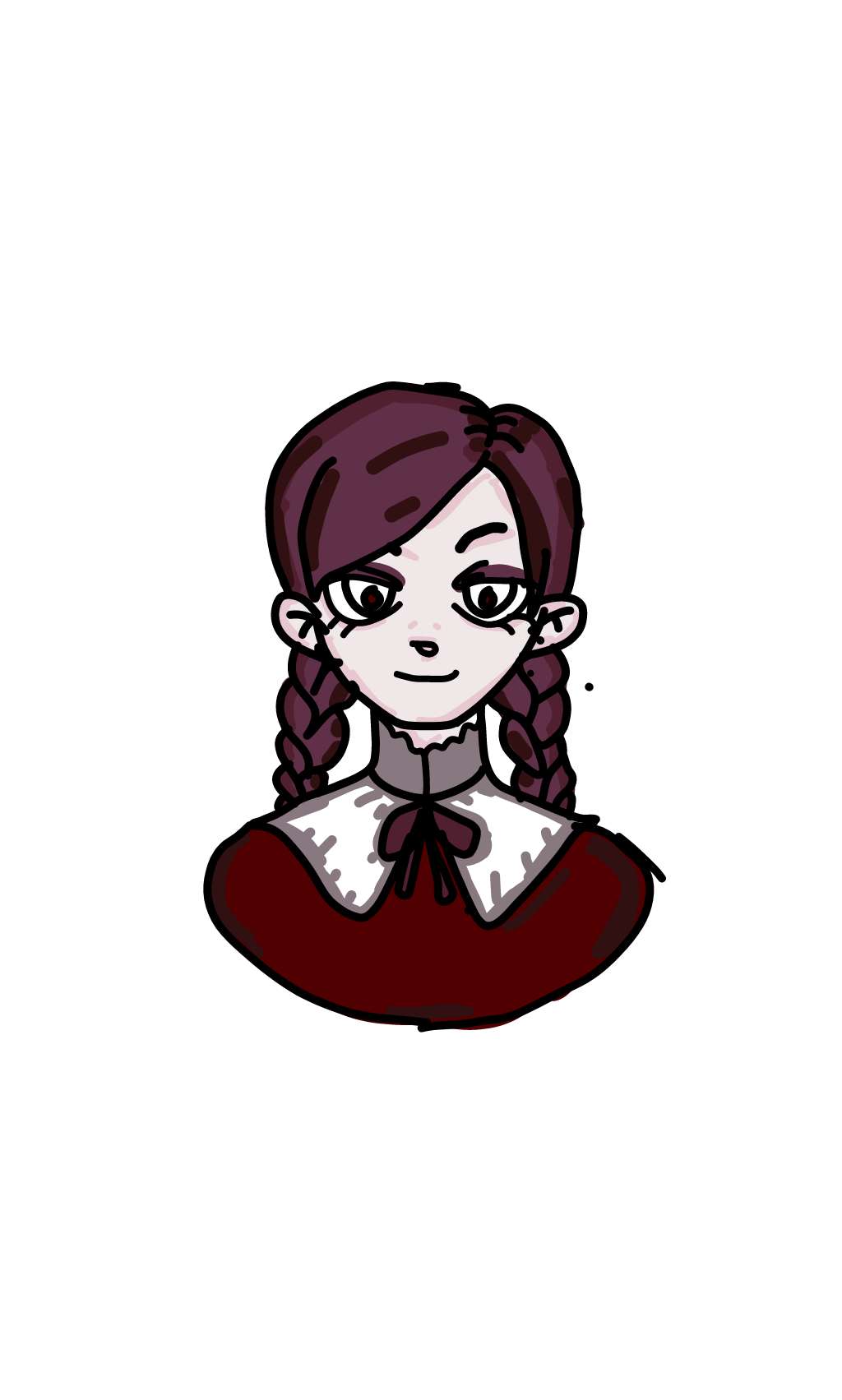
Before adding details, block out Wednesday’s shape. Her most recognizable elements are simple: center-parted hair, two braids, a neat collar, a dark dress, and a still, upright posture. This is why she works in cartoons, comics, digital portraits, and even tiny doodles in the corner of a math notebook. Her design is clean, graphic, and instantly identifiable.
Try drawing her as a black shape first. If the silhouette reads as Wednesday without facial features, the foundation is strong. If it looks like a random schoolgirl who just lost a spelling bee, sharpen the design. Make the braids clearer. Make the collar pop. Give the pose that classic “I am not impressed, and I brought receipts” energy.
2. The Deadpan Expression
Wednesday’s face is a masterclass in minimalism. She does not need raised eyebrows, a giant grin, or dramatic tears. In fact, those things would probably offend her. Her expression often depends on tiny choices: a straight mouth, heavy-lidded eyes, a slightly lowered chin, or a stare that feels like it knows what you did last summer and graded it a C-minus.
When drawing her face, resist the urge to overact. Keep the mouth small and flat. Let the eyes do the haunting. If you want humor, place that blank expression in a ridiculous situation: Wednesday holding a pastel birthday balloon, Wednesday judging a puppy parade, or Wednesday calmly sketching a guillotine while everyone else paints flowers.
3. The Braids, Collar, and Black Dress
Wednesday’s visual identity depends on contrast. Pale face, dark hair. Crisp collar, black dress. Childlike styling, disturbingly adult levels of sarcasm. These contrasts are what make the character fun to draw. The collar is especially important because it frames her face and separates her dark hair and clothing from the rest of the design.
For beginners, start with simple shapes: an oval face, a triangular dress, two rope-like braids, and a white collar. For advanced artists, focus on texture. Give the braids weight. Add fabric folds. Use lighting to make black clothing readable instead of turning the entire drawing into one large ink puddle wearing shoes.
Choose Your Wednesday Addams Era
The Classic Cartoon Wednesday
The earliest Addams Family style was rooted in single-panel cartoon humor. If you want to honor that era, keep your drawing loose, witty, and slightly unsettling. Use simple lines, exaggerated proportions, and a visual joke. Maybe Wednesday is watering a plant that appears to be watering her back. Maybe she is politely offering poison ivy as a bouquet. The humor should be dry, not loud.
The 1960s Sitcom Wednesday
The television version from the 1960s leaned into quirky family charm. This Wednesday can be drawn softer and younger, with rounder features and a playful kind of gloom. She is still strange, of course, but in a way that feels like she might invite a spider to tea and ask whether it prefers one lump of sugar or one unfortunate fly.
The 1990s Movie Wednesday
Christina Ricci’s Wednesday became a fan-art favorite because of her razor-sharp stillness. This version is ideal for artists who love clean expressions, dark comedy, and dramatic contrast. Her face can be almost mask-like, which makes tiny changes incredibly powerful. Move one eyebrow a millimeter and suddenly she has either discovered a secret or decided your entire bloodline is disappointing.
The Modern Nevermore Wednesday
Jenna Ortega’s Wednesday brought more motion, mystery, and gothic teen style into the character. This version works beautifully for digital illustration, fashion-inspired portraits, dance poses, and moody academy settings. Think black uniforms, shadowy halls, violins, raven imagery, and the kind of lighting that suggests the sun has been asked to leave the premises.
Drawing Ideas for “Hey Pandas, Draw Your Best Wednesday Addams”
1. Wednesday With Thing
Thing is a gift to artists because a disembodied hand can add comedy, movement, and storytelling without stealing the spotlight. Draw Thing fixing Wednesday’s braid, holding a pencil for her, tapping impatiently on a desk, or giving a tiny thumbs-up while Wednesday refuses to acknowledge emotional support.
2. Wednesday at Art Class
This version practically writes itself. Everyone else is painting sunsets, kittens, or bowls of fruit. Wednesday is painting a beautifully rendered thunderstorm over a cemetery. Bonus points if the teacher looks concerned and the painting itself looks proud.
3. Wednesday as a Cute Chibi Character
A chibi Wednesday is funny because the style is naturally adorable and Wednesday is naturally anti-adorable. Keep the big head and tiny body, but preserve her flat expression. The contrast creates instant comedy. Add oversized braids, a tiny dress, and a stare powerful enough to curdle glitter glue.
4. Wednesday in a Gothic Fashion Portrait
For artists who love detail, turn Wednesday into a fashion illustration. Emphasize lace, velvet, pleats, boots, and dramatic lighting. Use a limited palette of black, white, gray, and one accent color, such as deep purple or blood red. Keep the mood elegant, not messy. Wednesday would never tolerate visual clutter unless it was evidence.
5. Wednesday Meets Your Own Style
The best fan art often happens when the artist’s personality shows. Try drawing Wednesday as a manga heroine, a vintage comic character, a paper-cut silhouette, a watercolor portrait, a spooky sticker, or a pixel-art sprite. The key is to keep her core traits intact: braids, collar, dark outfit, stillness, intelligence, and a complete lack of interest in pretending to be normal.
Step-by-Step: How to Draw Your Best Wednesday Addams
Step 1: Gather Reference, Then Put It Away
Look at several versions of Wednesday before drawing. Notice what stays consistent and what changes. The braids, the dark clothes, and the deadpan expression are nearly always present, but proportions, age, costume details, and mood shift across adaptations. Once you understand the ingredients, stop copying one image too closely and build your own version.
Step 2: Sketch the Pose
Wednesday’s body language is usually controlled. She rarely flails, slouches dramatically, or waves her arms like a haunted inflatable tube person. Try upright poses, hands folded, arms crossed, one hand holding a book, or a calm stance in the middle of chaos. Stillness is part of the joke.
Step 3: Build the Face Around the Eyes
Her eyes are the emotional engine, even when the emotion is “none of the above.” Draw them first, then design the rest of the face around that stare. Keep the mouth understated. A tiny frown can work. A straight line can work. A smirk can work if used sparingly. A giant smile should be reserved for parody, nightmares, or Wednesday’s evil twin from an alternate universe where everyone wears yellow.
Step 4: Add Costume Details
The collar and dress do a lot of storytelling. Keep the collar bright and clean. Use the dress shape to guide the eye down from the face. If you are drawing the Nevermore-inspired version, add academy details such as stripes, a blazer, or gothic accessories. If you are drawing a classic version, keep the design simpler and more graphic.
Step 5: Use Shadows Wisely
Black clothing can be tricky. Do not color everything flat black and call it a day unless your artistic goal is “mysterious laundry pile.” Use highlights, folds, and subtle gray tones to show form. A little rim light on the hair or shoulders can make the figure stand out while keeping the gloomy mood intact.
Step 6: Add a Story Element
A drawing becomes more memorable when it suggests a situation. Is Wednesday reading a forbidden book? Playing cello in a thunderstorm? Winning a science fair with something that may still be breathing? Standing calmly while a cheerful party collapses behind her? Give viewers a tiny narrative and they will spend more time with the artwork.
Common Mistakes to Avoid
Making Her Too Cheerful
Wednesday can be funny, but she is not bubbly. Even when the scene is silly, keep her emotionally controlled. The humor comes from contrast: the world is absurd, and Wednesday remains beautifully unmoved.
Forgetting the Collar
The white collar is not just clothing; it is a visual anchor. Without it, Wednesday can start to look like any dark-haired character in a black dress. The collar sharpens the design and gives the face a strong frame.
Overcomplicating the Design
Wednesday’s power comes from restraint. Too many accessories, patterns, weapons, sparkles, or dramatic effects can bury the character. She does not need twelve bats, five skulls, and a fog machine. She is the fog machine.
How to Make Your Drawing Stand Out Online
If you are posting your Wednesday Addams fan art for a community prompt, presentation matters. Photograph or scan your work clearly. Crop out messy desk edges unless the desk adds charm, such as a dramatic coffee stain that looks like a Victorian curse. Use a title that describes your concept, not just “Wednesday drawing.” Try something like “Wednesday Addams at Art Class,” “Nevermore Sketchbook,” or “Wednesday Judges My Pencil Choices.”
Add a short caption explaining your idea. People love knowing what inspired the drawing. Mention your tools, whether you used pencil, ink, watercolor, markers, Procreate, Photoshop, Clip Studio Paint, or a pen you found in a drawer that may or may not belong to a dentist. A friendly caption helps viewers connect with the piece and encourages comments.
Why Artists Keep Returning to Wednesday
Wednesday Addams endures because she is simple enough to recognize and complex enough to reinterpret. She is gothic without being chaotic, funny without being goofy, and emotionally restrained without being empty. She gives artists a rare mix: iconic design, cultural history, and room for personal style.
She also represents the outsider who refuses to apologize for being different. That makes her especially appealing to creative communities. Drawing Wednesday is not just about drawing a famous character. It is about drawing confidence, weirdness, intelligence, and the quiet joy of not fitting into a pastel box labeled “normal.”
Experience: The Night I Tried to Draw My Best Wednesday Addams
The first time I tried to draw Wednesday Addams seriously, I made the classic beginner mistake: I assumed she would be easy. After all, how hard could it be? Black dress, two braids, blank expression. Done. Ten minutes, maybe fifteen if the pencil felt dramatic. I sat down with a sketchbook, sharpened my pencil, and immediately discovered that drawing “no expression” is somehow harder than drawing a dragon sneezing fireworks.
My first sketch looked less like Wednesday Addams and more like a tired substitute teacher who had just found glitter in the attendance folder. The braids were uneven, the collar looked like two tortilla chips, and the eyes had that unfortunate “I have seen the copier jam again” energy. Still, there was something fun about it. Wednesday is forgiving in a very unforgiving way. Even a slightly wrong drawing can teach you what matters.
So I tried again. This time I started with the silhouette. I made the hair darker, the center part cleaner, and the shoulders more still. Suddenly, the character began to appear. Not perfectly, but enough that I could hear the tiny imaginary voice of Wednesday saying, “Acceptable. Barely.” That felt like encouragement, or at least the Addams Family version of a gold star.
The biggest breakthrough came when I stopped trying to make the face dramatic. I had been drawing heavy shadows, sharp cheekbones, and intense eyebrows, as if Wednesday were about to announce the end of civilization at a school assembly. But her power is quieter than that. A straight mouth. Calm eyes. A little downward tilt of the head. Once I removed half the drama, the drawing became more Wednesday. Apparently, the secret was not adding more gloom. It was editing the gloom until it had excellent posture.
I also learned that props help. My favorite version from that sketching session showed Wednesday holding a sketchbook of her own. Inside it, she had drawn a smiling sun and crossed it out with impressive commitment. It was a small joke, but it made the picture feel alive. Fan art works best when it adds a tiny idea instead of simply repeating a costume.
By the end of the night, my desk looked like a pencil storm had passed through a haunted stationery store. There were rejected faces, abandoned braids, and one drawing where Thing looked more like a nervous potato with fingers. But the final sketch had personality. It was not perfect, and Wednesday herself would probably have called it “adequate for a living person,” but it captured the feeling I wanted: still, strange, smart, and quietly hilarious.
That is the real joy of the “Hey Pandas, Draw Your Best Wednesday Addams” prompt. It is not about creating the most polished portrait in the room. It is about finding your version of a character everyone recognizes but no two artists see exactly the same way. Maybe your Wednesday is cute. Maybe she is cinematic. Maybe she is spooky, sarcastic, elegant, awkward, or standing next to a suspiciously happy frog. If the drawing feels unmistakably Wednesday while still feeling like you, congratulations. Your inner goth art critic may now nod once and return to the shadows.
Conclusion
Drawing Wednesday Addams is a delightful exercise in restraint, contrast, and character storytelling. Her best features are simple on the surface but surprisingly rich in practice: the braids, the collar, the dark dress, the still posture, and the expression that says she has no time for nonsense unless the nonsense is extremely well organized. Whether you sketch her in pencil, paint her digitally, turn her into a chibi sticker, or place her in a dramatic Nevermore-inspired scene, the goal is the same: capture the attitude, not just the outfit.
For artists and fans, “Hey Pandas, Draw Your Best Wednesday Addams” is a perfect creative prompt because it welcomes every skill level. Beginners can practice shapes and expressions. Experienced artists can explore lighting, fashion, humor, and mood. Everyone gets to spend a little time with one of pop culture’s most beloved gloomy icons. And really, any drawing challenge that makes black clothing, deadpan comedy, and emotional restraint feel this fun deserves a polite, unsmiling round of applause.