Space photos have a strange superpower: they can make a person feel tiny, amazed, slightly dizzy, and suddenly very interested in dust. Not regular household dust, of course. We are talking about cosmic dust, asteroid dust, Martian dust, comet dust, and the kind of ancient material that helped build planets before Earth had oceans, clouds, Wi-Fi, or anyone arguing about Pluto at dinner.
Images of Earth’s solar system are more than pretty pictures. They are visual records of discovery. Every photo of Mercury’s cratered face, Venus’s hidden volcanic landscape, Earth’s blue curve, Mars’s rusty deserts, Jupiter’s stormy clouds, Saturn’s glowing rings, Uranus’s icy calm, Neptune’s deep blue atmosphere, and Pluto’s frozen plains tells us something about how our neighborhood in space works. These images come from spacecraft, orbiters, rovers, telescopes, observatories, and astronauts who have turned the solar system into the most dramatic photo album humanity has ever made.
And unlike most family albums, this one includes volcanoes taller than mountains, storms larger than Earth, moons with underground oceans, rings made of ice, and a star that occasionally throws energetic tantrums. In other words, the solar system has range.
What Do We Mean by “Earth’s Solar System”?
Earth’s solar system is the planetary system we live in, centered on the Sun. It includes eight planets, five officially recognized dwarf planets, hundreds of known moons, and a huge population of asteroids, comets, meteoroids, and icy objects. The planets are Mercury, Venus, Earth, Mars, Jupiter, Saturn, Uranus, and Neptune. The officially recognized dwarf planets include Ceres, Pluto, Haumea, Makemake, and Eris.
In photos, the solar system often looks like a neat lineup of colorful marbles. That is useful for posters, classrooms, and people who enjoy order. Reality is much messier. The planets are separated by enormous distances, the asteroid belt is not a crowded rock traffic jam, and the outer solar system stretches into regions so remote that sunlight becomes more of a polite suggestion than a blazing spotlight.
Solar system images help bridge that distance. They turn numbers into places. A crater becomes a scar from an ancient impact. A cloud band becomes weather. A moon becomes a possible ocean world. A blue dot becomes home.
Why Photos of Space Matter
Space photography is not just decoration for science textbooks. It is data. Scientists use images to map terrain, track storms, study atmospheres, identify minerals, measure ice, monitor solar activity, and plan future missions. A single image may reveal the shape of a canyon on Mars, the structure of Saturn’s rings, the changing bands of Jupiter, or the seasonal behavior of Uranus and Neptune.
Photos also shape public imagination. The famous “Blue Marble” view of Earth helped people see our planet as a complete, fragile world. Images from the Hubble Space Telescope and James Webb Space Telescope have made distant planets and cosmic structures feel almost touchable. Rover panoramas from Mars make another planet look less like a myth and more like a dusty hiking destinationthough, admittedly, one with no oxygen, no snack bar, and very strict packing requirements.
The Sun: The Star of the Show, Literally
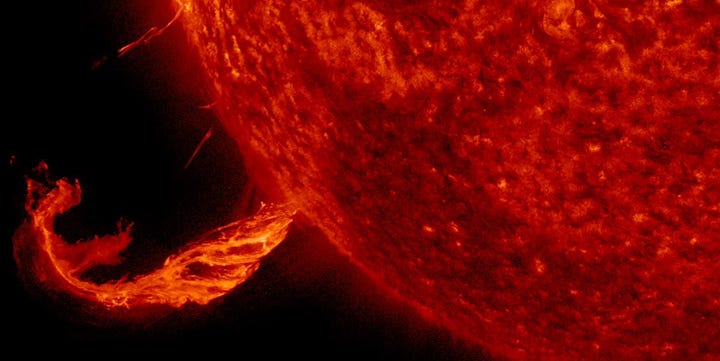
No solar system photo collection is complete without the Sun. It is the gravitational anchor, the main energy source, and the reason we have daylight instead of permanent cosmic mood lighting. Modern solar images often come from spacecraft such as NASA’s Solar Dynamics Observatory, which observes the Sun in multiple wavelengths of light.
These solar images can look wildly colorful, but the colors are often assigned to different wavelengths that human eyes cannot naturally see. Extreme ultraviolet views reveal magnetic loops, flares, and active regions. When the Sun releases a flare, images may show a bright burst on the surface, followed by twisting magnetic structures that look like fiery spaghetti cooked by a very dramatic chef.
Studying solar images helps scientists understand space weather. Solar flares and coronal mass ejections can affect satellites, radio signals, astronauts, and power systems on Earth. So while solar photos are beautiful, they are also practical. They are weather reports from a star.
Mercury: A Cratered World Close to the Sun
Mercury is the smallest planet in the solar system and the closest to the Sun. In images, it can resemble Earth’s Moon at first glance: gray, rocky, and heavily cratered. But Mercury is its own strange world. Its surface preserves impact scars from the early solar system, offering a visual record of collisions that occurred billions of years ago.
NASA’s MESSENGER mission transformed our view of Mercury. Before MESSENGER, scientists had only partial close-up coverage of the planet. The spacecraft mapped Mercury in detail, revealing volcanic plains, long cliffs, impact basins, and chemical clues about the planet’s formation. Photos of Mercury remind us that the inner solar system was once a rough neighborhood. If planets had childhood scrapbooks, Mercury’s would be full of dents.
Venus: The Planet Hidden Under Clouds
Venus looks smooth and bright in visible-light photos because it is wrapped in thick clouds. From space, it can appear calm, creamy, and elegant. That is a little misleading. Beneath those clouds is an extremely hot surface, crushing atmospheric pressure, and a landscape shaped by volcanoes and lava flows. Venus is sometimes called Earth’s twin because of its similar size and neighboring orbit, but it is more like Earth’s dramatic cousin who moved into a sauna and never came out.
Because Venus’s clouds hide the surface from ordinary cameras, some of the most important images of Venus are radar maps. NASA’s Magellan mission used radar to image nearly the entire planet’s surface, giving scientists a detailed look at mountains, plains, volcanic features, and impact craters. These images proved that space photos are not always simple snapshots. Sometimes, to see a world clearly, you have to use the right kind of light.
Earth: The Blue Planet in the Solar System Gallery
Earth is the only planet in the solar system known to have life, oceans on the surface, and people who spend too much time choosing profile pictures. From space, Earth is instantly recognizable: blue oceans, white clouds, brown and green land, glittering ice, and the thin atmosphere that makes everything we know possible.
Images of Earth from space changed human culture. The “Blue Marble” showed the full disk of our planet in vivid color. Earth Observatory images reveal hurricanes, wildfires, city lights, plankton blooms, deserts, glaciers, and seasonal changes. Astronaut photography from orbit shows sunrise over the atmosphere, auroras dancing near the poles, and the delicate curve of the planet against black space.
Earth images are emotionally powerful because they are both scientific and personal. A photo of Jupiter is fascinating. A photo of Earth is personal property, collectively speaking. It is the group portrait of every ocean, forest, city, mountain, pet, garden, kitchen, memory, and unfinished to-do list.
The Moon: Our Closest Space Photo Subject
The Moon is Earth’s natural satellite and one of the most photographed objects beyond our planet. Its surface is covered with craters, plains, mountains, and ancient lava-filled basins called maria. Photos from lunar orbiters and Apollo missions revealed the Moon as a rugged, dusty world rather than a smooth silver disk.
Moon images are especially important because they connect astronomy with human exploration. Apollo astronauts photographed the lunar surface up close, including footprints, rocks, equipment, and Earth hanging above the horizon. More recent missions continue to map the Moon in high resolution, helping scientists identify landing sites, study polar ice, and prepare for future exploration.
Mars: The Red Planet in High Definition
Mars may be the solar system’s most photogenic desert. It has volcanoes, canyons, dunes, dry riverbeds, polar ice caps, dust storms, and landscapes that look familiar enough to feel invitinguntil you remember the atmosphere is thin and the temperature is not exactly picnic-friendly.
Photos of Mars come from orbiters, landers, and rovers. The Mars Reconnaissance Orbiter has captured detailed images of dunes, craters, landslides, ice deposits, and possible ancient water-related features. Rovers such as Spirit, Opportunity, Curiosity, and Perseverance have sent back ground-level views of rocks, hills, valleys, and dusty horizons.
These images are not just scenic. They help scientists understand whether Mars once had conditions suitable for life. Layered rocks, mineral deposits, and ancient streambeds suggest that water played a major role in Mars’s past. Every rover photo is a clue. Sometimes it is a clue about geology. Sometimes it is a clue that humans are very good at seeing “faces” and “animals” in random rocks. Space science is serious, but pareidolia never takes a vacation.
Jupiter: Storms, Stripes, and the Great Red Spot
Jupiter is the largest planet in the solar system, and its images are spectacular. The planet’s colorful bands are cloud systems moving at different speeds. Its Great Red Spot is a giant storm that has been observed for generations. NASA’s Juno spacecraft has captured dramatic close-ups of Jupiter’s cloud tops, polar cyclones, and swirling storms that look like abstract paintings made by weather itself.
Jupiter images also include its moons, especially the four large Galilean moons: Io, Europa, Ganymede, and Callisto. These moons are worlds in their own right. Io is volcanically active. Europa may have a subsurface ocean. Ganymede is the largest moon in the solar system. Callisto is heavily cratered and ancient. In solar system photography, Jupiter is not just a planet; it is a mini-system with a massive gravitational personality.
Saturn: The Ringed Icon
Saturn is the planet most likely to make people say, “That cannot be real,” even though it very much is. Its rings are made mostly of ice particles, with sizes ranging from tiny grains to much larger chunks. In photos, the rings look smooth and solid, but they are actually a vast, thin, complex structure shaped by gravity and the planet’s many moons.
The Cassini mission gave humanity some of the most beautiful images ever taken in the solar system. Cassini photographed Saturn’s rings, storms, moons, and atmosphere for years before ending its mission in 2017. Its images of Enceladus showed water-rich plumes erupting from the moon’s south polar region. Its views of Titan revealed a moon with a thick atmosphere and surface lakes and seas made of liquid hydrocarbons.
Saturn images are famous because they combine elegance and science. They look like art, but they also reveal ring waves, moon interactions, seasonal changes, and atmospheric patterns. Saturn is basically the solar system’s luxury brand ambassador, except the accessories are ice rings and the weather is terrifying.
Uranus and Neptune: The Ice Giants
Uranus and Neptune are often called ice giants because they contain heavier substances such as water, ammonia, and methane in addition to hydrogen and helium. In many images, Uranus appears pale blue-green, while Neptune is a deeper blue. Their colors are influenced in part by methane in their atmospheres, which absorbs red light.
For a long time, some of the best close-up images of these planets came from Voyager 2, the only spacecraft to fly by Uranus and Neptune. More recently, Hubble and Webb observations have added new details. Hubble has monitored seasonal changes and storms in the outer planets. Webb’s infrared images have revealed rings and atmospheric structures with fresh clarity, especially around Neptune and Uranus.
Photos of the ice giants remind us that the solar system does not end at Saturn’s rings. The outer planets are distant, cold, and less familiar, but they are essential to understanding planetary formation, atmospheric chemistry, and the architecture of our solar neighborhood.
Pluto and the Dwarf Planets: Small Worlds, Big Personality
Pluto may no longer be classified as one of the eight major planets, but it remains one of the most beloved worlds in the solar system. When NASA’s New Horizons spacecraft flew past Pluto in 2015, it revealed a complex dwarf planet with mountains, plains, glaciers of nitrogen ice, and a famous heart-shaped region. Before that flyby, Pluto was little more than a fuzzy dot in many images. Afterward, it became a place.
Pluto images changed how people think about the outer solar system. They showed that small, icy worlds can be geologically interesting. The Kuiper Belt, where Pluto resides, contains many icy bodies that preserve clues from the early solar system. Photos and measurements from New Horizons gave scientists a closer look at a region that had long been mostly theoretical.
Asteroids, Comets, and Meteors: The Solar System’s Leftovers
Asteroids, comets, and meteoroids are remnants from the formation of the solar system about 4.6 billion years ago. They may be smaller than planets, but their images are scientifically rich. Asteroids can reveal the rocky building blocks of planets. Comets can show icy material from the outer solar system warming as it approaches the Sun. Meteors, when seen from Earth, give us brief glowing reminders that space is not empty.
Spacecraft images of asteroids show irregular shapes, boulders, craters, and rubble-pile structures. Comet photos often reveal glowing comas and tails created as solar energy vaporizes ice and releases dust. These objects may look like cosmic leftovers, but leftovers can be valuable. Ask anyone who has found cold pizza in the fridge.
How Space Images Are Made
Not all space photos are captured the way a phone camera captures a sunset. Many are built from data collected through filters, sensors, radar, infrared instruments, ultraviolet cameras, or radio signals. Scientists and image processors may combine multiple exposures, assign colors to wavelengths, sharpen details, or create mosaics from many separate frames.
This does not make the images fake. It makes them translated. Human eyes see only a small slice of the electromagnetic spectrum. Space instruments can detect light and signals outside that range, giving us views of heat, chemistry, magnetic activity, and surface structure. A Webb infrared image of a planet may look different from a Hubble visible-light image because each telescope is revealing different physical information.
Best Types of Solar System Photos to Explore
Planet Portraits
These are full-disk images of planets, often used in educational posters and articles. They are perfect for comparing color, size, atmosphere, and surface features.
Surface Close-Ups
These include rover photos from Mars, radar maps of Venus, lunar surface images, and close views of Mercury or Pluto. They turn distant worlds into landscapes.
Atmospheric Images
These show storms, clouds, auroras, bands, hazes, and seasonal changes. Jupiter, Saturn, Uranus, Neptune, Earth, and the Sun are especially strong subjects.
Ring and Moon Images
Saturn’s rings are the superstar, but Jupiter, Uranus, and Neptune also have ring systems. Moon images reveal volcanic activity, ice, craters, oceans, and complex geology.
Mission Mosaics
Mosaics combine many images to create wide views or global maps. These are especially useful for planets and moons that cannot be captured in full detail with one image.
Why Solar System Images Still Surprise Us
One reason solar system images remain exciting is that they keep overturning expectations. Pluto turned out to be active and varied. Mars revealed ancient environments shaped by water. Jupiter’s poles looked more complex than many expected. Saturn’s moon Enceladus showed signs of a subsurface ocean. Venus’s radar-mapped surface raised new questions about volcanic activity. Even Earth, photographed daily by satellites, continues to surprise scientists with changing ice, storms, fires, and atmospheric patterns.
The solar system is familiar because it is our home region, but it is not simple. Every new image adds another layer. Sometimes the layer is beautiful. Sometimes it is confusing. Often, it is both.
Experience: What It Feels Like to Explore Photos of Space
Looking through images of Earth’s solar system can feel like opening a travel guide for places you cannot visitat least not yet. The first impression is usually beauty. Saturn’s rings look impossibly graceful. Mars looks lonely and cinematic. Earth looks alive. Jupiter looks like it hired a professional cloud stylist. But after the first wave of amazement, something deeper starts to happen: the photos make the solar system feel real.
One of the best experiences is comparing images from different missions. A simple classroom diagram may show Mars as a red dot, but rover panoramas show a real landscape with rocks, slopes, shadows, and dusty skies. Suddenly Mars is not just “the fourth planet from the Sun.” It is a place where a robot can stop, look around, drill a rock, and send a postcard home across millions of miles. That is a pretty impressive long-distance relationship.
Earth photos create a different feeling. When you see the planet from space, borders disappear. Oceans, clouds, continents, deserts, forests, and storms become part of one connected system. The experience is humbling without being gloomy. It quietly suggests that our planet is both sturdy and delicate. It has survived asteroid impacts, ice ages, volcanoes, and countless bad hair days in human history, but it still depends on balance.
Solar images bring another kind of awe. The Sun looks steady from the ground, but close-up images reveal a restless star with loops, flares, eruptions, and magnetic drama. It is easy to forget that sunlight is not just “brightness.” It is energy from a massive star that controls the rhythm of the solar system. Seeing the Sun in ultraviolet or extreme ultraviolet light feels like seeing the engine room of daylight.
Photos of Jupiter and Saturn are often the most visually addictive. Jupiter’s storms look painted, but they are enormous atmospheric systems. Saturn’s rings look peaceful, but they are shaped by motion, gravity, collisions, and moon interactions. The experience is similar to admiring a calm ocean from the beach, then remembering that waves, currents, tides, and weather are all working underneath the pretty surface.
Pluto images offer perhaps the biggest emotional twist. For decades, Pluto was a tiny blur. Then New Horizons arrived and revealed mountains, plains, haze, and a giant heart-shaped region. That transformationfrom dot to worldis one of the most satisfying experiences in space photography. It proves that distance can hide complexity, and that even small worlds can have big stories.
For readers, students, writers, photographers, and casual sky fans, exploring solar system photos is a reminder that science is not just a list of facts. It is a way of seeing. Every image asks a question: What made this crater? Why is this storm still spinning? How did this moon form? Is there water under that ice? What would Earth look like from there? The more you look, the more the solar system stops being a chart and becomes a neighborhoodstrange, beautiful, ancient, and still full of surprises.
Conclusion
Images of Earth’s solar system give us one of the greatest visual stories ever told. From the Sun’s explosive energy to Pluto’s frozen landscapes, from Earth’s blue glow to Saturn’s rings, these photos turn distant objects into understandable worlds. They help scientists study geology, weather, atmospheres, moons, rings, ice, dust, and planetary history. They also help everyone else feel the wonder of living on a small blue planet in a vast, active, photogenic cosmic neighborhood.
The best space photos do not simply show us what is out there. They change how we see where we are. They remind us that Earth is part of a larger system, that beauty can be scientific, and that even a dusty rock millions of miles away may have a story worth telling. The solar system is not just a place. It is an ongoing gallery, and humanity is still learning how to read the captions.
Note: This article is written in original, publication-ready language and is factually grounded in current solar system science from authoritative U.S. space and astronomy resources.