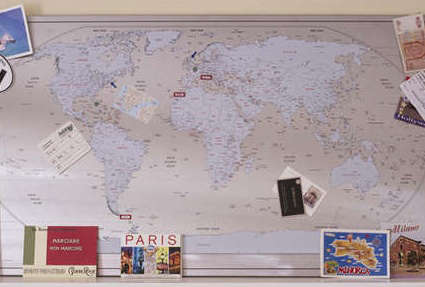
An Enormous Magnetic World Map is what happens when geography, travel dreams, home decor, and a tiny bit of “look, I’m cultured” energy all meet on one wall. It is big, bold, useful, and surprisingly emotional. One minute you are placing a magnet on Paris because you once ate a croissant there. The next minute you are staring at the South Pacific wondering whether you are brave enough to visit Fiji, or at least brave enough to correctly pronounce it in front of your friends.
Unlike a regular poster map that politely minds its own business, a magnetic world map invites interaction. You can mark countries visited, dream destinations, shipping routes, study locations, family origins, office branches, classroom lessons, or the places your suitcase claims it will visit “next year.” It turns a flat wall into a living travel journal.
But the best enormous magnetic world maps are more than oversized decoration. They combine cartographic accuracy, readable design, strong mounting, durable materials, and safe magnets. Whether you want one for a living room, classroom, office, homeschool space, travel agency, or conference room, choosing the right map requires more thought than “big map go boom.” Let’s explore what makes this giant wall piece so magneticliterally and emotionally.
What Is an Enormous Magnetic World Map?
An enormous magnetic world map is a large-format wall map printed, mounted, or built on a magnetic surface. The backing may be steel, a magnetic board, laminated metal, or another magnet-friendly material. Users can place small magnets, labels, pins with magnetic bases, photo magnets, or travel markers directly on the map without damaging the surface.
Most versions fall into three broad categories. First, there are magnetic poster maps, often laminated and mounted on a board. These are practical, affordable, and popular in classrooms or offices. Second, there are metal world map wall art pieces, where the continents themselves may be cut from steel or aluminum-like material designed for magnets. Third, there are decorative travel memory boards, which focus on storytelling: where you have been, where you are going, and where your passport is silently judging you for not going yet.
The word “enormous” matters. A small map is cute, but a large magnetic world map becomes a centerpiece. At sizes around 40 to 80 inches wide, it can fill a living room wall, anchor a home office, or command attention in a classroom. Larger maps are easier to read, easier to use with magnets, and better at creating that dramatic “global headquarters” feelingeven if your headquarters is just a desk, a coffee mug, and one houseplant fighting for its life.
Why Magnetic World Maps Are So Popular
The appeal is simple: people love maps because maps make the world feel understandable. A map turns continents, oceans, borders, and distances into a single visual story. National Geographic Education describes maps as symbolic representations of selected characteristics of a place, and that idea explains why maps are so powerful. They simplify the planet without making it boring.
A magnetic map adds one more layer: participation. You do not just look at it. You change it. You add a magnet for Tokyo after a business trip. You mark Yellowstone after a family vacation. You place a tiny airplane magnet over the Atlantic because, frankly, it looks adorable. The map becomes a record of movement, memory, and possibility.
For Travelers
For travelers, a giant magnetic world map functions like a visual bucket list. You can use one color of magnet for countries visited, another for future trips, and another for “maybe when flights stop costing the price of a small dragon.” Couples use them to plan honeymoons, families use them to track vacations, and solo travelers use them as motivation to keep exploring.
For Classrooms and Homeschooling
Large magnetic world maps are excellent educational tools. Geography learning improves when students can physically interact with locations, directions, regions, and patterns. Map-based activities help build spatial thinking, which supports learning in geography, history, science, and even math. A magnetic map lets students move labels, identify continents, compare distances, track historical journeys, or connect current events to real places.
For Offices and Businesses
In an office, a magnetic world map can show client locations, supplier networks, shipping routes, market expansion plans, or international team members. It gives abstract business data a physical home. A startup can mark target regions. A logistics company can map shipping lanes. A nonprofit can show project sites. It is much more interesting than another motivational poster saying “Synergy,” which has never once helped anyone find Argentina.
The Science Behind the “Magnetic” Part
Most magnetic wall maps do not generate magnetism themselves. Instead, they provide a surface that magnets can attach to. Steel is the classic choice because magnets stick strongly to iron-containing metals. Thin decorative metal can work, but the strength depends on the material, thickness, coating, and magnet type.
Magnets used on wall maps are often ceramic, ferrite, or neodymium. Neodymium magnets are much stronger, which can be useful on thicker surfaces or for holding postcards and photos. However, strong magnets require caution, especially around children. The U.S. Consumer Product Safety Commission warns that high-powered magnets can be dangerous if swallowed, because they may attract each other inside the body and cause severe injury. For homes with young children, larger low-strength magnets or enclosed magnetic markers are the safer choice.
There is also a fun difference between a magnetic world map and a map of Earth’s magnetic field. Earth itself has a magnetic field produced by movement in its molten outer core. NOAA’s World Magnetic Model is used for navigation systems and is updated because Earth’s magnetic field changes over time. That means magnetic north is not the same as true north, and it moves. Your decorative magnetic world map will not guide submarines through the Arctic, but it can start a great conversation about why compass needles are a little more dramatic than they look.
True North, Magnetic North, and Why Map Nerds Smile
A traditional world map usually shows geographic north, also called true north. This is the direction toward the geographic North Pole, where Earth’s rotation axis meets the surface. Magnetic north is different. It is the direction a compass needle points, based on Earth’s magnetic field. The angle between true north and magnetic north is called magnetic declination.
USGS explains that magnetic declination varies depending on where you are. In some places, a compass points east of true north; in others, it points west. The zero-declination line is called the agonic line. For hikers, pilots, sailors, surveyors, and anyone who has ever tried to look impressive with a compass, this matters.
Adding a small legend or educational note about magnetic north can make an enormous magnetic world map more interesting. It reminds viewers that maps are not just pretty drawings. They are tools, models, and sometimes arguments with reality. A map says, “Here is the world, simplified enough for your wall.” Earth replies, “Cute. I’m still spinning, shifting, drifting, and hiding molten iron under the floor.”
Best Places to Use an Enormous Magnetic World Map
Living Room
In a living room, a large magnetic world map works best as a focal point. Place it above a sofa, console table, or long cabinet. Choose a color palette that matches your room: antique tones for warmth, black and white for minimalism, blue oceans for a classic academic look, or metal silhouettes for modern industrial style.
Home Office
A home office map adds both personality and function. Remote workers can mark colleagues, clients, conferences, or dream workcation destinations. It also makes video call backgrounds more interesting than a blank wall and less suspicious than a shelf containing only one unread business book.
Classroom
In classrooms, size and readability are critical. Choose a political map with country names, capitals, borders, oceans, and major geographic labels. A magnetic surface allows teachers to add movable labels, arrows, weather systems, trade routes, migration paths, or historical timelines.
Kids’ Room
For children, a magnetic world map can turn geography into play. Use animal magnets, flag magnets, landmark magnets, or family-photo magnets. Just make sure the magnets are large enough to avoid choking and ingestion risks. Safety first, then adorable tiny giraffes.
Travel Agency or Hospitality Space
Hotels, travel agencies, study abroad offices, and tour companies can use magnetic maps to show routes, featured destinations, or customer journeys. A map makes the idea of travel immediate. People look at it and start imagining themselves elsewhere, which is basically the emotional engine of the travel industry.
How to Choose the Right Enormous Magnetic World Map
1. Pick the Right Size
Measure your wall before shopping. A map that looks enormous online may look shy above a long sofa. As a general design principle, large wall art should feel proportionate to the furniture or wall around it. If the map hangs above a sofa or cabinet, aim for a width that fills a substantial portion of that furniture without stretching awkwardly beyond it.
For small rooms, a map around 36 to 48 inches wide can feel large without overwhelming the space. For living rooms, classrooms, offices, and conference rooms, maps from 60 to 80 inches wide create a stronger effect. Very large walls may need multi-panel maps or custom installations.
2. Choose the Map Style
A political world map shows countries, borders, capitals, and major cities. This is best for education, travel tracking, and business use. A physical map shows mountains, deserts, rivers, and landforms, making it better for science and geography lessons. A minimalist metal map may look beautiful but might not include enough labels for learning.
If your goal is decor, choose the map that fits your interior style. If your goal is education, choose readability over moodiness. A gorgeous black-on-black map may impress guests, but if you need a flashlight to find Peru, the design has gone too far.
3. Check the Magnetic Surface
Not every “magnetic” map performs the same. Look for a surface designed to hold magnets securely. Steel-backed maps usually perform well. Magnetic receptive boards are also common. If you plan to hold postcards, tickets, or photos, stronger magnets may be necessary. If you only want small location markers, lighter magnets may be fine.
4. Look for Durable Finishes
A laminated or coated surface helps protect the map from fingerprints, dust, and daily use. Some magnetic maps also support dry-erase markers, which is especially useful for classrooms, offices, and planning boards. Always check manufacturer instructions before writing on the surface. “I thought it was dry erase” is not a sentence anyone wants to say while scrubbing permanent marker off the Indian Ocean.
5. Consider Mounting and Weight
Large magnetic maps can be heavier than standard posters. Metal panels, framed boards, and steel-backed maps require proper mounting hardware. Use wall anchors when needed, check the studs if possible, and follow installation instructions. A world map falling off the wall is not “continental drift.” It is poor mounting.
Creative Ways to Use a Magnetic World Map
The most obvious use is travel tracking, but an enormous magnetic world map can do much more. Use different magnet colors to create categories: visited, planned, dream destination, family heritage, favorite food cities, best beaches, historic sites, or places mentioned in books you love.
Teachers can create geography games by asking students to place magnets on continents, oceans, mountain ranges, climate zones, or countries in the news. Families can use the map to plan trips together, letting children research each destination and add a magnet when they make a convincing argument. Businesses can track customer regions, supplier chains, or global milestones.
You can also attach small photo magnets from trips. A magnet on Rome is nice. A magnet with your family eating gelato in Rome is better. A magnet with someone dropping gelato on their shirt is best, because history deserves honesty.
Common Mistakes to Avoid
The first mistake is buying a map too small for the wall. A tiny world map on a huge empty wall can look like Earth applied for a studio apartment. The second mistake is choosing style over readability. Decorative maps are beautiful, but if you want to use the map daily, labels matter.
The third mistake is ignoring magnet strength. Weak magnets may slide, especially on glossy or vertical surfaces. Overly strong magnets, however, can scratch finishes or pose safety concerns. The fourth mistake is poor placement. Avoid direct sunlight if fading is a concern, and avoid high-humidity locations unless the map is designed for them.
Finally, do not overcrowd the map. A magnetic world map should evolve over time. Leave room for future adventures. The empty spaces are not failures; they are invitations.
Experience Section: Living With an Enormous Magnetic World Map
The first thing you notice after putting an enormous magnetic world map on the wall is that people cannot ignore it. They may walk into the room planning to talk about normal thingscoffee, weather, weekend errandsbut the map catches them. Their eyes drift toward it. Then the questions begin. “Have you been to all these places?” “Why is there a magnet on Iceland?” “Who put a pizza magnet on Italy?” That last one is usually obvious, but it still deserves investigation.
Using a magnetic world map feels different from using a digital map. A phone map is fast and useful, but it disappears when the screen sleeps. A wall map stays present. It becomes part of the room’s personality. Every day, you pass it and see the shape of the world. You notice how far Japan is from California, how large Africa really is, how lonely islands look in the Pacific, and how many countries you still cannot confidently place without squinting.
One of the best experiences is planning travel visually. Instead of opening ten browser tabs and immediately losing emotional control, you stand in front of the map with magnets in hand. You mark possible routes. You compare regions. You realize that “we can just hop over to Greece” from Portugal is not exactly a casual hop unless your family owns a private jet or a very determined seagull.
For families, the map becomes a shared memory board. Children love placing magnets after trips, even short ones. A weekend road trip may not look dramatic on a global map, but the ritual matters. It says, “This place is part of our story now.” Over time, the map becomes a visual archive of birthdays, holidays, reunions, study abroad plans, and once-in-a-lifetime vacations.
In a home office, the map can quietly improve your mood. During a long workday, glancing at the world can make your inbox feel less like the center of the universe. It reminds you that beyond deadlines and spreadsheets, there are mountains, coastlines, cities, deserts, and people living entire lives in places you have not yet visited. That perspective is useful. Also, it is cheaper than quitting your job and moving to a lighthouse.
The most surprising benefit is conversation. An enormous magnetic world map gives guests permission to tell stories. Someone points to Vietnam and remembers a street food tour. Someone else points to Kenya and talks about wildlife. A grandparent points to a country their parents came from. A child asks why Greenland looks so big on some maps. Suddenly, the wall is not decoration anymore. It is a doorway into memory, curiosity, and learning.
Of course, living with a giant magnetic map has practical lessons too. Buy extra magnets from the beginning, because they disappear faster than socks. Use a simple color system, or your map may become a confetti storm of good intentions. Keep small powerful magnets away from children and pets. Clean the surface gently. And when mounting the map, use proper hardware. Gravity has no respect for cartography.
After a few weeks, the map starts to feel less like an object and more like a companion. It keeps track of where you have been and whispers about where you might go next. It is educational without being bossy, decorative without being empty, and personal without needing a photo album. That is the charm of an enormous magnetic world map: it makes the planet feel both huge and reachable.
Conclusion
An Enormous Magnetic World Map is one of the rare home or office pieces that is beautiful, practical, educational, and personal at the same time. It can serve as wall art, a travel tracker, a classroom tool, a planning board, a conversation starter, or a daily reminder that the world is bigger than your routine.
The best map for you depends on how you want to use it. For teaching, prioritize accuracy and readability. For travel memories, choose a durable magnetic surface and a design that makes your magnets stand out. For decor, match the color, material, and scale to your room. For families, choose safe magnets and a layout that invites children to learn through play.
Whether you mark every country you have visited or simply use it to dream about future adventures, a giant magnetic world map turns blank wall space into a story. And unlike most wall decor, it changes as your life changes. One magnet at a time, it becomes a record of curiosity, movement, and the wonderful human habit of asking, “Where should we go next?”