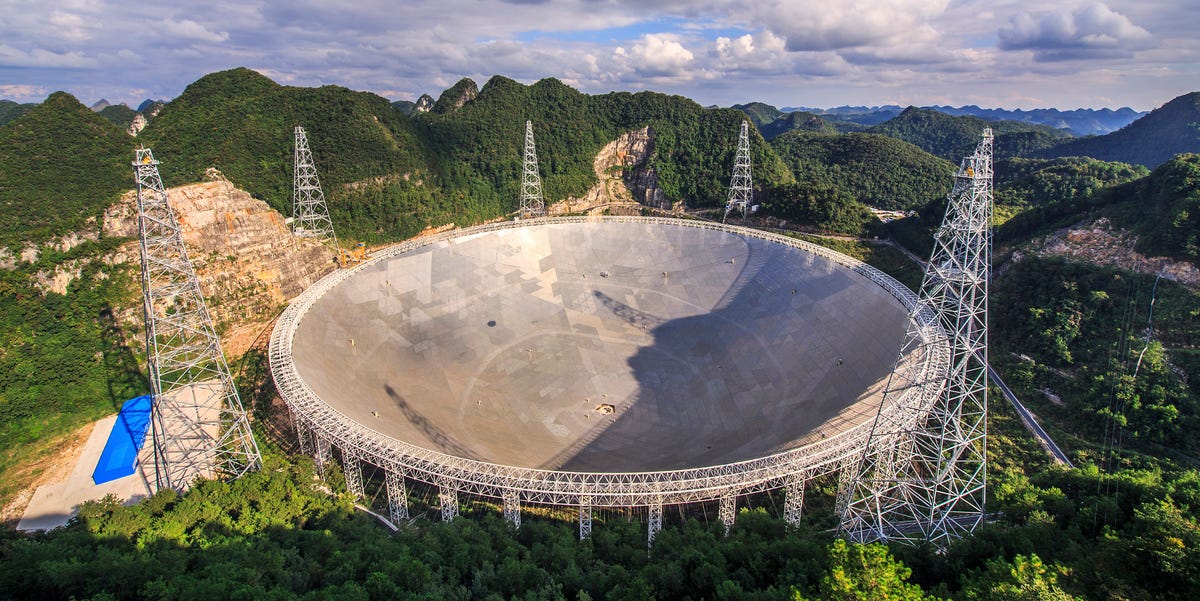
For a brief, glittering moment in June 2022, the internet did what the internet does best: it saw the words “alien signal,” sprinted past every caution sign, and started shopping for welcome mats that said “Greetings, Galactic Neighbor.” Reports suggested that China’s enormous FAST radio telescope, nicknamed “Sky Eye,” had detected narrow-band electromagnetic signals that might be “technological traces” from an extraterrestrial civilization. That phrase was enough to launch headlines, social media theories, and at least a few mental images of little green beings trying to call Earth collect.
But science, annoyingly for clickbait and wonderfully for civilization, does not work by vibes. The more accurate story is less dramatic: Chinese researchers found interesting radio signals that deserved investigation, not proof of aliens. In fact, experts quickly pointed to the most likely explanationradio-frequency interference from Earth. In other words, the “alien signal” was probably not a message from another world. It was more likely the cosmic equivalent of your neighbor’s Wi-Fi bleeding into the baby monitor.
That does not make the episode boring. Quite the opposite. The FAST signal story is a perfect case study in how the search for extraterrestrial intelligence actually works, why radio astronomy is so difficult, and how easily “interesting data” becomes “aliens confirmed” once it hits the headline blender. So let’s slow down, tune the dial, and separate the signal from the noise.
What Actually Happened With China’s FAST Telescope?
The story centered on the Five-hundred-meter Aperture Spherical radio Telescope, better known as FAST. Located in Guizhou province in southwestern China, FAST is one of the most powerful radio telescopes ever built. Its massive dish sits inside a natural karst depression, giving it an ideal location for collecting faint radio waves from deep space. The telescope has been used for pulsar research, radio astronomy, and the search for possible technosignaturessignals that might indicate technology beyond Earth.
In June 2022, reports based on China’s state-backed Science and Technology Daily said researchers had identified several suspicious narrow-band electromagnetic signals. Some of those signals reportedly appeared in data collected in 2019 and reviewed in 2020, while another was associated with observations of exoplanet targets in 2022. The wording was careful enough in the original scientific context, but not careful enough for the global attention economy. The phrase “possible technological traces” became “China may have found aliens,” and the story escaped the lab wearing a shiny tinfoil hat.
Then things got even stranger. The original report appeared to be removed from the Science and Technology Daily website. That deletion fueled more speculation, because nothing says “calm scientific process” quite like a missing article during an alien rumor cycle. But the removal did not prove a cover-up. It proved that the communication around the finding had probably moved faster than the verification. Scientists had not confirmed an extraterrestrial source. They had found candidates, and candidates are not conclusions.
Why Narrow-Band Signals Get SETI Researchers Excited
To understand why anyone cared, we need to talk about narrow-band radio signals. Natural cosmic objectsstars, black holes, nebulae, pulsars, and other astrophysical show-offsusually emit radio energy across broad ranges of frequencies. A very narrow signal, tightly concentrated in frequency, can look more like something made by technology. That is why SETI researchers often search for narrow-band radio emissions: they could, in theory, be signs of transmitters, radar, beacons, or other engineered systems.
However, “could be” is doing a lot of work here. Human civilization is also extremely good at producing narrow-band radio signals. We have satellites, aircraft, cell towers, electronics, navigation systems, computers, and countless devices leaking radio noise into the environment. We are basically living inside a giant invisible fog of electromagnetic chatter. A sensitive radio telescope can pick up breathtaking whispers from space, but it can also catch very earthly muttering from nearby electronics.
That is the central problem in radio SETI: the kind of signal that might be interesting is also the kind of signal humans accidentally create all the time. If aliens ever do call, scientists first have to make sure the phone is not ringing from the garage.
The Most Likely Explanation: Earth Was Talking to Itself
After the FAST story spread, several scientists and observers emphasized that radio-frequency interference was the most likely explanation. This is not an insult to the Chinese research team. It is simply the normal reality of SETI work. Most unusual radio detections are not alien civilizations. They are interference, instrument effects, satellites, aircraft, reflections, or other human-made sources that sneak into the data wearing a fake mustache.
Radio-frequency interference, often shortened to RFI, can be maddening. It may appear briefly. It may drift in frequency. It may look different from familiar signals. It may enter through side lobes of a telescope rather than the main observing direction. It can even mimic some of the features researchers expect from a possible technosignature. That is why SETI detections require aggressive follow-up before anyone should mention aliens without a large bucket of caution.
FAST is designed with advantages that help reduce interference. Its remote location provides some shielding, and its technical capabilities make it extremely sensitive. But sensitivity is a double-edged sword. The better your telescope becomes, the more faint junk it can detect. A world-class telescope does not only hear deeper into the universe; it also hears weaker human noise that older instruments might miss entirely.
Why “Not Aliens” Is Still Good Science
When a possible signal turns out to be interference, the public often treats it like a failed magic trick. No aliens? Boring. Next. But in science, ruling out false positives is not failure; it is the job. A signal candidate that teaches researchers how to improve filters, refine algorithms, and design better follow-up observations is useful even if it never came from a distant civilization.
Think of it like airport security for cosmic messages. SETI researchers are not just waiting for a dramatic beep. They are building systems that ask: Did the signal come from one point in the sky? Did it repeat? Did it appear when the telescope pointed away? Does it show Doppler drift consistent with motion between worlds? Was it seen by another observatory? Could it be produced by local electronics? Does it match known interference patterns? Only after surviving that obstacle course does a signal become truly extraordinary.
The FAST signals did not clear that bar. They were interesting enough to investigate, but not strong enough to support the claim that Chinese scientists had found alien communication. The responsible conclusion is simple: no confirmed alien radio signal was detected.
The BLC1 Lesson: We’ve Seen This Movie Before
The FAST episode was not the first time a promising radio signal made headlines and then came back down to Earth. One of the most famous recent examples is BLC1, a signal detected by Breakthrough Listen while observing Proxima Centauri, the nearest star system to our Sun. BLC1 had several features that made researchers pay attention. It was narrow-band. It persisted for hours. It seemed to come from an exciting direction. For a while, it was one of the most intriguing SETI candidates in modern history.
Then scientists did the hard, slow work. They analyzed related signals, examined interference patterns, checked the observing cadence, and looked for explanations that did not require extraterrestrial engineering. The conclusion: BLC1 was not a technosignature. It was human-generated interference, likely produced by complex interactions among local electronic sources.
That story matters because it shows what responsible SETI looks like. Researchers did not simply shrug and say, “Probably aliens.” They investigated until the extraordinary explanation was no longer needed. The same mindset applies to FAST. A mysterious radio signal is the beginning of a scientific question, not the end of one.
Why the Headline Got Ahead of the Evidence
Alien stories spread because they combine science, mystery, and the possibility that our cosmic loneliness may be temporary. That is irresistible. Unfortunately, irresistible stories often lose precision as they travel. A cautious phrase like “possible technological traces” can become “alien signal detected” in one rewrite. “Needs further investigation” becomes “scientists are hiding something.” By the time the story reaches social media, nuance has been vaporized.
This is especially true with SETI, because the public understandably wants a clear yes-or-no answer. Did we find aliens? Are they calling? Should we clean the planet before guests arrive? But real scientific answers often live in the middle: maybe interesting, probably interference, worth checking, not confirmed.
That middle ground is not as clickable, but it is where truth usually lives. The FAST signal was a candidate signal. Candidate signals are common. Confirmed alien signals are not. So far, humanity has no verified radio message from an extraterrestrial civilization.
What Would Count as a Real Alien Radio Signal?
A credible extraterrestrial radio signal would need to pass several demanding tests. First, it should appear to come from a fixed point in the sky rather than from multiple directions or from the telescope’s local environment. Second, it should ideally repeat or be detectable again during follow-up observations. Third, it should be observed by independent instruments, preferably in different locations. Fourth, researchers would need to rule out known sources of interference, equipment artifacts, satellites, aircraft, and natural astrophysical phenomena.
Even then, scientists would be careful. A truly convincing signal would likely require international collaboration, open data, independent verification, and a lot of patient analysis. The first confirmed detection of extraterrestrial technology, if it ever happens, would be one of the most important scientific events in human history. That is exactly why scientists cannot afford to announce it casually.
The burden of proof is not high because scientists are boring. It is high because the claim is enormous. “We found aliens” is not in the same category as “we found a new kind of beetle,” although beetle scientists may respectfully disagree. A confirmed technosignature would change astronomy, philosophy, religion, politics, and probably the souvenir mug industry. Evidence for that kind of claim must be rock solid.
FAST Still Matters in the Search for Life
None of this means FAST is overhyped. The telescope is a remarkable scientific instrument. Its enormous collecting area allows it to detect extremely faint radio emissions. It has contributed to pulsar discoveries and continues to play an important role in radio astronomy. Its involvement in SETI is valuable precisely because it can detect signals that less sensitive instruments might miss.
But powerful tools do not eliminate uncertainty. They create more data, and more data means more candidates, more false alarms, and more need for careful sorting. In that sense, FAST is not a magic alien detector. It is a superb listening device in a very noisy universe.
The search for extraterrestrial intelligence has always been a long game. Scientists are not just waiting for one spectacular signal. They are improving methods, expanding surveys, developing machine learning tools, and learning how to separate human interference from possible cosmic transmissions. Each false alarm sharpens the process. Each “not aliens” result makes the next search smarter.
Why Skepticism Is Not Cynicism
Some readers hear skepticism and assume it means scientists do not want to find aliens. That is backwards. SETI researchers absolutely want to find evidence of extraterrestrial technology. Many have dedicated their careers to that possibility. But wanting something to be true is not the same as proving it. The history of science is full of beautiful ideas that did not survive contact with evidence.
Healthy skepticism protects discovery. It keeps researchers from mistaking noise for knowledge. It prevents every strange blip from becoming a world-changing announcement. It also preserves public trust. If scientists cried “aliens” every time a telescope detected something odd, people would eventually stop listening. The careful approach may feel slower, but it is the only approach that can make a real discovery credible.
So yes, it is disappointing that the FAST signal was not a confirmed alien message. It would have been thrilling to learn that another civilization was broadcasting across the stars. But disappointment is not the same as defeat. The universe remains vast, radio telescopes are still listening, and the search continues with better tools than ever.
Experience-Based Perspective: What This Story Teaches Readers
The FAST alien-signal story is also a great lesson in how ordinary readers experience science news. Many people first encountered the headline while scrolling through a feed crowded with celebrity drama, political arguments, recipe videos, and someone’s dog wearing sunglasses. Then suddenly: “China may have detected alien signals.” Of course people clicked. That headline has everythingmystery, science, international intrigue, and the faint hope that someone out there finally has better Wi-Fi than we do.
The first experience is excitement. It is natural. Humans are curious creatures, and the idea of not being alone is emotionally powerful. Even skeptical readers may feel a quick spark: What if this is the one? What if the long silence is over? What if a radio telescope in China really caught the first technological whisper from another civilization? That emotional reaction is not foolish. It is part of why space science matters. The search for life beyond Earth connects data to wonder.
The second experience, if readers keep going, is confusion. One article says “possible alien signal.” Another says “probably interference.” Another says the original report was deleted. Social media adds speculation, jokes, conspiracy theories, and a few people who seem ready to appoint themselves ambassadors to the Andromeda Galaxy. At this stage, the average reader has to decide whether to trust the most exciting version of the story or the most careful one.
The third experience should be patience. Good science news often requires waiting. Initial reports are not final answers. A telescope detection must be checked, repeated, compared, and challenged. The most useful habit for readers is to look for words like “confirmed,” “candidate,” “possible,” “likely,” and “follow-up.” These words are not filler. They are the difference between discovery and speculation.
The FAST story also shows why scientific literacy is not about memorizing facts; it is about understanding process. A person does not need a PhD in radio astronomy to ask smart questions. Did other telescopes see the same signal? Did it repeat? Could it come from Earth? Are the scientists themselves cautious? Has the data been independently reviewed? Those questions help readers avoid being dragged around by every dramatic headline.
For writers, editors, and website publishers, the experience offers another lesson: curiosity should not be punished with exaggeration. You can write an engaging article about a non-alien signal without flattening the truth. In fact, the real story is better. It includes one of the world’s most powerful telescopes, the difficulty of listening for life in a noisy technological civilization, the drama of scientific verification, and the humbling reminder that the universe does not owe us an easy answer.
For readers, the best takeaway is balanced wonder. Be excited. Look up. Enjoy the possibility that somewhere, around some ordinary star, another intelligence may be asking the same questions. But keep your scientific seat belt fastened. Until a signal survives follow-up, independent confirmation, and every reasonable non-alien explanation, it belongs in the “interesting candidate” drawernot the “we met E.T.” trophy case.
Conclusion
Chinese scientists did not find a confirmed alien radio signal. They found intriguing radio signals with features that made them worth investigating, and the most likely explanation was terrestrial radio-frequency interference. That may sound less dramatic than first contact, but it is far more honestand honesty is what keeps science useful.
The FAST telescope remains an extraordinary instrument, and SETI remains one of humanity’s most fascinating scientific efforts. The lesson is not “stop looking.” The lesson is “look carefully.” If the universe ever sends us a true technological signal, we will want scientists to recognize it with confidence, not guesswork. Until then, every false alarm is practice for the day when the signal, at last, might be real.