Note: This article is written for web publication in standard American English, based on real information about neon bulb displays, addressable lighting, microcontroller control, and safe electronics design. Source links are intentionally not included in the article body.
When 384 Neon Bulbs Stop Being “Just Bulbs”
There are projects that blink. There are projects that glow. And then there are projects that look like they were smuggled out of a retro-futurist laboratory where every engineer wears safety glasses and secretly loves old sci-fi movie props. The project known as 384 Neon Bulbs Become Attractive Display belongs proudly in that last category.
At first glance, the idea sounds almost simple: take 384 tiny neon bulbs and arrange them into a display. Easy, right? Like building a pixel screen, except orange, vintage, and charmingly dramatic. But once you look closer, the project becomes much more interesting. Each bulb is not merely wired into a basic grid. Each one becomes a controlled light point, a glowing pixel with its own tiny electronics, allowing the entire panel to behave more like a modern addressable LED matrix than a dusty old indicator lamp.
The result is a beautiful contradiction. It is digital, but it feels analog. It is programmable, but it looks handcrafted. It uses microcontrollers and modern board design, yet the visual effect is pure neon nostalgia. The orange glow has that unmistakable softness that LEDs often try to imitate but rarely capture perfectly. It is the difference between a fireplace video and an actual ember. One is convenient; the other makes your brain lean in and say, “Wait, that’s lovely.”
The Big Idea: A Neon Matrix With Personality
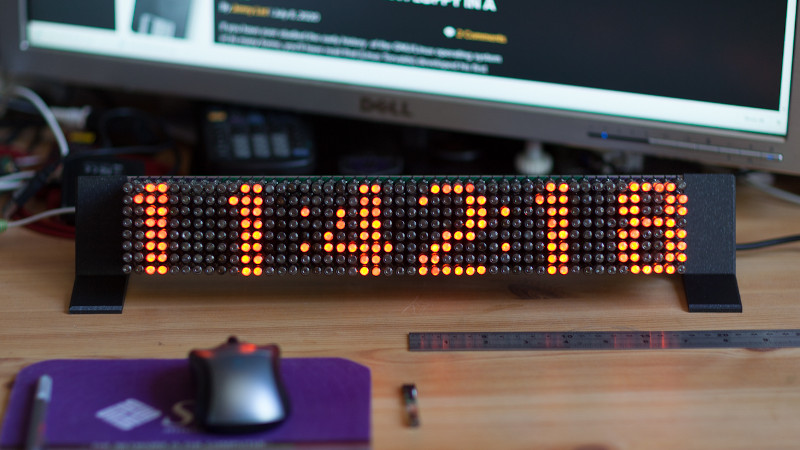
The display is built as an 8 by 48 matrix, giving it 384 individual light points. Each point uses a small INS-1 neon bulb, a miniature tube known for producing a focused orange dot of light. These bulbs are not like modern RGB LEDs that can be driven directly from a low-voltage microcontroller pin. Neon bulbs require a higher striking voltage before the gas inside ionizes and begins to glow. That immediately makes the engineering more complex, and frankly, more fun to read about.
Instead of treating the bulbs as passive lights in a simple multiplexed grid, the creator approached them like “neon pixels.” The inspiration is similar to addressable LED systems such as NeoPixels, where each LED has built-in control logic and can be chained into a larger display. In this neon version, each bulb receives its own tiny printed circuit board. That board carries a small microcontroller, voltage-boosting circuitry, and connectors that allow the module to plug into the larger backplane.
In other words, the display is not just a pile of bulbs. It is a swarm of 384 small electronic citizens, each with a job, an address, and a warm orange glow. If regular LEDs are a marching band, this project is a candlelit orchestra.
Why Neon Still Feels Magical
Neon has a visual character that is difficult to fake. When an electric current passes through neon gas at low pressure, it produces a bright orange-red glow. That color is not painted onto the glass and it is not a filter placed over a white light. It comes from the gas discharge itself, which gives neon its living, slightly mysterious look.
For decades, neon has been associated with diners, theaters, motels, downtown signs, jazz clubs, arcade nostalgia, and cities that refuse to go to bed at a reasonable hour. Museums in the United States preserve neon signs not just as advertising artifacts, but as pieces of design history. A neon sign is often both a commercial object and a public artwork. It tells you where the pancakes are, but it does so with flair.
That cultural memory matters. A modern LED matrix can be brighter, cheaper, more colorful, and easier to drive. But a neon bulb display offers something different: texture. It has depth. It has a warm orange dot that looks like it came from another era. It feels mechanical even when it is controlled by code. That is why this 384-bulb display attracts attention. It is not trying to win a brightness contest. It is trying to make pixels feel alive.
Inside the Engineering: Small Bulbs, Big Commitment
384 Individual Modules
The most impressive part of the project is not only the number of bulbs, but the decision to give every bulb its own dedicated electronics. Each neon tube is mounted to a small custom PCB. Each board contains multiple components, including a microcontroller and circuitry to generate the voltage needed to light the bulb. Multiply that by 384, and you begin to understand the scale of the work.
This is where hobby electronics stops being casual and starts becoming a test of patience. One small board is a weekend experiment. Ten boards are a project. Three hundred eighty-four boards are a personality assessment.
The benefit, however, is control. By distributing the electronics across the pixels, the display gains a modular structure. Each neon pixel can respond as part of a chain, allowing animations, patterns, scrolling effects, and brightness control. The final system is coordinated by an ESP32, a widely used microcontroller family known for wireless capability and enough processing muscle for many embedded projects.
Why the PIC16F15313 Makes Sense
The tiny controller used on each pixel module is from Microchip’s PIC16 family. This class of microcontroller is well suited to small embedded tasks where the job is specific, repetitive, and timing-sensitive. In this display, each pixel does not need to run a web server or calculate the mysteries of the universe. It needs to receive control data, manage timing, and drive the local electronics that light the neon bulb.
That division of labor is elegant. The central controller manages the display as a whole. The individual pixel controllers handle their own local behavior. It is like having one conductor and 384 musicians who each know how to play one glowing note.
Voltage Boosting Without Losing the Charm
Neon bulbs require a higher voltage to strike than typical LEDs. The INS-1 bulbs used in this kind of project are appealing partly because they are small and require less voltage than larger display tubes such as Nixies. Even so, the electronics must step up from a low-voltage supply to the level needed to ignite the glow discharge.
This is why safety and design discipline matter. A neon display may look cute, but the circuitry behind it deserves respect. High-voltage sections should be enclosed, current-limited, and handled only by people with suitable electronics knowledge. The attractive glow should be the only shocking thing about the project.
Neon Bulbs Versus LEDs: Why Choose the Hard Way?
From a purely practical point of view, LEDs win almost every round. They are efficient, inexpensive, widely available, and easy to control. Modern LEDs can be addressable, color-changing, tiny, waterproof, flexible, and bright enough to make your houseplants file a complaint.
So why build a display from neon bulbs?
The answer is emotion. Neon offers a distinct glow that connects technology with memory. LEDs are excellent for clean, sharp, colorful output. Neon is excellent for atmosphere. A neon bulb matrix does not merely display information; it performs it. Numbers, patterns, and animations feel warmer and more tactile because the light comes from tiny glass tubes instead of plastic-packaged emitters.
There is also educational value. A neon project teaches concepts that LED strips hide from view: gas discharge behavior, striking voltage, current limiting, boost conversion, distributed control, PCB repetition, signal propagation, and system-level planning. It is the kind of project that reminds makers that electronics is not just about convenience. Sometimes the hard way is the point.
What Makes the Display Attractive?
1. The Grid Is Simple, But the Glow Is Complex
The 8 by 48 layout is visually clean. It is a long rectangular matrix, useful for text, waveforms, simple animations, clocks, and abstract patterns. The geometry is straightforward, but the light itself adds character. Each neon dot has a soft edge and a warm core. When many bulbs glow together, the display has a vintage scoreboard feeling without looking like a replica.
2. The Orange Color Feels Intentional
Many modern displays chase millions of colors. This project leans into one. The orange neon glow becomes the identity of the piece. Instead of asking, “What color should this animation be?” the display asks, “How can orange be made interesting?” The limitation becomes a design strength.
3. It Has Visible Craft
Hand-built electronic projects carry a different emotional weight than mass-produced gadgets. Knowing that 384 modules had to be soldered, tested, and assembled makes the final display more impressive. The viewer does not need to understand every component to sense the effort. It is the electronic equivalent of seeing a handmade quilt and realizing every square was placed with intention.
4. It Blends Old and New Technologies
The display is attractive because it refuses to belong to one decade. Neon bulbs evoke old indicator panels, lab gear, and mid-century signs. The microcontrollers and serial control architecture belong to modern maker culture. Together, they create a bridge between eras. It is retro without being fake and modern without being sterile.
Practical Uses for a 384-Neon-Bulb Display
A project like this is partly art, partly engineering demonstration, and partly desk decoration for someone who thinks “normal lamp” is a tragic phrase. Still, it can serve real display functions. With 384 pixels, it can show scrolling text, simple icons, animations, countdowns, clocks, temperature readings, audio-reactive patterns, or status dashboards.
Because the panel is only 8 pixels tall, it is not meant for detailed images. Instead, it excels at low-resolution graphics. Think of old train station boards, retro computer terminals, elevator indicators, and minimalist pixel art. A small animation such as a moving sine wave, bouncing dot, loading bar, or digital rain effect would look fantastic in neon.
For interior design, the display could become a focal point in a workshop, studio, gaming room, coffee shop, music space, or technology exhibit. It would not be the most energy-efficient option compared with LEDs, but it would have far more personality than a standard digital sign. It is the kind of object that makes people ask questions, which is often the first job of good design.
Safety, Reliability, and Maintenance Considerations
Any project involving higher voltage deserves careful planning. Neon bulbs typically use very low current, but voltage is still a hazard if the circuit is exposed or poorly built. A safe display should keep high-voltage areas protected, use proper insulation and spacing, and avoid casual handling while powered. This is not a project for careless breadboard spaghetti.
Thermal behavior also matters. A large number of illuminated elements can produce heat, especially when the entire display is on. The original concept shows that the display can draw meaningful power when all pixels are active, so ventilation and power supply selection are important. A display meant to run for long periods should be tested under realistic conditions, not just admired for ten seconds while everyone says, “Ooooh.”
Maintenance is another factor. With 384 bulbs and 384 circuit modules, troubleshooting must be organized. Modular construction helps because a failed pixel can theoretically be identified and serviced without rebuilding the entire panel. Still, the more parts a project has, the more disciplined the builder must be with documentation, labeling, and testing.
Design Lessons From the Neon Pixel Approach
The biggest design lesson is that constraints can create beauty. The display is monochrome, low-resolution, and electrically more complicated than an LED equivalent. Yet those limitations force creative decisions. Animation must be readable. Typography must be simple. Patterns must be bold. The glow itself becomes part of the message.
A second lesson is that modularity is powerful. By breaking the project into repeated pixel boards, the builder turns a complex system into a repeated unit. This approach makes assembly long, but conceptually manageable. It also mirrors how many professional systems are designed: solve one unit well, then scale it carefully.
A third lesson is that aesthetics can justify effort. In engineering, efficiency is important, but not every project exists to minimize cost or power. Some projects exist to explore a feeling. The 384-neon-bulb display works because it understands its purpose. It is not trying to replace a commercial sign. It is celebrating the charm of neon through modern control.
Why Makers Love Projects Like This
Makers are often drawn to projects that combine technical difficulty with visible payoff. A hidden circuit can be brilliant, but a glowing matrix gives instant satisfaction. You can see the debugging. You can watch the first pixel light up. You can celebrate when the whole panel finally runs an animation without one rebellious dot refusing to cooperate.
This project also appeals because it is unnecessary in the best possible way. Nobody strictly needs a 384-neon-bulb display. That is exactly why it is wonderful. It exists because someone cared enough about a glow, a concept, and a challenge to make it real. The world needs practical devices, yes. But it also needs strange, beautiful objects that make technology feel playful again.
Experiences Related to “384 Neon Bulbs Become Attractive Display”
Imagine seeing a display like this on a desk for the first time. It probably would not shout for attention the way a giant RGB panel does. Instead, it would pull you in slowly. A few orange dots blink. Then a line scrolls across the matrix. Then the pattern changes, and suddenly the whole panel feels like a tiny city skyline at night. The glow has a softness that makes the room feel warmer, even before you start thinking about the electronics behind it.
The first experience is visual. Neon does not look flat. Even small bulbs have a sense of depth because the light forms inside glass. When 384 bulbs are arranged together, the panel becomes both a display and a sculptural object. You are not only watching pixels; you are looking at physical dots of glowing gas. That gives the display a handmade, almost mechanical presence.
The second experience is emotional. Neon carries nostalgia even for people who did not grow up around classic neon signs. It suggests diners, old theaters, late-night streets, vintage radios, laboratory equipment, and arcade corners where every machine made a different electronic beep. A neon display turns simple information into atmosphere. A clock shown on this panel would feel less like a utility and more like a prop from a stylish time machine.
The third experience is appreciation. Once you understand that every bulb has its own board and controller, the display becomes more impressive. You stop seeing only the front surface and begin imagining the hidden labor: solder joints, testing, programming, alignment, connectors, power distribution, and the patience required to repeat a tiny task hundreds of times. The display becomes a record of persistence.
The fourth experience is creative. A low-resolution neon matrix makes you think differently about design. You cannot rely on tiny details. You must use bold shapes, simple motion, and rhythm. A moving bar, a pulsing wave, or a short word can look more memorable than a complicated image. The display teaches restraint. It proves that a limited canvas can still feel expressive when the medium has character.
The fifth experience is conversational. Put this object in a room and people will ask about it. They will want to know whether the bulbs are real neon, how they are controlled, why the glow looks different from LEDs, and whether it was difficult to build. That makes the display valuable beyond its pixels. It becomes an invitation to talk about electronics, design, history, and the joy of making something that did not need to exist but absolutely deserves to.
In a world full of disposable screens, the 384-neon-bulb display feels refreshingly deliberate. It is slower, warmer, weirder, and more memorable than a standard digital panel. It reminds us that technology can still have texture. It can still glow like an object from a dream. And sometimes, the best display is not the one with the most colors, but the one with the most soul.
Conclusion
384 Neon Bulbs Become Attractive Display is more than a clever electronics project. It is a glowing argument for why old technologies still matter when they are reimagined with modern tools. By combining INS-1 neon bulbs, individual pixel boards, microcontroller control, voltage-boosting electronics, and a matrix layout, the project turns hundreds of tiny orange lights into a display with unusual warmth and personality.
It may not be the simplest way to make a screen. It may not be the most efficient. But it is unforgettable. The project shows that great maker work often lives at the intersection of curiosity, patience, and aesthetics. Anyone can buy a display. It takes a special kind of dedication to build one from 384 glowing neon dots and make it feel like art.