Medical note: This article is for educational purposes only. Scoliosis treatment decisions should be made with a qualified spine specialist who can review X-rays, symptoms, growth stage, medical history, and personal goals.
Scoliosis has a way of turning a simple spine check into a full-blown family strategy meeting. One minute someone notices uneven shoulders; the next, everyone is discussing X-rays, braces, physical therapy, Cobb angles, and whether surgery should even be on the table. The good news is that most scoliosis cases do not require surgery. The more useful question is not “Does scoliosis mean surgery?” but “When does surgery become the smarter option?”
In general, scoliosis surgery is considered when a spinal curve is severe, clearly progressing, causing major imbalance, affecting daily life, or creating risks that non-surgical treatment cannot reasonably control. In children and teens, many specialists start discussing surgery when curves reach roughly 45 to 50 degrees, especially if the child is still growing and the curve is likely to worsen. In adults, the decision often depends less on the number alone and more on pain, nerve symptoms, posture, walking ability, and quality of life. Major medical organizations and spine centers describe similar thresholds and decision factors, while emphasizing that each case is individual.
Understanding Scoliosis Before Talking About Surgery
Scoliosis is an abnormal side-to-side curvature of the spine, often combined with rotation. That rotation is why scoliosis may create a rib hump, uneven waist, tilted shoulders, or a body that seems to lean to one side. The curve is measured in degrees using the Cobb angle on an X-ray. A small curve may only need monitoring. A moderate curve in a growing child may need bracing. A large or worsening curve may eventually require a surgical conversation.
Most adolescent idiopathic scoliosis appears during the growth spurt around puberty. “Idiopathic” means doctors do not know the exact cause, not that the spine woke up one day and chose drama. Other types include congenital scoliosis, neuromuscular scoliosis, early-onset scoliosis, and adult degenerative scoliosis. Because these types behave differently, the right treatment plan can vary widely.
When Is Scoliosis Surgery Usually Considered?
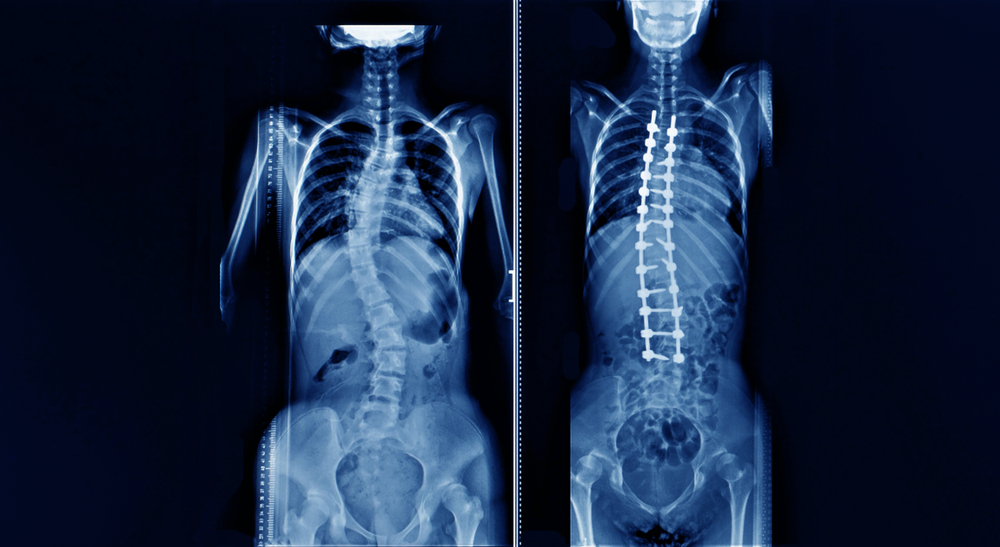
Scoliosis surgery is not recommended just because a curve exists. Surgery is typically considered when the benefits of correcting or stabilizing the spine outweigh the risks of a major operation. The most common surgical procedure for adolescent idiopathic scoliosis is spinal fusion, where the surgeon uses rods, screws, and bone graft material to help selected vertebrae heal into one solid, corrected section. Some younger patients may be candidates for growth-friendly techniques or vertebral body tethering, depending on age, curve pattern, skeletal maturity, and surgeon evaluation.
1. The Curve Is Around 45 to 50 Degrees or More
For growing children and teenagers, a curve in the 45- to 50-degree range is a common point where surgery becomes a serious discussion. The reason is not cosmetic alone. Larger curves are more likely to keep progressing, even after growth slows or ends. A curve that continues to increase may create more visible body imbalance, more complicated correction later, and in very severe cases, breathing or heart-lung concerns.
This does not mean every 45-degree curve automatically goes to the operating room. A mature teen with a stable curve, mild symptoms, and good balance may receive different advice than a younger child with rapid progression and years of growth remaining. The number matters, but it does not make the decision by itself.
2. The Curve Keeps Getting Worse Despite Bracing
Bracing is often used for moderate curves in children and teens who are still growing. Its main goal is not to make the spine perfectly straight; it is to stop or slow progression. Think of a brace less like a magic eraser and more like a very structured security guard telling the curve, “You shall not pass.”
If a child wears a properly fitted brace as prescribed and the curve still progresses into the surgical range, doctors may recommend surgery. This situation can be frustrating for families because everyone may feel they “did everything right.” But scoliosis can be stubborn, especially during growth spurts. A progressing curve is not a personal failure; it is a medical pattern that may require a stronger solution.
3. The Child Still Has Significant Growth Remaining
Growth is one of the biggest predictors of curve progression in adolescent scoliosis. A 35-degree curve in a child with lots of growth left can be more concerning than the same curve in someone who has finished growing. Doctors often look at height changes, growth plates, skeletal maturity markers, menstrual history in girls, and repeat X-rays to estimate risk.
If a curve is already large and the child is still growing quickly, surgery may be discussed earlier. The goal is to prevent the curve from becoming more severe and harder to correct. In some cases, earlier surgery can mean a less complex correction than waiting until the curve becomes much larger.
4. The Spine or Trunk Is Noticeably Imbalanced
A person with scoliosis may have uneven shoulders, one hip higher than the other, a rib prominence, or a trunk that shifts off-center. Mild asymmetry is common and may not require aggressive treatment. But when imbalance becomes pronounced, it can affect posture, clothing fit, walking comfort, sitting endurance, confidence, and daily function.
Surgery may be considered when the curve creates a visible and functional imbalance that is likely to worsen. In these cases, the goal is not to create a “perfectly straight” spine. Real spines are not furniture assembled from a diagram. The goal is better alignment, stability, and long-term function.
5. Pain or Nerve Symptoms Become Significant
In teenagers, scoliosis itself often causes little or no pain, although muscle fatigue and discomfort can happen. Severe pain in a child or teen should be evaluated carefully because doctors may need to rule out other causes. In adults, scoliosis may be linked with degenerative disc disease, arthritis, spinal stenosis, nerve compression, and loss of spinal balance.
Adults may consider surgery when non-surgical care fails and symptoms interfere with normal life. Warning signs include pain that limits walking, leg pain, numbness, weakness, or symptoms related to nerve compression. Some neurosurgical guidance notes that adult surgery may be recommended for curves above 50 degrees when leg nerve damage or bowel or bladder symptoms are present. Those symptoms require prompt medical evaluation.
When Surgery Is Usually Not the First Choice
Surgery is usually not the first option for mild scoliosis. Curves under about 20 degrees are often monitored with periodic exams and X-rays, especially if the patient is still growing. Moderate curves may be treated with bracing if growth remains. Physical therapy, scoliosis-specific exercises, core strengthening, and pain management can also play a role, particularly for adults.
However, it is important to be realistic about what non-surgical treatments can and cannot do. Exercises may improve strength, posture awareness, breathing mechanics, and comfort, but they usually do not reverse a severe structural curve. Braces can help prevent progression in growing children, but they generally do not correct large curves after skeletal maturity. A good care plan uses the right tool for the right stage, instead of asking one tool to perform miracles and then acting offended when it refuses.
Types of Scoliosis Surgery You May Hear About
Spinal Fusion
Spinal fusion is the most established surgery for many severe scoliosis cases. During the procedure, the surgeon corrects the curve as safely as possible and uses implants to hold the spine while bone graft material helps the selected vertebrae fuse. The fused section loses motion, but many people still return to school, work, exercise, and sports after recovery, depending on the extent of surgery and medical advice.
Vertebral Body Tethering
Vertebral body tethering, sometimes called VBT, is a motion-preserving procedure used in selected growing children and teens. Instead of fusing vertebrae, the surgeon places screws and a flexible tether along the curved side of the spine. As the child grows, the tether may help guide the spine toward better alignment. VBT is not appropriate for everyone. Candidates are usually carefully selected based on growth remaining, curve size, curve flexibility, and curve location.
Growing Rods and Growth-Friendly Systems
For very young children with early-onset scoliosis, surgeons may use growth-friendly systems that help control the curve while allowing the spine and chest to grow. Some rods can be lengthened magnetically in clinic visits, while other systems may require additional procedures. These cases are specialized and should be managed by pediatric spine teams experienced with early-onset scoliosis.
Questions to Ask Before Choosing Surgery
If surgery is being discussed, families should feel comfortable asking direct questions. What is the exact Cobb angle? Has the curve progressed, and how fast? Is growth still remaining? What happens if we wait six months? What are the realistic goals of surgery? Which vertebrae would be fused? How much correction is expected? What are the risks? How long is recovery? What activities will be limited, and for how long?
It is also reasonable to ask whether a second opinion would be helpful. A trustworthy surgeon should not be offended by thoughtful questions. Spine surgery is a major decision, not a drive-through order. You are allowed to understand the menu before choosing the main course.
Risks and Benefits: The Honest Conversation
The main benefits of scoliosis surgery can include preventing further curve progression, improving spinal alignment, reducing trunk imbalance, protecting future function, and sometimes improving pain or nerve-related symptoms. For many adolescents with severe curves, surgery can provide a durable correction and prevent a curve from becoming more difficult to manage later.
Still, surgery has risks. Possible complications include infection, bleeding, implant problems, nerve injury, lung-related issues, nonunion, and the need for another operation. Serious complications are not common in experienced centers, but they are real enough to discuss carefully. The decision should balance medical risk, curve behavior, long-term outlook, and the patient’s life goals.
Recovery: What Life May Look Like After Surgery
Recovery varies by procedure, age, health, and curve complexity. Many children and teens spend several days in the hospital after spinal fusion. The first weeks focus on pain control, walking, wound care, and slowly returning to basic routines. School may resume gradually. Sports and higher-impact activities usually require surgeon clearance.
Adults often have a longer and more complex recovery, especially if surgery involves decompression, fusion across multiple levels, or correction of spinal imbalance. Physical therapy, home support, and realistic pacing matter. Recovery is not a heroic montage where someone goes from hospital bed to mountain climbing in three minutes with inspiring background music. It is usually steady, practical progress: walking a little more, sitting a little longer, sleeping better, and getting back to life piece by piece.
Specific Examples of When Surgery Might Make Sense
Imagine a 13-year-old with a thoracic curve that increased from 34 degrees to 48 degrees during a growth spurt, even with bracing. That child still has growth remaining, and the curve is progressing into the surgical range. Surgery may be recommended to prevent further worsening and improve alignment.
Now imagine a 16-year-old whose curve measures 42 degrees but has stayed stable for two years and who is nearly done growing. The doctor may continue monitoring rather than immediately recommending surgery. The curve is important, but its behavior matters.
For an adult, consider a 58-year-old with degenerative scoliosis, spinal stenosis, leg pain, numbness, and difficulty walking through a grocery store. If medication, therapy, injections, and activity modification no longer help, surgery may be considered to relieve nerve pressure and stabilize the spine. In this case, the decision is driven by function and nerve symptoms, not just the curve measurement.
Experiences Related to Considering Scoliosis Surgery
People who reach the “Should we consider surgery?” stage often describe the experience as part medical decision, part emotional roller coaster, and part paperwork marathon. The first experience is usually uncertainty. Families may hear different numbers, new terminology, and unfamiliar options. A doctor says “Cobb angle,” and suddenly everyone is Googling like they are preparing for a final exam in spinal geometry. This is normal. Scoliosis surgery is not something most families expect to discuss, so the learning curve can feel steep.
One common experience is the tension between waiting and acting. Parents may wonder whether surgery is too aggressive, while also worrying that waiting could allow the curve to worsen. Teens may worry about appearance, sports, school, scars, or being treated differently by friends. Adults may worry about taking time off work, needing help at home, or whether surgery will truly improve pain. These concerns deserve space in the decision-making process. A good spine team should explain not only what they recommend, but why they recommend it now.
Another real-world experience is brace fatigue. Some teens work incredibly hard to wear a brace for the recommended hours, only to learn that the curve progressed anyway. That can feel discouraging. But bracing is not a character test. It is a treatment with limits. When a curve progresses despite good effort, surgery may become the next medical step, not a punishment for failing the brace era.
Families also often describe a shift after meeting the surgeon. Before the consultation, “surgery” may sound like one giant scary word. After a detailed visit, it becomes a list of specific facts: which levels may be fused, how long the hospital stay may be, what risks are most relevant, how pain is managed, and what recovery milestones look like. Specific information does not remove every fear, but it can replace vague panic with a plan.
Adults considering surgery may have a different experience. They may have lived with scoliosis for decades, adapting without much thought until pain, posture changes, or nerve symptoms begin shrinking their world. For them, the question is often not “Can my spine look straighter?” but “Can I walk farther, stand longer, sleep better, or stop planning my day around pain?” Adult surgery decisions may involve more medical complexity, so expectations must be especially realistic.
Recovery stories vary. Some people return to routines smoothly; others need more time, patience, and support. Many patients say the early days are the hardest, but small milestones become meaningful: walking down the hallway, showering independently, returning to school, sitting through a movie, or getting back to a favorite hobby. The best experiences tend to happen when patients understand the recovery timeline, follow restrictions, accept help, and stay in close contact with their care team.
Emotionally, it helps to remember that choosing surgery is not “giving up.” In many cases, it is choosing a long-term strategy when monitoring, bracing, therapy, or pain management are no longer enough. The decision should be informed, calm, and personal. The spine may be curved, but the path forward does not have to be confusing.
Conclusion: So, When Should You Consider Surgery for Scoliosis?
You should consider surgery for scoliosis when the curve is severe, worsening, likely to progress, causing major imbalance, creating nerve-related symptoms, or limiting quality of life despite appropriate non-surgical care. For adolescents, the surgical conversation often begins around 45 to 50 degrees, especially during growth. For adults, symptoms, nerve compression, posture, walking ability, and failed conservative treatment often carry more weight.
The best decision is not based on fear or a single number. It is based on curve size, growth remaining, progression, symptoms, overall health, and realistic goals. Scoliosis surgery is a major step, but for the right patient at the right time, it can prevent worsening, improve alignment, and protect future function. The smartest move is to work with an experienced spine specialist, ask detailed questions, and make the decision with both medical facts and real-life priorities in view.