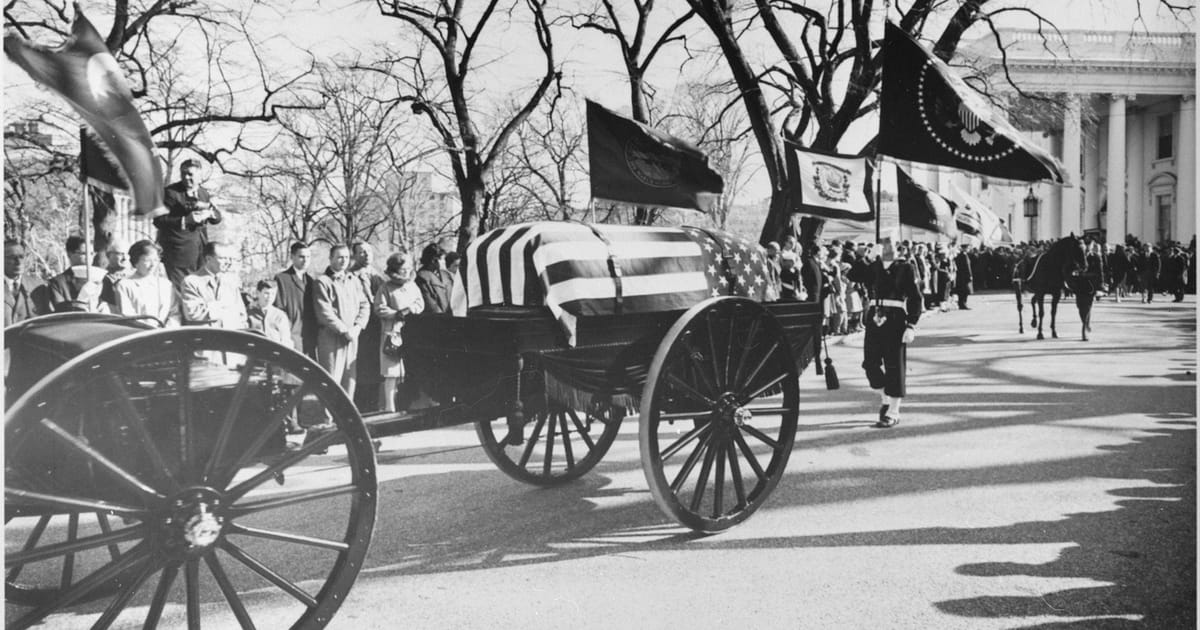
Big moments are easy to remember: the flag-draped coffin, the long black motorcades, the camera flashes, the hush that seemed to fall over an entire country.
But what lodges in people’s mindswhat turns history into something you can almost feelis often the smaller stuff. The stage directions. The symbols.
The objects that don’t speak, yet somehow say everything.
President John F. Kennedy’s state funeral on November 25, 1963 was built from those details. Some were centuries-old traditions. Others were choices made in the
blur of shock and grief. Together, they created a public language for mourningone that didn’t require a single person to find “the right words” when there were no
right words.
Why the “little details” mattered so much
A state funeral isn’t just a service; it’s choreography. When it’s done well, it gives millions of people something steady to hold onto:
a sequence, a rhythm, a shared experience. That matters even more when a death is sudden, violent, and hard to process.
JFK’s funeral had speeches and prayers, yesbut the most affecting parts were often nonverbal: a slow drum cadence, a riderless horse, the heavy swing of bronze
doors, the careful folding of a flag. These details worked like punctuation marks in a national sentence of grief.
The Lincoln echo: grief guided by history
One of the clearest themes was intentional: history as a guide rail. Jacqueline Kennedy asked that many ceremonial elements follow the protocol and details of
Abraham Lincoln’s 1865 state funeral. The result was not imitation for its own sake, but a way to place JFK’s death into a larger American storyone with precedent,
meaning, and (somehow) continuity.
The catafalque: a quiet platform with a loud message
In the White House, JFK lay in the East Room on the same catafalque used for Lincoln’s funeral. That’s a detail you might miss if you’re scanning photos for faces.
But it matters: it’s a physical bridge between two moments of national trauma, built from wood and tradition rather than words.
Later, in the Capitol Rotunda, the symbolism deepened: the president’s casket was placed on the catafalque originally constructed to hold Lincoln’s coffin in 1865.
It’s one of those historical artifacts that doesn’t “do” muchuntil a country needs it to. Then it becomes a kind of altar for civic memory.
The line of mourners: democracy in slow motion
More than 250,000 people filed past Kennedy’s coffin as he lay in state. That number is staggering, but the emotional weight is in the image: ordinary citizens
moving in a long, patient line, each person taking a brief turn in history’s spotlightno speeches, no commentary, just presence.
The Rotunda’s doors closed to the public on the morning of November 25 after that long vigil. Even the closing of doors can feel like a national heartbeat:
a chapter ending, a breath held.
The horse-drawn caisson: tradition that moves like a heartbeat
Modern life moves fast; grief does not. The caisson procession forced a slower tempo onto Washington, D.C.and, through television, onto the nation.
The measured pace made the day feel ceremonial instead of chaotic, deliberate instead of unreal.
The riderless horse: the boots that said “never again”
Behind the caisson walked a caparisoned (riderless) horseone of the most evocative military traditions. The empty saddle is haunting enough, but the detail that
often catches people is this: the rider’s boots are reversed in the stirrups. The meaning is blunt and timelesssymbolizing that the fallen will never ride again.
The horse associated with JFK’s funeral is widely remembered as Black Jack. Even if you don’t know the animal’s name, the image is unforgettable: a living creature
carrying absence like a uniform.
Eight blocks on foot: a choice that made grief visible
After the caisson passed the White House, Jacqueline Kennedy and mourners walked with the processionan intensely human choice in a day full of formal protocol.
Walking turns observers into participants. It also turns grief into something visible and shared, not hidden behind tinted glass.
The music: the funeral’s emotional “subtitles”
If you watch the footage, listen closely: the music isn’t background. It’s the emotional guide track.
Different service bands played as the procession moved, and the selections were chosen with carehymns, funeral marches, and familiar patriotic pieces that could
carry meaning without requiring anyone to explain it.
Marches and hymns on the move
As the cortege left the Capitol and moved through Washington, service bands proceeded in order and played from approved repertoires.
The titles themselves read like a table of contents for collective mourningsolemn, reverent, and built for an outdoor procession that had to “hold” a crowd’s attention
without entertaining it.
The stop at the White House: a choir on the North Portico
A detail that feels almost cinematicexcept it was real: at the White House North Portico, the Naval Academy Catholic Choir sang selections before the cortege moved on.
It’s the kind of moment that reminds you funerals aren’t only about the deceased; they’re also about the living trying to make order out of shock.
Bagpipes in Washington: nine pipers from the Black Watch
Then comes a striking contrast: nine pipers from the Black Watch (Royal Highlanders) played as the cortege left the White House for St. Matthew’s Cathedral.
Bagpipes can sound like sorrow turned into weatherwindy, insistent, impossible to ignore. For many viewers, that texture of sound became part of the day’s identity.
The cathedral: bronze doors, Latin prayers, and controlled quiet
St. Matthew’s Cathedral provided a different kind of gravityarchitectural, religious, intimate.
A cathedral can “hold” silence the way a stadium holds noise. It changes how people breathe.
The bronze doors: closing out the world
One small-but-chilling detail: the cathedral’s bronze doors closed as the Requiem Mass commenced, then opened again when it concluded.
Doors usually mean entry. On this day, they meant separationgrief contained, ritual protected, time temporarily set apart.
Choral choices: grief rendered in music and Latin tradition
The choral program included pieces such as “Subvenite” and “In Paradisum,” along with solo selections and a “Sanctus and Benedictus.”
Even if you don’t know the translations, you can feel the intention: the music was chosen to sound like farewell, intercession, and release.
Arlington: the slope, the flyover, the flame
Arlington National Cemetery was not only a destination; it was a symbolic landscape. The funeral ended where American military sacrifice is gathered and named.
And the details hereagaindid much of the speaking.
A moment of air and sky: the flyover
Shortly after the procession arrived, aircraft flew over Arlington. It’s a brief detail in the schedule, but emotionally it lands hard:
the sky itself participates, offering a salute that’s visible, audible, and gone in secondslike so much about that weekend.
“Taps,” a folded flag, and a cadence you can still hear
“Taps” was played after the gun salute and volleys, followed by the flag-folding ceremony.
The ritual is precisedeliberately so. Precision can feel like mercy when everything else feels out of control.
And then there’s the cadence: the muffled funeral drumming that so many viewers recall as relentless, slow, and impossibly steady.
It’s a sound designed to pace footsteps and steady the heartone beat at a time.
The Eternal Flame: a small fire with a permanent job
At the gravesite, Jacqueline Kennedy lit an Eternal Flame. The flame was not just a memorial flourish; it was a new symbolsimple, elemental, and continuous.
Unlike a statue, a flame is alive. It flickers, it endures, it needs care. That feels honest.
Today, the Eternal Flame burns from a granite stone at the head of JFK’s grave, maintained so it can relight if weather extinguishes it.
In other words: even the memorial is built around the idea of continuing.
The images that became national shorthand
Some details were not planned as symbols. They became symbols because cameras were there and because people needed something human to focus on.
John Jr.’s salute: one small gesture that carried a nation
Perhaps the most indelible image is the salute by John F. Kennedy Jr.and the detail that sharpens it further is that it happened on his third birthday.
The gesture lasts a second. The meaning lasts decades. It is childhood meeting history, innocence meeting duty, grief meeting ritual.
Caroline at the bier: childhood beside ceremony
Another remembered detail: Caroline Kennedy kneeling beside her mother at the president’s bier.
Children do not “perform” state funerals the way adults do. Their presence breaks the seal of formality.
It reminds everyone that behind the office is a family whose world has cracked open.
The international walk: diplomacy in plain shoes
The funeral was attended by representatives from more than 100 countries, with dignitaries following on foot during part of the procession.
It’s easy to overlook how unusualand how powerfulthat is. Leaders are typically protected by layers of distance. Here, they walked in public behind a coffin.
The effect was simple: shared vulnerability. Grief became a form of diplomacy, and the act of walking became a statementof respect, of alliance, of humanity.
What these details teach us about public grief
The small details from JFK’s funeral endure because they did a specific job: they translated a private catastrophe into a public ritual without turning it into spectacle.
They balanced grandeur with restraintusing symbols that were strong enough to be understood and quiet enough to be dignified.
In a way, the details were the message. The reversed boots, the bronze doors, the slow drum cadence, the choir’s Latin lines, the Eternal Flame:
each was a sentence in a language the nation already knew, even if it hadn’t needed to speak it so widely before.
Experiences that connect you to these details today (without time travel)
You don’t have to be old enough to remember 1963 to feel why these details mattered. The experience is still accessiblethrough places, objects, and the way ritual
communicates across generations. Here are a few grounded ways people connect with the same “small but poignant” elements now.
Watch the footage like a listener, not a scanner
Most of us watch historical clips the way we scroll: looking for the famous frame, the iconic image, the moment we already “know.” Try a different approach:
watch as if you’re there for the sound. Notice how the cadence controls the crowd’s movement. Listen for transitionsmarch to hymn, drum to silence,
silence to prayer. Those choices are part of the emotional architecture.
When you focus on sound, the funeral becomes less like a newsreel and more like a shared public ceremony. You can hear the difference between “noise” and “ritual.”
You can also hear how restraint works: how grief can be present without being loud.
Stand where symbols do their best work
If you’re ever in Washington, D.C., the locations themselves do a surprising amount of storytelling.
The Capitol Rotunda is not merely a pretty roomit’s a civic space designed to make individuals feel the scale of the nation.
Knowing that Lincoln’s catafalque has been used there since 1865 adds a quiet weight: you’re standing in a place that holds layers of national memory.
St. Matthew’s Cathedral, likewise, is more than a “site.” Cathedrals change how voices carry and how silence lands. People often describe feeling the difference
immediately: the sense that the room itself encourages composure, even if your emotions don’t cooperate. That’s what sacred architecture doesit supports the
human need for containment during grief.
Visit the gravesite and notice what the flame requires
At Arlington, the Eternal Flame is the detail that tends to stop people mid-step. Not because it’s flashy, but because it’s alive.
Visitors often fall quiet without being told to. The flame flickers. Wind shows up. Rain shows up. And the flame is designed to keep going anyway.
That’s the experience: a memorial that refuses to become purely “finished.” A statue is complete the moment it’s installed. A flame is never complete.
It’s maintained, protected, relit if needed. If you’re thinking about why people found it so moving in 1963, this is the shortcut:
it mirrors what grief actually feels likeongoing, changeable, and still present on ordinary days.
Pay attention to the human-scale moments in public rituals
Even when you can’t be at these places, you can still notice the “JFK funeral” pattern in other public rituals: the way a slow procession changes a crowd’s mood,
the way a flag-folding ceremony creates a focal point, the way music replaces speech when speech would fail.
That’s part of why John Jr.’s salute remains so powerful. It isn’t only that it’s heartbreaking. It’s that a child’s small gesture fits perfectly into the larger
ritual, as if the ceremony made room for something human. People carry that lesson forward: public grief becomes bearable when it’s structured enough to hold us,
but open enough to let real lifechildren, tears, silenceexist inside it.
Read the details as choices, not trivia
The boots reversed in the stirrups aren’t a “fun fact.” They’re a sentence: never again.
The bronze doors aren’t just doors; they’re a boundary between the world and a moment set apart.
The catafalque isn’t furniture; it’s continuity. When you treat details as choices, the story becomes clearer:
JFK’s funeral wasn’t remembered because it was large. It was remembered because it was carefully, respectfully made.