Some historical photographs do more than freeze a moment. They kick open a door, drag the past into the room, and say, “Look closelythis actually happened.” A great photograph can make a battlefield feel silent, a moonrise feel personal, or a lunch break on a skyscraper look like the most casual act of insanity ever performed with a sandwich.
The best historical photographs are not just old pictures. They are visual evidence, cultural memory, emotional shortcuts, and sometimes uncomfortable reminders that history was lived by real people with real fears, hopes, mistakes, and occasionally very questionable safety habits. From the first surviving camera photograph to images that shaped public opinion about war, civil rights, space exploration, and political courage, these famous historical pictures prove that one frame can carry the weight of an entire era.
Below are 15 incredible historical photographs that changed how people saw the worldand, in several cases, how the world saw itself.
1. View from the Window at Le Gras
The photograph that started the visual age
Created by French inventor Nicéphore Niépce in 1827, View from the Window at Le Gras is widely recognized as the oldest surviving camera photograph. At first glance, it looks more like a mysterious gray puzzle than a dramatic masterpiece. But that is exactly why it matters. This image marks the moment when light, chemistry, patience, and invention teamed up to create a permanent visual record.
Niépce used a process called heliography, exposing a treated pewter plate for an extremely long period. The result was not sharp by modern standards, but it changed everything. Every selfie, news image, wedding album, crime scene photo, and space telescope picture belongs to the family tree that begins here. Not bad for a blurry courtyard view that looks like it needed better Wi-Fi.
2. Abraham Lincoln Before the Cooper Union Speech
The portrait that helped build a president
Mathew Brady’s 1860 photograph of Abraham Lincoln shows the future president standing with quiet confidence before delivering his influential Cooper Union address in New York City. At the time, Lincoln was still introducing himself to many Eastern voters. His opponents often mocked his appearance, but Brady’s portrait gave him dignity, height, steadiness, and presidential gravity.
The image became part of Lincoln’s public identity during the 1860 campaign. It showed that photography was already becoming a political tool. Before television debates, social media clips, and campaign memes, there was the studio portrait. Lincoln understood that a picture could travel faster than a speech and linger longer than a rumor.
3. A Harvest of Death, Gettysburg
When war photography removed the romance from battle
Taken after the Battle of Gettysburg in 1863 and published in Alexander Gardner’s photographic record of the Civil War, A Harvest of Death presents a grim field of fallen soldiers. Earlier generations often imagined war through heroic paintings, polished uniforms, and patriotic music. This photograph offered something colder: aftermath.
Its power lies in its refusal to flatter. The bodies are not symbols arranged for glory; they are evidence of human cost. Civil War photography helped Americans understand that battle was not just strategy, flags, and speeches. It was mud, death, and families waiting for letters that would never come.
4. The Wright Brothers’ First Flight
Twelve seconds that changed transportation forever
On December 17, 1903, at Kitty Hawk, North Carolina, a camera captured Orville Wright piloting the first powered, controlled, sustained airplane flight while Wilbur Wright ran nearby. The flight lasted only 12 seconds and covered 120 feet, which sounds modest until you remember that the entire aviation industry had to begin somewhere.
The photograph is beautifully awkward. The aircraft looks fragile, the sand looks unforgiving, and the whole scene feels like a backyard experiment that accidentally opened the sky. Yet this single image documents the birth of modern aviation. Every commercial flight, cargo plane, air ambulance, and long-distance vacation owes a tiny nod to this windy moment.
5. Lunch Atop a Skyscraper
The world’s most terrifying lunch break
Shot in 1932 during construction of Rockefeller Center in New York City, Lunch Atop a Skyscraper shows 11 ironworkers sitting on a steel beam high above Manhattan, eating lunch as if they were on a park bench. The image was staged as publicity, but the danger was real enough to make modern safety inspectors faint into their clipboards.
The photograph became a symbol of American labor, immigration, urban ambition, and Depression-era grit. It celebrates the men who built modern skylines while also reminding viewers that progress often rested on the nerves and muscles of workers whose names were not printed in marble lobbies.
6. Migrant Mother
The face of the Great Depression
Dorothea Lange’s 1936 photograph of Florence Owens Thompson, known as Migrant Mother, is one of the most recognizable images of the Great Depression. Thompson sits with her children pressed close, her gaze turned away from the camera. Her face carries worry, endurance, hunger, and calculation all at once.
The image was made while Lange was documenting migrant agricultural workers for a New Deal agency. It helped personalize the economic disaster. Instead of statistics about unemployment and failed crops, Americans saw a mother trying to keep her family alive. The photograph also raises ethical questions about documentary work: who benefits from an image, who controls the story, and what does dignity look like when poverty is made public?
7. The Hindenburg Disaster
The fiery end of the airship dream
Photographs of the Hindenburg disaster on May 6, 1937, show the massive German airship collapsing in flames at Lakehurst, New Jersey. The images are shocking because they capture a technological marvel becoming a catastrophe in seconds.
Airships had once represented luxury, speed, and futuristic travel. The Hindenburg was enormous, elegant, and promoted as a symbol of engineering confidence. Then the photographs and newsreel footage made its destruction unforgettable. After Lakehurst, the romance of passenger airships never fully recovered. One image can sell a dream; another can end it.
8. Raising the Flag on Iwo Jima
A battlefield image turned national symbol
Joe Rosenthal’s 1945 photograph of U.S. service members raising the American flag on Mount Suribachi during the Battle of Iwo Jima became one of the defining images of World War II. The composition is almost sculptural: bodies leaning together, flagpole rising diagonally, movement caught at the exact instant of unity.
The photograph won the Pulitzer Prize and later inspired the Marine Corps War Memorial. Yet its fame can make people forget the brutal context. Iwo Jima was one of the bloodiest battles in Marine Corps history, and the flag raising did not mean the fighting was over. The image became a symbol of courage, but behind that symbol was exhaustion, sacrifice, and a terrible human price.
9. Robert Capa’s D-Day Photographs
Blurred images, clear terror
Robert Capa landed with American troops on Omaha Beach during the D-Day invasion on June 6, 1944. His surviving photographs are grainy, blurred, and chaoticwhich is precisely why they feel so real. They do not offer a clean heroic tableau. They show men struggling through water, smoke, fear, and uncertainty.
Capa once said that if your pictures were not good enough, you were not close enough. On D-Day, he was almost impossibly close. His images remind us that history is not lived from a comfortable distance. It is lived in wet boots, under fire, with no guarantee that anyone will reach the next minute.
10. V-J Day in Times Square
A celebration with a complicated afterlife
Alfred Eisenstaedt’s 1945 photograph of a sailor kissing a woman in Times Square on Victory over Japan Day became one of the most famous images of America celebrating the end of World War II. It captured release, shock, relief, and the sudden public explosion of emotion after years of global conflict.
Modern viewers also discuss the photograph differently than earlier generations did. The woman in the image, Greta Zimmer Friedman, later explained that the kiss was not romantic in the way many people assumed. That complexity matters. Historical photographs do not stay frozen in meaning. As values change, viewers ask new questions, and famous pictures gain new layers.
11. The March on Washington
Democracy photographed in motion
Photographs from the March on Washington for Jobs and Freedom on August 28, 1963, show a vast crowd gathered near the Lincoln Memorial, where Dr. Martin Luther King Jr. delivered his “I Have a Dream” speech. Wide images of the Reflecting Pool packed with demonstrators reveal the scale of the civil rights movement in a way words alone cannot.
These photographs matter because they show protest not as chaos, but as disciplined civic action. They capture signs, faces, songs, heat, patience, and collective purpose. In these archival images, history is not made by one speaker alone. It is made by hundreds of thousands of people choosing to stand together.
12. Earthrise
The photograph that made Earth look fragile
On December 24, 1968, Apollo 8 astronaut Bill Anders photographed Earth rising above the lunar horizon. Earthrise is breathtaking because it reverses the usual human perspective. Instead of looking up at the moon, humanity looked back at itself.
The photograph arrived during a turbulent decade marked by war, assassinations, protests, and cultural upheaval. From space, Earth appeared small, blue, delicate, and borderless. Many people later connected the image to the growth of environmental awareness. It showed that our planet was not an endless stage for human drama. It was a shared home floating in darkness.
13. Apollo 11 Bootprint
A footprint that became proof of possibility
Buzz Aldrin’s photograph of a bootprint in lunar soil during Apollo 11 is one of the simplest and most powerful images of the space age. There is no face in it, no flag waving dramatically, no crowd cheering. Just a print pressed into gray dust.
That quietness gives the image its force. The bootprint says: humans were here. The photograph was also scientifically useful, helping document the texture and behavior of lunar soil. As a symbol, it represents exploration, engineering, ambition, and the strange poetry of leaving a mark somewhere no living creature had walked before.
14. The Terror of War, Often Called “Napalm Girl”
The Vietnam War image that forced people to look
Taken on June 8, 1972, the photograph commonly known as “Napalm Girl” shows children fleeing after a napalm attack near Trảng Bàng, Vietnam. At the center is 9-year-old Phan Thi Kim Phuc, badly burned and running in terror. The image became one of the most devastating photographs of the Vietnam War.
For decades, the photograph has been credited to Associated Press photographer Nick Ut, though recent investigations have raised questions about authorship. What has not changed is the image’s historical impact. It showed the suffering of civilians with unbearable directness. It did not explain policy, strategy, or ideology. It showed pain, and that was enough to move public conscience.
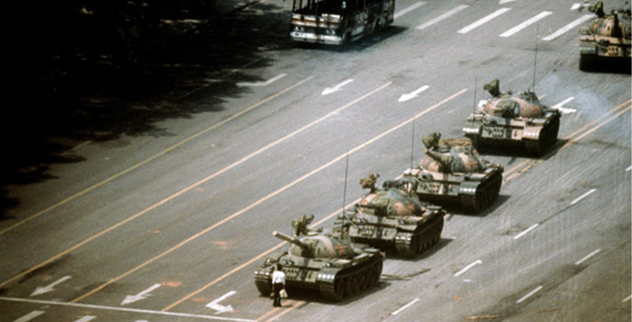
15. Tank Man
One person against a column of tanks
On June 5, 1989, the day after the violent crackdown around Tiananmen Square in Beijing, an unidentified man stood in front of a column of tanks on Chang’an Avenue. The photographs and video of the encounter became enduring symbols of individual defiance against state power.
The man’s identity remains uncertain, which somehow makes the image even larger. He could be anyone, and visually, he stands for everyone who has ever faced overwhelming force with nothing but a body, a conscience, and two shopping bags. History rarely gives us such clean visual metaphors. This one arrived fully formed.
Why Historical Photographs Still Matter
Historical photographs are powerful because they compress complexity. A single frame cannot explain everything, but it can make people care enough to learn more. That is why iconic photographs continue to appear in classrooms, documentaries, museum exhibitions, books, and search results. They are entry points into deeper stories.
They also teach visual literacy. A photograph can be evidence, but it is never neutral magic. It has a maker, a subject, a frame, a purpose, and an audience. Some images are candid; others are staged. Some are used for journalism; others for publicity, science, politics, or memory. Understanding historical photos means asking not only “What happened?” but also “Who took this, why, and what are we not seeing?”
That question is especially important online, where images travel faster than context. A famous photograph can be cropped, colorized, mislabeled, or turned into a meme before breakfast. The antidote is curiosity. Look for the archive record. Check the date. Learn the photographer’s role. Read about the people inside the frame. History gets richer when we stop treating images like decorations and start treating them like documents.
Experiences: How to Look at Historical Photographs Like They Are Alive
The best way to experience historical photographs is to slow down. That sounds simple, but it is almost rebellious now. Most people scroll past hundreds of images a day, giving each one a fraction of a second before the thumb moves on. Historical photographs ask for the opposite. They reward patience.
Start with the obvious details. Who is in the frame? What are they wearing? Where are their hands? What is happening in the background? In Lunch Atop a Skyscraper, the first reaction is usually panic: “Why are those men eating in the sky?” But keep looking. Notice the lunch pails, the relaxed shoulders, the city below them still under construction. The photograph becomes less of a stunt and more of a story about labor, risk, pride, and the building of modern New York.
Next, imagine the sound. The Wright brothers’ first flight might include wind, engine sputter, sand underfoot, and probably a few nervous thoughts that were not suitable for a family newspaper. The March on Washington would carry songs, speeches, footsteps, and the murmur of a massive crowd waiting for history to speak. Earthrise, by contrast, suggests silencean almost impossible quiet broken only by astronauts reacting to the sight of home.
Another useful experience is comparing your first emotional reaction with what you learn afterward. V-J Day in Times Square may first appear joyful. After learning more about Greta Zimmer Friedman’s later comments, the image becomes more complicated. That does not make the photograph less historical. It makes it more human. Real history is rarely tidy. It usually arrives with loose ends, contradictions, and people who remember the same moment differently.
Visiting digital archives can also feel surprisingly personal. The Library of Congress, National Archives, NASA image collections, museum databases, and photojournalism archives allow ordinary readers to zoom into the past. You can inspect a face in a crowd, a handwritten caption, a damaged negative, or a tiny background detail that a textbook never mentioned. It feels a little like time travel, except instead of a glowing machine, you get metadata and a “download TIFF” button.
For writers, students, teachers, and history lovers, the strongest habit is to pair every famous image with three questions: What did this photograph show? What did it hide? What did it change? Migrant Mother showed poverty and maternal endurance, but it also hid the full life and agency of Florence Owens Thompson. Tank Man showed defiance, but it hid the man’s identity and fate. The Apollo 11 bootprint showed achievement, but it also hinted at the vast unknown still beyond human reach.
That is the real magic of historical photographs. They do not finish the story. They begin it.
Conclusion
The 15 incredible historical photographs above prove that history is not only written in documents, speeches, and dates. It is also written in light. A camera can preserve triumph, tragedy, courage, invention, injustice, and wonder in a way that feels immediate even centuries later.
From Niépce’s first surviving photograph to Earthrise, from Gettysburg to Tiananmen Square, these iconic photographs remind us that the past was not abstract. It had faces, shadows, weather, danger, and dust. Most importantly, it had people. When we look carefully at historical photos, we do more than admire old images. We practice remembering with our eyes open.
Note: Before publishing reproductions of any historical photograph, verify copyright status, licensing terms, caption accuracy, and image-credit requirements with the holding archive, museum, agency, or rights owner.