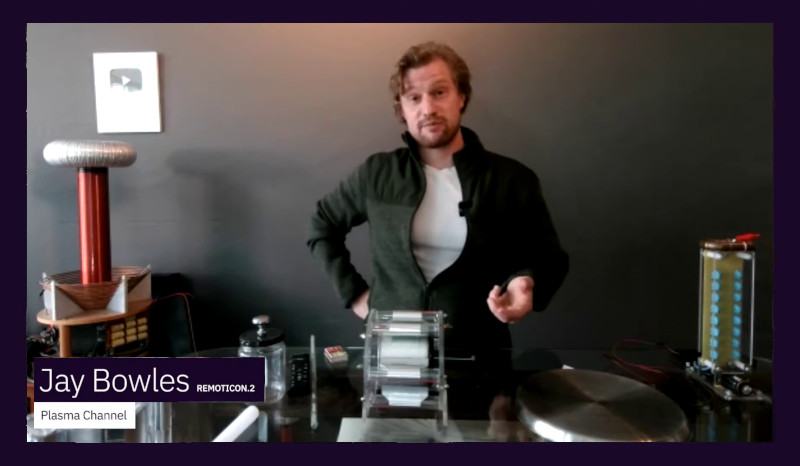
Some conference talks make you take notes. Others make you quietly check whether your fire extinguisher is still where you left it. “Remoticon 2021 // Jay Bowles Dips Into The Plasmaverse” belongs proudly in the second categorythough in the best possible way. Presented during Hackaday’s remote hardware conference, the talk brought Jay Bowles of Plasma Channel into the spotlight for a lively, high-voltage tour through plasma physics, electrostatics, and the strange beauty of invisible forces doing very visible things.
The word “plasmaverse” sounds like a superhero franchise where the villain is poor grounding, but the topic is very real. Plasma is often called the fourth state of matter, sitting alongside solids, liquids, and gases. It appears in lightning, neon signs, auroras, welding arcs, stars, and the occasional “please do not try this at home” demonstration. Bowles’ talk worked because it turned plasma physics from an intimidating textbook subject into something you could see, question, and almost feel buzzing through the screen.
This article explores what made the Remoticon 2021 presentation memorable, why Jay Bowles’ approach resonates with makers and science fans, and how high-voltage demonstrations can turn abstract physics into a hands-on adventurewithout pretending that thousands of volts are a casual weekend craft project.
What Was Remoticon 2021?
Remoticon was Hackaday’s online answer to the maker conference experience: talks, demos, hardware discussions, and the kind of wonderfully nerdy energy that makes people argue happily about circuit boards. The 2021 edition continued the remote-conference format, making it possible for electronics enthusiasts, engineers, hobbyists, and curious viewers around the world to tune in without booking flights, hotels, or emergency suitcase space for soldering gear.
The event featured hardware-focused presentations across a wide range of topics. In that lineup, Jay Bowles’ “A Dip Into the Plasmaverse” stood out because it was not merely a lecture about high voltage. It was a live-style science performance built around demonstrations: levitation, flame manipulation, corona discharge, and electrostatic motion. In short, it was the sort of talk that makes the comments section collectively lean forward.
Who Is Jay Bowles?
Jay Bowles is best known as the creator behind Plasma Channel, a science and engineering platform focused on high-voltage physics, plasma demonstrations, and experimental devices. His public profiles describe a long-running passion for making plasma physics tangible. That wordtangibleis the key. Bowles does not present electricity as a dry diagram. He presents it as something that bends flames, moves objects, spins motors, and glows like science has discovered dramatic lighting.
His style matters because plasma physics can feel distant from everyday life. Most people encounter it indirectly: a fluorescent tube humming overhead, a lightning storm outside the window, a microwave doing suspiciously powerful things to leftovers. Bowles’ work connects those familiar experiences to deeper principles such as ionization, electric fields, charge transfer, and corona discharge.
What Is the “Plasmaverse”?
The “plasmaverse” is not an official academic term, but it is an excellent one. It captures the idea that plasma physics is not a tiny niche tucked away in a laboratory. Plasma is everywhere once you know what to look for. The sun is plasma. Lightning is plasma. Auroras are plasma. Neon signs rely on excited gas atoms producing light. Even some advanced propulsion and energy research explores plasma-related behavior.
At its simplest, plasma forms when gas becomes ionizedmeaning some electrons are separated from atoms or molecules. That creates a mix of charged particles, including electrons and ions. Because those particles respond strongly to electric and magnetic fields, plasma behaves differently from ordinary neutral gas. It can glow, conduct electricity, form arcs, create wind-like flows of charged particles, and interact with nearby objects in surprising ways.
That is why a strong presentation on plasma does not need fireworks, though Bowles’ demonstrations certainly had sparkle. The subject already comes with its own special effects department.
The Big Idea Behind the Talk: Invisible Fields, Visible Results
The strongest theme of Jay Bowles’ Remoticon 2021 talk was that high-voltage physics becomes understandable when invisible forces produce visible outcomes. Electric fields are easy to define and hard to emotionally appreciate. A diagram with field lines can explain direction and strength, but a floating piece of foil or a bending flame makes the concept land instantly.
That is the magic of demonstration-based science. You do not simply hear that charged objects interact. You see a physical object respond. You do not merely learn that flames contain ions. You watch a flame shift under the influence of an electric field. You do not just memorize that electrostatic motors use charge attraction and repulsion. You see a rotor spin without the familiar magnetic coils found in conventional motors.
Electrostatic Levitation: When Foil Decides Gravity Is Optional
One of the most memorable demonstrations involved electrostatic levitation. In the talk coverage, Bowles used a high static voltage and careful isolation from ground to create conditions where a lightweight aluminum foil object could hover. This was not anti-gravity, wizardry, or a sponsorship from the Aluminum Foil Appreciation Council. It was electrostatics.
When charged objects interact, they experience forces based on electric charge. If the geometry, charge distribution, and surrounding field are just right, a lightweight object can be supported or stabilized by electrostatic forces. The result looks delightfully impossible: a small foil “boat” floating in air, held not by string or airflow but by electrical interaction.
What makes this demonstration especially educational is its fragility. Electrostatic levitation is not a simple on/off trick. It depends on balance. Too much force in the wrong direction and the object escapes its stable zone. Too little and gravity wins, as gravity usually does, smugly. Bowles’ explanation helped show that the demonstration was not just “high voltage makes things float,” but a carefully balanced system shaped by charge, distance, grounding, and field geometry.
Electrostatic Flame Bending: Fire Meets the Electric Field
Another highlight was electrostatic flame bending. A flame is not just hot glowing gas; it contains charged particles, including positive and negative ions. Because of that, a strong electric field can influence the flame’s shape and direction. In Bowles’ demonstration, the flame could be pulled or deflected, creating an effect that looked like firebending had wandered out of animation and into a physics lab.
This is where the talk struck a perfect balance between spectacle and explanation. Viewers could enjoy the weirdness firstbecause yes, watching a flame lean toward a charged object is weirdand then understand the science. The charged particles in and around the flame respond to electric forces, and their movement affects the surrounding hot gas. That combination can make the flame bend, stretch, or even split in dramatic ways.
It is also a perfect example of why high-voltage experimentation should not be copied casually. Fire, electricity, and the human body are three things that deserve separate respect. Combining them for science communication requires experience, planning, and safety discipline. Combining them on a kitchen table because “the internet made it look cool” is how you end up with a story that starts funny and ends with paperwork.
Corona Motors: High Voltage With a Spin
The talk also explored an atmospheric corona motor, a device that uses electrostatic forces rather than the electromagnetic principles behind many familiar motors. Traditional motors often rely on magnetic fields and current-carrying coils. A corona motor, by contrast, can use high voltage and very low current to create charge interactions that turn a rotor.
The underlying idea is elegant. Sharp points or electrodes create strong local electric fields. Under the right conditions, the surrounding air becomes ionized, producing corona discharge. Charged particles move through the air and transfer momentum. The rotor experiences forces that produce motion. It is a motor, yes, but not the kind most people imagine when they think of spinning machinery.
Bowles’ comparison to a waterwheel was especially helpful. In a waterwheel, flowing water transfers momentum and produces rotation. In a corona motor, moving charged particles and electrostatic forces play a similar conceptual role. The analogy makes a strange device feel familiar without flattening the science into oversimplified mush.
Why High Voltage Is Not the Same as High DangerBut Still Dangerous
One important teaching point in Bowles’ high-voltage work is the distinction between voltage and current. Voltage is electrical potential difference; current is the flow of electric charge. In many electrical injuries, current through the body is the direct danger. That said, high voltage is never something to treat casually. High voltage can break down air, jump gaps, create arcs, start fires, damage equipment, and turn small mistakes into memorable events for all the wrong reasons.
This distinction is useful because it helps viewers understand why some demonstrations can involve extremely high voltages at very low currents, while ordinary household electrical hazards can still be deadly. It is not a permission slip. It is a reminder that electrical safety depends on the whole system: voltage, current, exposure time, path through the body, stored energy, grounding, insulation, environment, and human errorthe most renewable resource in any workshop.
For readers inspired by the Remoticon talk, the safest next step is education, not improvisation. Learn basic electricity, read credible safety guidance, study circuit behavior, understand stored energy in capacitors, and respect the difference between watching an expert demonstration and building one yourself.
Why This Talk Worked So Well for Makers
The maker community loves practical curiosity. It is not enough to know that a phenomenon exists; makers want to know what it does, how it behaves, and what happens when you change one variable. Bowles’ talk fit that mindset perfectly. Each demonstration raised questions naturally:
- Why does the foil hover instead of flying away?
- Why does the flame bend toward one side?
- How can a motor spin without conventional magnetic drive?
- What role do sharp points play in corona discharge?
- How much of plasma science can be explored visually and safely?
Good science communication does not merely deliver answers. It creates better questions. That is exactly why Remoticon 2021 // Jay Bowles Dips Into The Plasmaverse remains a compelling topic for electronics enthusiasts, students, teachers, and anyone who has ever looked at a lightning storm and thought, “That seems important, terrifying, and honestly pretty stylish.”
The Educational Power of Plasma Demonstrations
Plasma physics often sits at the intersection of several disciplines: electricity, chemistry, thermodynamics, fluid dynamics, materials science, and even aerospace engineering. That can make it intimidating. Demonstrations lower the entry barrier by showing one principle at a time.
They Make Abstract Concepts Concrete
Electric fields are invisible, but their effects are not. When a flame bends or a rotor turns, viewers can connect the idea to observation. This is especially valuable for visual learners who may not immediately connect equations to physical behavior.
They Encourage Scientific Thinking
A good demonstration invites prediction. What happens if the electrode moves closer? What happens if the object is lighter? What happens if the shape changes? These questions lead naturally into hypothesis, testing, and analysis.
They Show Science as a Living Process
Bowles’ presentation did not feel like a museum display. It felt like an active exploration. That matters because science is not just a stack of established facts. It is a way of investigating realitysometimes with expensive equipment, sometimes with foil, and occasionally with a candle that is having a very confusing afternoon.
Real-World Relevance Beyond the Wow Factor
It would be easy to dismiss plasma demonstrations as visual entertainment, but the underlying science connects to serious fields. Plasma research is important in fusion energy, semiconductor manufacturing, lighting, medicine, propulsion, surface treatment, and environmental technologies. Corona discharge and ionic wind have also been studied for cooling, airflow control, and experimental propulsion systems.
One famous example is the development of an aircraft powered by ionic wind, demonstrated by researchers at MIT. While that technology is far removed from a conference demo, it shows that charged-particle motion through air is not merely a parlor trick. Under the right conditions, electric fields can move air, create thrust, and inspire new engineering approaches.
This is why Bowles’ “plasmaverse” framing is effective. A small demo can become a doorway. Today, a viewer watches a flame bend. Tomorrow, that same viewer may read about plasma propulsion, fusion reactors, ion thrusters, or electrohydrodynamic cooling. Curiosity scales beautifully.
What Content Creators Can Learn From Jay Bowles
Beyond the science, the Remoticon talk is a useful case study in technical communication. Bowles did not rely on jargon alone. He used physical demonstrations, clear comparisons, and a sense of excitement. That is a winning formula for creators who want to explain difficult subjects.
Start With Wonder
Before diving into definitions, show why the topic is worth caring about. A floating foil boat earns attention faster than a paragraph beginning, “Electrostatic force is proportional to…” The formula can come later, after the audience is already leaning in.
Use Familiar Analogies
Comparing a corona motor to a waterwheel gives viewers a mental handle. Analogies should not replace accuracy, but they can build a bridge from familiar experience to unfamiliar science.
Respect the Risks
Responsible creators make danger visible without sensationalizing it. High-voltage work looks cool because it is cool, but it also demands caution. Bowles’ subject matter is exciting precisely because it sits near the boundary between accessible demonstration and serious hazard.
Why the Talk Still Matters
Years after Remoticon 2021, the presentation remains relevant because it represents a style of science communication that the internet needs more of: informed, visual, enthusiastic, and grounded in real principles. It does not flatten science into trivia. It does not hide the complexity. It says, in effect, “This is strange, this is beautiful, and here is why it happens.”
That combination is powerful. Many people first fall in love with science not through a perfect equation, but through a moment of surprise. A magnet snaps to metal. A prism splits light. A balloon sticks to a wall. A flame bends toward an electric field. The world briefly reveals that it has rules, and those rules are more interesting than expected.
500-Word Experience Section: A Viewer’s Dip Into the Plasmaverse
Watching “Remoticon 2021 // Jay Bowles Dips Into The Plasmaverse” feels a little like being invited into a workshop where the air itself has opinions. There is a special kind of excitement that comes from seeing a science demonstration that is both elegant and slightly mischievous. You know the presenter understands what is happening, but part of your brain is still whispering, “That flame just moved sideways. Are we all going to pretend that is normal?”
The most memorable experience is not just the spectacle of high voltage. It is the way the demonstrations create a rhythm of curiosity. First, something surprising happens. Then Bowles explains the principle behind it. Then the viewer mentally rewinds the moment and sees it differently. The floating foil is no longer a magic trick. It becomes a balance of charge, geometry, mass, and electric field strength. The bending flame is no longer just a cool visual. It becomes evidence that fire contains charged particles that respond to invisible forces.
That shiftfrom “wow” to “oh, I understand why”is the heart of great science content. It gives the audience both delight and ownership. You do not walk away merely entertained; you walk away with a new lens. After a good plasma demonstration, ordinary objects seem a little less ordinary. A neon sign becomes a physics lesson in a diner window. A thunderstorm becomes a planetary-scale reminder that air can become conductive when pushed hard enough. Even a microwave starts looking less like an appliance and more like a tiny box of electromagnetic negotiations.
For makers, the talk also delivers a familiar emotional itch: the desire to build, test, and explore. But it wisely sits in a category where enthusiasm should be paired with restraint. High-voltage experimentation is not like assembling a bookshelf, unless your bookshelf stores energy and occasionally arcs through the air. The better lesson is not “copy this immediately.” The better lesson is “learn deeply enough to respect what you are seeing.” That is a more durable kind of inspiration.
Another enjoyable part of the experience is Bowles’ ability to make plasma physics feel adventurous without making it feel unreachable. He does not present the subject as something reserved only for national labs or advanced degrees. Instead, he frames it as a field where curiosity, careful experimentation, and patience matter. That is deeply encouraging. Many people assume physics is something that happens in textbooks after the fun has been removed. This talk argues the opposite: physics is what makes the fun possible.
In the end, the presentation works because it feels like a guided tour through a hidden layer of reality. The “plasmaverse” is not somewhere else. It is around usin storms, signs, stars, sparks, tools, and technologies. Bowles simply helps viewers notice it. And once you notice it, the world gets a little brighter, a little stranger, and a lot more electric.
Conclusion
“Remoticon 2021 // Jay Bowles Dips Into The Plasmaverse” is more than a recap-worthy conference talk. It is a reminder that science communication shines brightest when it combines accuracy, curiosity, and a little theatrical voltage. Jay Bowles used high-voltage demonstrations to make plasma physics feel immediate and understandable, showing how electric fields can levitate foil, bend flames, and spin motors through electrostatic forces.
For viewers, the talk offers a gateway into high-voltage physics without reducing the subject to simple tricks. It celebrates the wonder of plasma while respecting the seriousness of electrical safety. That balance is exactly what makes it valuable for makers, educators, students, and science fans. The plasmaverse is vast, glowing, and occasionally noisybut with the right guide, it becomes a place worth exploring.
Note: This article is written for educational and editorial purposes. High-voltage demonstrations can be dangerous and should not be attempted without proper training, equipment, supervision, and safety procedures.