There was a brief, unforgettable moment when the world looked at a public-health problem and thought, “What if the answer were… a giant hat?” Not a metaphorical hat. A literal one. A brim so wide it could clear a snack aisle. A foam appendage that politely said, please admire me from six feet away. A bubble dome that made its wearer look ready to either attend a techno festival or negotiate peace with Mars.
That was the strange genius of social distancing headgear. During the height of the pandemic, distancing moved from floor decals and awkward sidesteps into fashion, product design, and wearable tech. The idea was simple: if people struggled to remember invisible rules, maybe design could make personal space visible. And if that design happened to look like the love child of a Victorian bonnet and a sci-fi costume department, well, that was apparently a bonus.
What emerged was part safety theater, part speculative fashion, part practical experiment. Some pieces were obvious gimmicks. Some were legitimately clever. A few hinted at a bigger future where wearables help people navigate crowded spaces, communicate boundaries, and move through public life with a little more control. In other words, social distancing headgear was never just about looking ridiculous. It was about turning risk, etiquette, and personal space into something you could actually wear.
Why Headgear Became a Pandemic Design Obsession
To understand the rise of distancing headgear, you have to remember how rapidly public behavior changed. In 2020, “six feet apart” became a cultural catchphrase. It showed up in grocery lines, classrooms, airports, and just about every sign taped to every door in America. Later guidance became more nuanced, with public-health agencies emphasizing that there is no single magic number for every situation and that risk depends on symptoms, crowding, duration, and ventilation. But for everyday life, distance became a shorthand people could understand instantly.
Designers, artists, and brands saw an opportunity hiding inside that shorthand. Distancing rules were conceptually simple but behaviorally messy. People forgot. People guessed. People drifted. So creators began asking a wonderfully impractical yet oddly logical question: what if your clothes could do the measuring for you?
That question produced a flood of wearable experiments. Some extended outward from the head and shoulders with giant brims or noodle-like protrusions. Others enclosed the face in helmets, shields, or bubble structures. More technical versions added sensors, alarms, air filtration, or proximity alerts. The aesthetics varied wildly, but the mission was the same: make personal space visible enough that nobody had to argue about it in real time.
From Giant Brims to Bubble Domes
Oversized Hats: The Keep-Your-Distance Classic
The most iconic version of social distancing headgear was also the most gloriously low-tech: the oversized hat. If a normal hat says, “I enjoy shade,” a distancing hat says, “I would like shade, privacy, and a legally recognized perimeter.” Designers and businesses toyed with huge circular brims, halo-like structures, and comedic attachments that forced extra space around the wearer. At least one German café famously used hats fitted with pool noodles to keep diners from getting too cozy. Burger King in Germany even handed out oversized crowns to encourage spacing. If ever there were proof that public health and absurdism can share a table, that was it.
These hats worked less like protective gear and more like wearable etiquette. They did not clean the air. They did not replace masks. They did not magically neutralize risk. What they did do was create a physical and visual reminder that made distance feel social rather than abstract. You did not have to explain anything. The hat handled introductions.
The Bubble Look: A Little Space Age, A Little Fishbowl
Then came the bubble aesthetic. Clear domes, face enclosures, and helmet-like forms turned up in fashion concepts and public prototypes that made everyday errands look like deleted scenes from a retro-futurist film. The appeal was obvious. A transparent shell felt like a literal translation of the idea everyone was chasing: protect the breathing zone without disconnecting people entirely from the world around them.
Bubble-inspired headgear also carried strong visual symbolism. It said that the body had become a border and that even ordinary social life now required architecture. You were not just wearing an accessory. You were carrying a tiny room around your head.
Of course, the look raised practical questions immediately. Fogging, comfort, communication, airflow, heat, cleaning, and social awkwardness all became part of the equation. Looking futuristic is easy. Breathing comfortably inside the future is harder.
The Micrashell: Peak Pandemic Cyberpunk
If one design captured the theatrical ambition of the era, it was the Micrashell. Developed by Los Angeles-based Production Club, the concept imagined a concert-ready protective suit with a clear upper shell, ventilation features, integrated communications, and a silhouette that screamed “club kid astronaut.” It was not subtle, and that was exactly the point.
The Micrashell represented a shift from defensive public-health gear to experience design. Instead of asking how people could avoid crowds, it asked how crowds might be redesigned. Could nightlife, concerts, and festivals become safer through wearable infrastructure? Could design preserve the thrill of public gathering while reducing at least some of the chaos? The Micrashell did not become everyday streetwear, thankfully for subway riders everywhere, but it crystallized a broader design fantasy: a future where public life is mediated through beautiful, bizarre personal systems.
When Headgear Became Smart
Not all distancing wearables were giant hats and speculative art pieces. Some moved toward actual tech. Researchers and companies experimented with devices that could detect proximity and alert wearers when someone got too close. In workplaces, these systems used sound, vibration, lights, or data logging to support distancing without constant human policing.
That matters because the real challenge of distancing was rarely conceptual. Most people understood the rule. The hard part was following it consistently in motion, in conversation, and in crowded places. A wearable can offload that mental math. Instead of estimating two meters with your eyes while balancing a coffee and social anxiety, a device can nudge you the moment the boundary is crossed.
Studies on social-distancing wearables suggest there was real promise here. In one workplace study discussed by ACM’s Interactions, proximity-alert wearables were linked to reductions in the time workers spent within close ranges of one another. Reviews of pandemic-era wearables also noted that social distancing and contact tracing became major development targets for the sector. In other words, even if the hat with noodles was mostly a joke with excellent posture, the underlying idea of wearable spatial awareness was serious.
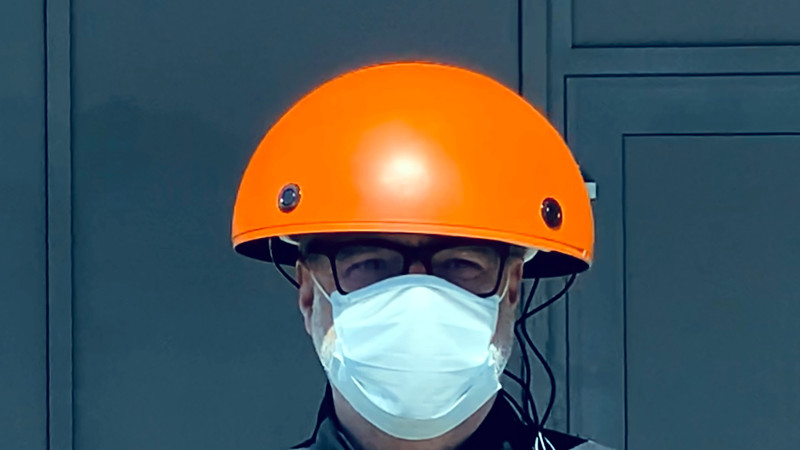
Headgear also intersected with temperature screening and smart infrastructure. Helmet-style screening tools appeared in some transportation settings outside the United States, reinforcing the broader idea that the face and head were becoming prime real estate for pandemic tech. The future, apparently, had arrived wearing a visor.
Did Social Distancing Headgear Actually Work?
The honest answer is: sometimes, in very specific ways.
If by “work” you mean “reduce airborne transmission on its own,” the answer is mostly no. Distancing headgear was never a silver bullet. Public-health guidance consistently pointed to layered protection: staying home when sick, avoiding crowded spaces, improving ventilation, masking in certain contexts, and keeping physical distance when appropriate. A giant brim might remind people to back off, but it does not change the airflow in a poorly ventilated room or substitute for broader risk reduction.
But if by “work” you mean “change behavior,” then the answer gets more interesting. Distancing headgear could act as a social signal, a conversation starter, a boundary marker, or an assistive cue. It could make people laugh and step back at the same time, which is honestly a better outcome than many office memos have ever achieved. Smart versions added even more utility by providing alerts or records of repeated close contacts.
That distinction matters. The most successful designs were not necessarily the ones that promised invincibility. They were the ones that reduced friction. They made the invisible visible. They gave people a script. They turned awkward personal space negotiations into something a product could partly handle on their behalf.
Why the Look Felt So Perfectly Futuristic
Social distancing headgear exploded because the cultural moment practically begged for it. The pandemic transformed everyday life into something that felt eerily speculative. Offices emptied. restaurants installed partitions. showrooms shifted to appointment-only visits and virtual consultations. Airports flirted with thermal screening and touchless systems. The built environment was being redesigned in real time, so of course fashion joined the party.
And fashion, to its credit, did not whisper. It went straight for visual drama. Huge brims. Clear shells. hoops. sculptural extensions. glowing alerts. suddenly, garments were no longer just decorative or expressive; they were spatial devices. They measured room, announced intention, and translated public-health logic into a form people could actually see from across the sidewalk.
That visual logic also tapped into a long tradition in fashion history. Clothing has always managed space. Corsets, crinolines, panniers, shoulder pads, towering hats, and ceremonial dress all altered how close bodies could get and how much room a person occupied. Pandemic headgear felt new because the reason was new, but the strategy was ancient: use silhouette to control interaction.
What changed was the tone. Historical fashion often used volume to signal rank, wealth, modesty, or spectacle. Distancing headgear used volume to signal caution, autonomy, and risk awareness. It was social choreography with a sci-fi filter.
What the Trend Revealed About Us
For all its weirdness, distancing headgear revealed a lot about modern culture. First, it showed that people are far more willing to experiment with public behavior when design makes the experiment legible. A taped floor marker is functional. A giant hat is memorable. Guess which one gets photographed, shared, debated, and copied.
Second, it exposed the blurry line between protection and performance. During the pandemic, many objects did both. Masks protected, but they also communicated identity. Partitions created barriers, but they also reassured customers. Distancing headgear took that double role and dialed it up to eleven. Wearing it was never only about safety. It was also about signaling values, humor, caution, creativity, or plain old emotional exhaustion with invisible risk.
Third, it suggested that the future of wearables may be less about raw data and more about social intelligence. The most compelling devices were not necessarily the ones that tracked the most information. They were the ones that changed human interaction gracefully. A buzzer, a light, a sculptural brim, a clear visual cuesometimes the best tech is the kind that helps people negotiate space without turning the moment into a lecture.
Could It Come Back?
As an everyday category, probably not. Most people do not want to commute dressed like a concept rendering for a moon colony brunch. But the ideas behind social distancing headgear are not gone. They have simply diffused into other areas.
You can already see echoes in wearable safety gear, smart workplace badges, inclusive design for immunocompromised users, festival fashion, and speculative design exhibitions. The bigger lesson is that public-health behavior does not always have to be communicated through sterile signage or scolding language. Sometimes a product can do the job with humor, aesthetics, and a little theatrical flair.
That said, any comeback will depend on restraint. The line between useful wearable and annoying gimmick remains very real. So does the line between helpful alerting and intrusive surveillance. If future versions collect data, track interactions, or monitor movement, privacy has to be part of the design conversation from the beginning. Nobody wants a hat that judges them and reports to management.
Design Lessons Worth Keeping
- Visibility matters. People follow spatial rules more easily when those rules are physically and socially obvious.
- Humor has value. Playful design can reduce resistance and make compliance feel less punitive.
- Comfort beats cleverness. If something is hot, awkward, heavy, or impossible to clean, it will become closet decor.
- Wearables should support judgment, not replace it. Context still matters more than any one device.
- The future is hybrid. The best concepts connect behavior, environment, and technology instead of pretending one object can solve everything.
Experiences Related to Social Distancing Headgear For The Futuristically Inclined
The experience of social distancing headgear was never just about wearing an object. It was about entering a room and instantly changing the social script. A normal hat disappears into the background after about three seconds. A distancing hat becomes the room’s unofficial moderator. People notice it, laugh at it, photograph it, andmost importantlyrespond to it. That response is part of the experience. The gear creates a tiny pause in human autopilot. Before the handshake, before the lean-in, before the absentminded step forward, there is a beat of recognition. “Oh right, space matters now.” In that sense, the wearer is not only dressed differently; the wearer is managing the behavior of everyone nearby.
That can feel empowering, especially for people who are tired of verbally defending their boundaries. One of the most uncomfortable parts of pandemic life was the emotional labor of asking others to move back. Distance is easy to recommend in theory and awkward to enforce in person. Wearable distancing tools, whether theatrical hats or sensor-based devices, shifted some of that burden from the individual to the object. The hat says it first. The alarm says it first. The design takes the blame for the social correction. That is a small but meaningful change in experience, particularly for workers, caregivers, and cautious people who did not want every interaction to become a negotiation.
At the same time, the experience could be deeply funny and deeply exhausting. Funny, because many of these objects looked delightfully absurd. There is no serious way to describe pool noodles attached to headwear without sounding like you are recapping a school craft project designed by an alien. But exhausting, because absurdity does not erase self-consciousness. Wearing visibly unusual gear in public makes you hyper-aware of your body. You feel the weight, the width, the attention, the way doorways suddenly seem narrower and strangers suddenly seem more curious. The object creates safety theater, yes, but it also creates self-awareness theater. You are not just going grocery shopping. You are making an entrance.
There is also a very particular sensory experience to futuristic distancing gear. Clear shields can alter sound. Dome-like forms can make speech feel slightly delayed or oddly intimate. Proximity wearables add beeps, lights, or vibration to moments that would otherwise pass unnoticed. Even the non-electronic versions change the rhythm of movement. You turn more carefully. You judge gaps more deliberately. You stop treating space as empty and start treating it as something structured, measured, and designed. That may be the most lasting lesson of all. These objects taught people to feel architecture at the scale of the body.
And then there is the emotional side. For some, futuristic headgear offered reassurance, a sense that design could help tame uncertainty. For others, it reflected the surrealism of living through a historic disruption where every errand carried a tiny risk calculation. The gear looked ridiculous because the moment itself was ridiculous. Yet inside that weirdness was a sincere attempt to build tools for care, caution, and coexistence. That is why the trend remains fascinating. Social distancing headgear did not succeed because everyone wanted to look like they were headed to a stylish aquarium. It succeeded as an idea because it gave form to invisible anxiety. It made boundaries tangible. It let people perform caution without surrendering creativity. And for one very strange chapter of recent history, that was not only useful. It was weirdly beautiful.
Conclusion
Social distancing headgear was one of the pandemic era’s strangest design detours, but it was not a meaningless one. It showed how quickly fashion, technology, and public behavior can merge when the world needs new rules fast. Some of the results were silly. Some were smart. A few were both, which is often where the best ideas begin.
More than anything, these wearable experiments proved that personal space is not just a matter of policy. It is a matter of design. When distance became part of daily life, people did not respond with spreadsheets alone. They responded with brims, bubbles, helmets, sensors, and full-on cyberpunk optimism. That may not be the future we expected, but it certainly made the sidewalks more interesting.
Note: This is clean body-only HTML in standard American English, ready for web publishing and free of citation placeholder artifacts.