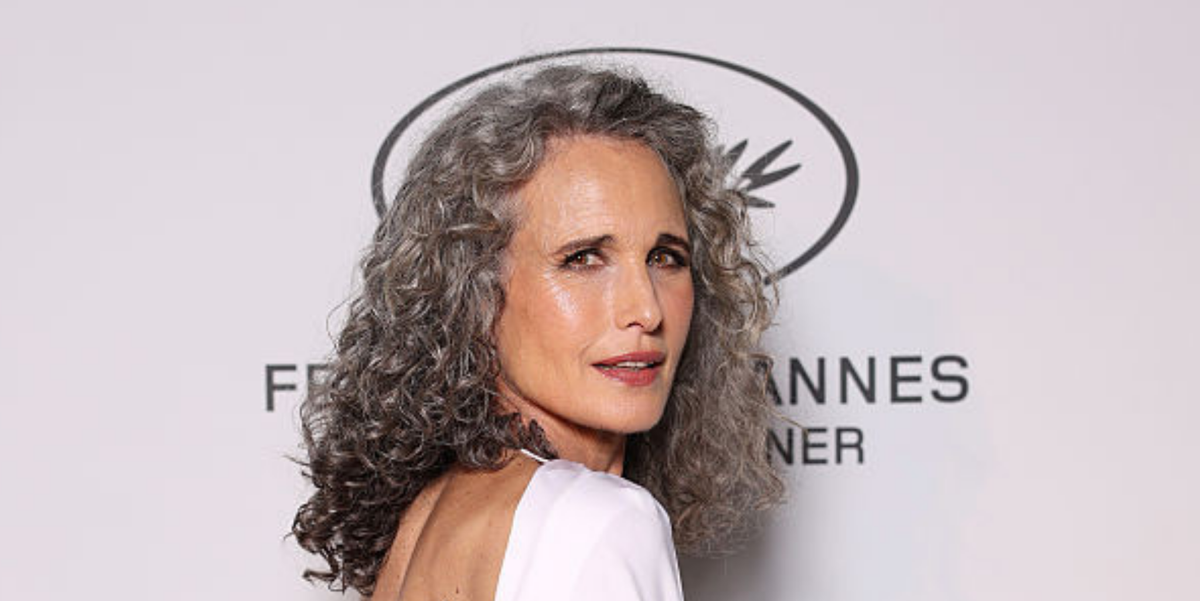
Andie MacDowell has spent decades making memorable entrances: silver curls on a red carpet, a soft-but-steely look in a drama scene, a perfectly timed smile in a romantic comedy, and now, a small tattoo with a surprisingly big emotional backstory. The beloved actress, currently known to many Hallmark viewers as Del Landry on The Way Home, recently opened up about the meaning behind an angel-wing tattoo on her shoulder. It is not a vanity design. It is not a midlife rebellion. It is not the celebrity equivalent of buying a motorcycle and naming it “Freedom.” It is, in MacDowell’s own telling, a tribute to motherhood, her children, and a phrase of affection passed down from her father.
The tattoo may be small, but the story behind it touches several themes that have long shaped MacDowell’s public image: family, aging with confidence, emotional honesty, and the idea that beauty becomes more powerful when it carries meaning. For fans of The Way Home, the timing feels especially fitting. MacDowell’s character, Del, is a mother and grandmother whose journey is filled with grief, reconciliation, memory, and love. Off-screen, MacDowell’s angel wing feels like a real-life echo of the same emotional territory.
What Is Andie MacDowell’s Tattoo?
Andie MacDowell’s tattoo is an angel wing placed on her shoulder. She explained that she got it during her daughter’s wedding celebration, where a tattoo artist was part of the party. The late-night spontaneity of the moment gives the story a charming, almost cinematic quality. There is something wonderfully human about a glamorous star deciding, close to midnight, that the right way to mark a family milestone is with permanent ink.
But the design was not random. MacDowell said the angel wing represents motherhood. She described her children as precious angels and connected the phrase to her own father, who used to call her his precious angel. In other words, the tattoo works in several emotional directions at once. It honors her children, remembers her father, and captures the way love can travel through generations like a whispered family blessing.
The Meaning Behind the Angel Wing
Angel-wing tattoos are common, but MacDowell’s version stands out because of the personal story attached to it. In tattoo culture, wings often symbolize protection, remembrance, guidance, spirituality, or a loved one watching over someone. For MacDowell, the meaning is more intimate. The wing is less about an abstract angel and more about the sacred feeling of being a mother.
That is what makes the tattoo resonate. Anyone can choose a pretty design. A meaningful tattoo becomes something else: a tiny archive on the skin. It says, “This matters to me.” It may be visible to the world, but it belongs first to the person wearing it. MacDowell’s angel wing is a soft, graceful mark, yet it carries the weight of family history. It connects her role as a daughter to her role as a mother. It also suggests that the language of love often repeats itself. Her father called her a precious angel; she now sees her own children through that same tender lens.
Why Fans Connected With the Story
Fans responded warmly because the tattoo story feels sincere. Celebrity tattoos can sometimes feel like trend reports with better lighting, but this one has the emotional texture of a family keepsake. MacDowell did not frame the tattoo as a fashion statement. She framed it as a memory, a tribute, and a symbol of affection.
That matters because audiences have followed MacDowell through many eras of her career. Some remember her from Sex, Lies, and Videotape. Others associate her with Groundhog Day or Four Weddings and a Funeral. More recent viewers know her from Maid or The Way Home. Across those decades, MacDowell has cultivated an image that feels elegant but not untouchable. She can look like a movie star and still sound like someone telling a story at a kitchen table. That combination is rare, and it is part of why a small tattoo can become a headline.
How the Tattoo Connects to The Way Home
MacDowell’s current role as Del Landry adds another layer to the story. The Way Home centers on three generations of women: a grandmother, her daughter, and her granddaughter. The series blends family drama with time travel, but its emotional engine is not the pond, the mystery, or the timeline twists. It is the ache of family relationships: what gets lost, what gets misunderstood, and what can still be repaired.
Del is a matriarch shaped by loss and resilience. She is not a simple “sweet grandmother” character who exists only to hand out wisdom and pie. She has edges. She has regrets. She carries history in her face, her posture, and her silences. As the series has developed, viewers have watched Del’s relationships with Kat and Alice deepen. The character’s emotional growth mirrors a truth many families understand: healing rarely arrives in one dramatic speech. It comes in fragments, in small acts of honesty, and sometimes in the courage to soften.
That is why MacDowell’s angel-wing tattoo feels so on-brand for this chapter of her career. The tattoo is about motherhood, but not in a greeting-card way. It recognizes that family love is layered. It can be joyful, complicated, protective, nostalgic, and vulnerable all at once. In that sense, the tattoo could almost belong in the world of The Way Home, where memory and love are never as simple as they first appear.
Andie MacDowell’s Children and the Family Connection
MacDowell has three children: Justin Qualley, Rainey Qualley, and Margaret Qualley. While Justin has mostly lived outside the entertainment spotlight, Rainey and Margaret have built creative careers of their own. Rainey is an actress, model, and musician who performs as Rainsford. Margaret Qualley has become one of the most acclaimed actresses of her generation, with roles in projects such as The Leftovers, Maid, Poor Things, and The Substance.
The family connection has also appeared on-screen. In Maid, MacDowell and Margaret played mother and daughter, bringing a real-life bond into a fictional story about trauma, survival, and complicated maternal love. That performance reminded viewers that MacDowell’s strength as an actress often comes from emotional transparency. She does not need to overplay a scene to make it land. She understands how to let feeling rise quietly until it fills the room.
Seen through that lens, the angel-wing tattoo is not just a personal detail. It is another sign of how openly MacDowell values motherhood. She has spoken before about family being a priority, even while building a major career. Her tattoo makes that priority visible in a simple, permanent way.
A Tattoo That Fits MacDowell’s Era of Authenticity
In recent years, Andie MacDowell has also become a symbol of graceful authenticity, especially after embracing her natural gray hair. Her silver curls have become a signature, not because they are trendy, but because they look like a woman refusing to apologize for time. In an industry that often treats aging as a technical problem to be edited, softened, or hidden behind suspiciously youthful lighting, MacDowell has made aging look like a power move.
The tattoo belongs to that same larger story. It is another example of MacDowell choosing meaning over performance. She is not chasing a younger image or trying to shock people. She is allowing her public self to include her private values: motherhood, memory, vulnerability, and devotion.
That is why the tattoo feels refreshing. It is not loud. It does not demand attention. It simply says something true. In a celebrity culture that often rewards spectacle, a quiet symbol can be surprisingly powerful.
Why Meaningful Tattoos Have Such Staying Power
Meaningful tattoos endure because they turn emotion into a physical reminder. A person might get a tattoo after a wedding, birth, loss, recovery, move, graduation, or personal transformation. The design becomes a landmark. You may not think about it every minute, but when you catch sight of it, you remember who you were when you chose it and why it mattered.
MacDowell’s tattoo also reflects a broader trend: people increasingly use tattoos to tell family stories. A child’s name, a parent’s handwriting, a symbolic flower, a date, a bird, a wing, or even a tiny line drawing can become a portable memorial. The appeal is not only aesthetic. It is emotional ownership. A tattoo lets someone carry a story without having to explain it every time.
The Beauty of a Small Symbol
One reason MacDowell’s angel wing works so well is its simplicity. A wing is instantly recognizable but open enough to hold different meanings. It can suggest protection, tenderness, faith, memory, or freedom. For MacDowell, it gathers several loved ones into one image. That is elegant storytelling. No footnotes required. No family tree tattooed across the shoulder blade. Just one wing, doing a lot of emotional heavy lifting.
What This Reveals About Andie MacDowell
The tattoo story reveals what many fans already admire about MacDowell: she is sentimental without being sugary, glamorous without being distant, and reflective without sounding rehearsed. She has lived enough life to understand that beauty is not only about how something looks. It is also about what it means.
Her angel wing shows a woman honoring the people who shaped her and the children who changed her. It also shows someone comfortable enough in her own skin to let that skin carry a story. That is a lovely thing. It is also a reminder that personal style becomes more interesting when it has a pulse.
Why the Story Works for The Way Home Fans
Fans of The Way Home are especially likely to appreciate this story because the show is built on emotional symbolism. The pond is not just a pond. The farm is not just a farm. A family heirloom is rarely just an object. Everything carries memory. Everything has roots.
MacDowell’s tattoo fits perfectly into that kind of storytelling. It is a visible symbol of invisible bonds. It says that family love can outlast time, distance, and change. That is also the core promise of The Way Home: the past may be complicated, but it is not unreachable. The people we love continue to shape us, even when we are not standing in the same room, the same year, or the same chapter of life.
Conclusion: A Small Tattoo With a Big Heart
Andie MacDowell’s angel-wing tattoo is meaningful because it is not trying too hard. It is personal, graceful, and rooted in family. The design honors her children, recalls her father’s loving words, and reflects the emotional openness that has made this stage of MacDowell’s career so compelling. For fans of The Way Home, the tattoo feels especially touching because it echoes the show’s themes of motherhood, memory, healing, and generational love.
In the end, the most powerful tattoos are not always the largest or most elaborate. Sometimes they are the ones that carry a private sentence in a public place. MacDowell’s angel wing says, in its own quiet way, that love leaves marks. Some are invisible. Some are remembered in family phrases. And some, if the night is right and there happens to be a tattoo artist at the wedding, become a delicate wing on a shoulder.
Experience Notes: Why This Tattoo Story Feels So Relatable
Stories like Andie MacDowell’s tattoo tend to stay with people because nearly everyone has a symbol that means more than it appears to mean. It may not be a tattoo. It might be a ring worn on a chain, a recipe card in a grandmother’s handwriting, a child’s drawing taped inside a cabinet, a faded photo in a wallet, or a voicemail someone refuses to delete. On the surface, these objects are small. Emotionally, they are skyscrapers.
That is why MacDowell’s angel wing feels familiar even to people who would never get a tattoo themselves. The point is not the ink. The point is the desire to keep love close. Motherhood, in particular, has a way of turning ordinary things into sacred objects. A hospital bracelet becomes a treasure. A school craft becomes museum-worthy. A tiny shoe becomes impossible to throw away, even when the “baby” who wore it is now taller than the refrigerator and eating leftovers at midnight like a raccoon with Wi-Fi.
Meaningful tattoos often happen at emotional crossroads. Weddings are especially powerful settings because they gather past, present, and future in one place. Parents see their children stepping into a new life. Siblings remember childhood and meet adulthood in real time. Families laugh, cry, dance, pose for photos, lose track of someone’s uncle, and somehow create a memory that feels both chaotic and holy. In that atmosphere, a tattoo can become a way to say, “I want to remember how this felt.”
MacDowell’s choice of an angel wing also captures the bittersweet side of parenting adult children. When children are young, love is hands-on: lunches, school pickups, bedtime routines, scraped knees, and negotiations over vegetables that could qualify for international diplomacy. When children grow up, love changes shape. Parents must learn to bless, support, and release. That can be beautiful, but it can also ache. A wing is a fitting image for that stage. It suggests protection, but also flight.
For viewers who admire MacDowell, the tattoo may also feel like permission to make meaningful choices at any age. Too often, people talk about tattoos, fashion, hair, romance, and reinvention as if they belong only to the young. MacDowell quietly rejects that idea. Her silver hair, her evolving roles, and now her angel-wing tattoo all send the same message: a woman’s story does not become less interesting with time. It becomes richer.
That may be the most relatable part of all. People want to feel that their memories still matter, that their family stories are worth carrying, and that beauty can deepen instead of disappear. MacDowell’s tattoo is small, but it points to something large: love is not a phase. It is a lifelong language. Sometimes we speak it in words. Sometimes in art. Sometimes in a wing on the shoulder, chosen late at night, when the music is still playing and the heart is wide open.