What happens when you take a classic Disney Princess out of a castle, forest, tower, or undersea kingdom and drop her straight into the chaos of the 21st century? Honestly, magic still happens. It just wears sneakers, carries an iced coffee, doom-scrolls a little too much, and probably has three unread group chats.
That was the idea behind illustrating Disney Princesses as modern day girls living in the 21st century. I did not want to simply swap gowns for denim jackets and call it a day. That would be the artistic equivalent of microwaving leftovers and pretending you cooked. I wanted each redesign to feel true to the original character while showing how her personality, values, and energy would naturally exist in a world of smartphones, social media, side hustles, climate anxiety, online shopping, therapy language, and public transit delays.
The fun part is that Disney Princesses have always been more than pretty dresses and dramatic staircases. Over the years, the princess archetype has shifted from pure fairy-tale beauty toward courage, curiosity, leadership, resilience, and self-definition. That makes them surprisingly easy to imagine as 21st-century girls. Snow White becomes a warm-hearted community builder. Belle becomes the smartest girl in the bookstore and probably the only person who still annotates novels for fun. Ariel is the curious friend who falls down research rabbit holes at 2 a.m. Tiana is the ambitious entrepreneur with a business plan, a backup plan, and a folder called “Version Final FINAL 3.”
In other words, the modern redesign works because the heart of each princess already feels contemporary. The clothes change. The setting changes. The technology changes. The personality does not. That is where the art comes alive.
Why This Concept Works So Well
Illustrating Disney Princesses in modern settings is not just trendy fan art. It works because these characters are built around recognizable traits that still matter today. Kindness still matters. Intelligence still matters. Persistence still matters. The desire to choose your own future matters now more than ever.
In the earlier fairy-tale era, princess stories often leaned heavily on fantasy, romance, and transformation. In more recent decades, Disney heroines have increasingly been defined by action, independence, vocation, leadership, and identity. That evolution makes modern reinterpretation feel natural rather than forced. A princess no longer has to be waiting for life to happen to her. She can be starting the business, changing the system, booking the trip, fixing the problem, or becoming the story’s moral center.
As an illustrator, that gives you more than a costume challenge. It gives you a character challenge. You are not drawing “Belle in jeans.” You are drawing what intelligence, curiosity, and quiet rebellion look like in a modern visual language. You are not drawing “Cinderella in sneakers.” You are drawing grace under pressure in a world full of deadlines, awkward family group texts, and rent that apparently believes it is royalty.
Reimagining the Princesses for a 21st-Century World
Snow White: The Gentle Optimist With Main-Character Warmth
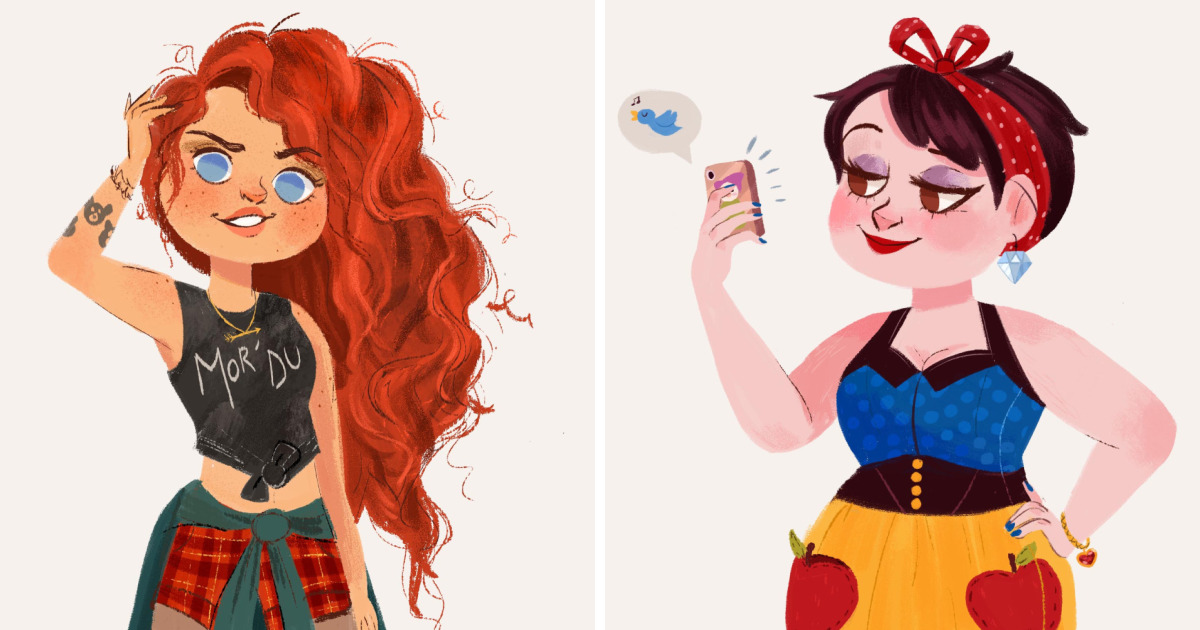
Modern Snow White was easy to imagine once I stopped thinking about the apple and started thinking about her energy. She is optimistic, nurturing, friendly, and unusually good at making people feel safe. In the 21st century, she would be the girl who remembers everyone’s birthday, knows the best little café in the neighborhood, and somehow turns every awkward gathering into a functioning community.
Visually, I pictured her in soft, cheerful colors with a vintage-meets-modern wardrobe: a cropped cardigan, a playful headband, clean white sneakers, and a tote bag filled with snacks, flowers, and possibly a paperback she insists you borrow. She would look wholesome, but not fragile. Her strength would come from emotional intelligence. She would absolutely run a community garden account on social media and post captions that are either deeply sincere or accidentally poetic.
Cinderella: Elegant, Overworked, and Weirdly Unstoppable
Cinderella in the 21st century is not waiting for a ball. She is surviving burnout, quietly rebuilding her life, and still managing to look composed while everyone else is unraveling over a calendar invite. Her story has always been about endurance, hope, and transformation under pressure, so a modern redesign naturally leans into ambition with grace.
I imagined her as a young professional with polished style, minimalist jewelry, and a talent for making affordable fashion look expensive. She is the queen of clean lines, neutral tones, and one pair of shoes that somehow goes with everything. But beneath that polished exterior is grit. Modern Cinderella is the girl who leaves a toxic situation, starts over, and still has the emotional range to help someone else fix their résumé.
Belle: Bookish, Brilliant, and Completely Unbothered by the Crowd
Belle might be the easiest princess to translate into modern life because she already feels timeless. She is intelligent, imaginative, observant, and comfortable being different. Today, she would be the kind of girl who splits her time between a local bookstore, a graduate seminar, and a notes app filled with ideas for essays, novels, and possible life reinventions.
For the illustration, I leaned into academic-chic details: oversized sweater, structured coat, leather satchel, ankle boots, messy-but-intentional hair, and a stack of books she absolutely does not need to carry all at once. She would have a quiet confidence, the type that says, “I know this café is overpriced, but the lighting is good and I am staying.” Belle as a modern girl is not trying to be the trend. She is the person trends eventually chase.
Ariel: Curious, Restless, and Born to Explore
Ariel belongs in the 21st century because the internet was practically invented for her personality. She would want to know everything, try everything, research everything, and probably order things online at 1:13 a.m. because she found a niche hobby and now it is apparently her entire identity.
But beyond the joke, Ariel is driven by curiosity. She wants to understand worlds beyond her own. That gives her a modern identity somewhere between creative explorer and future marine advocate. I pictured her in breezy layers, bold earrings, sea-glass colors, and a playful, energetic silhouette. Her room would be full of maps, found objects, headphones, and half-finished plans. She is the girl who sends voice notes that begin with, “Okay, hear me out,” and somehow they always end in an adventure.
Jasmine and Mulan: Two Very Different Kinds of Power
Jasmine in a modern redesign is not just stylish. She is politically aware, outspoken, and impossible to control. She would be the woman who questions systems instead of decorating them. Her fashion would be sharp, elegant, and bold, with strong silhouettes and a clear sense of self. She is not dressed for approval. She is dressed like someone who already knows who she is.
Mulan, meanwhile, translates beautifully into a modern story of courage, discipline, and reinvention. She would be the friend who underestimates her own impact until everyone else points out that she just carried the entire group project, solved the crisis, and still apologized for “not doing much.” Visually, I imagined practical pieces, clean lines, athletic energy, and a focus on motion rather than ornament. Mulan should always look like she is ready to act.
Tiana, Rapunzel, Merida, and Moana: The Dreamers Who Actually Do the Work
Tiana is a dreamer, but she is not dreamy. That distinction matters. In the modern world, she would be a founder, chef, creative entrepreneur, or business owner who is building something real with relentless discipline. Her look would balance polish and practicality: tailored pants, rolled sleeves, beautiful shoes she can still move in, and the kind of confidence that comes from competence.
Rapunzel is creativity in human form. In the 21st century, she would be an illustrator, designer, animator, or content creator with a color-coded studio and seventeen active hobbies. Her style would be bright, artsy, layered, and joyfully chaotic in the best possible way.
Merida would absolutely reject anything too polished. She is outdoorsy, independent, stubborn, and wonderfully allergic to nonsense. I pictured her in boots, textured jackets, a messy ponytail, and the expression of someone who has already decided she is not following your ridiculous plan.
Moana belongs to a generation thinking deeply about place, purpose, and responsibility. A modern Moana redesign feels rooted, athletic, and quietly powerful. She would be the girl who knows where she comes from, cares about the future, and moves through the world with purpose. Her wardrobe would be natural, functional, and expressive without losing warmth.
Fashion, Tech, and Tiny Details That Make the Art Feel Real
The biggest mistake in modern princess redesigns is making them all look like the same influencer in different color palettes. Real character design lives in the details. Accessories matter. Posture matters. Color theory matters. Even the way a character holds a phone can tell a story.
For a believable 21st-century princess illustration, I thought about questions like these: What app would she use the most? What shoes would she reach for when she is in a hurry? Does her room look curated, chaotic, minimal, or sentimental? Is her beauty routine five steps or fifty? Does she thrift, invest, borrow, repair, or impulse-buy? All of that shapes the final look.
That is why a modern Belle cannot feel identical to a modern Ariel, and why Tiana should never be styled with the same visual priorities as Rapunzel. The redesign only works when personality leads and aesthetics follow. Otherwise, you are not reimagining a character. You are just changing her outfit and hoping nobody notices.
Why People Love Modern Disney Princess Art
There is a reason this concept keeps circulating online. People love seeing familiar characters placed in unfamiliar worlds because it reveals what was essential about them all along. Strip away the tiara, the castle, the fairy dust, and the orchestra swelling in the background, and what remains? Ideally, someone recognizable.
That is also why modern Disney Princess illustrations feel personal. Viewers do not just see a princess. They see a version of themselves, their friends, or the girls they wish they had seen more often growing up. A modern princess can be ambitious without being cold, soft without being weak, stylish without being shallow, and idealistic without being naive. That combination is powerful.
And yes, let us be honest, it is also just very fun. There is something wildly satisfying about asking important artistic questions like: Would Cinderella own a capsule wardrobe? Would Ariel break her phone by dropping it into a fountain while trying to photograph a fish? Would Belle judge your bookshelf organization? Would Rapunzel become famous on social media by accident? These are the great cultural debates of our time.
What I Learned From Illustrating Them
The deeper I went into this concept, the more I realized that modernizing Disney Princesses is not about making them cool. They were already cool. It is about translation. It is about figuring out how timeless qualities appear in a world that looks very different from the one these stories first inhabited.
I also learned that the strongest redesigns do not chase trends too hard. They respect the emotional DNA of the character. Snow White still needs warmth. Belle still needs intellect. Tiana still needs purpose. Moana still needs direction. If you preserve that core, the 21st-century styling becomes believable almost instantly.
Most of all, I learned that audiences connect to reinterpretations when they feel both nostalgic and new. That is the sweet spot. You want viewers to smile because they recognize the princess, then keep looking because they recognize the person.
My Experience Bringing Disney Princesses Into the 21st Century
When I started this project, I assumed the biggest challenge would be fashion. I thought I would spend most of my time choosing jackets, hairstyles, shoes, and accessories. I pictured myself solving surface-level design problems: What would look cute? What would feel current? What would make the art pop on a screen? Instead, the process turned out to be surprisingly emotional.
Every time I sat down to redesign a princess, I found myself thinking less about what she would wear and more about who she would become if she grew up in the same world we live in now. That changed everything. Suddenly, the illustrations were not just about style. They became tiny character studies about girlhood, identity, pressure, ambition, softness, and self-expression in a very modern age.
Some princesses came together instantly. Belle basically walked into the sketchbook on her own, carrying books and quiet confidence like she had been waiting for this assignment her entire life. Tiana was another clear vision. Her posture, work ethic, and polished practicality translated so naturally into a modern setting that the design almost built itself. She was never going to be the princess lounging around for aesthetic purposes. She was going to be moving, building, planning, and staying ten steps ahead.
Others surprised me. Cinderella, for example, became much stronger in a contemporary setting than I expected. Once I removed the fantasy elements and focused on resilience, she started to feel incredibly modern. She became the girl who has survived difficult environments without losing her grace. That version of Cinderella felt less delicate and far more powerful. It made me appreciate her in a completely different way.
Ariel was the most fun because modern life is basically a giant curiosity trap, and she would thrive in it. I could picture her collecting random objects, watching educational videos at midnight, starting hobbies with reckless enthusiasm, and making spontaneous plans that somehow turned into unforgettable memories. Designing her reminded me that wonder still has a place in modern life, even in an era that can feel overly curated and cynical.
The most rewarding part of the experience was realizing that these princesses do not need to be “fixed” for the 21st century. They need to be understood. Once I paid attention to their original personalities instead of their most famous visual symbols, the redesigns started to feel honest. The best modern versions were not the flashiest. They were the ones that preserved the emotional truth of the character.
I also noticed how much viewers bring their own experiences into these images. Someone sees Belle and thinks of their love for books. Someone sees Tiana and thinks about hustle, family, and goals. Someone sees Merida and remembers what it feels like to reject expectations. That made the project feel bigger than nostalgia. It became a conversation between classic stories and modern identity.
By the end, I did not feel like I had simply illustrated Disney Princesses as modern day girls. I felt like I had translated them into a visual language people live every day. And that, to me, is what made the series meaningful. It was not just about asking how a princess would dress now. It was about asking how she would move through this century, what she would care about, how she would carry herself, and why we still see pieces of ourselves in her.
Conclusion
Illustrating Disney Princesses as modern day girls living in the 21st century is part fashion exercise, part character analysis, and part love letter to the staying power of these stories. The princesses endure not because they are frozen in time, but because they can evolve with it. Put them in a city apartment, a college campus, an art studio, a startup office, a neighborhood café, or on a solo trip with a playlist and a carry-on bag, and they still make sense. Maybe that is the real magic. Not the wand. Not the castle. Just the simple truth that great characters can survive any era, including one with low battery anxiety and suspiciously expensive oat milk.