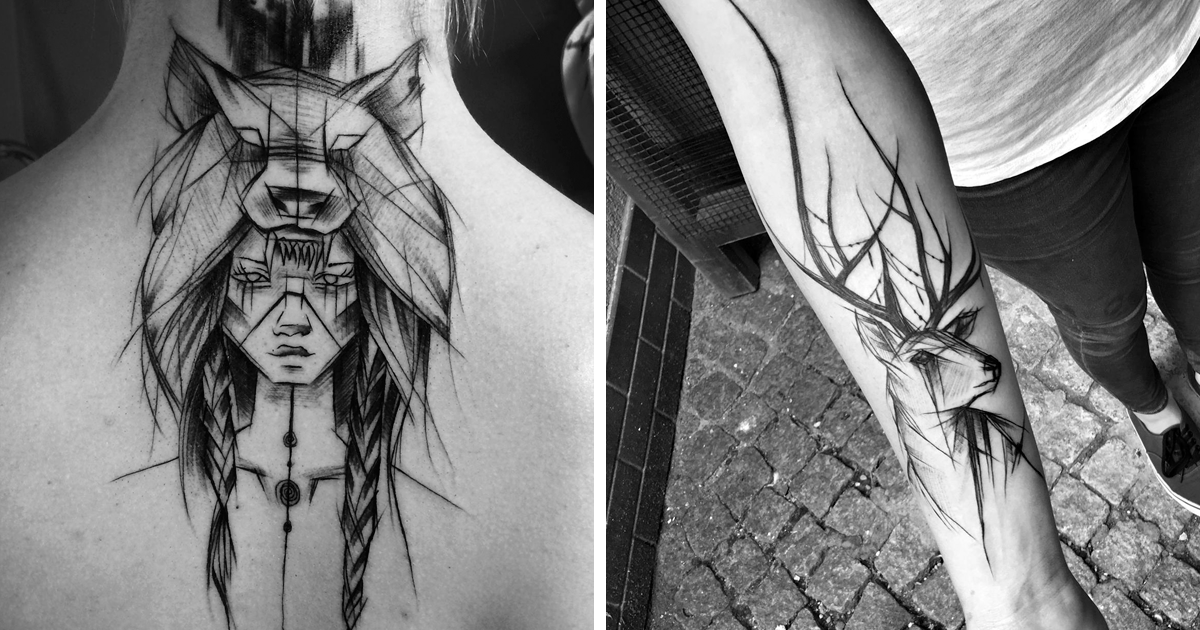
Some tattoos enter the room wearing a tuxedo: polished outlines, perfectly packed color, every detail sitting politely in its assigned chair. Then there are sketch tattoosthe art-school rebels of the tattoo world. They arrive with raw pencil energy, dramatic black lines, unfinished edges, and just enough visual chaos to make perfection look a little overdressed.
Polish tattoo artist Inez Janiak has become one of the most recognizable names associated with this expressive style. Her sketch tattoos look less like traditional body art and more like pages from an artist’s notebook that somehow wandered onto skin and decided to stay forever. Using mostly black ink, broken contours, shading, and dynamic lines, she transforms animals, nature-inspired forms, mythic figures, and abstract compositions into tattoos that feel alive, moody, and wonderfully imperfect.
The viral fascination around “Polish Tattoo Artist Shows The Beauty Of Imperfection With Her Sketch Tattoos (101 Pics)” is easy to understand. These designs do not beg to be flawless. They breathe. They wobble. They leave room for motion, memory, and interpretation. In a world obsessed with filters, symmetry, and airbrushed everything, Janiak’s work reminds us that imperfection can be the most honest kind of beauty.
Who Is Inez Janiak?
Inez Janiak is a Polish tattoo artist widely known for her sketch-style tattoos, blackwork compositions, and designs that often resemble pencil or charcoal drawings. Her work has been shared across tattoo communities, art blogs, and visual culture websites because it sits in that deliciously unusual space between fine art illustration and permanent body art.
What makes her style memorable is not just the subject matter, but the way she lets the tattoo look like it is still in motion. Many artists try to hide the draft stage. Janiak celebrates it. A fox may appear with overlapping lines around its face, as though it has just leaped out of a sketchbook. A bird may be built from energetic strokes that suggest wings before fully describing them. A portrait may feel mysterious because some details are sharp while others fade into rough shading.
That “unfinished” effect is not laziness. It is control wearing a leather jacket. Sketch tattooing requires confidence because every loose line must still support the composition. A random scratch is just a random scratch. A purposeful sketch line, however, can suggest speed, tension, emotion, or depth.
What Are Sketch Tattoos?
Sketch tattoos are tattoos designed to look like hand-drawn sketches. Instead of relying only on clean, closed outlines, they often use layered strokes, hatching, cross-hatching, loose construction marks, smudged-looking shading, and unfinished edges. The result can resemble pencil drawing, charcoal illustration, pen-and-ink studies, or early concept art.
In traditional tattooing, the goal is often clarity: bold lines, readable shapes, and strong contrast. Sketch tattoos still need readability, but they approach it with more visual freedom. They can look spontaneous, even when they are carefully planned. This is part of the charm. The viewer feels like they are seeing both the final image and the creative thought process behind it.
Common Elements of Sketch-Style Tattoos
Sketch tattoos often include expressive black lines, unfinished outlines, layered strokes, geometric accents, soft shading, and negative space. Many also include abstract splashes, energetic scribbles, or repeated contour lines that mimic the way artists search for form on paper.
In Janiak’s work, black ink is especially important. It gives her pieces a bold graphic quality while preserving the rawness of drawing. Without bright color competing for attention, the eye follows the linethe scratch, the curve, the shadow, the almost-mistake that turns out to be the best part.
The Beauty of Imperfection
Why do these tattoos feel so compelling? Because they reject the idea that beauty must be polished until it squeaks. A sketch tattoo shows its process. It lets the viewer see the hand behind the art. The lines may overlap. The shading may feel rough. The edges may appear incomplete. Yet those details create personality.
In many ways, sketch tattoos are closer to emotional memory than photographic realism. A realistic wolf tattoo might show every strand of fur. A sketch-style wolf can show the feeling of the wolf: alert, wild, half-shadow, half-instinct. A botanical tattoo can become less about copying a flower and more about capturing how delicate, temporary, and wind-touched a flower feels.
That is where Janiak’s art shines. Her tattoos do not simply decorate the body. They interact with it. The curve of an arm can become part of a wing. A shoulder can give movement to an animal’s posture. A thigh or back can become a dramatic canvas for larger compositions. The body is not just a wall for art; it is part of the drawing.
Why Inez Janiak’s Sketch Tattoos Went Viral
The internet loves tattoos that stop the scroll, and Janiak’s work does exactly that. In a feed full of polished images, her tattoos have the texture of something handmade and immediate. They look personal before you even know the story behind them.
Another reason for the viral appeal is contrast. Sketch tattoos can feel delicate and intense at the same time. A single animal design might combine soft shading with sharp black lines. A portrait can look fragile but dramatic. A nature motif can feel elegant while still carrying a little thunderstorm in its pocket.
The “101 pics” format also helps because sketch tattoos are best understood through variety. One design may show how loose lines create motion. Another may show how negative space can make a tattoo feel lighter. Another may prove that an “imperfect” outline can be far more expressive than a perfect one. By seeing many examples together, readers start to understand the visual language of the style.
Popular Themes in Her Work
Animals With Attitude
Animals are among the strongest subjects for sketch tattoos because they already carry movement, symbolism, and personality. Foxes, wolves, birds, deer, horses, insects, and sea creatures can all benefit from the raw energy of sketch lines. A fox can look clever and restless. A raven can feel mysterious. A deer can appear gentle but alert, like it heard your thoughts and politely chose not to comment.
Janiak’s animal tattoos often feel like studies in motion. The lines do not simply outline the creature; they suggest fur, bone, speed, direction, and mood. The result is less “here is an animal” and more “here is a moment when the animal almost became a myth.”
Nature-Inspired Designs
Nature motifs fit beautifully into sketch tattooing. Leaves, branches, flowers, feathers, insects, and wild landscapes can all be rendered with loose strokes and selective detail. Instead of overexplaining every petal or vein, the artist can guide the eye with gesture and shadow.
This style works especially well for people who want a tattoo that feels organic rather than overly decorative. A sketch flower does not need to behave like a greeting card. It can look windswept, symbolic, or slightly hauntedin the best possible way.
Portraits, Mythology, and Dark Illustration
Some of the most striking sketch tattoos use human figures, mythic characters, or surreal faces. Here, the unfinished quality can create mystery. A fully polished portrait tells you exactly what to see. A sketch-style portrait leaves room for atmosphere, which is a fancy way of saying it lets your imagination do some cardio.
Dark illustration also plays well with this style. Skulls, masks, hands, moths, and symbolic objects can feel more powerful when they are not overly tidy. A little roughness can make the design feel ancient, personal, or dreamlike.
Why Black Ink Works So Well
Black ink is the backbone of many sketch tattoos. It allows the artist to build strong contrast without relying on color. It also preserves the drawing-like quality of the design. Shading can mimic charcoal. Fine strokes can mimic pencil. Thick lines can anchor the piece so it does not disappear into visual fuzz.
Blackwork also tends to suit the emotional tone of sketch tattoos. The style can be dramatic, poetic, and slightly rebellious. Bright color can be beautiful, of course, but black ink gives sketch tattoos that raw studio-table energythe feeling of a drawing made at midnight with coffee nearby and exactly one responsible life decision in the room.
How Sketch Tattoos Age and Heal
Anyone considering a sketch tattoo should remember that tattoos are living art. Skin changes, ink settles, and fine details may soften over time. That does not mean sketch tattoos are a bad idea. It means the design should be created with longevity in mind.
Strong composition matters. If a tattoo relies only on tiny, delicate scratches, it may lose clarity as the years pass. A good sketch tattoo balances expressive looseness with enough structure to remain readable. This is why choosing an experienced artist is so important. The style may look spontaneous, but it should not be improvised by someone who treats skin like a napkin at a diner.
Placement matters too. Areas that stretch, rub, or receive heavy sun exposure can affect how a tattoo looks over time. Larger designs often allow more room for detail and aging. Smaller sketch tattoos can work beautifully, but they need smart simplification.
Safety Still MattersEven When the Art Looks Effortless
Sketch tattoos may look like freehand magic, but tattoo safety should never be casual. A tattoo breaks the skin, so professional hygiene, clean equipment, reputable ink, and proper aftercare are essential. The dream is “beautifully imperfect art,” not “mysterious rash with emotional backstory.”
Before getting any tattoo, choose a licensed professional studio, review healed work, ask about sterilization practices, and follow aftercare instructions carefully. New tattoos usually need gentle cleaning, moisturizing as recommended by the artist, protection from sun exposure, and patience during healing. Picking at flakes or scabs is a terrible hobby. Try puzzles instead.
People should also be aware of possible skin reactions, allergies, and infections. If swelling, worsening redness, unusual discharge, severe pain, fever, or intense allergic symptoms occur, it is time to seek medical advice rather than consult the “my cousin said coconut oil fixes everything” committee.
Design Ideas Inspired by Inez Janiak’s Sketch Tattoo Style
If you love the look of Janiak’s work, the goal should not be to copy one of her tattoos exactly. Tattoo ethics matter, and original art deserves respect. Instead, use the style as inspiration for your own concept.
Animal Concepts
A fox with layered construction lines can symbolize intelligence, adaptability, or mischief. A raven can suggest mystery, memory, or transformation. A wolf may represent instinct, loyalty, or independence. A moth can carry themes of attraction, change, and nighttime dramabasically the insect version of a gothic novel.
Botanical Concepts
Sketch-style flowers, branches, mushrooms, or wild herbs can feel softer and more personal than traditional floral tattoos. A flower does not need to look like a catalog illustration. It can look like something pressed inside an old notebook, slightly imperfect and full of meaning.
Personal Symbols
Objects also work well: a compass, book, candle, mask, key, violin, camera, or moon phase can become more interesting through sketch lines and unfinished shading. These designs can feel intimate without becoming too literal.
What Makes a Great Sketch Tattoo Artist?
A great sketch tattoo artist understands drawing first. That is the secret. The style depends on line quality, proportion, rhythm, contrast, and restraint. It is not enough to make the design look messy. It has to look intentionally alive.
When reviewing an artist’s portfolio, look for healed tattoos, not just fresh ones. Fresh tattoos often look sharp because the ink is new and the skin has not settled. Healed photos reveal whether the design holds together. Pay attention to whether the artist can create expressive looseness without losing anatomy, balance, or clarity.
Communication also matters. A strong tattoo artist will help translate your idea into a design that works on the body. They may suggest changing size, placement, or detail level. This is not them ruining your vision. This is them preventing your tiny majestic dragon from aging into a confused lizard-shaped noodle.
Why Imperfect Tattoos Feel So Human
There is something deeply human about sketch tattoos. They do not pretend life is cleanly outlined. They understand that identity is layered, messy, revised, erased, redrawn, and occasionally held together by caffeine and stubbornness. That is probably why the style resonates with so many people.
Perfect lines can be impressive, but imperfect lines can feel intimate. They show movement. They show searching. They show the beauty of becoming rather than simply being finished. Janiak’s work captures that feeling with unusual grace.
Her tattoos remind us that art does not always need to arrive polished and symmetrical. Sometimes the most powerful image is the one that still looks like it is thinking.
Experiences and Reflections: Living With the Sketch Tattoo Aesthetic
One of the most interesting things about sketch tattoos is how differently people react to them in real life compared with online. On a screen, viewers often zoom in and analyze every line. They ask whether the tattoo is finished, whether the loose marks are intentional, or whether the artist “forgot” to clean up the design. In person, however, the effect is usually more immediate. The tattoo moves with the body, and suddenly those broken lines make sense.
Imagine seeing a sketch-style bird on someone’s forearm. When the arm is still, the tattoo may look like a dramatic drawing. When the person gestures, the lines seem to flutter. The unfinished edges stop feeling incomplete and start feeling kinetic. That is the special power of this style: it does not just sit on skin; it performs with it.
For people choosing their first sketch tattoo, the experience can feel both exciting and slightly terrifying. Traditional tattoo designs often offer a clear preview: here is the outline, here is the color, here is the final shape. Sketch tattoos require a little more trust because the beauty often lives in the irregularities. The extra line near the jaw, the loose shading behind a wing, the scratchy marks around a flowerthese details may seem strange on paper but become essential once placed on the body.
That trust is why consultation matters. A thoughtful client brings meaning, references, and openness. A skilled artist brings composition, technical judgment, and the ability to say, “This idea will work better if we make it larger,” without crushing the client’s soul like a stale cracker. The best results usually happen when both sides respect the art and the anatomy.
There is also a personal confidence that comes with wearing an imperfect-looking tattoo. It quietly says, “I do not need everything about me to be polished to be beautiful.” That message feels especially relevant now, when so much visual culture is edited until it barely has a pulse. A sketch tattoo keeps the pulse visible.
People who love this style often describe it as artistic, emotional, raw, or alive. It appeals to those who like illustration, dark art, nature symbolism, and designs that feel custom rather than mass-produced. It is not the right fit for everyone, and that is fine. Tattoo styles are like shoes: some people want polished leather, some want hiking boots, and some want paint-splattered sneakers with a story.
The biggest lesson from Inez Janiak’s sketch tattoo work is not simply that imperfect lines can look cool. It is that imperfection can carry meaning. A broken line can suggest motion. A rough shadow can create mood. A half-finished edge can invite imagination. In the hands of the right artist, what looks unfinished becomes unforgettable.
Conclusion
Inez Janiak’s sketch tattoos prove that body art does not need to be perfectly polished to be powerful. Her work celebrates black ink, expressive movement, nature-inspired imagery, and the emotional honesty of unfinished lines. Whether the subject is an animal, a flower, a portrait, or a symbolic object, the sketch tattoo style turns imperfection into personality.
For anyone drawn to this aesthetic, the best approach is to seek originality, choose an experienced artist, think carefully about placement and scale, and treat aftercare seriously. A sketch tattoo may look wild and spontaneous, but the best ones are built on skill, intention, and respect for the body as a living canvas.
Editorial note: This article is an original SEO-focused editorial synthesis created for web publication. It does not reproduce the 101 tattoo images and is written to describe the style, artist, cultural appeal, and practical considerations in fresh language.