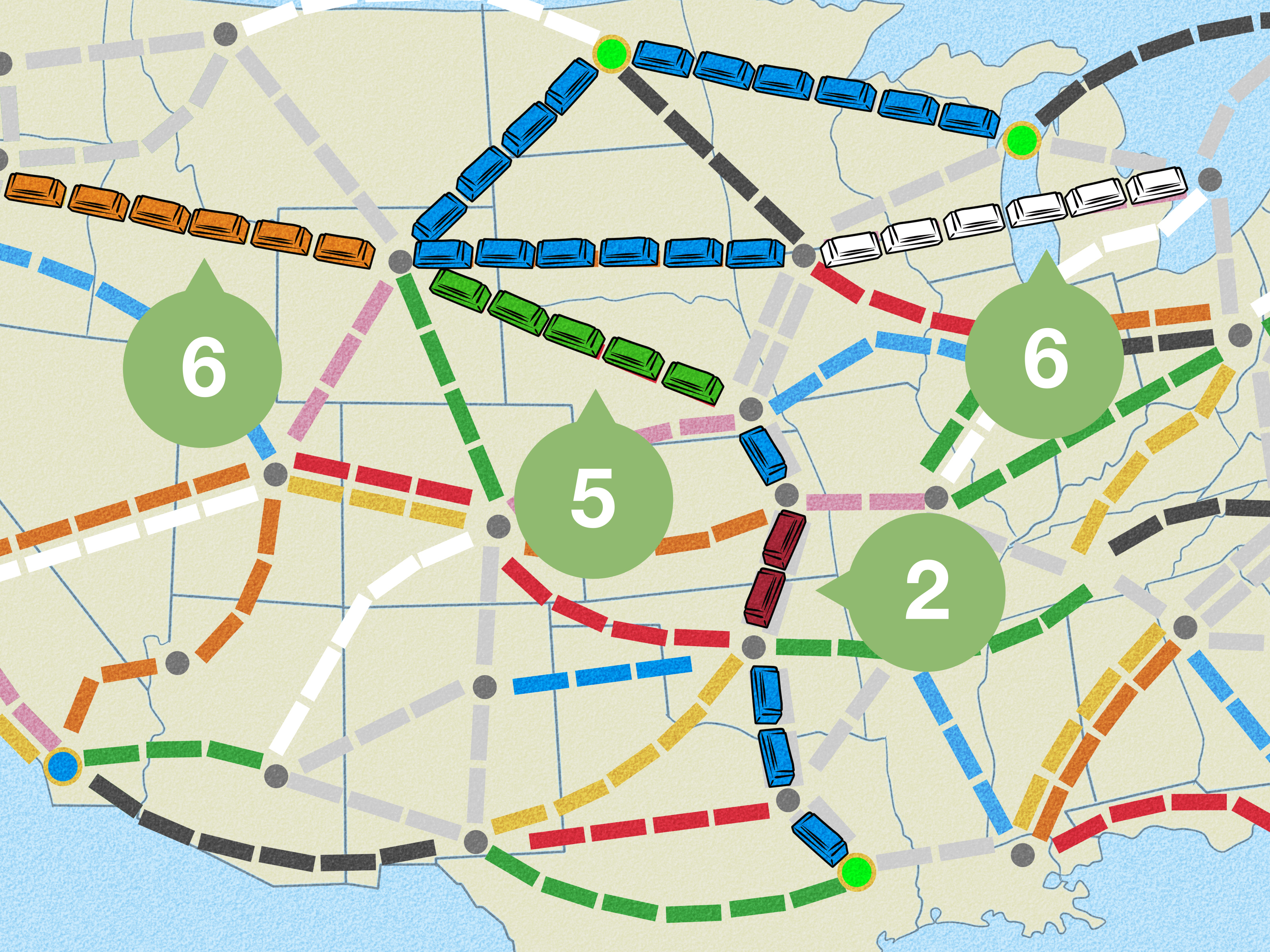
If you have ever looked at a Ticket to Ride board and thought, “Wow, that is either a delightful train adventure or a colorful spaghetti incident,” good news: it is the first one. This modern board game classic is famous for being easy to learn, quick to teach, and just strategic enough to make everyone at the table suddenly care deeply about a rail line in the middle of nowhere.
In the classic North America edition, players collect train cards, claim routes between cities, complete destination tickets, and race for the most points. The rules are simple enough for beginners, but the decisions can get sneaky fast. Do you grab cards and keep your plans hidden? Do you claim that key route now before your cousin Kevin blocks it out of pure chaos? Do you risk drawing more tickets late in the game like a rail baron with no fear and questionable judgment?
This guide breaks down exactly how to play Ticket to Ride, including setup, scoring, turn actions, and the best ways to win more often. If you are learning for the first time or teaching it at your next game night, this is the clear, no-nonsense, low-drama version of the rules. Well, as low-drama as a train game can be.
What Is Ticket to Ride?
Ticket to Ride is a route-building board game for 2 to 5 players. In the base game, you play on a map of North America and score points by claiming railway routes, completing destination tickets, and earning the bonus for the longest continuous path.
The core loop is wonderfully simple: collect matching train cards, spend them to claim a route, and slowly stitch together a rail network that completes your secret tickets. It is one of the reasons the game has become such a popular gateway board game. You can teach the basics in a few minutes, but winning consistently takes timing, planning, and a healthy respect for choke points.
Ticket to Ride Setup
If you are playing the classic base game, here is how to set everything up:
1. Put the board in the middle of the table
Make sure everyone can see the North America map clearly. This is important because a shocking amount of strategy in Ticket to Ride begins with staring at cities and pretending you totally know what you are doing.
2. Give each player a color
Each player takes:
- 45 plastic train cars in one color
- 1 matching scoring marker
Everyone places their scoring marker on the start space of the score track.
3. Shuffle and deal the train cards
Shuffle the train car deck and deal 4 cards to each player. Then place the rest of the deck nearby and reveal 5 train cards face up next to it.
4. Place the longest route bonus card nearby
You will not use it until final scoring, but set it next to the board now so nobody forgets it later when emotions are running high and someone is convinced they built the Great American Masterpiece.
5. Shuffle and deal destination tickets
Deal 3 destination ticket cards to each player. Each player secretly looks at them and must keep at least 2. You may keep all 3 if you want. Any tickets you do not keep go to the bottom of the destination ticket deck.
6. Choose a first player
The official rulebook says the most experienced traveler goes first. If that somehow starts an argument, just pick someone and let the trains begin.
Object of the Game
Your goal is to finish with the most points. You score by:
- Claiming routes on the board
- Completing destination tickets
- Getting the longest continuous path for a 10-point bonus
You also lose points for any destination tickets you fail to complete by the end of the game. So yes, optimism is encouraged, but reckless optimism can absolutely ruin your score.
How to Play Ticket to Ride
On your turn, you must do one of the following three actions:
- Draw train car cards
- Claim a route
- Draw destination tickets
That is it. The elegance of the game is that each turn is simple, but choosing the right action at the right time is where the real strategy lives.
Action 1: Draw Train Car Cards
You may draw 2 train cards on your turn. You can take them from the 5 face-up cards, from the top of the deck blindly, or a mix of both.
There is one major exception: if you take a face-up locomotive card, that counts as your full draw, so you only take 1 card total that turn. Locomotives are wild cards and can be used as any color when claiming routes, so they are extremely useful.
However, if you draw a locomotive blindly from the top of the deck, it does not end your turn. Lucky you. The game has briefly decided to be generous.
Also remember this rule: if 3 of the 5 face-up cards are locomotives, discard all 5 face-up cards and replace them with 5 new ones. This keeps the card row from turning into a wild-card buffet.
Action 2: Claim a Route
To claim a route, play a set of train cards that matches both the color and length of that route.
For example:
- A blue route of length 3 requires 3 blue cards
- A gray route of length 4 can be claimed with any one color, as long as all 4 cards match each other
- Locomotives can substitute for missing cards in a set
Once you claim a route, place your plastic trains on every space of that route and immediately score points based on its length.
You do not have to connect a new route to your existing network when you claim it. That surprises a lot of first-time players. You can claim any open route on the board, even if it is floating somewhere else entirely.
You may claim only one route per turn.
Double Routes Rule
Some cities are connected by two parallel routes. These are called double routes.
- The same player may never claim both routes in a double route pair
- In a 2-player or 3-player game, only one of the double routes may be used
That second rule matters a lot. It makes blocking much more powerful in smaller games.
Action 3: Draw Destination Tickets
If you want more ticket goals, draw 3 destination tickets from the top of the deck. You must keep at least 1, but you may keep 2 or all 3.
Each ticket shows two cities and a point value. If you connect those cities with a continuous path of your trains by the end of the game, you gain those points. If you fail, you lose them.
This is where Ticket to Ride gets deliciously tense. Drawing more destination tickets can be brilliant if your network is flexible. It can also be the exact moment you begin making choices you will regret for the next 25 minutes.
Ticket to Ride Scoring
When you claim a route, you score points immediately based on route length:
- 1 space = 1 point
- 2 spaces = 2 points
- 3 spaces = 4 points
- 4 spaces = 7 points
- 5 spaces = 10 points
- 6 spaces = 15 points
Longer routes are much more efficient, which is one reason experienced players value them so highly.
At the end of the game, you also:
- Add points for completed destination tickets
- Subtract points for incomplete destination tickets
- Add 10 points if you have the longest continuous path
When Does Ticket to Ride End?
The end game begins when one player has 2 or fewer trains left at the end of their turn. After that, every player, including the one who triggered the end, gets one final turn.
Then everyone reveals destination tickets, scores bonuses and penalties, and the player with the highest total wins.
Tie-breakers
If players are tied on points:
- The tied player who completed the most destination tickets wins
- If still tied, the tied player with the longest continuous path wins
How to Win at Ticket to Ride
Knowing the rules is step one. Winning is step two. Step three is acting casual about it.
1. Build your backbone early
At the start of the game, look for shared segments between your opening destination tickets. If two tickets can be completed using the same central routes, that is your backbone. Build around that first.
Strong opening players do not chase everything at once. They identify the skeleton of their network and secure the most important pieces before the board gets crowded.
2. Claim critical choke points before they disappear
Some routes are more important than others because they connect major parts of the map or offer rare access. If you wait too long on a critical link, another player can force you into a clumsy detour that costs extra cards, extra turns, and maybe your remaining self-respect.
If a route is essential to your plan, do not be too clever about waiting for the perfect hand. Sometimes good enough now is better than perfect too late.
3. Use gray routes for flexibility
Gray routes are strategic gold because they can be claimed with any one color. They let you adapt to the cards you actually draw rather than the cards you hoped the universe would deliver.
If your hand is messy, gray routes can smooth everything out. In many games, they are the difference between a clean network and a panicked patchwork quilt.
4. Draw blind sometimes to hide your plan
If you always grab face-up cards in one color, you are basically putting up a giant billboard that says, “Hello everyone, I desperately need orange.” Strong players mix in blind draws to avoid telegraphing their plan too clearly.
This also matters when face-up cards would reveal which route you are preparing to claim. Information is part of the game, and giving away less of it is often smart.
5. Know when to stop collecting and start building
Beginners often spend too long drawing cards because building feels like commitment. But Ticket to Ride rewards timely action. If a route matters, claim it before someone else does. A hand full of beautiful cards is not worth much if your key line is gone.
6. Do not overload yourself with bad tickets
Drawing extra destination tickets can win games, but only if your network is already broad enough to support them. The best time to draw more tickets is when you have a flexible web of routes and enough trains left to finish what you take.
If your board position is narrow and fragile, taking more tickets is less “bold strategy” and more “railroad-themed gambling.”
7. Pay attention to other players
You do not need to memorize every card drawn, but you should watch which colors players collect and where they place routes. If someone is clearly building across the center or aiming west to east, you can often predict which routes matter to them.
Even if you never deliberately block, reading the table helps you protect yourself from getting boxed out.
8. Control the pace of the end game
When you are ahead and your tickets are complete, consider pushing the game toward the finish by burning through your remaining trains efficiently. If you are behind, you usually want more turns, not fewer. End-game pacing is a real weapon in Ticket to Ride, and strong players use it.
Common Beginner Mistakes
- Keeping too many difficult starting tickets: More tickets are not always better.
- Ignoring route efficiency: Long routes score much better than short ones.
- Waiting too long on a must-have connection: Hesitation can be expensive.
- Forgetting the double-route rule in smaller games: In 2 or 3 players, only one side is available.
- Drawing extra tickets too early: A flexible network first, ambition second.
- Playing your own board only: Watching opponents is part of the strategy.
Why Ticket to Ride Is Still So Popular
Part of the magic of Ticket to Ride is that it feels inviting right away. The rules are clean, the turns are simple, and every action feels productive. But beneath that friendly surface, there is a very satisfying layer of timing, probability, and route planning.
That combination is why the game works for families, casual groups, and more competitive players alike. New players can focus on matching colors and building tracks. Experienced players start thinking about hidden information, card timing, route denial, and end-game tempo. Same train game, very different brain activity.
Experiences From the Table: What Playing Ticket to Ride Actually Feels Like
After a few games, most players realize that Ticket to Ride is not really about trains. It is about hope, timing, and the emotional damage of seeing someone claim the exact route you needed one turn before you. That is part of its charm.
One of the best things about the game is how often it creates stories. A first-time player may quietly collect cards for several rounds, look totally harmless, and then suddenly drop a massive route that makes the rest of the table sit up straight. Another player may start with a neat, elegant plan, only to spend the middle of the game building a bizarre emergency detour through half the continent because one tiny connection vanished.
That is also why the game teaches useful instincts without feeling like homework. You learn to think ahead. You learn to value flexibility. You learn that a route in the middle of the map can be worth more than a prettier one off to the side. And, perhaps most importantly, you learn that drawing “just one more turn” is sometimes how chaos enters your home.
In casual family games, the fun often comes from the reveal at the end. Everyone flips their destination tickets over, and suddenly all the weird choices make sense. The player who kept building in the north was not confused after all. The person who aggressively grabbed a random central route was not being annoying for sport. Well, maybe they were. But they also had a plan.
In more competitive groups, the experience changes. People start watching face-up cards closely. They notice which colors disappear fast. They recognize when an opponent is clearly building a long east-west line. The game becomes quieter, sharper, and somehow even funnier, because nobody wants to admit how deeply they now care about a four-space gray route.
There is also a wonderful rhythm to the game. Early turns feel open and optimistic. Midgame gets crowded and tense. Endgame becomes a scramble of math, hope, and tiny plastic trains. You may feel fully in control one minute and mildly betrayed by geography the next. That emotional curve is a big reason Ticket to Ride stays fresh even after many plays.
Personally, the most memorable games are rarely the ones where everything goes perfectly. They are the ones where a plan falls apart, a backup route somehow works, and the final score is absurdly close. Those are the games where players laugh, point at the board, and say things like, “I cannot believe Omaha ruined my entire evening.” If a board game can make rail mapping feel dramatic, it has done something right.
So if you are learning Ticket to Ride for the first time, do not worry about playing perfectly. Learn the rhythm. Watch the board. Protect the routes you cannot live without. And remember: every experienced player at some point has stared at their tickets, stared at the map, and whispered, “Well, this seems bad.” That is not failure. That is tradition.
Final Thoughts
If you want a board game that is easy to teach, satisfying to master, and excellent for game night, Ticket to Ride absolutely deserves its reputation. The rules are refreshingly clean: draw cards, claim routes, complete tickets, score points. But the decision-making stays interesting every time you play.
Once you understand the setup, the three turn actions, the scoring system, and a few winning habits, the game clicks fast. From there, it becomes a race to balance efficiency, flexibility, and nerve. Build smart, watch the board, and do not let anyone steal your must-have route while you are off collecting pretty cards.