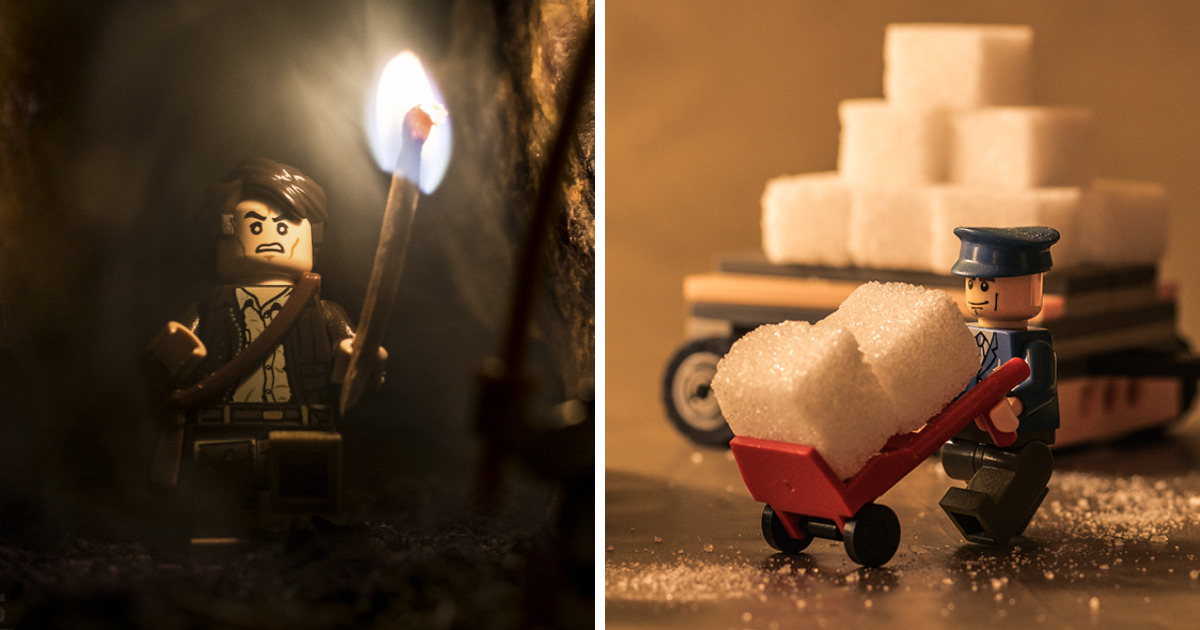
What happens when a quiet collection of LEGO minifigures stops behaving like shelf decor and begins invading kitchens, forests, city streets, and possibly the family snack drawer? That question inspired LEGO Attack, my new themed LEGO photo seriesa miniature universe where plastic characters create very large problems.
The project combines LEGO photography, practical effects, handmade dioramas, macro photography, and visual storytelling. Each image belongs to a different genre, but the central idea remains the same: make a tiny scene feel like one frame from a much bigger adventure.
How the LEGO Attack Photo Series Began
The idea arrived while I was rearranging a few minifigures on my desk. One figure tipped forward, knocked over a tiny vehicle, and started a chain reaction that ended with three characters on the floor. It looked less like an accident and more like an extremely low-budget disaster movie.
Instead of rebuilding the display, I photographed it.
That first image suggested a broader concept. Every photograph could portray an “attack,” but the word did not have to mean the same thing each time. It could describe an alien invasion, a pirate raid, a dragon encounter, an army of hungry minifigures attacking breakfast, or nature reclaiming a brick-built city.
This flexible premise gave the series a recognizable identity without trapping every picture inside one visual style. The photographs could be funny, suspenseful, cinematic, or surprisingly emotional. LEGO bricks became actors, props, scenery, and occasionally emergency supports when a character refused to remain upright.
Why LEGO Photography Is Such a Powerful Storytelling Tool
LEGO photography occupies an entertaining space between still-life photography and filmmaking. A normal product photograph shows what a figure looks like. A narrative toy photograph suggests what happened five seconds earlier and what might happen next.
That distinction shapes every LEGO Attack scene. Before choosing a lens or turning on a light, I ask three questions:
- Who is the main character?
- What does that character want?
- What has gone hilariously or catastrophically wrong?
A photograph becomes more engaging when viewers can answer at least two of those questions from visual clues. A frightened astronaut staring at a cracked laboratory door already creates suspense. Add a green glow beneath the door and one suspicious tentacle, and the audience begins writing the rest of the story.
Small Expressions, Big Emotions
Minifigures have limited articulation, so posing requires careful attention. A slight backward lean can suggest fear. A lowered head may communicate sadness or exhaustion. Raising one arm can turn an otherwise motionless figure into a leader, protester, explorer, or person desperately trying to flag down a very small taxi.
Eye-lines matter too. When several characters look in different directions, the scene can feel disconnected. When they react to the same threat, their poses guide the viewer toward the center of the action.
The Different Themes in My LEGO Attack Series
1. Science-Fiction Invasion
The science-fiction theme is the loudest chapter in the series. Astronauts defend a research station while unidentified creatures emerge from glowing tunnels. Transparent bricks, colored LEDs, metallic surfaces, and a little atmospheric haze help create the illusion of an enormous futuristic complex.
Blue light establishes the cold environment, while red or orange highlights signal danger. The contrasting colors also separate the figures from the background. One photograph shows a lone technician holding a wrench against a shadowy invader. Is the wrench a weapon? Technically. Is it a good weapon? The technician and I have chosen to remain optimistic.
2. Medieval Fantasy Attack
For the fantasy photographs, castles, knights, forests, and dragons replace laboratories and spacecraft. Small stones become cliffs, twigs become fallen trees, and dry leaves provide texture that would require hundreds of bricks to imitate.
The most effective fantasy scenes are not necessarily the largest. A knight standing beneath an enormous dragon shadow can create more tension than a crowded battlefield. By leaving the attacker partly outside the frame, the photograph encourages viewers to imagine a creature more frightening than anything I could build.
Warm backlighting produces a sunset or firelight effect, while cooler fill light preserves detail on the minifigure. The result resembles a frame from an adventure movieassuming that movie’s entire production budget could fit inside a sandwich container.
3. Noir City Mystery
The noir theme slows the action and replaces explosions with suspicion. A detective walks through a rain-soaked alley while a mysterious figure watches from a second-story window. Black bricks, reflective surfaces, hard side lighting, and carefully controlled shadows create the mood.
A spray bottle can add tiny water droplets to the street, while a piece of clear plastic beneath the set creates reflections. Photographing from minifigure eye level makes the buildings appear taller and the alley more convincing.
In this chapter, the “attack” may be psychological rather than physical. Someone is being followed. Evidence has disappeared. The coffee shop is closed. For a noir detective, that last development may be the darkest twist of all.
4. Wild West Ambush
The Western images use sand, weathered wood, muted colors, and strong directional light. One scene features a stagecoach entering a narrow pass while bandits wait behind rocks. Another turns a kitchen windowsill into a frontier town at sunset.
Low camera placement is crucial. Shooting downward exposes the miniature scale, while a ground-level perspective makes a pebble resemble a boulder and a few inches of sand resemble open desert. Keeping modern household objects outside the frame also protects the illusion. Nothing ruins an Old West showdown faster than a Bluetooth speaker looming behind the sheriff.
5. Everyday Comedy
Not every LEGO attack needs a dragon, alien, or outlaw. Some of my favorite images place minifigures inside ordinary human situations. A construction crew attempts to cut a gigantic sandwich. Explorers climb a mountain of pancakes. A tactical team approaches an overturned coffee mug as though it were a hazardous chemical spill.
The comedy comes from the contrast between familiar objects and miniature characters. Forced perspective makes a cookie look like an ancient artifact, a houseplant resemble a jungle, and a running shoe appear to be an abandoned stadium.
These photographs also make the series approachable. They can be created with a phone, a lamp, and whatever happens to be on the table. Expensive equipment is useful, but imagination remains suspiciously difficult to purchase online.
6. Nature Strikes Back
In the nature theme, plants, water, dirt, and weather become the attackers. Tiny explorers disappear into moss. A city street floods beneath a tipped glass. A gardener confronts a flower that appears to have grown through an entire building overnight.
Natural textures are excellent for miniature photography because they contain unpredictable details. Moss can resemble dense vegetation, while bark becomes a cliff face when photographed closely. The challenge is choosing materials that match the apparent scale. A thick blade of grass beside a minifigure may look less like grass and more like a suspiciously healthy tree trunk.
Building Each Miniature Scene
I begin each photograph with a rough sketch. It does not need to be beautiful; its main job is to decide where the subject, threat, background, and light sources will go. Planning prevents me from building a magnificent wall that later blocks the camera’s only useful angle.
The set is then built around the final composition. Only the areas visible to the camera require detail. A convincing doorway may need just one complete side. A distant building can be a narrow facade held upright by supports outside the frame. This approach saves bricks and keeps the set easy to adjust.
Choosing a Background
A background should support the story without competing with it. Colored paper works well for clean portraits and stylized scenes. A computer or tablet screen can provide distant skies, although brightness, reflections, and visible pixels must be controlled. Fully built LEGO environments offer consistent texture but require more time and pieces.
Whenever possible, I place the background farther from the subject. The added separation creates natural blur, gives the image depth, and keeps distracting details from pulling attention away from the main character.
Creating Depth With Layers
Foreground objects, a clearly focused subject, and a softer background make a tiny scene feel larger. A blurred branch near the camera can frame a forest explorer. Rubble in the foreground can make a battle scene feel as though the viewer is crouching behind cover.
Every object must earn its position. If a prop does not clarify the location, strengthen the mood, or advance the story, it probably belongs back in the storage bin.
Lighting LEGO Minifigures Like Movie Actors
Lighting is where the plastic begins to feel alive. A large, diffused source creates soft and friendly illumination, while a small side light produces sharper shadows and greater tension. Colored lights can establish different worlds without requiring the entire set to be rebuilt.
My basic setup uses a key light for the subject, a weaker fill light to control shadows, and an optional backlight to separate the figure from the scenery. A sheet of white paper can serve as a reflector. Baking parchment or another heat-safe diffusion material can soften a cool-running lamp, but it should never touch a hot bulb.
LEGO pieces have shiny surfaces, so direct light may create bright reflections. Moving the light higher, changing its angle, or increasing diffusion usually works better than trying to repair every highlight later.
Using Color to Establish Mood
Warm orange and yellow light can suggest fire, sunlight, excitement, or danger. Blue and green tones often feel colder, quieter, or more mysterious. Combining warm and cool light creates visual contrast and can separate safe areas from threatening ones.
Color should still serve the story. A photograph containing every available RGB setting may look impressive, but it can also resemble a minifigure nightclub experiencing a minor electrical emergency.
Camera Techniques That Make Tiny Worlds Feel Real
A dedicated macro lens offers excellent close-focusing ability, but it is not mandatory. Many compact cameras and smartphones can produce strong LEGO photography when the subject is well lit and the camera is stable.
The most important choice is often camera height. Placing the lens near a minifigure’s eye level makes the audience feel present inside the scene. Higher angles can communicate vulnerability or reveal a complex environment, while very low angles make heroes and monsters appear larger.
Managing Focus and Depth of Field
Close-up photography naturally produces a shallow depth of field. That can isolate the main figure beautifully, but it may also leave half the subject blurry. A narrower aperture increases the focused area, although it requires more light or a longer exposure.
When the scene is completely still, focus stacking is another option. Several photographs are captured from the same camera position, with the focus moved slightly between frames. The sharp areas are then combined during editing. A tripod is essential because even a tiny shift can make the images difficult to align.
Practical Effects Without a Blockbuster Budget
Water spray, dust, cotton fog, paper debris, and small fans can add motion. These effects are most convincing when captured during the photograph rather than painted entirely into the image afterward.
Safety matters more than spectacle. I avoid open flames, fireworks, uncontrolled smoke, and anything that could injure someone or damage the figures. A bright LED behind translucent material can suggest an explosion without converting the studio into an actual disaster scene.
Editing While Preserving the Handmade Look
Post-processing helps unify the photograph, but it should support the physical scene. I adjust exposure, white balance, contrast, color, and selective sharpness. Visible supports, dust, or small gaps may be removed, especially when they distract from the illusion.
Macro photography magnifies every fingerprint and fiber, so cleaning the pieces before shooting saves considerable editing time. A soft brush and microfiber cloth are humble tools, but they have rescued more photographs than my most dramatic lighting equipment.
I also resist sharpening the entire frame equally. Keeping the main figure crisp while allowing the foreground and background to remain softer directs attention toward the story’s central moment.
Extended Experience Notes: What I Learned From Creating LEGO Attack
The biggest lesson from this LEGO photo series is that the simplest concept usually produces the strongest image. Early in the project, I tried to fill every scene with buildings, vehicles, background characters, smoke, debris, and enough colored light to guide aircraft through fog. The photographs were detailed, but the central action was difficult to understand.
I began removing elements one at a time. Once the unnecessary props disappeared, the characters became easier to read. A single overturned chair could communicate panic. One abandoned helmet could imply that someone had escapedor had not. Empty space was not wasted space; it gave the mystery room to breathe.
Another lesson involved patience. Minifigures are excellent actors until gravity receives a speaking role. A figure might remain perfectly balanced during ten minutes of lighting adjustments and fall precisely when the shutter is pressed. Temporary adhesive, transparent supports, and careful posing help, but some collapses are inevitable.
Instead of treating every accident as a failure, I started looking for unexpected improvements. A fallen wall became battle damage. A vehicle that rolled forward created a more dynamic position. A crooked hat gave a character more personality. Miniature photography rewards planning, but it also rewards anyone willing to negotiate with chaos.
Shooting outdoors brought a different set of surprises. Wind that felt gentle at human scale behaved like a hurricane inside the scene. Loose paper, lightweight props, and unsecured minifigures disappeared from their carefully assigned positions. Direct sunlight also produced harsh reflections on plastic faces.
I learned to work near sunrise or late afternoon, when the light was softer and lower. I carried a piece of white card for bounce light, a dark card for controlling reflections, and a shallow container to prevent valuable accessories from vanishing into grass. Searching for a tiny gray sword in a public park is an effective way to reconsider every decision that brought you there.
The themed format improved my creative discipline. Science fiction encouraged experiments with color and atmosphere. Noir taught me to value shadow and negative space. Fantasy pushed me to combine natural materials with brick-built scenery. Everyday comedy showed that a good idea can be more memorable than an elaborate set.
I also became more deliberate about visual continuity. Although every chapter has a different genre, recurring camera angles, color relationships, and humorous details help the images feel connected. A small red brick appears somewhere in each photograph as a visual signature. It may be a warning light, a flower, a book, or an unexplained object sitting in the desert and refusing to answer questions.
Most importantly, the project reminded me that photography can still be play. Technical decisions matter, but they are tools for communicating curiosity, suspense, wonder, or laughter. The successful images are not necessarily the cleanest ones. They are the photographs that make viewers pause and imagine the world continuing beyond the frame.
Conclusion: The Invasion Has Only Begun
LEGO Attack is more than a collection of toy photographs. It is an experiment in scale, genre, lighting, and visual storytelling. By moving the same small characters through science-fiction laboratories, fantasy forests, noir alleys, Western deserts, and oversized household environments, the series demonstrates how flexible a miniature world can be.
The best part is that anyone can try it. Start with one minifigure, one location, and one clear problem. Lower the camera, shape the light, remove distracting objects, and photograph the moment when ordinary plastic begins to suggest a living character. The invasion does not require a professional studio. It may already be waiting on your desk.