Some desk accessories are useful. Some are pretty. A rare few manage to be useful, pretty, nerdy, and weirdly charming all at once. The Geo-grafia Paper Globe belongs in that last category. At first glance, it looks like a stylish world globe with a fresh, geometric twist. Spend another minute with it, though, and you realize it is doing something more ambitious: turning geography, design, paper engineering, and pure tabletop theater into one object.
That is the magic of this piece. It does not just show you the world. It makes you notice the world. The tilt. The shape. The way a sphere becomes a structure. The way a map stops being a flat fact sheet and becomes a physical experience again. In a time when most of us pinch, zoom, swipe, and barely glance at a physical map, the Geo-grafia Paper Globe feels almost rebellious. It asks you to slow down, rotate the planet with your hands, and remember that Earth is not a rectangle squeezed into your phone screen.
For anyone searching for a globe that doubles as modern decor, a thoughtful gift, a geography conversation starter, or a paper object that quietly steals the show from everything else on the shelf, this one has serious appeal. It is educational without feeling like homework, artistic without trying too hard, and clever without becoming smug. That is a hard combo to pull off. This globe pulls it off with style.
What Is the Geo-grafia Paper Globe?
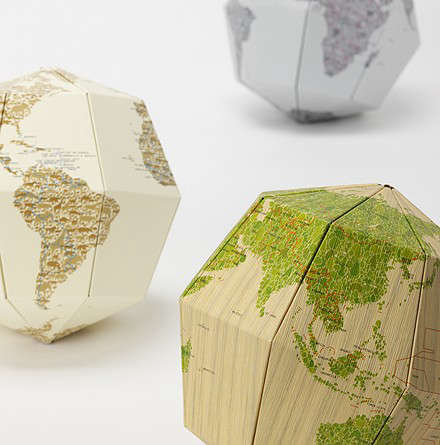
The Geo-grafia Paper Globe is a design-forward paper globe that reimagines the classic desktop world globe through folded geometry and a more tactile, sculptural form. Instead of copying the old classroom model exactly, it leans into what makes a globe fascinating in the first place: the fact that Earth is a three-dimensional body, not a flat image pretending to behave.
One of the most memorable design details is the angle. The globe is configured to sit at roughly 23.4 degrees, echoing the tilt of Earth’s axis. That might sound like a tiny technical flourish, but it completely changes the personality of the object. Suddenly, this is not just a decorative orb on a desk. It becomes a visual nod to the reason we have seasons, shifting daylight, and all the annual drama that makes the planet feel alive.
The construction also matters. Because it is made from paper and built through sections or facets, the globe feels more architectural than bulky. It has the soul of a model, the elegance of a design object, and the visual intrigue of something you want to pick up immediately. That urge to touch it is part of the charm. This is not a “look but do not touch” museum piece. It practically begs for a slow spin.
Why a Paper Globe Feels So Fresh
Paper has a funny reputation. People hear the word and assume fragile, temporary, maybe even a little crafty in the “glitter emergency” sense. But great paper design can be astonishingly sophisticated. For centuries, paper engineers have used folds, cuts, tabs, cylinders, and layered forms to create objects that are both structural and expressive. In other words, paper is not a downgrade here. It is the whole point.
That material choice gives the Geo-grafia Paper Globe a different emotional effect than a plastic or metal globe. It feels lighter, warmer, and more intentional. A traditional globe can sometimes read as school supply, office cliché, or “my uncle once watched a documentary.” A paper globe reads as design. It looks curated. It has texture. It invites the eye to linger on edges, planes, and printed surfaces.
There is also a quiet intelligence to the material. Paper turns geography into something hand-scaled and approachable. It reminds you that all mapping is interpretation. Even the most accurate-looking globe is still a human-made model of an absurdly big world. When that model is made of folded paper, the idea becomes beautifully obvious: knowledge is constructed. Representation is designed. And yes, your shelf can still look fantastic while making that point.
A globe with sculptural energy
The Geo-grafia Paper Globe works especially well because it does not hide its geometry. Instead of pretending to be a perfectly seamless sphere, it celebrates construction. That gives it sculptural energy. It is the sort of object that fits naturally in a home office, creative studio, reading nook, classroom library, or minimalist living room where every object has to earn its keep.
A conversation starter that actually deserves the conversation
Let’s be honest: many “conversation pieces” are mostly pieces. This one actually earns the title. People notice the unusual form, ask why it is tilted, wonder how it is assembled, and end up talking about cartography, travel, education, design, or the strange beauty of seeing the planet reduced to a handheld artifact. That is a pretty impressive performance for something made of paper.
Why Globes Still Matter in a Flat-Map World
We live surrounded by flat maps. They are on phones, laptops, textbooks, weather apps, airline screens, and food delivery trackers that somehow make your dinner feel like an international expedition. Flat maps are practical, fast, and necessary. They are also distorted. That is not a flaw of one bad mapmaker. It is a built-in challenge of taking a round world and pressing it onto a flat surface.
This is where a globe wins. A globe presents Earth as a three-dimensional form, which means it handles direction, spatial relationships, and large-scale surface patterns more naturally than a flat map can. It does not eliminate all simplification, of course, but it avoids the weird visual tricks that projections introduce. Continents stop playing size games. Distance feels more intuitive. The planet looks like a planet again.
That makes the Geo-grafia Paper Globe more than decor. It becomes a surprisingly strong tool for geographic literacy. Even in homes where no one is formally “studying geography,” a physical globe helps people think spatially. It encourages questions like: Where is that country actually located? Why does this route curve? Why do seasons flip between hemispheres? Why do world maps always seem to start arguments?
In that sense, the object belongs to a long tradition. Globes have been used for centuries to understand the Earth, visualize movement, and teach relationships between land, water, distance, and time. The format has history on its side. The Geo-grafia version simply gives that old format a smart contemporary wardrobe.
The Design Story: Geography Meets Paper Engineering
The most interesting thing about the Geo-grafia Paper Globe is that it lives at the intersection of several disciplines. It is part geographic model, part paper-engineered object, part design statement, and part educational tool. Many products manage one or two of those roles. This one comfortably holds all four.
From a design perspective, the geometric surfaces and tilted stance make it visually dynamic even when it is sitting still. That matters more than it sounds. Ordinary globes often become background furniture. The Geo-grafia Paper Globe has enough form and tension to stay visually active. It catches light differently. It creates shadows. It looks considered from more than one angle. Basically, it refuses to become shelf wallpaper.
From a learning perspective, the structure reinforces the lesson. You are not just looking at a printed world map wrapped around a ball. You are seeing how segments, surfaces, and geometry come together to represent a sphere. That is a quietly brilliant way to teach. Good educational design does not shout answers. It makes people curious enough to ask better questions.
And from a craft perspective, the paper construction links the object to a broader tradition of engineered paper forms, from movable books to sculptural folds and pop-up models. That heritage matters because it reminds us that paper is not only for pages. In the right hands, it becomes architecture in miniature.
How the Geo-grafia Paper Globe Fits Into Modern Interiors
This is where the globe quietly overachieves. It is easy to imagine a world globe in a study, library, or old-school office. The Geo-grafia Paper Globe works there too, but it also fits contemporary spaces that do not want anything heavy or overly traditional.
On a walnut desk, it adds warmth without clutter. On a white shelf, it adds shape without visual noise. In a child’s room, it introduces the world without looking like a cartoon. In a design studio, it signals curiosity and taste in one compact move. In a classroom, it can sit between art supplies and atlases like a peace treaty between creativity and curriculum.
The paper construction also gives it a softer presence than glossy plastic. It feels human. It feels made. And in homes full of screens, metal finishes, and synthetic surfaces, that softness is refreshing. It is the sort of object that makes a room feel more thoughtful without making it feel fussy.
Best places to display it
A home office desk, entryway console, bookshelf, reading corner, architecture studio, classroom resource shelf, or gift table are all strong options. The globe works best when it has a little visual breathing room around it. Let it be the interesting one. It has earned that role.
Who Should Buy a Geo-grafia Paper Globe?
This paper globe makes sense for more people than you might expect.
Design lovers will appreciate the geometry, the material, and the fact that it does not look like a generic office globe from 1997.
Teachers and parents will appreciate that it sparks spatial thinking without feeling like a lecture disguised as furniture.
Travel dreamers will appreciate the way a physical globe turns distant places into something tangible. It is one thing to bookmark a destination online. It is another to spin the world and point at it with your finger.
Gift buyers will appreciate that it feels unusual and intelligent. It says, “I thought about this,” rather than, “I panicked in the gift shop.”
Creative professionals will appreciate how naturally it bridges science, craft, and aesthetics. It is especially good for writers, designers, architects, cartography fans, educators, and anyone whose brain lights up at the words topography, projection, or fold pattern.
Experiences Related to the Geo-grafia Paper Globe
Living with a Geo-grafia Paper Globe is a little different from owning most decorative objects, because it keeps shifting roles on you. One day it feels like decor. The next day it feels like a teaching tool. Then suddenly it becomes the thing you absentmindedly rotate during a phone call while trying to remember where Iceland sits in relation to Greenland. Spoiler: farther east than many people picture, and yes, this is exactly the kind of argument a globe can settle before coffee gets cold.
There is also a small but real pleasure in seeing how people react to it. Children usually go straight for the spin. Designers tend to stare at the facets and construction. Travelers start naming places. Geography fans begin explaining map distortion whether anyone asked or not. The object draws out different kinds of curiosity, and that makes it feel alive in a room. It is not passive decor. It participates.
In a workspace, the experience is surprisingly grounding. Screens flatten everything. A paper globe does the opposite. It restores volume, scale, and physical orientation. When your day has been reduced to tabs, notifications, and a to-do list that reproduces like rabbits, glancing at a globe can be oddly calming. It reminds you that the world is large, layered, and not actually contained in your inbox. That is good for perspective in every sense of the word.
For families, the experience can become wonderfully informal. You do not need a formal lesson plan to use a globe well. A child asks where a grandparent lives. Someone mentions summer in Australia. A movie is set in Morocco. A storm appears in the Pacific on the news. Suddenly the globe becomes part of the conversation. That is the beauty of a physical world model. It waits quietly until real life gives it an opening.
There is also something satisfying about the paper itself. A glossy globe can feel finished in a distant, factory-perfect way. A paper globe feels closer to the hand. Even when assembled cleanly, it keeps a whisper of process about it. You sense the folds, the edges, the intention behind the form. That tactile quality makes the experience more intimate. You are not just owning an image of the world. You are owning a constructed interpretation of it.
And then there is the mood factor. The Geo-grafia Paper Globe brings a gentle kind of intelligence to a room. Not the loud kind that screams “look how cultured I am,” but the nicer kind that suggests curiosity, thoughtfulness, and maybe a tendency to browse atlases for fun. It pairs well with books, sketches, travel mementos, and quiet corners. It makes a desk feel less like a workstation and more like a thinking place.
If you are the sentimental type, the globe can take on meaning over time. Certain places start to matter more. Trips happen. Friends move. News stories hit differently when you can physically find the region in seconds. The object collects emotional geography. It becomes less about continents and more about connections.
That may be the strongest argument for the Geo-grafia Paper Globe in the end. It is not impressive merely because it looks good. It is impressive because it keeps creating little moments of engagement. Wonder. Memory. Orientation. Curiosity. For a paper object sitting quietly on a shelf, that is a pretty extraordinary life.
Final Thoughts
The Geo-grafia Paper Globe proves that a globe can still surprise us. It takes one of the oldest ways of representing Earth and gives it new energy through paper construction, geometric design, and a smart nod to the planet’s real axial tilt. The result is not just a modern globe. It is a more memorable one.
If you want an object that blends geography decor, paper sculpture, educational design, and modern desktop style, this globe is a compelling pick. It respects the science, embraces the artistry, and looks good doing it. Not bad for something made of paper and big planetary ambition.