There are two kinds of people in this world: the ones who hear “three thousand dollars for an espresso machine” and laugh like they’ve just been handed a screenplay for a luxury-comedy series, and the ones who quietly open a calculator and start dividing that price by every latte they’ve bought in the last two years. I understand both camps. I also understand why Breville’s new flagship machine makes the expensive camp look a little less unhinged than usual.
The machine in question is the Breville Oracle Dual Boiler, a premium home espresso machine that lands at the “I hope this also folds my laundry” price tier. But unlike some overbuilt kitchen gadgets that charge extra for chrome and vibes, this one has a real argument. Not a flimsy one. Not a “well, it looks nice on Instagram” one. A real one.
After digging through recent product specs, hands-on reviews, comparison guides, and retailer listings, I kept coming back to the same conclusion: the Oracle Dual Boiler doesn’t justify its price with one flashy trick. It does it with a smart combination of dual-boiler performance, automated puck prep, and a genuinely useful smart interface. Those are the three features that move this machine from “ridiculous splurge” to “dangerously persuasive purchase.”
Is it for everyone? Absolutely not. It is large, expensive, and still more machine than casual coffee drinkers need. But for people who want café-quality espresso at home without turning every morning into a graduate seminar on grind distribution, the Oracle Dual Boiler is weirdly compelling.
Why This Breville Espresso Machine Is Getting So Much Attention
Breville has spent years living in a sweet spot between approachable espresso gear and enthusiast-level machines. The brand’s more affordable models, like the Barista Express and Bambino line, helped make at-home espresso less intimidating. But the new Oracle Dual Boiler is clearly aiming higher. This is not the “cute little espresso machine for weekend cappuccinos” lane. This is the home barista espresso machine for someone who wants professional-style workflow, higher consistency, and fewer messy steps.
That matters, because espresso machines often force buyers into an annoying trade-off. You can have control, or you can have convenience. You can have café-style power, or you can have a machine that doesn’t demand a chemistry degree before breakfast. Breville’s pitch here is simple: why not both?
The Oracle Dual Boiler tries to bridge that gap. It automates the most failure-prone parts of making espresso at home, but it also gives more serious users room to tweak, experiment, and play. That’s a big reason so many reviewers describe it as a machine for people who love espresso but don’t necessarily love espresso chaos.
The Three Features That Make the Price Easier to Swallow
1. Dual boilers that let you brew and steam at the same time
This is the headline feature, and honestly, it deserves the spotlight. A dual boiler espresso machine uses one boiler for brewing espresso and another for steaming milk. That means it can pull a shot and steam milk simultaneously instead of making you wait for the machine to switch modes like it’s changing outfits backstage.
For home users, that may sound like a luxury. And yes, it is. But it is the kind of luxury that actually improves the coffee experience. Separate boilers help with temperature stability, which is a very boring phrase for a very important thing. Espresso is fussy. Tiny temperature swings can change taste, texture, and extraction. A more stable system gives you a better shot at consistent results.
It also makes milk drinks dramatically smoother to prepare. If your household runs on lattes, flat whites, or cappuccinos, simultaneous brewing and steaming is not just a flex feature. It saves time, keeps the workflow moving, and makes the machine feel less like a hobby project and more like a capable countertop appliance.
There’s another reason this matters: at $3,000, the Oracle Dual Boiler is competing less with entry-level consumer machines and more with serious prosumer equipment. In that category, boiler design is not fluff. It is part of the performance story. Breville knows it, and reviewers know it. This feature alone pushes the machine into a more elite class.
And unlike some dual-boiler machines that seem designed mainly for people who enjoy reading forums about pressure profiling, this one packages that power in a format that does not feel openly hostile to ordinary humans.
2. The Auto Puck System cuts out the messiest part of espresso
If the first feature is about power, the second is about sanity. Breville’s new automated puck prep system handles the grind, dose, and tamp process inside the machine. In plain English: it does the finicky, messy, easy-to-mess-up part for you.
That is a bigger deal than it sounds. Espresso people love to talk about extraction, but a lot of home frustration starts earlier. Bad puck prep can wreck a shot before the water even hits the coffee. Uneven dosing, sloppy tamping, and inconsistent grind adjustment are where a lot of beginners lose the plot and start wondering whether they accidentally bought a stainless-steel argument.
The Oracle Dual Boiler tries to solve that by automating puck preparation with electronic grind adjustment, integrated Baratza burrs, and a system built to produce more consistent pucks from shot to shot. For many buyers, that is the feature that makes the entire machine make sense. It removes friction without removing the ritual altogether. You still use a 58mm professional-style portafilter. You still move through an espresso workflow. You just do it without spraying coffee dust across the kitchen like a tiny caffeinated leaf blower.
This matters for experienced users too. Even people who know how to dial in espresso do not always want to do a full barista performance before work. Some mornings are for artistry. Some mornings are for survival. A machine that can reliably prep the puck for you is not “cheating.” It is time management with crema.
Now, to be fair, this is also one of the areas where the Oracle Dual Boiler gets its most nuanced criticism. Some reviewers found the built-in grinder less ideal for light roasts or full-on manual obsessives who want absolute control over every variable. That is worth knowing. If your happy place is single-origin light roast espresso with an external grinder, this may not be your forever machine. But if you drink medium to dark roasts, make milk drinks, or want strong consistency with less fuss, the automated prep system is a huge selling point.
3. The touchscreen and smart features are actually useful
Normally, “smart kitchen appliance” is my cue to lower expectations. Too often it means one unstable app, three notifications no one asked for, and a button that somehow works worse than a knob. But Breville’s interface here sounds like it was designed by people who have actually made coffee before their first cup of coffee.
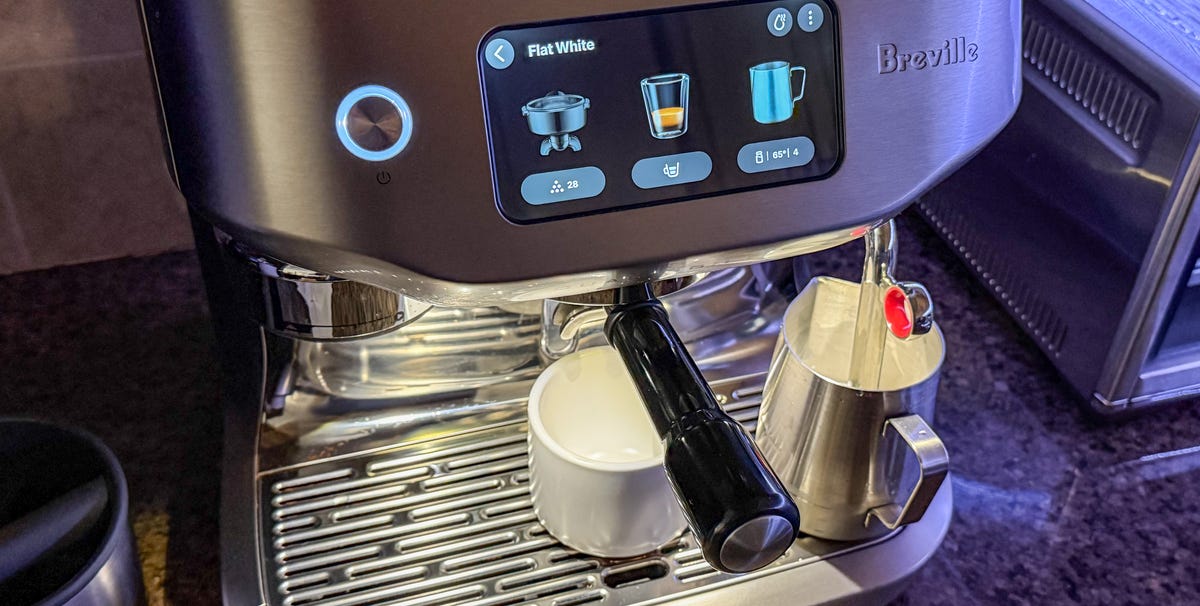
The Oracle Dual Boiler uses a responsive 5.7-inch touchscreen with Auto and Manual modes, guided controls, and customizable drink settings. It also connects to Wi-Fi through the Breville app, which lets you remotely power on and preheat the machine. Is that necessary? No. Is it glorious? Deeply.
Remote preheating is the kind of feature that sounds ridiculous until you imagine waking up, starting the machine from bed, and walking into the kitchen when it is already hot and ready. Suddenly it stops sounding silly and starts sounding like emotional support infrastructure.
But the touchscreen matters for more than convenience. It lowers the learning curve. The machine is still advanced, but it does a better job than many high-end competitors of showing users what is happening and what to do next. That makes the Oracle Dual Boiler more approachable than traditional prosumer machines that assume you were born knowing what pre-infusion should look like.
Better still, this interface is not just for beginners. In Manual mode, more experienced users can adjust factors like bloom time or pre-infusion and watch shot behavior in real time. That flexibility gives the machine a wider audience. It can babysit you when you are tired and hand over control when you are feeling ambitious. That is a smart design choice, not just a tech gimmick.
What Makes This Breville Espresso Machine Different From Cheaper Models?
The simplest answer is this: cheaper Breville machines are often great, but they each make a compromise. Some heat up fast but give you less power. Some offer excellent value but less automation. Some are better for beginners but less satisfying once you get deeper into espresso.
The Oracle Dual Boiler tries to be the one machine that covers the whole board. It gives you the premium boiler setup, integrated grinder, auto tamping, advanced milk steaming, guided touchscreen controls, and enough manual flexibility to keep things interesting. That breadth is part of what you are paying for.
You are also paying for scale. This machine is big. It is heavy. It makes a statement on the counter that says, “Yes, I care deeply about coffee, and yes, I probably have opinions about burr geometry.” If you have a tiny kitchen, this is not a minor footnote. It is a real drawback. A smaller machine may be the smarter choice even if the Oracle is objectively more capable.
And then there is the question of value. No, a $3,000 espresso machine is not “saving money” in the normal-person sense unless your household drinks a heroic number of café beverages. But for coffee lovers who already spend heavily on espresso gear, milk drinks, and beans, consolidation has value. A machine that combines strong espresso performance with meaningful automation can replace a pile of separate frustrations.
Who Should Actually Buy the Breville Oracle Dual Boiler?
This machine makes the most sense for a pretty specific buyer.
You should consider it if: you drink espresso-based beverages almost daily, you want café-style drinks at home, you appreciate automation, and you still want enough control to fine-tune your routine. It also makes sense for multi-coffee households where speed matters and milk drinks happen often.
You should probably skip it if: your kitchen is tight on space, your budget is already sweating, or you genuinely enjoy building a separate grinder-and-machine setup piece by piece. It is also probably not the first pick for hardcore light-roast tinkerers who want a machine that gets completely out of the way.
In other words, this is not the best espresso machine for everyone. It may not even be the best Breville espresso machine for everyone. But it is a fascinating machine because it knows exactly whom it is for: the person who wants the ritual of espresso without every single inconvenience that usually comes with it.
Final Verdict: Would I Pay $3K for This New Breville?
Against my better financial judgment? Yes, I get it.
The Breville Oracle Dual Boiler is expensive in the way luxury carry-on luggage is expensive, or in the way a professional camera body is expensive. It is not trying to be reasonable. It is trying to eliminate compromise. And in this case, it comes surprisingly close.
The dual boilers give it real performance credibility. The automated puck prep system removes one of the biggest barriers to consistently good espresso at home. And the touchscreen plus Wi-Fi setup makes the machine easier, faster, and more livable than many premium competitors. Those are not tiny perks. Those are foundational reasons a machine becomes part of someone’s daily routine instead of becoming an expensive stainless-steel monument to ambition.
Would everyone be happy with this purchase? No. Would many people be better served by a Breville Barista Pro, Oracle Jet, or even a simpler manual setup? Absolutely. But if you are looking for a top-tier home espresso machine that blends power, automation, and a genuinely modern user experience, this new Breville makes a very persuasive case for itself.
Three thousand dollars is still a lot of money for a machine whose main skill is turning beans into joy. But if your morning coffee is one of the most used luxuries in your life, that math starts to look a lot less absurd.
Extra Experience: What Living With a $3,000 Espresso Machine Actually Feels Like
Here is the part product specs cannot fully capture: a machine like the Oracle Dual Boiler changes the mood of your kitchen. That sounds dramatic, but coffee people know exactly what I mean. A truly premium espresso setup does not just make drinks. It changes how mornings flow.
Imagine the difference between “making coffee” and “arriving at coffee.” With a cheaper machine, there is usually a little negotiation involved. You wait for heat-up. You second-guess the grind. You spill grounds. You tamp badly. You oversteam the milk and suddenly your cappuccino tastes like stress. That does not happen every time, but it happens enough to take the shine off the ritual.
With a machine like this, the experience becomes smoother in all the small ways that matter. The touchscreen prompts feel less like instructions and more like a quiet nudge in the right direction. The auto grind and tamp system keeps the counter cleaner. The dual boilers mean you are not standing there waiting for the machine to catch up while your espresso cools down and your patience files for divorce.
There is also a confidence factor. When a machine consistently helps you pull a good shot, you stop feeling like you are borrowing someone else’s hobby. You start feeling capable. You start making drinks for guests without a disclaimer speech. You stop saying, “Sorry, this might be bad,” and start saying, “Do you want a flat white or a latte?” That shift is part of the value, even if it never appears on the spec sheet.
And yes, there is something undeniably satisfying about a machine that feels overqualified. The 58mm portafilter, the polished stainless steel, the serious steam power, the preheated readiness when you walk into the kitchenit all contributes to that little daily illusion that your home life is more together than it actually is. The sink may be full of dishes. Your inbox may be on fire. But your cortado? Your cortado has standards.
Of course, real ownership would also include the less glamorous truths. This machine would demand counter space, regular cleaning, descaling discipline, decent beans, and at least a little patience while you learn its rhythm. Premium espresso gear does not erase maintenance; it just makes the payoff more delicious. But for people who enjoy the process, those tasks start to feel less like chores and more like upkeep on something worth having.
That is why I understand the emotional logic of this machine. Nobody needs a $3,000 espresso maker. But some purchases are not about need. They are about repetition. The things you use once a year should be cheap. The things you use every morning should earn their place. If coffee is your daily ritual, your tiny luxury, your housewarming gift to yourself every single day, then a machine that makes that ritual easier and better starts to look less indulgent and more intentional.
And that, really, is the heart of the Oracle Dual Boiler pitch. It is not selling coffee. It is selling fewer compromised mornings.
Conclusion
The Breville Oracle Dual Boiler is not trying to win the budget category, the small-kitchen category, or the “totally reasonable appliance purchase” category. It is trying to be one of the most complete luxury home espresso machines you can buy right now. Thanks to its dual-boiler architecture, automated puck prep, and genuinely useful smart controls, it has a better case than most.
If your dream setup involves café-quality drinks, faster workflow, and less espresso guesswork, this machine earns a hard look. Not because it is cheap. Because it knows exactly how to make expensive feel tempting.