Kinetic energy sounds like something reserved for rocket scientists, roller-coaster engineers, and people who casually use the phrase “non-relativistic particle” before breakfast. Fortunately, the basic calculation is much friendlier than its name suggests.
Whenever an object moves, it possesses kinetic energy. A rolling bowling ball, a speeding car, a thrown baseball, and even a determined shopping cart with one rebellious wheel all have energy because of their motion. To calculate that energy, you need only two measurements: the object’s mass and its speed.
This guide explains how to calculate kinetic energy in nine clear steps, including unit conversions, worked examples, common mistakes, reverse calculations, and practical problem-solving habits.
What Is Kinetic Energy?
Kinetic energy is the energy an object has because it is moving. An object at rest has zero translational kinetic energy relative to the observer measuring it. Once the object begins moving, its kinetic energy increases according to its mass and speed.
The classical kinetic energy formula is:
KE = ½mv2
In this equation:
- KE represents kinetic energy.
- m represents the object’s mass.
- v represents the object’s speed.
In the International System of Units, mass is measured in kilograms, speed is measured in meters per second, and kinetic energy is measured in joules. One joule is equivalent to one kilogram-meter squared per second squared, written as kg·m2/s2.
The squared speed is the formula’s most important feature. Doubling an object’s mass doubles its kinetic energy, but doubling its speed multiplies its kinetic energy by four. Tripling the speed produces nine times the kinetic energy. Physics apparently believes speed deserves dramatic consequences.
How to Calculate Kinetic Energy in 9 Steps
-
Step 1: Identify the Moving Object
Begin by deciding exactly which object or system you are analyzing. It might be a baseball, bicycle, vehicle, runner, or falling package.
This sounds obvious, but it determines which mass should be included. For a cyclist traveling on a bicycle, for example, a question may ask for the kinetic energy of the bicycle alone or the combined kinetic energy of the cyclist and bicycle. Read the wording carefully before reaching for the calculator.
-
Step 2: Write Down the Given Mass and Speed
Record the mass and speed supplied in the problem. Label each value with its unit so that a kilogram does not accidentally wander into a calculation pretending to be a pound.
Suppose a problem states:
- Mass: 50 kilograms
- Speed: 6 meters per second
You can write these values as m = 50 kg and v = 6 m/s.
If the problem gives velocity, the ordinary kinetic energy formula uses the magnitude of that velocity, which is speed. Direction does not make kinetic energy negative because the velocity is squared.
-
Step 3: Convert the Mass to Kilograms
The standard formula produces joules when mass is expressed in kilograms and speed is expressed in meters per second. If the mass is already in kilograms, no conversion is required.
For grams, divide by 1,000:
500 g ÷ 1,000 = 0.500 kg
For pounds, multiply by approximately 0.453592:
10 lb × 0.453592 ≈ 4.54 kg
Do not substitute grams directly into the SI formula unless you intentionally want a result in a different unit system. A 250-gram baseball is not a 250-kilogram baseball, unless the sport has become considerably more dangerous.
-
Step 4: Convert the Speed to Meters per Second
If speed is given in meters per second, proceed to the next step. Otherwise, convert it before calculating kinetic energy.
To convert kilometers per hour to meters per second, divide by 3.6:
72 km/h ÷ 3.6 = 20 m/s
To convert miles per hour to meters per second, multiply by approximately 0.44704:
30 mph × 0.44704 ≈ 13.41 m/s
Unit conversion is one of the most common sources of incorrect answers. A perfectly entered formula cannot rescue measurements wearing the wrong units.
-
Step 5: Square the Speed
Multiply the speed by itself:
v2 = v × v
For a speed of 6 m/s:
(6 m/s)2 = 36 m2/s2
Be sure to square only the speed, not the mass or the entire expression. On a calculator, enter the speed first and use the square key, or multiply the value by itself.
-
Step 6: Multiply the Squared Speed by the Mass
Now multiply the object’s mass by the squared speed:
mv2 = 50 kg × 36 m2/s2
mv2 = 1,800 kg·m2/s2
Keep a few extra digits during intermediate calculations when using converted values. Rounding too early can make the final result less accurate.
-
Step 7: Multiply by One-Half
Complete the formula by multiplying the previous result by ½, which is the same as dividing it by two:
KE = ½ × 1,800
KE = 900 J
You can also substitute everything into the equation at once:
KE = ½ × 50 × 62 = 900 J
-
Step 8: Write the Answer in Joules
The standard SI unit of kinetic energy is the joule, abbreviated J. Therefore, the final answer is:
The object has 900 joules of kinetic energy.
Large quantities may be easier to express in kilojoules or megajoules:
- 1 kilojoule, or kJ, equals 1,000 J.
- 1 megajoule, or MJ, equals 1,000,000 J.
For example, 300,000 J can be written as 300 kJ or 0.300 MJ.
-
Step 9: Check Whether the Result Makes Sense
Perform a quick reasonableness check before declaring victory.
- Kinetic energy should not be negative in this classical calculation.
- An object with zero speed should have zero kinetic energy.
- A heavier object at the same speed should have more kinetic energy.
- A faster object should show a particularly large increase because speed is squared.
- The final unit should be joules when kilograms and meters per second are used.
If a small toy rolling slowly across a table somehow produces the kinetic energy of a freight train, inspect the unit conversions before contacting the scientific community.
Worked Kinetic Energy Examples
Example 1: A Thrown Baseball
Consider a baseball with a mass of 0.145 kg traveling at 40 m/s.
KE = ½mv2
KE = ½ × 0.145 × 402
KE = 0.0725 × 1,600
KE = 116 J
The baseball has approximately 116 joules of kinetic energy.
Example 2: A Moving Car
Suppose a 1,500 kg car travels at 20 m/s, which is approximately 45 mph.
KE = ½ × 1,500 × 202
KE = 750 × 400
KE = 300,000 J
The car possesses 300,000 joules, or 300 kilojoules, of kinetic energy.
If the same car doubles its speed to 40 m/s, its kinetic energy becomes:
KE = ½ × 1,500 × 402 = 1,200,000 J
The speed doubled, but the kinetic energy quadrupled. This relationship helps explain why higher vehicle speeds have such a major effect on braking demands and collision energy.
Example 3: A Cyclist and Bicycle
A cyclist and bicycle have a combined mass of 90 kg and move at 8 m/s.
KE = ½ × 90 × 82
KE = 45 × 64
KE = 2,880 J
The combined system has 2,880 joules of kinetic energy.
Example 4: A Ball Measured in Grams
A 250-gram ball moves at 12 m/s. First convert the mass:
250 g = 0.250 kg
Then calculate:
KE = ½ × 0.250 × 122
KE = 0.125 × 144 = 18 J
The ball has 18 joules of kinetic energy.
How Mass and Speed Affect Kinetic Energy
Kinetic energy is directly proportional to mass. If mass doubles while speed remains unchanged, kinetic energy also doubles.
Speed has a stronger effect because it is squared. If speed doubles, kinetic energy becomes four times greater. If speed triples, kinetic energy becomes nine times greater.
| Change | Effect on Kinetic Energy |
|---|---|
| Mass doubles | Kinetic energy doubles |
| Mass triples | Kinetic energy triples |
| Speed doubles | Kinetic energy becomes four times greater |
| Speed triples | Kinetic energy becomes nine times greater |
| Speed is cut in half | Kinetic energy becomes one-fourth as large |
This squared relationship is central to transportation, sports, machinery, and safety analysis. It also explains why simply saying that one object is “twice as fast” does not describe the full increase in its motion-related energy.
How to Rearrange the Kinetic Energy Formula
Some problems provide kinetic energy and ask you to find mass or speed. The same formula can be rearranged.
Finding Mass
Begin with:
KE = ½mv2
Solve for mass:
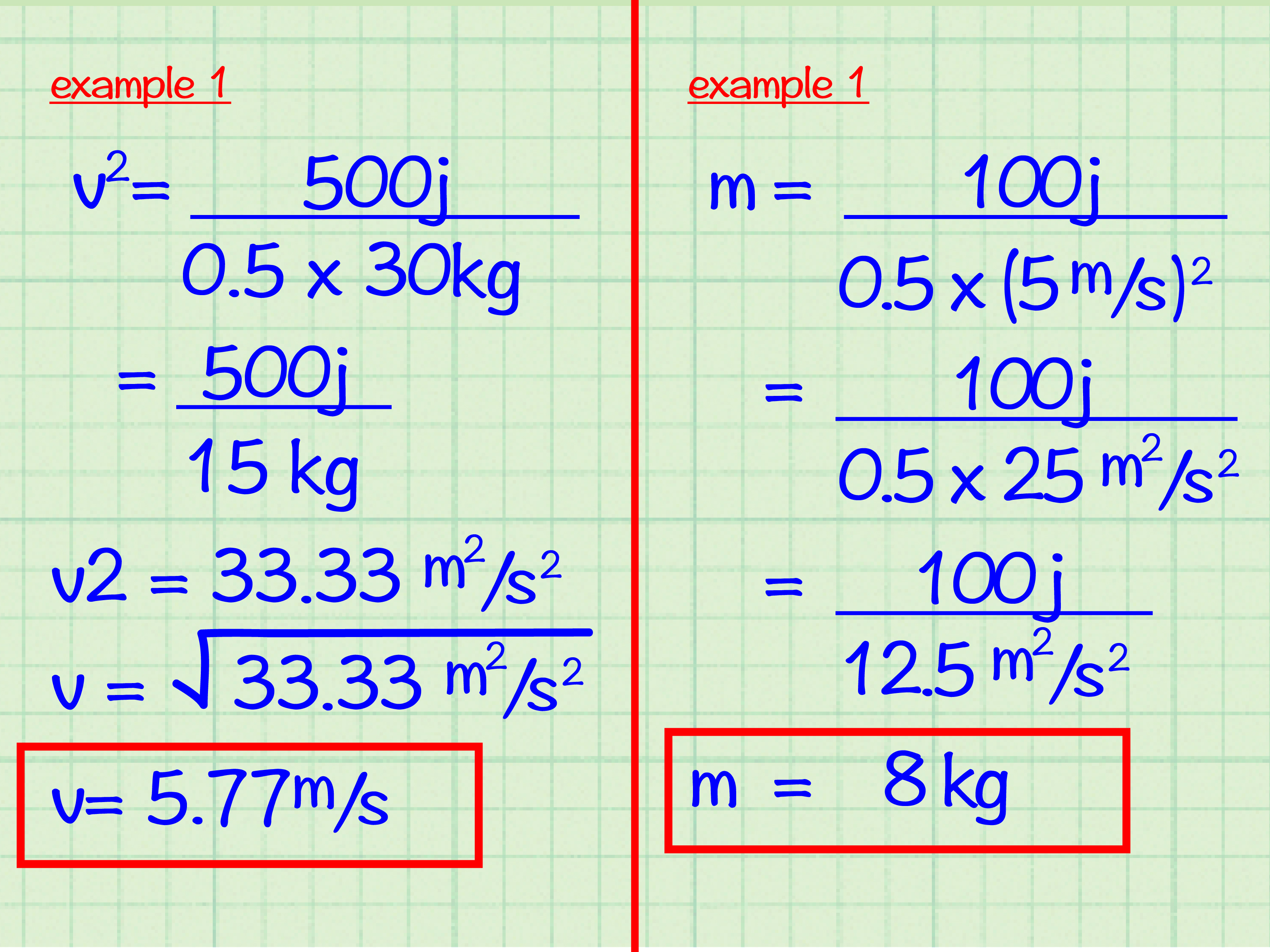
m = 2KE ÷ v2
If an object has 400 J of kinetic energy while moving at 10 m/s:
m = (2 × 400) ÷ 102 = 800 ÷ 100 = 8 kg
Finding Speed
Solve the original equation for speed:
v = √(2KE ÷ m)
Suppose a 4 kg object has 200 J of kinetic energy:
v = √[(2 × 200) ÷ 4]
v = √100 = 10 m/s
Remember to take the square root after completing the multiplication and division inside the expression.
Common Kinetic Energy Calculation Mistakes
Forgetting to Square the Speed
Using KE = ½mv instead of KE = ½mv2 produces an incorrect result. The exponent is not decorative punctuation.
Using Grams Instead of Kilograms
Substituting 500 grams as “500” instead of 0.500 kg makes the answer 1,000 times too large.
Using Kilometers per Hour Without Conversion
A speed of 72 km/h must be converted to 20 m/s before it is used in a standard SI calculation.
Squaring the Wrong Quantity
Only the speed is squared. The correct expression is ½ × m × v2, not ½ × m2 × v or (½mv)2.
Leaving Off the Unit
A final answer of “900” is incomplete. Write “900 J” so readers know the number represents energy rather than mass, speed, or an unusually ambitious calculator display.
Rounding Too Early
Keep unrounded converted values during the calculation and round the final result according to the precision of the original measurements.
How Kinetic Energy Relates to Work and Other Forms of Energy
The work-energy theorem states that the net work done on an object equals its change in kinetic energy. Positive net work increases kinetic energy, while negative net work decreases it. This connection allows many motion problems to be solved through energy instead of calculating every stage of acceleration.
Kinetic energy can also be converted into other forms. A falling object may gain kinetic energy as gravitational potential energy decreases. When brakes slow a vehicle, much of its kinetic energy is transformed into thermal energy through friction. Energy changes form, but it is accounted for within the system being analyzed.
Translational and Rotational Kinetic Energy
The formula KE = ½mv2 calculates translational kinetic energy associated with the motion of an object’s center of mass. A spinning wheel, rotating fan, or rolling ball may also possess rotational kinetic energy.
Rotational kinetic energy is calculated with a different equation involving moment of inertia and angular speed. A rolling object can possess both translational and rotational kinetic energy, so ½mv2 may represent only part of its total kinetic energy.
The Importance of the Reference Frame
Speed must always be measured relative to a chosen reference frame. A passenger sitting on a moving train has zero speed relative to the seat but moves rapidly relative to the ground. Therefore, the passenger’s calculated kinetic energy differs depending on the observer’s frame of reference.
When the Classical Formula Is Not Enough
The familiar formula works extremely well for ordinary objects moving far below the speed of light. At speeds approaching the speed of light, classical mechanics must be replaced by relativistic equations. This limitation does not affect typical calculations involving vehicles, sports equipment, machinery, or everyday falling objects.
Practical Experiences and Lessons From Solving Kinetic Energy Problems
Working through kinetic energy exercises reveals that the multiplication is rarely the hardest part. Most errors happen before anyone presses the equals key. The most dependable habit is to organize the information before calculating anything.
Start by writing the equation and listing the known values underneath it. This simple routine prevents mass, speed, and energy from becoming a pile of unlabeled numbers. It also makes missing information obvious. When a problem supplies pounds and miles per hour, seeing those units on the page immediately signals that conversion is required.
A second practical lesson is to treat unit conversion as a separate stage rather than mixing it into the main equation. Convert grams to kilograms, kilometers per hour to meters per second, or miles per hour to meters per second first. Then rewrite the converted values clearly. Attempting to perform three conversions and the kinetic energy calculation in one calculator entry is an excellent way to create a mystery number.
It is also useful to estimate the result before calculating it precisely. Consider a 1,000 kg car moving at roughly 10 m/s. Half the mass is about 500, and the squared speed is about 100, so the energy should be near 50,000 J. If the calculator returns 50 J or 50 million J, the estimate warns that something went wrong.
Comparing two situations often provides more intuition than calculating one isolated value. Imagine the same bicycle traveling at 5 m/s and 10 m/s. The second speed is only twice as large, but the kinetic energy is four times greater. Repeating comparisons like this makes the squared relationship memorable without relying on pure memorization.
Real measurements introduce another lesson: speed is not always constant. A rolling cart may slow because of friction, while a thrown ball changes speed throughout its flight. In an experiment, the calculated kinetic energy applies to the speed at the particular moment being measured. Using an average speed may not produce the same result as averaging the object’s kinetic energy over time because energy depends on speed squared.
Calculator entry deserves attention as well. Parentheses are especially important when solving backward for speed with v = √(2KE/m). Enter the entire quantity 2KE/m before taking the square root. Taking the root too early produces a polished-looking answer that is confidently wrong.
Significant figures matter in laboratory work. If mass is measured as 2.4 kg and speed as 3.1 m/s, reporting twelve decimal places of kinetic energy suggests a level of precision the measurements never had. Carry extra digits during the calculation, but round the final answer sensibly.
Diagrams can help when kinetic energy appears alongside potential energy, springs, slopes, or friction. Mark the initial and final positions, list the energy present at each point, and identify whether external or nonconservative forces transfer energy. This often turns a complicated motion problem into a manageable accounting exercise.
Finally, always explain what the answer means. Writing “KE = 2,880 J” completes the arithmetic, but writing “the cyclist and bicycle have 2,880 joules of kinetic energy at 8 m/s” completes the reasoning. Units, context, and interpretation distinguish a physics solution from a calculator receipt.
Conclusion
To calculate kinetic energy, identify the moving object, record its mass and speed, convert the measurements to kilograms and meters per second, square the speed, multiply by the mass, divide by two, and report the result in joules. A final reasonableness check catches many unit and calculator mistakes.
The equation KE = ½mv2 is simple, but it describes an important feature of motion: speed influences kinetic energy much more strongly than mass does. That principle appears everywhere from rolling toys and athletic equipment to cars, aircraft, industrial machines, and planetary motion.
Note: This guide covers classical translational kinetic energy. Problems involving substantial rotation, deformable systems, microscopic thermal motion, or speeds close to the speed of light may require additional equations.