Bauhaus design is what happens when artists, architects, and craftspeople get together and agree on two things: (1) clutter is exhausting, and (2) a chair shouldn’t need a chandelier’s worth of ornament to do chair stuff. It’s a design philosophy born in early-20th-century Germany that still shapes how we build, decorate, and even type words on screens today.
But Bauhaus isn’t just “white walls and vibes.” It’s a whole mindset: make it useful, make it honest, make it beautiful because it worksnot because it’s wearing decorative lace like it’s going to prom.
What Is Bauhaus Design?
Bauhaus (pronounced “BOW-house”) refers to both a famous design school (1919–1933) and a broader movement that helped define modernist design. At its core, Bauhaus aimed to unite art, craft, and industryso everyday objects could be thoughtfully designed, functional, and scalable for modern life.
In practical terms, Bauhaus design tends to look:
- Simple (clean lines, minimal ornament)
- Geometric (circles, squares, triangles doing the heavy lifting)
- Functional (every detail earns its paycheck)
- Material-forward (steel looks like steel; wood looks like woodno costume parties)
A Quick History of Bauhaus
The Bauhaus story reads like a design-world mini-series: visionary founding, radical experiments, political drama, and an international legacy tourespecially in the United States.
1919: Founded in Weimar
Bauhaus began in 1919 in Weimar, founded by architect Walter Gropius. The goal was ambitious: break down the old hierarchy that treated “fine art” as fancy and “applied art” as merely practical. Bauhaus wanted them to collaboratelike a dream team where painters, carpenters, typographers, and architects actually talk to each other.
Education at Bauhaus wasn’t “sit quietly and admire a plaster bust.” Students learned through making. Workshops became the heart of the school: metal, weaving, wood, ceramics, typography, and moreeach one a lab for building the modern world.
1925–1932: The Dessau Era (Peak Bauhaus Energy)
Political pressure pushed the school out of Weimar, and Bauhaus relocated to Dessau in 1925. This is where Bauhaus architecture becomes iconic. Gropius designed the famous Bauhaus building in Dessauglass curtain wall, steel-frame construction, and a layout engineered for efficiency and collaboration.
If Bauhaus had a “signature look,” it sharpened here: modern materials, asymmetry, and that confident sense of “we’re designing the future, please don’t spill coffee on it.”
1932–1933: Berlin and Closure
The school moved againthis time to Berlinand in 1933 it shut down under pressure from the Nazi regime. Bauhaus was seen as too progressive, too international, too experimental, and (in the eyes of authoritarian politics) way too interested in people thinking for themselves.
Bauhaus Goes Global (Hello, America)
Here’s where the movement gets its second act. Many Bauhaus leaders and teachers emigrated, spreading Bauhaus ideas worldwideespecially to the United States.
- Walter Gropius taught at Harvard, influencing American architectural education and modernism.
- László Moholy-Nagy founded The New Bauhaus in Chicago in 1937, which evolved into the Institute of Design at Illinois Tech.
- Josef and Anni Albers brought Bauhaus approaches to teaching and materials to American art and design culture (notably through experimental education).
The result: Bauhaus didn’t end in 1933. It multiplied.
What Made Bauhaus Different?
Bauhaus wasn’t merely an aesthetic; it was a system. It treated design like a serious disciplinesomething you could study, test, refine, and apply to real life.
1) A “Basic Course” That Trained Your Eye (and Your Hands)
Bauhaus emphasized fundamentals: form, color, materials, space, and composition. Students explored how materials behave and how shapes communicate. Think of it as design boot camp, minus the yellingthough some critiques probably felt like emotional push-ups.
2) Workshops Over Ivory Towers
Instead of separating “artists” from “makers,” Bauhaus put them together. Students moved from theory into specialized workshopsmetalwork, textiles, furniture, typographywhere prototypes and production methods mattered.
3) Design for Modern Life (and Mass Production)
Bauhaus didn’t want design to be trapped in galleries or reserved for the wealthy. A key idea was designing objects and buildings that could be made efficientlybringing good design into everyday life.
Key Characteristics of Bauhaus Design
If you’re trying to recognize Bauhaus style “in the wild,” these are the traits that show up again and again.
Function First (Yes, It’s a MottoBut It’s Also a Mood)
The Bauhaus approach asks: What is this for? Then it designs backward from that purpose. A teapot should pour well. A chair should support you. A building should guide movement naturally. Beauty isn’t ignoredit’s just built on usefulness, not decoration-for-decoration’s sake.
Simple, Geometric Forms
Bauhaus loves geometry the way some people love organizing their spice rack alphabetically: unapologetically and with deep conviction. Circles, squares, triangles, and clean lines create clarity. This isn’t “boring.” It’s visual efficiency.
Minimal Ornament (Because Your Object Isn’t Trying to Impress Royalty)
Bauhaus rejected unnecessary decoration. Instead, it found elegance in proportion, balance, and structure. You don’t add flourishes to prove you careyou care by designing it well.
Honest Materials: Steel, Glass, Concrete, Wood
Modern materials weren’t hiddenthey were celebrated. Tubular steel furniture became a Bauhaus icon because it was lightweight, strong, and industrially relevant. Glass wasn’t just for windows; it became a statement about openness and modernity.
Primary Colors (Used Like a Chef Uses Salt)
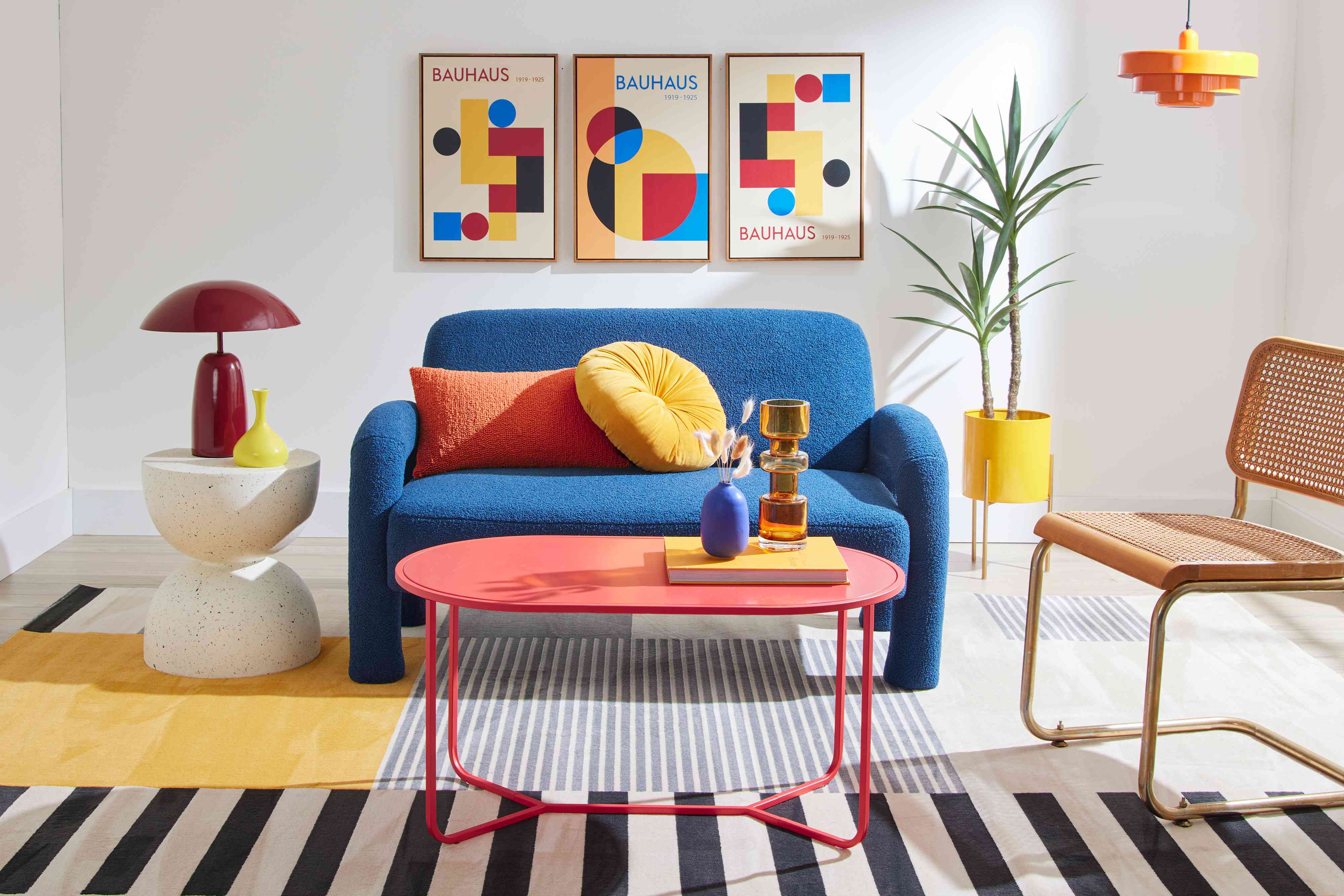
Bauhaus color is often bold but controlled. You’ll see primary colorsred, blue, yellowespecially in graphics, teaching exercises, and some interiors. But it’s not “rainbow explosion.” It’s deliberate contrast used to clarify structure and hierarchy.
Asymmetry and Smart Use of Space
Bauhaus compositions often avoid traditional symmetry. Layouts feel dynamicbalanced without being mirror-matched. In architecture and interiors, space is planned for movement, light, and function rather than grand ornament.
Bauhaus Typography and Graphic Design
Bauhaus didn’t just change furniture and buildingsit helped shape modern graphic design. Clean typography, grid systems, strong hierarchy, and a preference for legibility all tie into Bauhaus thinking. The movement’s designers pushed toward what we’d now call “modern branding”: clarity, structure, and visual logic.
Iconic Examples of Bauhaus in the Real World
Bauhaus is easier to understand when you can picture it. Here are some classic examples and why they matter:
The Bauhaus Building in Dessau
Glass curtain walls, steel structure, and a layout designed for workflow and collaboration. It’s basically the prototype for modern design schools, offices, and “creative campuses” that want to feel smart.
Tubular Steel Furniture
Designers like Marcel Breuer explored furniture that looked industrial and felt modernoften using tubular steel to create chairs that were lighter and more production-friendly than traditional heavy wood pieces.
Metalwork and Product Design
Tea infusers, lamps, tablewareBauhaus workshops treated everyday objects as serious design problems. The best pieces look clean and rational, but also surprisingly warm when you use them. (Yes, a teapot can have charisma.)
Bauhaus vs. Other Styles People Confuse It With
Bauhaus vs. Minimalism
Minimalism often emphasizes reduction for calm and simplicity. Bauhaus is reduction with a mission: build a better modern world through design logic and production thinking. Minimalism says, “Less is more.” Bauhaus says, “Less is more… and also manufacturable.”
Bauhaus vs. Art Deco
Art Deco can be glamorous, luxurious, and decorativethink zigzags, shine, and drama. Bauhaus is more utilitarian and system-driven. If Art Deco arrives in a feathered cape, Bauhaus arrives with a toolbox and a blueprint.
How to Use Bauhaus Design Today (Without Turning Your Home Into a Museum)
You can borrow Bauhaus principles without living inside a white cube with a single chair and existential dread.
In Interiors
- Choose furniture with clean lines and visible structure.
- Use a neutral base (white, black, gray) and add controlled pops of primary color.
- Prioritize function: storage that works, lighting that actually lights, layouts that flow.
In Graphic Design and Branding
- Use grid systems for alignment and hierarchy.
- Favor legible typography and strong contrast.
- Let shapes and spacing do the talking instead of piling on effects.
In Architecture
- Emphasize form driven by use: circulation, daylight, and structure.
- Use materials honestlydon’t fake “wood” with plastic that cries when you touch it.
- Keep ornament minimal; make the building’s logic the visual identity.
Common Misconceptions About Bauhaus
“Bauhaus is cold.”
Not inherently. Poorly executed minimal spaces can feel sterile, but Bauhaus itself explored textiles, color, photography, and playful abstraction. Warmth comes from proportion, materials, and human-centered layoutnot from adding random decorative pillows like emotional support objects.
“Bauhaus is just white boxes.”
Architecture is only one output. Bauhaus also shaped furniture, typography, stage design, product design, and education methods. If you only picture flat-roof buildings, you’re seeing one slice of a very layered cake.
“Bauhaus means ‘no decoration ever.’”
Bauhaus rejected unnecessary decoration. It didn’t reject delight. The delight just had to come from form, balance, materials, and thoughtful purposenot from ornamental confetti.
Bauhaus Experiences (About of Real-World, Relatable Moments)
To really “get” Bauhaus, it helps to notice how it shows up in everyday lifesometimes in places you wouldn’t expect. You don’t need to tour a historic building in Germany (though it sounds like a pretty great flex). You can spot Bauhaus thinking the next time you interact with something that feels quietly inevitable, like it was designed by someone who cared about your time and your elbows.
Experience #1: The chair test. You sit down in a sleek, steel-framed chair at a café. It doesn’t wobble. It doesn’t creak. It doesn’t try to swallow you whole like an overstuffed beanbag. It just… works. That’s a Bauhaus-adjacent moment: structure is visible, function is clear, and the aesthetic comes from the logic of the object. The chair isn’t performing; it’s delivering.
Experience #2: The “why is this so readable?” poster. You’re walking past a museum or event flyer andwithout tryingyou instantly understand the headline, date, and location. No deciphering. No squinting. No “is this a band or a law firm?” confusion. That clarity often traces back to modern graphic design principles shaped by Bauhaus-era experimentation: grids, hierarchy, strong type, and a sense that communication is a design responsibility.
Experience #3: The apartment that feels bigger than it is. You enter a small space that somehow feels breathable. Furniture sits where it should. Walkways aren’t blocked by decorative detours. Light bounces off simple surfaces. Storage is integrated instead of improvised. This is where Bauhaus principles become a quality-of-life upgrade: efficient planning, functional zones, and fewer objects that exist solely to be objects.
Experience #4: The product that doesn’t make you angry. You know that rare feeling when you open a kitchen tool, lamp, or device and immediately understand how it worksno manual, no guessing, no accidental summoning of a new settings menu? That’s design as problem-solving, not decoration. Bauhaus was obsessed with this kind of usability before “UX” became a job title you can put on LinkedIn.
Experience #5: The “I can copy this look” moment. Maybe you see a living room with a neutral base, one bold primary-color artwork, a geometric rug, and a couple of clean-lined pieces that look like they’ve been earning their place for decades. It doesn’t feel trendy; it feels stable. That’s the Bauhaus legacy at its best: timeless structure with just enough personality to keep things human.
The punchline is that Bauhaus isn’t a strict costume you put on your home or your brand. It’s a toolkit. And once you start noticing it, you’ll realize it’s been quietly organizing your modern world this whole timelike a very stylish librarian who also knows engineering.
Conclusion
Bauhaus design is the art of making the modern world make sense. Born as a school and expanded into a global movement, it fused creativity with craftsmanship and industryinsisting that objects, buildings, and graphics should be functional, honest, and thoughtfully made. Its signature characteristicsclean geometry, minimal ornament, material clarity, and purposeful designstill power everything from modern interiors and furniture to typography, branding, and architectural planning.
If you want a simple takeaway: Bauhaus isn’t about removing personality. It’s about designing with intentso the personality comes through in smart choices, not decorative noise.