Most deer hunting stories end with a buck, a missed shot, or a long explanation about how the wind “totally changed at the last second.” This one ended with a mammoth tusk. Yes, a real mammoth tuskthe kind of Ice Age discovery that makes a normal day outdoors suddenly feel like someone opened a secret door under the American Southwest.
In West Texas, an unnamed hunter was searching for deer on the privately owned O2 Ranch, a huge property spread across Brewster and Presidio counties near the Big Bend region. Instead of antlers, he noticed something strange in a creek drainage. At first glance, it looked like an old stump. That is understandable. Nature is very good at making rocks look like animals, roots look like bones, and every shadow at dusk look like “maybe a twelve-point buck.” But this object was different. The hunter took photos, showed them to ranch manager Will Juett, and soon the Center for Big Bend Studies at Sul Ross State University was involved.
The result: researchers confirmed the object was a rare mammoth tusk, an isolated fossil that had been separated from the rest of the animal’s remains. For anyone who loves paleontology, archaeology, Texas history, or the delightful chaos of accidental discoveries, this is the kind of story that makes you check the ground a little more carefully the next time you go outside.
The Deer Hunt That Turned Into a Prehistoric Mystery
The discovery happened on the O2 Ranch, a vast West Texas property known for rugged terrain, geological variety, cattle history, hunting leases, and the kind of scenery that makes a person feel small in the best possible way. The ranch sits in the high Chihuahuan Desert, where dry creek beds, exposed sediment, erosion, and ancient landscapes can sometimes reveal surprises that have been hidden for thousands of years.
When the hunter first spotted the object, the situation was not exactly a Hollywood fossil moment. There were no dramatic lightning strikes. No orchestra. No mammoth ghost appearing over the ridge and nodding solemnly. Just a curious shape in the ground, a photo, and a question: could this be something important?
Juett admitted he was skeptical at first. He thought it might be an old stump, which is a reasonable guess when someone brings you a picture of something brown, curved, and partly buried. Still, the possibility was too interesting to ignore. Because Juett had a working relationship with the Center for Big Bend Studies, he contacted experts at Sul Ross State University in Alpine, Texas.
That call mattered. In fossil discoveries, the difference between a scientific treasure and a damaged curiosity is often what happens in the first few hours. Instead of yanking it out, loading it into a pickup, and accidentally turning a mammoth tusk into prehistoric trail mix, the ranch team brought in professionals.
How Experts Confirmed the Mammoth Tusk
The Center for Big Bend Studies team included director Bryon Schroeder, archaeologist Erika Blecha, University of Kansas graduate student Haley Bjorklund, and anthropology professors Justin Garnett and Devin Pettigrew. Once they reached the site, they examined the find and quickly confirmed the hunter’s suspicion. It was not wood. It was not a weird root. It was a mammoth tusk.
The tusk was found in the drainage area of a creek bed. Researchers did not find the rest of the skeleton nearby, which suggests the tusk had been separated from the animal’s other remains long before its modern rediscovery. Water, erosion, sediment movement, and time are all enthusiastic editors of the fossil record. They move things, break things, bury things, and occasionally reveal things just enough for one alert person to notice.
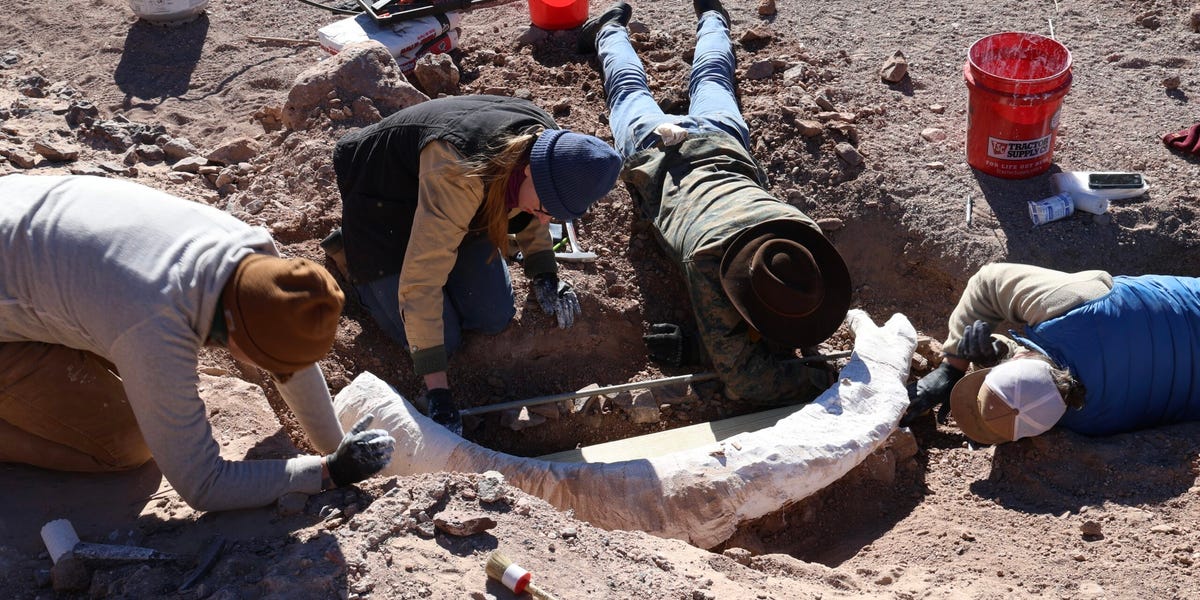
Once the tusk was identified, the team spent two days carefully preparing it for transport. They used a process called plaster-jacketing, which involves wrapping the fossil in strips of plaster-covered burlap to create a protective shell. Think of it as a cast for a broken arm, except the patient is an Ice Age fossil and the doctor has to worry about ten thousand years of fragility.
The researchers also built a frame to move the tusk safely to Sul Ross State University for study. That slow, careful work may not sound as flashy as “hunter finds mammoth tusk,” but it is the part that protects the scientific value of the discovery. Fossils are not just objects; they are data. Their position, surrounding sediment, preservation, and context can reveal clues about ancient animals, environments, and climate.
Why a Mammoth Tusk in West Texas Is Such a Big Deal
Mammoth fossils are not unheard of in Texas. In fact, the state has one of the most famous mammoth fossil sites in the country: Waco Mammoth National Monument. There, the fossil remains of Columbian mammoths preserve the nation’s first and only recorded nursery herd of Ice Age Columbian mammoths. Those animals stood as tall as 14 feet and could weigh around 20,000 pounds, which is roughly the size of “please do not park that in my driveway.”
But West Texas is different. Mammoth remains from the Trans-Pecos region are rare. According to researchers, the O2 Ranch tusk is only the second mammoth artifact from the region expected to be carbon-dated. The previous known carbon-dated tusk from the area was found near Fort Stockton in the 1960s, when radiocarbon dating was much less precise than it is today.
Modern dating methods can narrow the timeline much better than earlier techniques. In the original announcement, researchers said carbon dating results were expected in the following months. As of the latest public reports available, the final age has not been widely published, but the expectation is that analysis will help place the tusk more accurately in the Ice Age history of the region.
That matters because fossils from unexpected places can redraw scientific assumptions. A single tusk may seem modest compared with a full skeleton, but paleontology often advances through fragments: a tooth here, a jaw there, a tusk in a creek bed, a trackway under a layer of sediment. The ancient world rarely hands over a complete puzzle. Usually, it gives scientists one oddly shaped piece and says, “Good luck.”
Meet the Columbian Mammoth: Texas-Sized Before Texas Was Texas
The mammoth linked to the West Texas discovery was likely a Columbian mammoth, known scientifically as Mammuthus columbi. Columbian mammoths were among the giants of Ice Age North America. Unlike their woolly cousins, which were adapted for colder northern climates, Columbian mammoths lived farther south and favored grasslands, open environments, and warmer regions.
They roamed much of what is now the United States, including Texas, during the Pleistocene Epoch. These animals were not just oversized elephants with dramatic dental accessories. They were ecosystem engineers, long-distance grazers, and key players in ancient grassland environments. Their tusks could be used for display, defense, social behavior, foraging, and possibly clearing vegetation or snow in some environments.
A mammoth tusk is not a horn. It is an elongated incisor tooth, and like modern elephant tusks, it grew over the animal’s lifetime. Tusks can preserve growth layers that work somewhat like tree rings. Scientists can sometimes study those layers to learn about age, diet, seasonal stress, movement, and even aspects of climate. In other words, a tusk is not just a big curved fossil. It is a prehistoric biography written in ivory.
That is why the O2 Ranch discovery is more than a novelty. If enough of the tusk is preserved and suitable for analysis, researchers may be able to learn where the mammoth fits into the broader story of West Texas during the late Pleistocene. Was the landscape wetter? Drier? More open? Did mammoths pass through occasionally, or were they more common than the sparse fossil record suggests? One tusk cannot answer everything, but it can sharpen the questions.
The Ancient Landscape Behind the Discovery
Today, the Big Bend region is famous for desert basins, mountains, canyons, grasslands, and hard light that makes every sunset look like it has a personal lighting crew. During the Ice Age, the environment was not identical to today’s desert landscape. Cooler and sometimes wetter conditions supported different plant communities and animal populations across parts of North America.
Columbian mammoths would have needed large amounts of vegetation. Like elephants, they were massive herbivores with serious dietary demands. A full-grown mammoth did not nibble politely on two blades of grass and call it lunch. It required a landscape capable of supporting huge grazers, along with other Ice Age animals that may have included horses, camels, bison, ground sloths, and predators.
The tusk’s creek-bed location is also important. Waterways are natural collectors of bones and fossils. They cut through sediment, expose old layers, move material downstream, and sometimes uncover ancient remains at just the right moment. Many major fossil finds happen not because someone digs randomly, but because erosion does the first draft of excavation.
What the Discovery Says About Amateur Observation
One of the best parts of this story is that it began with a non-scientist paying attention. The hunter was not carrying a paleontology grant proposal in one hand and a deer rifle in the other. He was outdoors, noticed something unusual, and took the right next step by documenting it and reporting it.
That is how many important discoveries happen. Farmers, hikers, ranchers, miners, construction workers, fossil collectors, and everyday walkers have all stumbled upon scientifically meaningful finds. The professional team is essential, but so is the first person who says, “That looks odd. Maybe I should not ignore it.”
The lesson is not that everyone should go out digging for mammoths. Please do not turn your weekend hike into a chaotic excavation sponsored by a garden shovel. The lesson is that careful observation matters. If you find something that appears to be a vertebrate fossil, especially on public land, the safest and most scientifically responsible approach is to leave it in place, photograph it, record the location, and contact land managers, a museum, a university, or the appropriate agency.
Fossil Rules: Why “Finders Keepers” Is Not Always the Law
Fossil ownership and collection rules in the United States depend heavily on where the fossil is found. On private land, the landowner generally has strong rights over fossils, though state-specific laws and agreements can matter. On federal public lands, vertebrate fossils such as mammoth bones, dinosaur bones, and fossilized mammals are protected and generally cannot be collected without permits.
That distinction is important. A mammoth tusk is a vertebrate fossil, not a decorative rock for the mantel. Removing it without proper documentation can destroy scientific context. Even well-meaning people can cause damage by cleaning, drying, moving, or exposing fossils too quickly. Ivory and bone can crack, crumble, or lose information if handled poorly.
The O2 Ranch discovery is a good example of doing it right. The hunter did not try to haul the tusk home. The ranch manager contacted specialists. Researchers excavated and stabilized the fossil. The tusk went to an academic institution for study. Everybody wins: the ranch gets an incredible story, science gets data, and the mammoth gets a more dignified ending than becoming a questionable coffee table.
Why Mammoths Still Capture the American Imagination
Mammoths sit in a strange place in our imagination. They are extinct, but not dinosaur-old. They lived close enough to humans in time that ancient people saw them, hunted them, used their bones and tusks, and possibly told stories about them. When we picture a mammoth, we are not imagining a creature from a completely alien planet. We are imagining a world that overlapped with our own species’ early history.
That closeness makes mammoth discoveries emotional. A tusk in a creek bed is not just a fossil; it is a message from a world that vanished recently in geological terms. It asks uncomfortable and fascinating questions. What happened to the megafauna? How did climate change reshape their habitats? What role did human hunting play? Why did some populations survive longer in certain places while others disappeared?
The answers are complex. Researchers have debated the causes of mammoth extinction for decades, and the most balanced view often involves multiple pressures: warming climate, habitat change, shifting vegetation, human hunting, population stress, and local ecological events. Nature rarely uses one villain when five will do.
Specific Examples of Accidental Fossil Finds
The West Texas tusk joins a long list of accidental fossil discoveries. At Waco Mammoth, the story began in 1978 when local residents found a large bone near a creek. That discovery eventually led to one of America’s most important mammoth sites. In Mississippi, a fossil hunter found a rare Columbian mammoth tusk in a creek, and experts helped excavate and preserve it. At La Brea Tar Pits in Los Angeles, construction and excavation projects have revealed a staggering Ice Age fossil record, including mammoths, dire wolves, saber-toothed cats, and other animals preserved in asphalt-rich deposits.
These examples show that paleontology is not limited to remote badlands or dramatic movie-style dig sites. Fossils can appear in ranches, creeks, quarries, riverbanks, road cuts, construction zones, and backyards. The earth is a messy archive, and it does not always file its documents neatly.
Experience Section: What This Discovery Teaches Anyone Who Spends Time Outdoors
Anyone who hunts, hikes, fishes, camps, ranches, or simply wanders around outdoors knows that the landscape has a way of surprising you. You leave home with one plan and return with a completely different story. Maybe you went fishing and watched a bald eagle steal your moment. Maybe you went hiking and found a thunderstorm with your name on it. Maybe you went deer hunting and found evidence of a giant Ice Age animal. That last one is rarer, admittedly, but it makes the point beautifully.
The first experience this story highlights is patience. Hunters spend long hours scanning tiny details: a twitch in the brush, a track in soft ground, a line that does not match the rest of the landscape. That same attention can turn an ordinary outing into a discovery. In this case, the hunter’s eye was trained to notice what did not belong. A curved object in a creek bed was not automatically dismissed. It was questioned. Curiosity did the rest.
The second experience is humility. The outdoors constantly reminds people that they are walking across layers of time. A ranch road may cross soil that formed over centuries. A dry creek may cut into sediment laid down long before modern fences, roads, or towns existed. A hillside may hold traces of animals no human alive has seen breathing. Finding a mammoth tusk during a deer hunt is a dramatic reminder that our daily routines happen on top of deep history. We are all moving across old stories, even when we are just trying not to trip over mesquite roots.
The third experience is responsibility. When someone finds a possible fossil, the temptation to touch it, pull it, clean it, or take it home can be strong. After all, it is exciting. But the better choice is usually restraint. Take photos. Mark the location. Leave it where it is. Contact experts. That approach preserves the object and its context. It also prevents the awkward moment when a priceless fossil becomes three sad chunks in the back of a pickup.
The fourth experience is wonder. Stories like this make people look differently at familiar places. A creek bed is not just a creek bed. A ranch is not just a ranch. A hunting trip is not just a hunting trip. The ground underfoot may contain fragments of vanished worlds. That does not mean every odd rock is a mammoth tooth, but it does mean the landscape deserves attention.
For outdoor enthusiasts, the O2 Ranch mammoth tusk is a perfect reminder to slow down and look closely. The best discoveries often begin with a simple sentence: “That’s strange.” It is not a fancy scientific phrase, but it has launched plenty of real science. In this case, “That’s strange” connected a modern deer hunter to a massive animal that may have roamed Texas thousands of years ago. Not bad for a day outside.
Conclusion: A Tusk, a Hunter, and a Window Into Ice Age Texas
The story of the deer hunter who found a mammoth tusk in West Texas is charming because it begins so normally. A person went hunting. He noticed something odd. He showed someone. Experts came. Suddenly, a quiet patch of ranchland became part of the Ice Age map.
But the deeper value of the discovery is scientific. The tusk may help researchers better understand mammoths in the Trans-Pecos region, a place where such finds are rare. Its context, preservation, and eventual dating can add detail to the story of ancient Texas landscapes, mammoth movement, and the environmental changes that shaped North America after the Pleistocene.
It is also a public lesson in how discoveries should be handled. The hunter paid attention. The ranch manager contacted experts. The researchers protected the fossil. That chain of good decisions turned a mysterious object in a creek bed into a meaningful piece of natural history.
And yes, it is still funny that someone went looking for deer and found a mammoth. The deer, presumably, were relieved.