There is a suspicious sewer grate in Stardew Valley, a mysterious shadowy resident living underground, and a key that looks as if it has spent the last century losing a fight with moisture. Naturally, you want in.
The good news is that getting the Rusty Key in Stardew Valley is straightforward once you know the real requirement. You do not need to finish the Community Center, reach a particular year, become best friends with Gunther, or wander around Pelican Town hoping the key falls out of a bush. In the standard, unmodded game, you simply need to donate 60 unique artifacts and minerals to the Museum. Gunther then visits your farmhouse the following morning and gives you the Rusty Key.
That sounds simple, but collecting 60 different Museum donations can take a while if you rely on luck alone. This guide explains how to find the Rusty Key efficiently, how to speed up your Museum collection, what to do after receiving the key, and how to troubleshoot the common “Gunther, where is my key?” problem.
What Is the Rusty Key in Stardew Valley?
The Rusty Key is a special progression item used to unlock The Sewers beneath Pelican Town and Cindersap Forest. It cannot be purchased or sold, and there is no random chest containing it. Gunther is the source.
In current versions of vanilla Stardew Valley, the requirement is 60 Museum donations. These donations consist primarily of unique artifacts and minerals. After reaching the milestone, sleep for the night. Gunther should appear at your farmhouse the next morning and hand over the key during a short cutscene.
Stardew Valley 1.6 also moved special items such as the Rusty Key into the Special Items & Powers section of the player menu, so longtime players returning from older versions should not panic when they cannot find the familiar wallet display.
How to Find the Rusty Key in Stardew Valley in 11 Easy Steps
Step 1: Visit the Museum and Meet Gunther
Your first stop is the Stardew Valley Museum & Library in the southeastern part of Pelican Town, just south of the Blacksmith. When you first arrive with a suitable artifact or mineral, Gunther explains that the Museum’s collection is essentially empty and asks you to help rebuild it.
This establishes the Museum donation system. From this point forward, whenever you discover something Gunther wants, bring it to the Museum rather than immediately selling it.
A useful early-game rule is simple: if the item description says Gunther can tell you more about it, donate your first one. Your wallet might complain temporarily, but Future You will appreciate not having to hunt down the same artifact three seasons later.
Step 2: Understand the 60-Donation Requirement
The number that matters is 60. Not 60 items found. Not 60 minerals sitting in a chest. Not 60 things shipped. You need 60 different eligible items physically donated to the Museum.
You also do not have to complete the entire Museum collection. The full collection contains considerably more entries, so the Rusty Key arrives well before total Museum completion.
This distinction matters because many new players assume Gunther will eventually hand over the key as part of the story. He will not. Pelican Town may operate on friendship, magic, and suspiciously profitable mayonnaise, but Gunther wants exhibits.
Step 3: Dig Every Artifact Spot You See
Keep your hoe with you while exploring. The small wiggling stems or artifact spots sticking out of the ground can produce artifacts, lost books, resources, and other useful items.
Artifacts are particularly important because many are exclusive or strongly associated with specific areas. Check the Beach, Cindersap Forest, the Mountain, Bus Stop, Backwoods, Town, and other accessible regions regularly.
Do not postpone digging an artifact spot because you are “busy.” It takes a few seconds, while failing to dig it could mean another day of your Museum looking like Gunther rented a very large empty room for no particular reason.
Step 4: Spend Plenty of Time in the Mines
The Mines are one of the fastest ways to increase your Museum donation count because mining provides both standalone minerals and geodes.
As you descend through different mine environments, the variety of rocks, gems, minerals, monsters, and geodes changes. This naturally exposes you to more potential Museum entries.
Common gems such as Quartz, Earth Crystal, Amethyst, Topaz, Aquamarine, Jade, Ruby, Emerald, and Diamond can all contribute to your broader collection progress when eligible and not previously donated.
Rather than repeatedly farming one narrow group of floors, keep pushing deeper. New sections mean new materials, and diversity is exactly what you need when the goal is 60 unique donations.
Step 5: Save Your Geodes and Let Clint Crack Them Open
Geodes are Museum-progress machines disguised as rocks.
Take Geodes, Frozen Geodes, Magma Geodes, Omni Geodes, and other processable geodes to Clint at the Blacksmith. Opening them can reveal minerals you have never donated before.
Early in the game, it is usually smart to process a healthy number of geodes instead of stockpiling all of them indefinitely. A chest containing 47 unopened geodes may look impressive, but Gunther awards no points for geological interior decorating.
Whenever Clint produces a new mineral, check whether the Museum needs it before selling it.
Step 6: Explore Different Areas Instead of Farming One Location
If your Museum progress stalls around 40 or 50 donations, lack of variety is usually the problem.
Different artifacts and minerals come from different sources. If you spend every free hour repeating the same mine floors, you will eventually see more duplicates than new discoveries.
Mix your routine. Mine one day. Visit the Beach and Forest the next. Dig artifact spots whenever you travel. Open your accumulated geodes. Fish when conditions are favorable. Push into deeper mine levels when your equipment allows it.
This diversified approach is far more efficient than trying to force one activity to produce all 60 donations.
Step 7: Use Fishing Treasure Chests as a Bonus Source
Fishing is not only about turning largemouth bass into pocket money. Treasure chests encountered while fishing can contain minerals, geodes, artifacts, and other valuable items.
You should not depend exclusively on treasure chests to build the Museum because their contents involve plenty of randomness. However, fishing naturally complements mining and artifact hunting.
If you already plan to level the Fishing skill, grabbing treasure chests gives you additional chances to obtain Museum items without dedicating separate days to archaeology.
Think of it as Gunther outsourcing excavation work to fish.
Step 8: Donate New Discoveries Before Selling Them
One of the most common delays happens when players sell a rare artifact or valuable gem and then realize much later that the Museum never received one.
When you discover a new item, prioritize the first copy for Gunther unless you have a specific reason not to. Once the Museum has an example, future copies can generally be sold, crafted with, gifted, stored, or otherwise used according to your plans.
This habit becomes especially helpful around donation number 50. At that point, new discoveries become less frequent, so accidentally selling an undonated mineral can create an irritating scavenger hunt.
Step 9: Track Your Actual Museum Donations Carefully
Do not assume that discovering an item means you donated it. Finding, shipping, and donating are different actions.
Stardew Valley 1.6 improved collection information by showing artifacts, gems, and minerals in the relevant collection tracking after they are donated to the Museum. Even so, physically reviewing your Museum exhibits is useful if you believe you have reached the threshold.
The classic mistake is counting 59 donations and confidently declaring it 60. Stardew Valley players have been doing this for years. Gunther is not withholding your key out of spite; arithmetic is simply the game’s secret final boss.
If the reward does not trigger, verify your donation total before assuming your save file is broken.
Step 10: Donate Item Number 60 and Go to Sleep
Once your 60th unique Museum item has been donated, you have completed the actual requirement for the Rusty Key.
However, Gunther does not normally hand the key across the Museum counter like the usual donation rewards. Finish your day and sleep.
The following morning, Gunther visits your farmhouse during a cutscene. He thanks you for rebuilding the Museum collection and gives you an old key that has apparently spent about a century developing its signature rusty aesthetic.
If the next day happens to conflict with certain special events, such as your wedding, the visit may occur afterward rather than interrupting the occasion. Even Gunther understands that “congratulations on your marriage; here is a sewer key” is questionable timing.
Step 11: Take the Rusty Key to the Sewers
Congratulations. You can now unlock The Sewers.
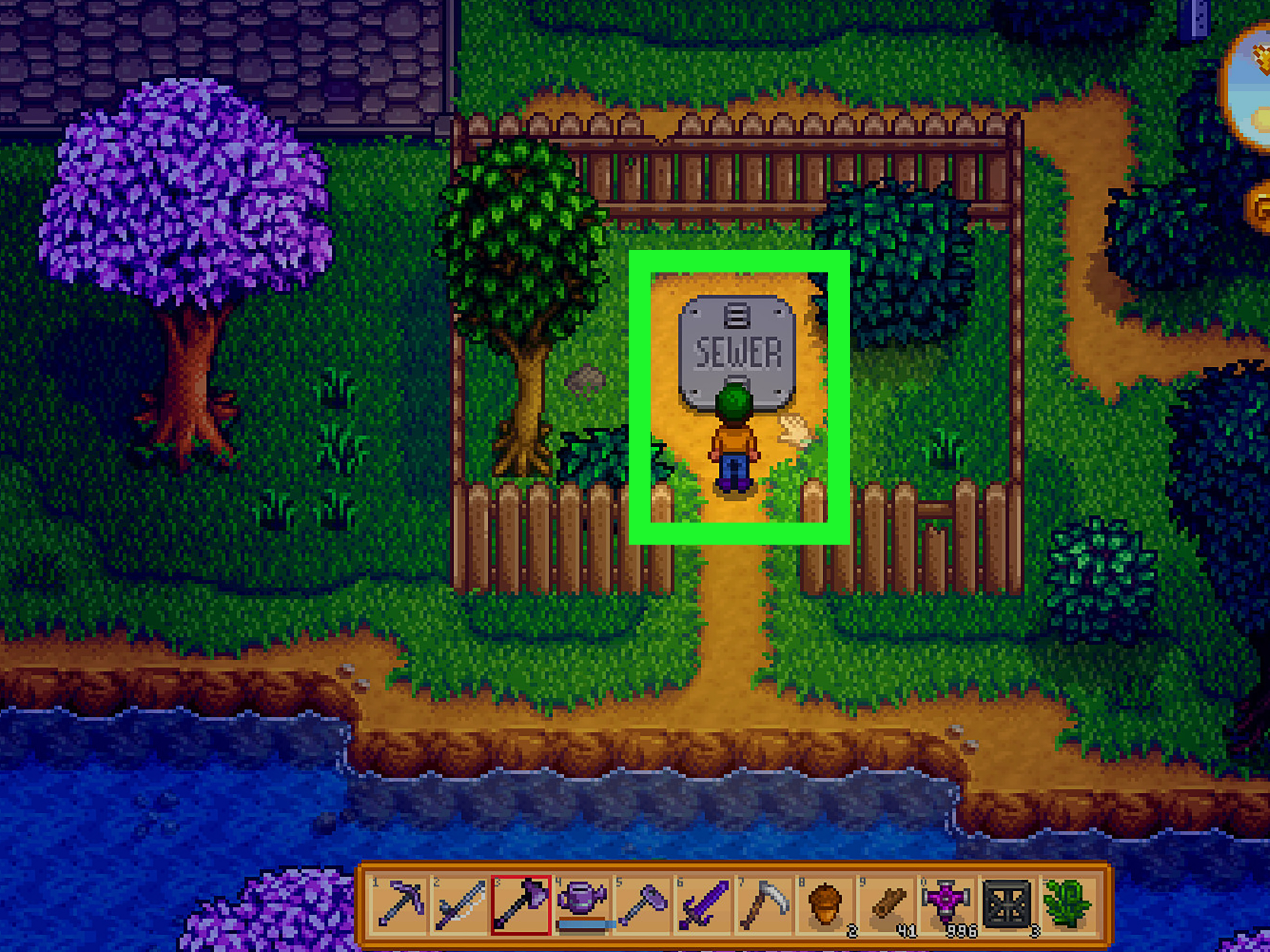
There are two primary entrances:
- The sewer cover in the southern area of Pelican Town.
- The sewer grate in the southern part of Cindersap Forest.
Interact with an entrance after receiving the Rusty Key and the previously locked passage becomes accessible.
The Sewers remain available once unlocked, giving you access to an important character, useful services, fishing opportunities, and later-game progression.
What Does the Rusty Key Unlock?
Krobus and His Shop
The most famous resident of The Sewers is Krobus, the friendly shadow person who operates a shop underground. His inventory includes several unusual and valuable items, including a one-time Stardrop purchase and a rotating selection of other goods.
Krobus also becomes important for later quests, making sewer access much more significant than simply opening another map area.
The Statue of Uncertainty
The Sewers contain the Statue of Uncertainty, which allows you to reset a profession associated with one of your skills for 10,000g. After paying and selecting a skill, you can choose your profession path again when you go to sleep.
This is extremely useful if your farm strategy changes. Perhaps you selected a profession that looked brilliant in Spring Year 1 but feels less brilliant after your farm becomes an industrial wine empire.
Fishing in the Sewers
The strange green water is fishable. Most notably, the Sewer is associated with the Mutant Carp, one of Stardew Valley’s legendary fish.
That means obtaining the Rusty Key also matters for players chasing the complete fishing collection.
Later Access to the Mutant Bug Lair
During later story progression involving the Dark Talisman quest, Krobus can open a sealed passage leading toward the Mutant Bug Lair. The Rusty Key therefore becomes part of a longer chain of progression beyond the initial Museum milestone.
How to Get 60 Museum Donations Faster
If your main goal is unlocking Krobus as soon as practical, build your routine around variety rather than grinding one source endlessly.
- Carry your hoe: Dig artifact spots whenever you encounter them.
- Mine frequently: Minerals and geodes provide a large portion of early donations.
- Push deeper: Different Mine sections produce different resources.
- Process geodes regularly: Do not leave hundreds unopened in storage.
- Catch fishing treasure chests: They provide additional artifact and mineral opportunities.
- Donate before selling: Give Gunther the first copy of new Museum items.
- Explore widely: Different regions have different artifact possibilities.
A balanced first-year playthrough can accumulate 60 Museum donations without turning the game into a full-time archaeological internship.
Why Didn’t Gunther Give Me the Rusty Key?
You Have Not Actually Donated 60 Items
This is the most common explanation. Players often count discovered artifacts or collection entries rather than confirmed Museum donations.
Check your exhibits and donation tracking carefully. If necessary, donate another new item and sleep again.
You Forgot to Sleep After Donation Number 60
The Rusty Key is not a standard Museum reward that you collect immediately from Gunther’s counter. The important cutscene normally happens the next morning.
Finish the current day and go to bed.
You Are Playing Multiplayer
Multiplayer has historically produced extra confusion around this event. In the current vanilla rules, the shared Museum still needs 60 donations, and the host’s interaction with Gunther can matter for triggering the key event correctly.
If you are playing co-op and the expected event does not occur, have the host visit and speak with Gunther, verify the Museum count, sleep, and make sure everyone is running the same current game version.
You Are Using Stardew Valley Expanded or Another Mod
This is a big one.
Stardew Valley Expanded can change how the Rusty Key is obtained. Depending on the mod version and configuration, Marlon and additional progression requirements may become involved. Instructions written for vanilla Stardew Valley may therefore be completely correct while still not working in your modded save.
If you use Stardew Valley Expanded or another progression-altering mod, check documentation specifically for your installed version rather than repeatedly donating artifacts to an increasingly confused Gunther.
Do You Need the Jas and Vincent Sewer Cutscene?
Early in the game, Jas and Vincent can appear near the sewer entrance during a Cindersap Forest cutscene and discuss what might be hiding below. This introduces the mystery surrounding the Sewers and hints at Gunther’s connection to the key.
The scene can occur from Spring 11 of Year 1 onward under appropriate time and day conditions, but the fundamental method for earning the Rusty Key in vanilla remains the Museum donation milestone.
In other words, do not spend several in-game weeks desperately walking in and out of Cindersap Forest because somebody told you a child must personally authorize your sewer exploration permit.
Is the Rusty Key the Same as the Skull Key?
No. Stardew Valley has several special keys, and their similar names can confuse newer players.
The Rusty Key comes from Gunther after 60 Museum donations and opens The Sewers.
The Skull Key is obtained by reaching the bottom of the regular Mines and is associated with later areas such as Skull Cavern.
If you are standing beside a sewer grate holding the Skull Key and wondering why nothing happens, you have brought the right concept but the wrong piece of metal.
Common Player Experiences When Hunting for the Rusty Key
The journey toward the Rusty Key tends to follow a surprisingly familiar pattern. At first, Museum progress feels effortless. You mine Quartz, find an Earth Crystal, crack open a few geodes, dig up an ancient spoon, and Gunther happily accepts almost everything you carry through the door. The first few dozen donations practically throw themselves onto the display tables.
Then comes the slowdown.
A typical player reaches somewhere around 45 to 55 donations and suddenly feels as though Stardew Valley has stopped generating new artifacts. Every geode contains something already donated. Every artifact spot seems determined to produce clay. The Mines deliver yet another Amethyst when all you want is something new. This is where changing activities becomes more productive than simply grinding harder.
One especially useful habit is creating a temporary chest near the farmhouse specifically for geodes, artifacts, and possible Museum items. After a mining trip, dump candidates there instead of automatically placing everything into the shipping bin. Every few days, process the geodes and make one Museum trip. This reduces the risk of accidentally selling something valuable for collection progress.
Another common experience is the legendary 59-donation problem. The Museum looks full. You are certain there must be at least 60 objects in there. You sleep. Morning arrives. Robin is outside building something, your chickens want attention, the television predicts rainand Gunther is nowhere to be seen.
Before declaring war on the Museum, count carefully. Many supposed Rusty Key bugs turn out to be one missing donation. The difference between 59 and 60 is visually tiny but mechanically enormous.
Geodes are often what finally break the stalemate. Players who have concentrated heavily on farming sometimes accumulate stacks of unopened geodes because spending money at Clint feels less important than buying seeds or upgrading tools. Processing that backlog can suddenly produce several missing minerals in a single visit.
The first trip into The Sewers is also memorable because Stardew Valley spends so much time presenting Pelican Town as a cozy farming community. Then you unlock a sewer, meet a mysterious shadow creature running a retail business underground, discover a statue capable of rewriting your career choices, and realize that perhaps growing parsnips was never the whole story.
Modded players have a different recurring experience: following a perfectly accurate vanilla guide and wondering why nothing works. Stardew Valley Expanded in particular changes enough progression that the source of the sewer key may differ from vanilla gameplay. If your save includes large content mods, always identify whether a guide refers to vanilla Stardew Valley before troubleshooting.
The broader lesson is that the Rusty Key rewards normal exploration. You do not need to race for it. Mine, fish, dig artifact spots, process geodes, and remember to donate first copies. Eventually the 60th exhibit lands in the Museum, Gunther appears at the farmhouse, and the underground side of Stardew Valley opens up.
Final Thoughts
Learning how to find the Rusty Key in Stardew Valley becomes much easier once you ignore the mystery surrounding the sewer entrance and focus on the actual requirement: 60 unique Museum donations.
Mine for minerals, process your geodes, dig artifact spots, pursue fishing treasure chests, and give Gunther the first copy of anything the Museum still needs. Once donation number 60 is placed, sleep for the night and watch for Gunther’s farmhouse visit the next morning.
Afterward, use the Rusty Key at either sewer entrance to meet Krobus, access his shop, fish in the underground waters, use the Statue of Uncertainty, and prepare for later quests connected to the Sewers.
So if the mysterious locked grate has been mocking you every time you walk through Pelican Town, the solution is not lockpicking. It is archaeology. Apparently, even Stardew Valley’s sewer system respects cultural preservation.
Note: This guide describes the current vanilla Stardew Valley progression. Large gameplay mods such as Stardew Valley Expanded can alter the requirements or character who provides the Rusty Key.
Research verification: Core Rusty Key mechanics, 60 Museum donations, next-morning Gunther event,
Special Items & Powers location, sewer entrances, Krobus, and multiplayer behavior were cross-checked
against current official/community documentation and established gaming references.
Additional cross-checks included PC Gamer, Destructoid, Pro Game Guides, Gamepur, Dot Esports,
Steam Community, Stardew Valley Forums, Fandom, Arqade, and Gamepressure coverage.