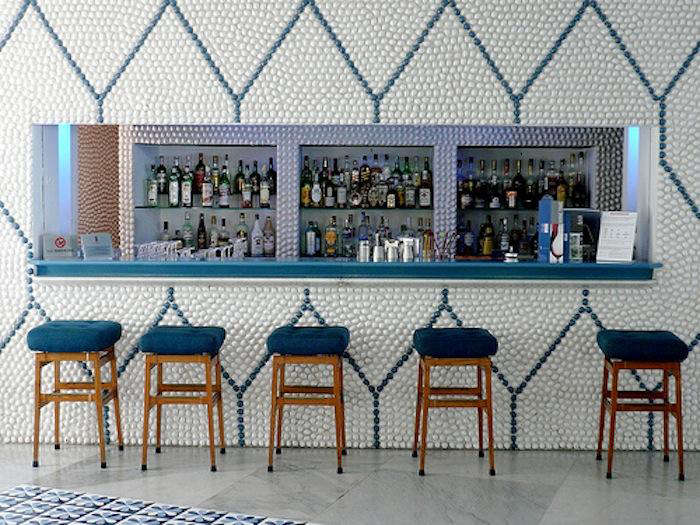
Some hotels offer a bed, a breakfast buffet, and a lobby plant bravely fighting for its life. Then there is Hotel Parco dei Principi in Sorrento, the Gio Ponti masterpiece often folded into the larger Amalfi Coast design pilgrimage. It does not merely host guests; it stages an argument for how architecture, color, craft, sea air, and a very confident shade of blue can turn a stay into a design education.
Designed by the legendary Italian architect and designer Gio Ponti and inaugurated in 1962, Parco dei Principi overlooks the Gulf of Naples from a cliffside setting on the Sorrentine Peninsula. While technically Sorrento sits just beyond the official Amalfi Coast, the hotel belongs spiritually to the same dramatic Mediterranean world: cliffs, citrus trees, cinematic water, and sunlight that behaves as if it has a personal stylist.
For travelers searching for Gio Ponti architecture, Amalfi Coast design hotels, or mid-century Italian interiors, this property is more than a photogenic escape. It is one of the clearest examples of Ponti’s idea that modern design should feel light, joyful, intelligent, and deeply human. In other words, it is not cold minimalism wearing expensive sunglasses. It is modernism with a heartbeat.
Who Was Gio Ponti?
Gio Ponti was born in Milan in 1891 and became one of the most influential Italian architects and designers of the 20th century. His career stretched across architecture, furniture, ceramics, lighting, publishing, and industrial design. Calling him “busy” feels insulting. Ponti was the sort of creative force who made the rest of us look like we are still deciding which notebook to buy.
He founded Domus magazine in 1928, helped shape international conversations about modern design, and created landmark works such as the Pirelli Tower in Milan, the Superleggera chair for Cassina, Villa Planchart in Caracas, and numerous interiors that treated everyday living as an art form. Ponti believed beauty was not a decorative bonus added at the end, like parsley on a restaurant plate. For him, beauty was structural. It belonged in the plan, the chair, the door handle, the floor tile, the glass, and the way a person moved through a room.
That philosophy is exactly what makes Parco dei Principi so memorable. Ponti did not approach the hotel as a building that needed some nice furnishings. He approached it as a total environment. Architecture, interiors, furniture, tiles, color, proportion, and landscape were all part of one conversation.
The Story Behind Hotel Parco dei Principi
The hotel was commissioned by engineer Roberto Fernandes, who wanted a modern luxury property that respected the natural beauty of Sorrento while offering the comfort expected by sophisticated travelers of the early 1960s. Ponti accepted the challenge with enthusiasm and supervised the project down to the decorative details.
Parco dei Principi opened on April 11, 1962, and is often described as one of the world’s first design hotels. Today, that phrase appears everywhere, sometimes attached to any hotel with a brass lamp and a moody lobby playlist. But in Ponti’s case, “design hotel” meant something much deeper. The design was not branding. It was the building’s language.
The hotel sits above the sea, surrounded by gardens and reached through a landscape that softens the transition from town to cliffside retreat. From the outside, the structure is crisp and geometric, yet it never feels hostile to its setting. Ponti understood that a modern building on the Mediterranean should not shout over the view. It should frame it, answer it, and occasionally wink at it.
Why This Gio Ponti Masterpiece Still Feels Fresh
The most famous feature of Parco dei Principi is its blue-and-white world. Ponti designed a series of geometric ceramic tiles in shades of blue, azure, and white for the hotel. These tiles appear across floors and walls in different combinations, creating a rhythmic visual experience that changes from room to room. Lines, circles, triangles, leaves, stars, and moon-like motifs become a kind of Mediterranean alphabet.
The result is immersive but not overwhelming. You do not feel trapped inside a tile showroom. You feel as if the sea has been translated into pattern. The blue recalls the Gulf of Naples, the white reflects the intense southern light, and the geometry keeps everything disciplined. It is playful, but it has manners.
This is the genius of Ponti’s work. He could combine exuberance with restraint. A lesser designer might have seen the coast and reached for nautical clichés: ropes, anchors, shells, perhaps a decorative oar leaning sadly in a corner. Ponti did something smarter. He abstracted the sea into color, repetition, and reflection.
The Power of Blue and White
Blue and white may sound simple, but at Parco dei Principi the palette becomes architectural. The colors organize space, calm the eye, and connect the interiors to the horizon. In guest rooms, corridors, terraces, and public areas, the combination feels cool and precise, a welcome contrast to the heat and visual drama outside.
There is a practical beauty here too. Mediterranean light can be intense, and Ponti’s use of white surfaces helps bounce that light through the interiors. Blue gives the rooms depth without heaviness. Together, they create a sensation of clarity. You feel awake, but not overstimulated. Stylish, but not scolded by the furniture.
The tile designs also show Ponti’s respect for craft. They connect modern architecture with the long ceramic traditions of southern Italy, especially the majolica heritage associated with Campania and nearby Salerno. This blend of modern geometry and regional craftsmanship is one reason the hotel has aged so well. It is not a generic international-modern box. It belongs to its place.
Architecture That Frames the Landscape
Parco dei Principi is a cliffside hotel, and Ponti made the most of that setting. Deep loggias, sea-facing rooms, terraces, and carefully placed openings allow the building to interact with the Gulf of Naples. The view is not treated as wallpaper. It is part of the composition.
One of the most memorable aspects of the property is the way movement through the hotel gradually reveals the coast. Guests move from gardens to interiors, from tile-lined spaces to terraces, from structured geometry to open water. The journey has rhythm. It is almost cinematic, which feels appropriate for a hotel whose 1960s mood still carries a faint echo of Italian film glamour.
The hotel also offers access to a private beach area, reached through passages carved into the rock. That detail alone sounds like something a screenwriter invented after a long lunch. Yet it captures the drama of the place perfectly: modern design above, ancient stone below, and the sea waiting at the end like the final scene.
Inside the Rooms: A Total Design Experience
The guest rooms designed by Gio Ponti continue the hotel’s blue-and-white story. Many feature ceramic floors with distinctive patterns, white furnishings, clean lines, and a sense of visual order that makes the rooms feel peaceful rather than plain. Ponti understood that a hotel room should not exhaust the guest. It should restore them.
His furniture choices and spatial planning reflect the same philosophy that shaped his broader career. A chair was never just a chair. A bed was never just a bed. Every object had to participate in the room’s balance. The goal was not luxury as clutter, but luxury as harmony.
That idea feels surprisingly current. In an age when many hotels compete with louder colors, bigger headboards, and bathrooms that require a small user manual, Ponti’s rooms feel refreshingly intelligent. They show that hospitality design can be memorable without behaving like a nightclub.
A Design Hotel Before Design Hotels Became a Trend
Today, the term “design hotel” is everywhere. It can mean a thoughtfully restored architectural landmark, a boutique hotel with serious furniture, or a place where the lobby sofa is shaped like a question. Parco dei Principi predates the trend and, in many ways, defines the best version of it.
Ponti created a destination where guests could live inside a complete design vision. The hotel was not simply decorated by a famous architect. It was conceived as an integrated work of architecture, interiors, craft, and landscape. That makes it a powerful reference point for contemporary hospitality design, especially along the Amalfi Coast, where newer hotels often draw from mid-century Italian style, local tiles, whitewashed surfaces, and sea-inspired palettes.
Modern properties such as Borgo Santandrea in Conca dei Marini show how enduring this language has become. Mid-century Italian furniture, hand-painted tiles, Mediterranean blues, and locally rooted craftsmanship remain central to the region’s luxury identity. Ponti did not just design a hotel; he helped write a coastal design vocabulary that still sounds fluent more than six decades later.
Why Design Lovers Visit Sorrento for Gio Ponti
For architecture lovers, Parco dei Principi is a pilgrimage site. For design fans, it is a live-in museum with room service. For ordinary travelers, it is simply beautiful, which may be the highest compliment. You do not need a degree in architecture to enjoy the way the blue tiles meet the white walls or how the sea appears through a perfectly framed opening. Good design explains itself through experience.
That is why the hotel continues to attract photographers, decorators, historians, and travelers who appreciate places with a strong point of view. It offers something rare: originality that has not curdled into novelty. Ponti’s design remains distinctive, but it does not feel trapped in 1962. It still breathes.
What Makes It an Amalfi Coast Essential?
Although Parco dei Principi is in Sorrento rather than Positano, Amalfi, or Ravello, it belongs naturally on an Amalfi Coast itinerary. Sorrento is a gateway to the region, with easy access to Capri, Pompeii, Naples, and the coastal towns along the winding road to Amalfi. For travelers interested in design, it offers a calmer base with serious architectural value.
The Amalfi Coast is famous for vertical landscapes, pastel villages, lemon terraces, tiled domes, and impossible roads where every bus driver deserves a medal and possibly a national holiday. But beyond the postcard beauty, the region has a rich design identity shaped by ceramics, craft, sea light, and the relationship between architecture and cliffs. Parco dei Principi captures that identity in modern form.
It is not rustic, and it is not overly romantic. It is crisp, graphic, and intelligent. Yet it still feels Mediterranean to its bones. That balance makes it a masterpiece.
Lessons From Gio Ponti’s Coastal Modernism
1. Color Can Be Architecture
Ponti’s blue-and-white palette does more than decorate the hotel. It organizes the entire visual experience. The lesson for homeowners, designers, and hoteliers is simple: color becomes powerful when it is used with discipline.
2. Local Craft Makes Modern Design Feel Human
The ceramic tiles connect the hotel to regional traditions. This prevents the modern architecture from feeling anonymous. Good modernism does not erase place; it learns from it.
3. A Strong Concept Can Last for Decades
Trends age quickly. Concepts age better. Parco dei Principi still feels relevant because Ponti built the hotel around a clear idea: Mediterranean light, sea color, geometric clarity, and joyful living.
4. Luxury Does Not Have to Be Loud
The hotel proves that elegance can be quiet, exact, and playful. No gold overload. No chandelier trying to win an argument. Just proportion, craft, and atmosphere.
Experience Section: Living With the Gio Ponti Mood on the Amalfi Coast
To experience a place like Parco dei Principi properly, do not rush in with a checklist. This is not a “see lobby, photograph tiles, drink espresso, leave” situation, though honestly, that would still be a pretty good afternoon. The better approach is to let the hotel work on you slowly. Ponti’s design rewards attention. The longer you look, the more the patterns begin to feel less like decoration and more like music.
Start with the arrival. The gardens create a pause before the architecture reveals itself. That pause matters. After the sensory drama of Sorrentothe scooters, the citrus shops, the restaurant menus promising the best limoncello in human historythe hotel feels composed. It gives you room to breathe. The blue-and-white facade appears with the confidence of a well-dressed person who did not need to ask whether the outfit was too much.
Inside, the first experience is often visual coolness. The palette immediately lowers the temperature, at least emotionally. The sea outside may be glittering like it has a public relations team, but the interiors bring everything into balance. You notice the tiles underfoot, then the geometry on the walls, then the way daylight sharpens the edges of furniture. It is not flashy. It is precise.
A walk through the corridors can be surprisingly enjoyable because Ponti refused to treat transitional spaces as boring necessities. Corridors, stairs, and public areas are part of the experience. They are not merely routes to the “important” rooms. This is a useful reminder for anyone designing a home, hotel, or office: the in-between spaces shape memory. A hallway can be dull, or it can be a quiet little procession.
The best time to appreciate the hotel may be morning, when the light is bright but still gentle. The blue tiles feel crisp, the white surfaces glow, and the sea looks close enough to borrow sugar from. Breakfast becomes more than breakfast. It becomes a lesson in atmosphere. Even a simple cup of coffee tastes more elegant when surrounded by good proportions. This may not be scientifically proven, but anyone who has had coffee in a beautiful Italian hotel will understand.
Later, the private beach experience adds another layer. Moving from Ponti’s structured modernism down toward the rock and water creates a powerful contrast. Above, everything is geometry and design intention. Below, everything is salt, stone, and sun. The journey between the two makes the hotel feel connected to the landscape rather than perched indifferently above it.
For travelers planning a broader Amalfi Coast design trip, Parco dei Principi pairs beautifully with visits to Positano, Ravello, Amalfi, and Conca dei Marini. In Positano, the buildings tumble down the cliffs in a theatrical cascade. In Ravello, gardens and villas turn the landscape into a balcony over the sea. In Amalfi, ceramic traditions appear in shops, churches, and everyday details. After seeing those places, Ponti’s hotel becomes even more interesting because it translates the same coastal spirit into a modern language.
The experience also changes how you look at interiors back home. Suddenly, a tile is not just a tile. A color palette is not just a mood board. A window is not merely an opening but a carefully staged relationship with the outside world. Ponti makes design feel generous. He reminds you that rooms should support life, not just impress visitors for the first seven seconds.
And perhaps that is the real magic of this Gio Ponti masterpiece on the Amalfi Coast. It is beautiful, yes. It is historically important, absolutely. It is extremely photographable, dangerously so. But above all, it makes a persuasive case that good design can improve the way we move, rest, look, eat, think, and remember. That is a lot of responsibility for blue-and-white tiles, but somehow they manage.
Conclusion
A Gio Ponti masterpiece on the Amalfi Coast is not just a phrase designed to make architecture lovers click faster. It points to a real and enduring achievement: Hotel Parco dei Principi in Sorrento, a place where mid-century Italian design, Mediterranean light, local craft, and cliffside drama meet with remarkable grace.
More than 60 years after its opening, the hotel remains a reference point for design hotels around the world. Its blue-and-white tiles, geometric interiors, sea-facing architecture, and total design vision show why Gio Ponti continues to matter. He did not merely create objects or buildings. He created atmospheres where life could feel lighter, brighter, and more beautifully arranged.
For anyone planning an Amalfi Coast journey, a Sorrento stay, or a deep dive into Italian modernism, Parco dei Principi deserves attention. It is elegant without being stiff, playful without being silly, and historic without feeling embalmed. In the crowded world of luxury travel, that is rare. In the world of design, it is close to immortal.
Note: This article is original editorial content synthesized from publicly available information from reputable architecture, design, travel, hotel-history, and cultural sources. It is written for web publication in standard American English without copied source text or citation artifacts.