Old CDs are shiny, mysterious, and usually hiding in a drawer next to a tangled charger from 2009. So when viral videos claim you can turn them into a working solar panel, the idea feels wonderfully tempting. Free electricity from your old “Summer Road Trip Mix” disc? That sounds like recycling, science, and revenge against rising utility bills all at once.
But can you really build a solar panel out of old CDs? The honest answer is: not a real photovoltaic solar panel. A CD can reflect, scatter, and split sunlight into rainbow colors, but it cannot convert sunlight into usable electricity by itself. A true solar panel needs photovoltaic cells, usually made from semiconductor materials such as silicon. CDs are mostly plastic and a thin reflective metal layer. They are sparkly, yes. Magical electricity wafers, no.
That does not mean old CDs are useless for solar-related projects. They can be used in educational experiments, decorative reflectors, light-diffraction demonstrations, and small solar thermal projects where the goal is to redirect sunlight as heat. However, calling a CD craft a “solar panel” is like calling a toaster a rocket because both get hot. Close enough for comedy, not for engineering.
What a Real Solar Panel Actually Does
A real solar panel is built from photovoltaic cells. These cells convert sunlight directly into electricity through the photovoltaic effect. When photons from sunlight hit a semiconductor material, they transfer energy to electrons. The structure of the cell guides those electrons into an electric current that can be captured by wires and used to power devices, charge batteries, or feed an electrical system.
Most residential solar panels use silicon cells because silicon has the right electrical properties, is abundant, and can be manufactured into reliable photovoltaic modules. A finished panel is not just one magic sheet. It includes many solar cells wired together, protective glass, encapsulant, a backing layer, conductive metal contacts, a frame, and sometimes bypass diodes to manage shade and electrical flow.
That is why solar panels are so much more than “something shiny in the sun.” They are carefully engineered electrical devices. The shine on a solar panel is not what makes it generate power. In fact, solar manufacturers often try to reduce reflection so more light is absorbed by the cells instead of bouncing away like a dramatic exit from a reality show.
What Old CDs Are Made Of
A compact disc is mainly a polycarbonate plastic disc with microscopic tracks that store data. It also has a thin reflective layer, often aluminum, plus protective coatings and printed artwork. Those tiny tracks are why a CD makes rainbow patterns when it catches light. The surface acts somewhat like a diffraction grating, separating white light into different colors.
This rainbow effect is real science. A CD can split light beautifully, which is why teachers and hobbyists sometimes use old discs to make simple spectroscopes. But splitting light is not the same as generating electricity. The CD is redirecting light; it is not creating an electric current.
Why Viral “CD Solar Panel” Videos Are Misleading
Many viral DIY videos show old CDs arranged on cardboard or wood, connected with wires, and supposedly producing electricity. Some even claim outrageous outputs, like hundreds or thousands of watts. That is where the science meter starts screaming.
A CD does not have a p-n junction, semiconductor wafer, or photovoltaic structure. Without those, it cannot turn sunlight into meaningful electrical energy. If a video shows a voltage reading, there is usually something else involved: a hidden solar cell, a diode responding weakly to light, a battery in the circuit, or a meter picking up a tiny, unstable signal. Sometimes the project is simply a decorative reflector, but the title promises “free energy” because the internet loves a miracle almost as much as it loves cats knocking things off tables.
Can a CD Produce Any Electricity at All?
By itself, no useful amount. A CD is not designed to produce voltage from light. Some electronic components, such as certain diodes or LEDs, can create tiny amounts of electricity when exposed to bright light because they contain semiconductor materials. That does not mean the CD is the solar cell. It means the semiconductor component is doing the real work while the CD stands nearby looking fabulous.
If you attach wires to a CD and put it in the sun, you should not expect it to charge a phone, run a fan, or power garden lights. At best, you may create a neat science display. At worst, you create a hot-glue sculpture with delusions of grandeur.
What CDs Can Do With Sunlight
Old CDs are not photovoltaic panels, but they can interact with sunlight in interesting ways. They reflect light, scatter light, and create colorful spectra. These traits make them useful for learning about optics, solar energy, and the difference between light reflection and electricity generation.
1. CDs Can Reflect Sunlight
The shiny surface of a CD can bounce sunlight toward another object. This is similar in basic concept to solar thermal systems that use mirrors to concentrate sunlight and create heat. Professional concentrating solar power systems use large, precise mirrors to focus sunlight onto receivers, where the heat can be used to produce electricity. A CD is far less efficient and far less accurate, but the basic idea of reflecting sunlight is easy to demonstrate.
2. CDs Can Split Light Into Colors
A CD can spread light into a spectrum because of its closely spaced tracks. This makes it a fun tool for explaining visible light, wavelengths, and diffraction. If you shine sunlight indirectly onto a CD and project the reflection onto a white surface, you may see a rainbow band. This is educational, not electrical.
3. CDs Can Be Used in Solar Crafts
Old CDs are popular in garden art, sun catchers, bird deterrents, and decorative reflectors. They can make outdoor spaces shimmer, though neighbors may wonder if you are signaling aliens. Used carefully, they can also be part of small solar thermal demonstrations, such as reflecting light toward a dark container to show how dark surfaces absorb more heat.
Can You Build a Solar Heater With Old CDs?
You may be able to build a small solar heat experiment using old CDs as reflectors, but it will not be a practical home heating system. Solar thermal devices work by collecting sunlight and turning it into heat. A simple example is a black-painted can placed in the sun. If you add reflective surfaces around it, you may increase the amount of sunlight reaching the can.
Old CDs can contribute to this kind of experiment, but they are not ideal mirrors. Their surfaces are curved, patterned, and interrupted by the center hole. They scatter light instead of focusing it cleanly. For a real solar cooker or solar heater, smoother reflective materials such as aluminum foil, reflective Mylar, mirrors, or purpose-built solar reflectors usually work better.
Also, concentrated sunlight can be dangerous. Even small reflectors can create glare, eye hazards, and heat spots. Never aim reflected sunlight at faces, traffic, windows, pets, aircraft, or anything flammable. Science should be exciting, but not “explain this to the fire department” exciting.
How to Make a Safe CD Solar Science Project
If you want a useful project with old CDs, build a solar light and reflection demo instead of a fake solar panel. This gives you real learning value without pretending a 1998 software disc is about to power your refrigerator.
Materials
- 3 to 6 old CDs or DVDs
- Cardboard or foam board
- Tape or non-toxic glue
- A black aluminum can or small dark container
- A thermometer
- White paper for observing reflected light
- Safety glasses
Steps
- Place the black container in direct sunlight.
- Measure its starting temperature.
- Arrange the CDs around it so they reflect sunlight toward the container, not toward your eyes.
- Wait 10 to 20 minutes and measure the temperature again.
- Compare the result with a second container placed nearby without reflectors.
This experiment teaches an important lesson: reflective materials can redirect sunlight and increase heating, but that is different from generating electricity. You are building a basic solar thermal demonstration, not a photovoltaic panel.
How to Build a Real Small Solar Panel Project Instead
If your goal is to generate electricity, use actual mini photovoltaic cells. These are inexpensive and widely available in small educational kits. With real solar cells, you can build a tiny panel capable of powering an LED, charging a small capacitor, or running a miniature motor in bright sunlight.
A beginner-friendly setup may include small solar cells, tabbing wire, a blocking diode, a multimeter, and a low-power load such as an LED or small fan. The project will teach you about voltage, current, series wiring, parallel wiring, shade loss, and panel angle. Unlike the CD version, it will also produce measurable, repeatable electricity.
CD Project vs. Real Mini Solar Project
| Feature | Old CD Project | Mini Solar Cell Project |
|---|---|---|
| Generates electricity? | No meaningful electricity | Yes |
| Main function | Reflects and diffracts light | Converts light into electric current |
| Best use | Optics and solar heat demonstration | Renewable energy experiment |
| Skill level | Easy | Easy to moderate |
| Practical power output | Essentially none | Small but real |
Why the Myth Keeps Spreading
The old-CD solar panel myth spreads because it looks believable at first glance. CDs are shiny. Solar panels are shiny. Both sit in the sun. Add a few wires, dramatic music, and a thumbnail that says “FREE ENERGY,” and suddenly half the internet is ready to wire Grandma’s jazz collection into the electrical grid.
Another reason is confusion between different solar technologies. Photovoltaic panels make electricity directly. Solar thermal systems collect heat. Concentrating solar power uses mirrors to focus sunlight and generate high-temperature heat, which can later help produce electricity. CDs can imitate the reflective part in a very crude way, but they do not include the photovoltaic materials needed to make electricity directly.
Finally, people love the idea of turning waste into power. That instinct is good. We should reuse materials when possible. But good intentions still need good physics. Recycling is wonderful; fake electricity is less wonderful.
What Should You Do With Old CDs?
If you have a stack of old CDs, you have several better options than building a pretend solar panel. You can reuse them for art projects, donate usable discs, make educational science tools, or check local recycling options. CDs and DVDs are not always accepted in curbside recycling because they are made from mixed materials, so it is smart to look for electronics recycling programs or specialty recyclers.
For schools, old CDs are excellent low-cost teaching supplies. Students can learn about light, color, reflection, waste reduction, and the limits of viral “life hacks.” A CD spectroscope, for example, can show how different light sources produce different spectra. That is real science, and it does not require claiming your craft table is now a power plant.
Common Mistakes to Avoid
Mistake 1: Thinking Shine Equals Solar Power
Solar energy is not generated by shininess. A mirror is shiny, but it does not produce electricity. A solar cell may look dark because it is designed to absorb light. In photovoltaic technology, absorption and semiconductor behavior matter more than sparkle.
Mistake 2: Trusting Huge Power Claims
Any project claiming that a few CDs can generate hundreds of watts should be treated with extreme skepticism. A typical real solar panel requires engineered photovoltaic cells and substantial surface area to produce meaningful power. A handful of CDs cannot replace that.
Mistake 3: Ignoring Safety
Reflective materials can create glare and heat. Avoid direct eye exposure, do not use reflectors near roads, and do not leave experimental solar heaters unattended. DIY should be clever, not chaotic.
So, Can You Really Build a Solar Panel Out of Old CDs?
No, you cannot build a real electricity-generating solar panel out of old CDs alone. You can build a solar-themed craft, a light-reflection experiment, or a small solar thermal demonstration. But a CD is not a photovoltaic cell, and it cannot replace silicon solar technology.
The better question is not “Can CDs become solar panels?” but “What can CDs teach us about solar energy?” The answer: quite a lot. They can show how light reflects, how colors separate, how internet myths can be tested, and why renewable energy depends on materials science, not just shiny surfaces.
Real-World Experience: Testing the Old CD Solar Panel Idea
Imagine setting up this experiment on a bright Saturday afternoon. You gather a stack of old CDs, a cardboard backing, some tape, a cheap multimeter, and the kind of optimism normally reserved for assembling furniture without reading the instructions. The CDs look promising. In the sun, they throw little rainbows across the wall. The project feels futuristic, like something a genius inventor would build in a garage before dramatically announcing, “Behold!”
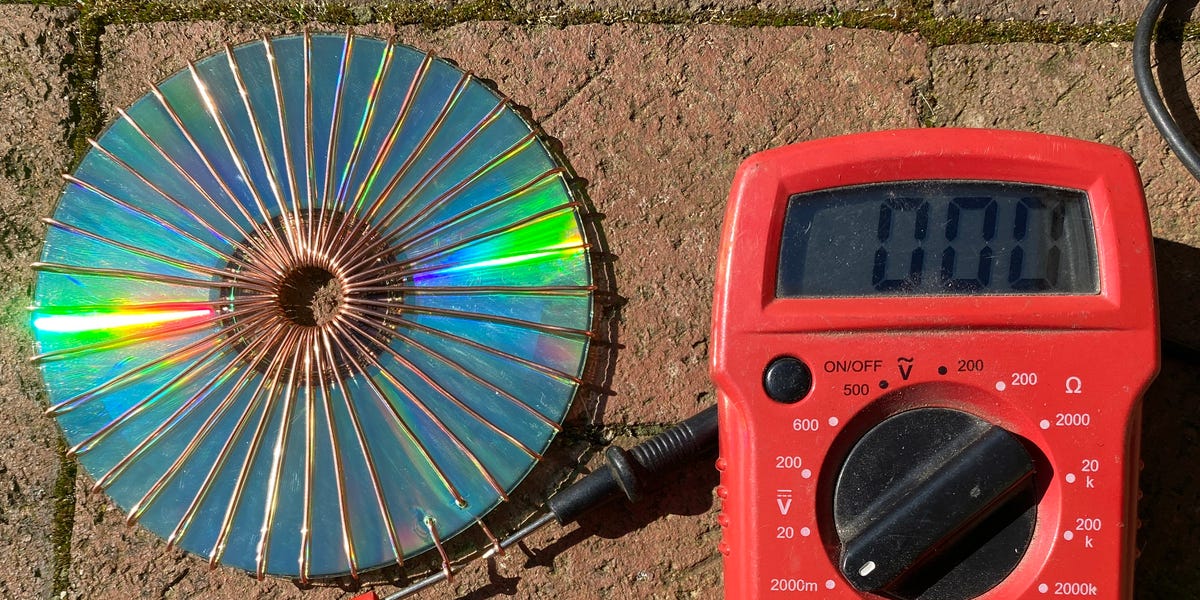
Then comes the first reality check. You tape wires to the shiny surface of a CD and connect the multimeter. Nothing useful happens. You angle it toward the sun. Still nothing meaningful. You press the probes harder, because naturally the first rule of home science is “maybe it works if I poke it with more determination.” The meter may flicker slightly, but the reading is unstable and not useful. That tiny response is not the CD powering the future. It is usually contact noise, environmental interference, or another component in the circuit doing something small and temporary.
Next, you try using the CDs as reflectors. This works much better because reflection is what CDs can actually do. When several discs are angled toward a black can, the can gets warmer faster than a similar can sitting without reflectors. Now you have a real result. It is not electricity, but it is solar energy in the form of heat. This is the moment when the project becomes valuable: it teaches the difference between solar photovoltaic and solar thermal energy.
In a classroom, this experience can be surprisingly powerful. Students often start by believing the viral claim because the setup looks convincing. After testing it, they see that a scientific claim needs evidence, measurement, and repeatability. The old CDs become a gateway into bigger questions: What materials conduct electricity? Why do solar cells use semiconductors? Why do black surfaces heat up faster? Why does a CD make rainbows? Why should we be suspicious when a video promises unlimited free energy with hot glue and dramatic background music?
At home, the project is also a useful reminder that DIY energy experiments are most rewarding when the goal is learning, not replacing the utility company by dinner. A CD reflector can warm a small object. A CD spectroscope can reveal the colors inside light. A CD garden spinner can scare birds and confuse squirrels. But if you want real electricity, even a tiny amount, buy small solar cells designed for that purpose. Connect them properly, measure their output, and compare how they perform in shade, direct sun, morning light, and different angles.
The best experience is combining both projects. Use old CDs to explore reflection and diffraction, then use real mini photovoltaic cells to generate electricity. Side by side, the lesson becomes obvious. The CD shines and scatters light, while the solar cell quietly produces voltage. One is the performer; the other is the engineer. Both are interesting, but only one can charge a battery.
So yes, old CDs deserve a second life. Just do not ask them to become rooftop solar panels. They have already survived dial-up internet, scratched cases, and years in a junk drawer. Let them retire with dignity as science props, sun catchers, or rainbow machines.
Conclusion
Old CDs cannot be turned into real photovoltaic solar panels because they lack the semiconductor structure needed to convert sunlight into electricity. However, they can still play a useful role in solar education. Their reflective surfaces can demonstrate how sunlight bounces, how colors separate, and how solar thermal heating differs from solar electric generation.
If your goal is practical renewable energy, use real solar cells. If your goal is a fun science project, old CDs are fantastic. They are cheap, shiny, memorable, and just weird enough to make people ask questions. And in science, a good question is often more powerful than a drawer full of obsolete discs.
Note: This article is based on synthesized information from reputable U.S. energy, science, solar technology, and environmental education resources. Source links are intentionally omitted from the article body as requested.